

What if the most effective way to restore your farm’s productivity isn’t found in a synthetic bag, but in the microscopic infrastructure already beneath your boots? Many New Zealand growers are facing a tipping point where traditional inputs no longer offset the costs of degraded soil carbon and increasingly volatile climate patterns. It’s a frustrating cycle where rising fertiliser prices meet diminishing returns on the land you’ve worked for generations.
The transition toward high-performance natural crop yield boosters has moved from the fringes of niche horticulture to the centre of professional broadacre strategy. We’ll help you master the selection and application of biological soil enhancers, such as BioGro-certified microbial solutions, to rebuild your soil’s natural capacity. This guide provides a professional evaluation checklist for 2026, covering how to verify microbial technology, ensure BioGro compliance, and implement liquid applications that drive measurable nutrient uptake and drought resilience across your paddocks.
Key Takeaways
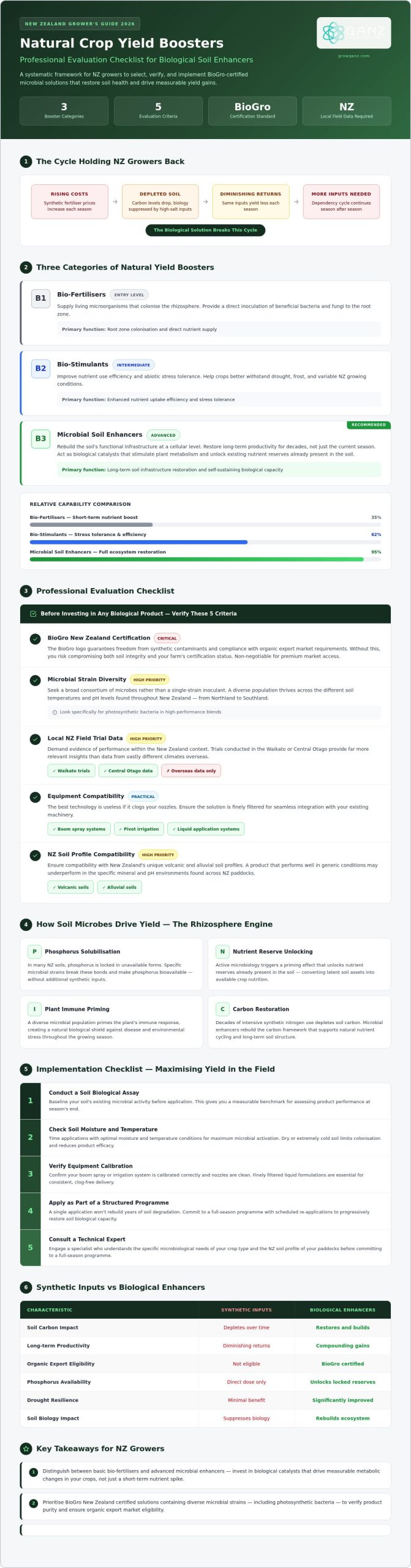
- Distinguish between basic bio-fertilisers and advanced microbial enhancers to ensure you are investing in biological catalysts that drive measurable metabolic changes in your crops.
- Verify product purity and efficacy by prioritising BioGro New Zealand certified solutions that contain diverse microbial strains, specifically photosynthetic bacteria.
- Select the right natural crop yield boosters for your specific region, ensuring compatibility with New Zealand’s unique volcanic or alluvial soil profiles.
- Master the implementation process by conducting soil biological assays and timing applications with optimal moisture and temperature for maximum microbial activation.
- Leverage high-performance microbial technology like Quantum Organic-Total® to restore soil health and improve nutrient efficiency without the need for synthetic inputs.
The Fundamentals of Natural Yield Boosters in Modern Agriculture
Modern farming is undergoing a fundamental shift from chemical reliance to biological stewardship. We define natural crop yield boosters as sophisticated biological agents designed to stimulate plant metabolism and restore soil health at a cellular level. Unlike traditional inputs that simply provide a direct dose of nitrogen or potassium, these boosters act as catalysts for the entire agricultural ecosystem. They don’t just feed the plant; they equip the soil to function as a living, self-sustaining organism.
It’s essential to distinguish between the various categories available to the professional grower. Bio-fertilisers focus on supplying living microorganisms that colonise the rhizosphere, while bio-stimulants improve nutrient use efficiency and abiotic stress tolerance. Microbial soil enhancers go a step further by rebuilding the soil’s functional infrastructure. This ensures the land remains productive for decades rather than just the current season. By choosing the right biological tools, you aren’t just chasing a temporary spike in growth, but investing in the long-term vitality of your soil profile.
Across New Zealand, the transition toward regenerative practices is driven by both environmental necessity and commercial reality. Achieving BioGro certification has become a critical benchmark for growers looking to secure premium market access. It provides a guarantee of organic integrity that international consumers increasingly demand. This makes verified natural crop yield boosters a cornerstone of a farm’s commercial strategy, allowing growers to meet stringent compliance standards while maintaining high productivity levels on the land.
Why Soil Microbes are the Engine of Yield
The rhizosphere is the command centre of your crop’s success. This thin layer of soil surrounding the roots is where beneficial bacteria perform the heavy lifting of nutrient acquisition. In many New Zealand soils, phosphorus remains locked in forms that plants cannot readily absorb. Specific microbial strains solubilise these minerals, making them bioavailable without the need for additional synthetic inputs. A diverse microbial population also primes the plant’s immune response, creating a natural shield against disease and environmental stress.
Moving Beyond Synthetic Dependency
Decades of intensive synthetic nitrogen use have often left soil structures brittle and carbon levels depleted. High-salt fertilisers can suppress the very biology needed for natural nutrient cycling, leading to a cycle of dependency. Natural boosters trigger a priming effect, where the introduction of active microbiology unlocks existing nutrient reserves already present in the soil. By viewing soil vitality as a commercial asset, growers can transition away from high-cost synthetics toward a more resilient model that protects the integrity of the New Zealand landscape. For growers seeking a structured pathway to reduce chemical dependency, the sustainable agriculture inputs NZ 2026 commercial guide outlines how biological restoration can replace synthetic reliance while maintaining export-ready yields.
The Microbial Evaluation Checklist: What to Look For
Selecting the right biological inputs requires a methodical approach that goes beyond the promises on a label. For New Zealand growers, the first step in evaluating natural crop yield boosters is verifying their certification status. A BioGro New Zealand logo is not just a badge of honour; it’s a rigorous guarantee that the product is free from synthetic contaminants and meets the strict requirements for organic export markets. Without this verification, you risk compromising your soil’s integrity and your farm’s certification status.
A professional evaluation should also prioritise the following criteria:
- Strain Diversity: Look for a broad consortium of microbes rather than a single-strain inoculant. A diverse population is more likely to thrive across the different soil temperatures and pH levels found from Northland to Southland.
- Local Field Data: Demand evidence of performance within the New Zealand context. Trials conducted in the Waikato or Central Otago provide much more relevant insights than data from vastly different climates overseas.
- Equipment Compatibility: The best technology is useless if it clogs your nozzles. Ensure the solution is finely filtered for seamless integration with existing boom sprays or pivot irrigation systems.
Before committing to a full-season programme, it’s wise to consult with a technical expert who understands the specific microbiological needs of your crop type.
The Power of Photosynthetic Bacteria
High-performance microbial blends often include photosynthetic bacteria, a group of organisms that play a dual role in the soil ecosystem. These microbes are unique because they can capture solar energy and atmospheric carbon to create energy-rich compounds that feed other beneficial soil life. This process directly supports carbon sequestration and improves the overall energy availability within the plant’s rhizosphere. Photosynthetic bacteria are biological solar panels for the soil.
Liquid vs. Granular: The Delivery Debate
While granular products are common, liquid inoculants generally offer superior performance for professional operations. Liquid formats allow microbes to remain in a stable state of dormancy until they are diluted and applied, ensuring a higher count of viable organisms reaches the root zone. They penetrate the soil profile more effectively than dry amendments, leading to faster colonisation rates. For large-scale growers, the labour-saving benefits are significant; liquid solutions can be easily metered into existing fertigation lines without the need for heavy lifting or specialised spreading equipment.
Comparing Natural Booster Categories for NZ Growers
Understanding the functional differences between various natural crop yield boosters is vital for any commercial operation. While many products are marketed under a broad organic umbrella, their modes of action vary significantly. Seaweed extracts primarily act as hormonal triggers to help plants manage heat or drought stress. Humic and fulvic acids improve the soil’s physical structure and cation exchange capacity. Microbial inoculants, however, represent the active biological workforce that drives nutrient cycling. For a truly resilient system, growers should consider how these categories complement one another rather than viewing them as interchangeable.
New Zealand’s diverse geology requires a tailored approach to biological inputs. In the volcanic soils of the Central North Island, where phosphorus retention is often high, microbial inoculants are essential to unlock mineral reserves that are otherwise unavailable to the plant. Conversely, the alluvial plains of Canterbury often benefit from the moisture-retention properties of humic acids paired with robust microbial populations to prevent nutrient leaching through gravelly profiles. Layering these boosters creates a synergistic effect where the humics provide the structural “housing” and the microbes provide the functional “labour.” Growers looking to align these biological strategies with export compliance requirements can find a practical framework in this guide to sustainable agriculture inputs NZ commercial operations rely on for clean produce certification.
Boosters for Vegetables and Horticulture
Short-cycle vegetable crops require rapid nutrient availability to meet tight market windows. In these high-intensity systems, microbial boosters accelerate the breakdown of organic matter into plant-available forms. This is particularly crucial during the early stages of growth when the plant is most vulnerable. Learning how to improve seedling establishment naturally ensures that young plants develop the robust root systems needed to support high-density production. Commercial nurseries that prioritise root zone development through early microbial inoculation often see more uniform growth and reduced transplant shock.
Solutions for Fruit, Nuts, and Viticulture
Perennial systems like orchards and vineyards demand a focus on long-term soil stability rather than just seasonal spikes. Microbial treatments contribute to better wood health and consistent sap flow by maintaining a healthy rhizosphere over multiple years. This biological balance doesn’t just improve tree vigour; it directly influences the quality of the harvest. Growers often report higher brix levels and improved storage life when the soil’s microbial infrastructure is actively supported. By fostering a diverse biological environment, orchardists can reduce their reliance on late-season synthetic interventions while maintaining the premium standards required for export.
Implementation Checklist: Maximising Yield in the Field
Success with natural crop yield boosters isn’t guaranteed by the product alone; it’s the result of precise application and timing. To move beyond a “spray and pray” approach, professional growers must treat biological inputs with the same technical rigour as any other high-value asset. This starts with understanding the current state of your soil’s living community through a comprehensive biological assay. Without this baseline, you’re essentially flying blind, unable to measure the true impact of your interventions on soil vitality.
Follow these five critical steps to ensure your biological programme delivers measurable results:
- Step 1: Establish a Baseline. Conduct a soil biological assay to quantify existing microbial populations and identify specific deficiencies before your first application.
- Step 2: Optimise the Environment. Ensure soil moisture is adequate and temperatures are within the range for microbial activation, typically above 10°C for most beneficial strains to thrive.
- Step 3: Calibrate with Care. Adjust your spray equipment to avoid high-pressure shearing or excessive heat that can damage delicate microbial life during the application process.
- Step 4: Strategic Timing. Align your applications with peak plant demand, such as during flowering or fruit set, when the crop’s metabolic and nutrient needs are at their highest.
- Step 5: Verify via Tissue Analysis. Use regular leaf tissue testing to monitor nutrient uptake improvements and adjust your programme based on real-time plant performance data.
If you’re ready to transition your paddocks to a more resilient biological model, explore our specialised microbial solutions to find the right fit for your specific operation.
Restoring Soil After Chemical Use
Intensive systems that have historically relied on soil fumigation or heavy synthetic inputs often face the challenge of “dead” soil. These environments lack the natural microbial diversity required for efficient nutrient cycling and plant protection. Re-colonisation in such systems can be slow, sometimes taking several seasons to reach functional levels naturally. Utilising targeted natural crop yield boosters, specifically those designed for broadacre recovery, can significantly compress this timeline and restore productivity to degraded blocks in regions like Pukekohe or Canterbury.
Managing Environmental Stress
Climate volatility is a growing concern for New Zealand farmers, from the drought-prone regions of Hawkes Bay to the increasingly frequent heatwaves in the South Island. Biological enhancers help plants retain water more effectively by improving soil structure and encouraging deeper root penetration. Some microbial strains even produce protective bio-films around the roots, acting as a biological buffer against temperature extremes and moisture loss. For more detailed insights on protecting your harvest against these stressors, read our guide to microbial solutions for field crops.
The GrowQanz Advantage: Certified Organic Microbial Solutions
GrowQanz operates as more than a supplier; we’re a technical partner for growers navigating the complexities of modern biological farming. Our suite of natural crop yield boosters is anchored in proprietary microbial technology that’s been rigorously verified for the New Zealand environment. Central to this commitment is our BioGro New Zealand certification. This ensures that every drop of our technology meets the highest standards of organic integrity, providing you with the confidence to apply our solutions without risking your certification or market access. We prioritise reliability over hype, focusing on evidence-based progress for the professional agricultural sector.
Transitioning to a biological model requires more than just a product; it demands a structured shift in soil management strategy. Our team provides the technical context and field-tested guidance necessary to integrate these solutions into your existing operations. By grounding our microbiology in practical, tangible outcomes, we help you move away from synthetic dependency toward a self-sustaining soil infrastructure. This principled approach ensures that your farm remains a productive commercial asset while acting as a knowledgeable steward of the land.
Quantum Organic-Total®: The All-in-One Solution
Quantum Organic-Total® represents our flagship technology for holistic soil vitality. It features a diverse microbial consortium, including the photosynthetic bacteria discussed earlier, designed to function as a complete biological system. For the professional grower, the value lies in the efficiency of a single, high-performance application that addresses nutrient solubilisation and plant stress simultaneously. We’ve analysed the financial impact of this technology in detail, and you can explore the data in our Quantum Organic-Total cost-benefit analysis. This resource helps you understand how microbial investment translates into reduced synthetic costs and improved crop resilience.
Specialised Solutions for Turf and Horticulture
Our technology delivers exceptional results in high-pressure environments like professional turf management and intensive horticulture. Our professional turf biological products are engineered to maintain soil health under heavy traffic and frequent mowing cycles. These specialised solutions, such as Quantum-VSC®, provide the specific microbial strains needed to manage thatch and improve root depth in sports turf and golf courses. We invite growers to contact our technical team for a customised programme design that accounts for your specific soil assays and seasonal goals. Working together, we can ensure your transition to natural crop yield boosters is both profitable and sustainable.
Securing the Future of New Zealand Agriculture
Integrating high-performance natural crop yield boosters into your farm’s strategy is about more than just immediate productivity; it’s about rebuilding the biological infrastructure that allows your soil to thrive independently of synthetic inputs. By prioritising BioGro New Zealand certified technologies and adhering to a methodical implementation checklist, you ensure your land remains a resilient commercial asset for the long term. This approach moves your operation from a model of chemical extraction to one of biological stewardship.
Leveraging proprietary microbial technology that has delivered proven results across New Zealand’s horticulture and broadacre regions allows you to restore soil carbon and improve nutrient uptake. This technical transition isn’t just an environmental choice; it’s a principled business decision that protects your bottom line against rising input costs and climate-driven stress while maintaining strict organic compliance.
Explore the BioGro Certified GrowQanz Range for Your Farm and begin the journey toward a more resilient soil profile. Your commitment to biological health today creates the foundation for a more sustainable and profitable harvest tomorrow.
Frequently Asked Questions
Do natural crop yield boosters work as fast as synthetic fertilisers?
Natural boosters don’t provide the same immediate chemical flush as synthetic nitrogen; instead, they initiate biological processes that sustain growth over a longer period. While synthetics offer an instant nutrient spike, microbial solutions focus on improving nutrient use efficiency and building long-term soil health. You may notice subtle changes in plant vigour early on, but the most significant benefits appear as the soil’s natural nutrient cycling engine fully engages.
Are all biological yield boosters certified for organic farming in New Zealand?
No, not every biological product on the market meets the rigorous standards required for organic certification in the New Zealand landscape. Growers must look for the BioGro logo to ensure a product is free from synthetic contaminants and compliant with organic export requirements. Using unverified products can risk your farm’s certification status, making it essential to prioritise solutions that have undergone a formal verification process.
Can I apply liquid microbial treatments through my existing irrigation system?
Yes, high-performance liquid microbial treatments are specifically designed for seamless integration with existing irrigation and spray equipment. These solutions are finely filtered to prevent nozzle blockages in pivot, drip, or boom spray systems. This allows for efficient broadacre or horticultural application without the need for specialised machinery, reducing the labour costs typically associated with applying bulk solid amendments to the soil.
What is the best natural booster for restoring soil after heavy chemical use?
Restoring soil that has been depleted by intensive chemical use requires a diverse consortium of microbes rather than a single-strain product. Quantum Organic-Total® is engineered to re-establish the soil’s biological infrastructure by introducing a broad range of beneficial organisms, including photosynthetic bacteria. This helps to restart natural nutrient cycling and rebuild soil carbon levels that have been suppressed by years of high-salt fertiliser applications.
How often should I apply microbial boosters to see a measurable yield increase?
The frequency of application depends on your specific crop cycle and soil assay results, but most professional programmes target key growth stages. Generally, natural crop yield boosters are applied at planting, flowering, and fruit set to provide the plant with maximum support when metabolic demand is highest. Regular monitoring through leaf tissue analysis will help you determine if additional mid-season applications are required to maintain productivity.
Will natural boosters help my crops survive a drought?
Natural crop yield boosters significantly enhance drought resilience by improving soil structure and encouraging deeper, more robust root development. Beneficial microbes produce protective bio-films that shield roots from moisture loss and heat stress during extreme weather events. This biological buffer helps the plant retain water more effectively, which is a critical advantage for farms in drought-prone regions such as Hawkes Bay or Canterbury.
