
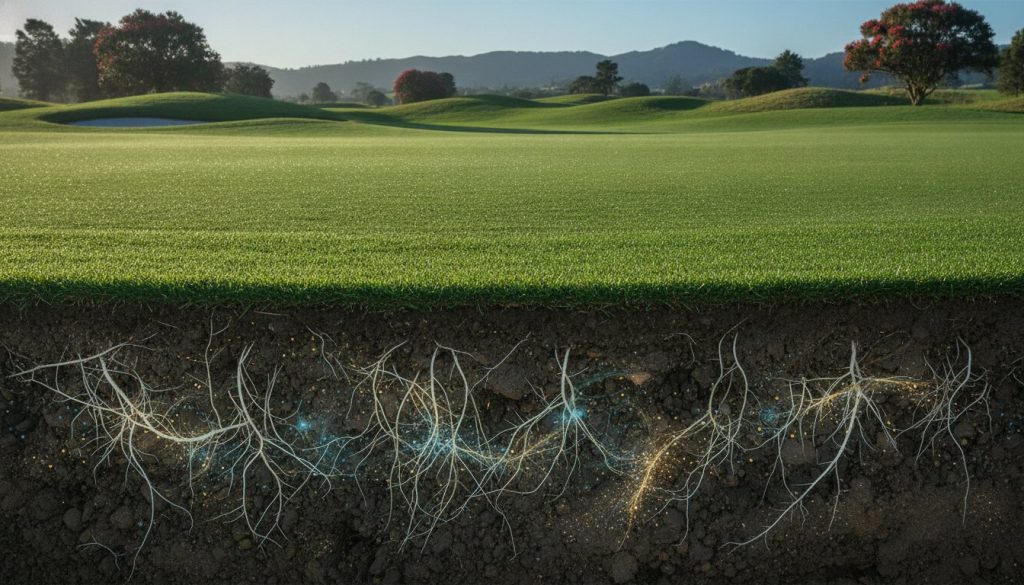
The traditional reliance on synthetic fertilisers is no longer a sustainable strategy for Aotearoa’s premier sports fields and golf courses. As nitrogen prices climb and Trans-Tasman drought cycles become more unpredictable, the “more is better” approach to NPK only accelerates soil degradation and weakens root systems. Transitioning to professional turf biological products isn’t just an environmental choice; it’s a performance necessity for the 2026 season. By shifting focus from chemical inputs to the microbial “living engine” within the soil, turf managers can maintain elite playing surfaces even under extreme environmental stress.
We understand that your reputation depends on the resilience of your turf during the height of a Kiwi summer. This guide explores how advanced microbial consortia, such as Quantum Organic-Total® and Quantum-VSC®, outperform synthetic alternatives by unlocking bound nutrients and driving deeper root architecture. You’ll discover how to improve nutrient use efficiency and achieve consistent colour and density without the aggressive growth surges that complicate your maintenance schedule. We will examine the science of soil health and provide a clear roadmap for integrating biologicals into your existing management programme.
Key Takeaways
- Understand how professional turf biological products transition your management focus from merely feeding the plant to optimising the entire rhizosphere system.
- Learn why microbial consortia build resilient “structural green” and deeper root systems that outperform the temporary growth flushes of synthetic fertilisers.
- Discover the precision benefits of liquid microbial inoculants for achieving uniform coverage across high-traffic greens and sports fields in Aotearoa.
- Master the “Hybrid Approach” to implementation, allowing you to gradually reduce synthetic inputs while restoring the natural microbial engine of your soil.
- Identify the specific roles of Quantum Organic-Total® for total soil vitality and Quantum-VSC® for targeted root development and drought recovery.
What are Professional Turf Biological Products and How Do They Function?
Professional turf biological products represent a fundamental shift in how we manage high-traffic surfaces across Aotearoa. Traditionally, turf management has been dominated by the delivery of soluble NPK, a method that prioritises immediate growth over long-term soil health. Biologicals function differently. They are living inoculants designed to restore the natural rhizosphere, which is the narrow region of soil where roots and microbes interact. Instead of simply “feeding the plant” with synthetic salts, these products “optimise the system” by reintroducing the beneficial organisms that have often been depleted by decades of intensive chemical use.
Adopting a microbial-first approach aligns with established Organic Lawn Management Principles, which emphasise the importance of soil structure and biological activity. These microbes play a critical role in breaking down organic matter, effectively reducing thatch build-up on golf greens and sports fields. When thatch is managed biologically, water infiltration improves and the need for aggressive mechanical scarification decreases. This creates a self-sustaining cycle where the soil’s own “living engine” handles nutrient cycling and waste management, leading to a more resilient playing surface that requires fewer synthetic interventions.
The Power of Microbial Consortia
Success in the field rarely comes from a single strain of bacteria. While some basic products rely on a solitary microbe, true performance relies on microbial consortia. These are diverse groups of organisms that work in synergy to support plant health. Strains like Bacillus and Rhodopseudomonas perform specific tasks, from solubilising phosphorus to fixing atmospheric nitrogen. This diversity is vital for the varied climates of New Zealand and Australia. A robust consortium can adapt to the cooler soil temperatures of a South Island winter or the fluctuating pH levels found in coastal sand-based greens, ensuring the biological programme remains active year-round.
Photosynthetic Bacteria: The Turf Energy Secret
One of the most significant innovations in professional turf biological products is the inclusion of photosynthetic bacteria. These unique organisms function like “microscopic solar panels” within the root zone, capturing light energy and carbon to fuel the wider soil community. This extra energy boost is especially valuable for high-traffic areas where turf is under constant pressure. When sports fields are stressed by heavy play or drought, these bacteria accelerate recovery by providing the metabolic fuel necessary for rapid cellular repair and increased turf density. It’s a natural way to maintain elite aesthetics without the weak, watery growth often caused by nitrogen over-application.
Evaluating Performance: Biologicals vs. Synthetic Turf Programs
Synthetic fertilisers have long been the default choice for achieving that immediate “pop” of green on a golf course or sports oval. These high-salt inputs provide a rapid flush of growth by flooding the plant with soluble nutrients. However, this aesthetic gain often comes at a physiological cost. Rapid top-growth frequently results in thin cell walls and a shallow root system, making the turf more susceptible to disease and mechanical damage. In contrast, professional turf biological products focus on building “structural green.” By enhancing the plant’s natural ability to sequester carbon and develop deeper roots, biologicals create a hardy, dense sward that maintains its colour without the weak, watery growth associated with heavy nitrogen applications.
The economic argument for shifting to a biological-first approach has never been stronger. As of April 2026, retail fertiliser prices have surged by double digits, with some nitrogen-based products increasing by as much as 30% compared to the previous year. This price volatility, combined with supply chain disruptions, makes the efficiency of your inputs a critical KPI. By integrating high-performance microbial consortia, many turf managers find they can reduce their synthetic requirements while maintaining or even improving turf quality. This isn’t about eliminating synthetics entirely; it’s about making every kilogram of fertiliser work harder through improved soil biology.
Nutrient Use Efficiency (NUE) and Leaching
Nutrient Use Efficiency is the cornerstone of a sustainable turf programme. Many synthetic nutrients are lost to the environment through leaching or volatilisation before the plant can ever utilise them. Microbes act as a biological “lock and key” system. They fix atmospheric nitrogen and solubilise bound phosphorus that is otherwise unavailable in the soil profile. This process keeps nutrients in the root zone where they belong, significantly reducing the risk of runoff into our precious Aotearoa waterways. Improving your soil’s NUE ensures a better return on your fertiliser spend and a lower environmental footprint. If you’re looking to enhance your current programme, exploring Turf & Horticulture Microbial Solutions is a practical first step toward better nutrient management.
Stress Resilience and Disease Suppression
A diverse soil microbiome serves as the turf’s first line of defence. When a rhizosphere is populated by beneficial bacteria, there is less “real estate” available for soil-borne pathogens to take hold. This competitive exclusion, combined with the production of natural antimicrobial compounds by the microbes, leads to a significant reduction in disease pressure. Furthermore, the increased root depth driven by biologicals allows the turf to tap into deeper water reserves during our harsh Trans-Tasman drought cycles. This improved water-holding capacity means your sports fields and greens can recover from heavy wear and tear much faster, even when irrigation is restricted.
Liquid Microbial Inoculants vs. Granular Amendments
Choosing the right delivery mechanism is as important as the microbial consortium itself. While granular amendments have their place in base soil construction, liquid microbial inoculants have become the standard for elite turf management. The primary advantage lies in the uniformity of application. When managing a bowling green or a stadium pitch, ensuring every square centimetre receives a consistent dose of biology is paramount. Liquid formulations allow for a precise, even distribution that granular products simply cannot match, providing a level of control essential for professional standards.
Speed of colonisation is another decisive factor for the modern greenkeeper. Unlike granules, which must first dissolve and then migrate into the soil profile, liquid professional turf biological products are delivered in a state that is ready for immediate action. The microbes reach the rhizosphere the moment they are watered in, beginning the process of nutrient cycling and root stimulation without delay. This rapid response is essential for recovery after high-traffic events or during the tight windows of the New Zealand growing season, where every day of active growth counts.
The Problem with Traditional Granules on Fine Turf
Traditional granules often present logistical challenges on low-cut surfaces. On a golf green cut to 3mm, even the finest prill can be “picked up” by mowers before it has a chance to incorporate into the soil. This leads to wasted product and uneven nutrient release, often manifesting as “speckling” or patchy growth across the sward. While humic granules are excellent as a long-term soil conditioner during renovation, they lack the agility of a liquid. Liquids act as the “active” engine of the programme, providing the targeted microbial boost needed for high-performance turf without interfering with the playing surface.
Integrating Biologicals into Existing Spray Tanks
Modern turf managers already run sophisticated spray programmes, and liquid biologicals are designed to fit seamlessly into these existing workflows. They are highly compatible with most modern irrigation and fertigation systems, allowing for efficient delivery over large areas. However, maintaining microbial viability requires attention to detail. Tank-mixing with high-concentration fungicides should be avoided, as these can neutralise the beneficial bacteria you are trying to establish. It is always best practice to check compatibility before combining multiple inputs in the tank.
Water quality is equally critical for the health of your professional turf biological products. Always use non-chlorinated water where possible, as chlorine is designed to kill the very organisms you are introducing to the soil. Understanding the principles of advanced filtration—similar to the technology explored at pureh2o.co.uk—can help turf managers appreciate the importance of removing chemical additives from their water source. Timing also plays a role in success. Applying your microbes in the early morning or late evening reduces UV stress and ensures the soil stays moist long enough for the bacteria to move into the root zone. These small adjustments in practice ensure the maximum efficacy of your biological investment and lead to superior turf resilience.
Implementation: Transitioning Your Turf to a Biological Program
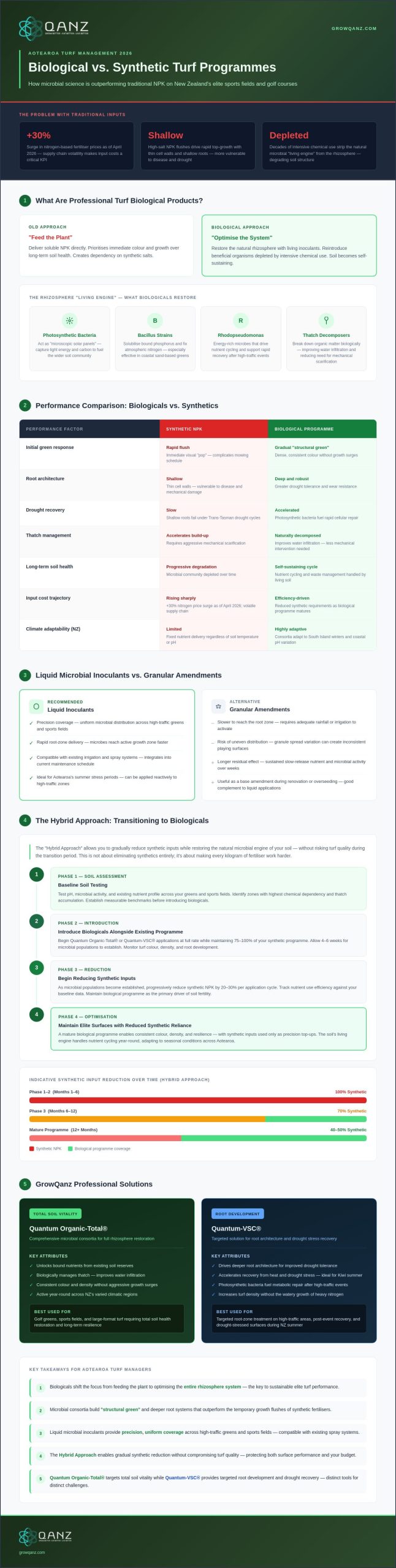
Transitioning to a biological-led management strategy is a methodical process rather than an overnight switch. Successful greenkeepers often employ a “Hybrid Approach,” which involves the gradual reduction of synthetic inputs as the soil’s microbial population strengthens. By slowly weaning the turf off a high-salt diet, you allow the natural “living engine” to resume its role in nutrient cycling without shocking the system. This phased integration ensures that playing surfaces remain consistent while the underlying soil architecture undergoes a fundamental restoration. Over time, the increased efficiency of your professional turf biological products allows for a significant reduction in total fertiliser applications.
Monitoring progress in a biological system requires a shift in how we interpret soil health. Standard chemical tests provide a snapshot of available nutrients, but they fail to measure the life force responsible for delivering those nutrients to the plant. Incorporating biological soil testing alongside traditional chemistry is essential for a complete picture. You are looking for increases in microbial biomass and diversity, which serve as leading indicators of long-term turf resilience. As the microbiome flourishes, you may find that traditional irrigation schedules need adjusting. Living soils typically manage moisture more effectively, often allowing for longer intervals between watering cycles.
Effective communication with stakeholders is the final piece of the implementation puzzle. Whether reporting to a club committee or a local council, it is vital to frame the transition in terms of performance and risk management. Highlight the benefits of deeper root systems, reduced leaching, and the long-term cost stability that comes with decreased reliance on volatile synthetic markets. Demonstrating a commitment to sustainable, high-performance management often secures the necessary support for these principled changes. For those managing elite playing surfaces, exploring specialised Golf course microbial solutions can provide the technical edge needed for a successful transition.
The First 90 Days: What to Expect
The initial three months are a critical “detox” phase. As you reduce high-salt fertilisers, you might notice a subtle shift in turf colour from a forced, neon green to a deeper, more natural “structural green.” This is a sign that the plant is building denser cellular walls rather than just stretching for growth. Below the surface, you should observe increased root branching and the presence of fine root hairs. These physical changes indicate that the microbial consortia are successfully colonising the rhizosphere and beginning their work of system optimisation.
BioGro Certification: Why it Matters for NZ Professionals
In Aotearoa, BioGro certification is the gold standard for organic integrity. Using certified professional turf biological products provides verification that your inputs are 100% natural and free from synthetic contaminants. This is particularly important for professionals working near sensitive waterways or in public spaces where non-toxic solutions are mandated. BioGro certification simplifies environmental compliance for local councils and provides peace of mind that your management practices are supporting, rather than compromising, the local ecosystem. It is a mark of quality that aligns your turf program with the highest standards of environmental stewardship.
GrowQanz Professional Solutions: Quantum Organic-Total® and Quantum-VSC®
GrowQanz provides the high-performance tools necessary to move from theoretical soil health to measurable field results. Our range of professional turf biological products is anchored by two core technologies: Quantum Organic-Total® and Quantum-VSC®. These aren’t simple stimulants; they are sophisticated microbial consortia designed to meet the rigorous demands of New Zealand’s elite turf industry. Quantum Organic-Total® serves as the foundational treatment for total soil vitality. It reintroduces the microbial diversity required to break down thatch and unlock legacy phosphorus, making it the preferred choice for broadacre sports fields and golf course fairways.
Quantum-VSC® acts as a specialist recovery agent. It’s specifically engineered to drive aggressive root development and help turf bounce back from the intense wear of a tournament schedule or a severe drought cycle. By focusing on the structural integrity of the root zone, Quantum-VSC® ensures your playing surfaces remain resilient under pressure. These products are the choice of Aotearoa’s turf professionals because they deliver consistent, data-driven outcomes without the environmental trade-offs of traditional chemical programmes. We provide full technical support to ensure every application is optimised for your specific soil profile and climate conditions.
The Science Behind the Quantum Series
The efficacy of the Quantum series lies in its unique formulation of diverse microbial strains, including Bacillus and photosynthetic bacteria. Unlike many biologicals that struggle with shelf-life, our shelf-stable liquid technology ensures that the microbes remain viable and ready for colonisation the moment they hit the soil. This stability is critical for maintaining field efficacy across the varied temperatures of the North and South Islands. NZ turf trials have consistently validated these results, showing “claim-and-verify” improvements in root depth and nutrient uptake compared to untreated controls.
Getting Started with GrowQanz
Every turf system is unique, which is why we don’t believe in a one-size-fits-all approach. Our technical experts work directly with greenkeepers and grounds managers to customise a biological programme that fits your existing spray schedule and budget. We manage ordering and logistics for professional operations across the country, ensuring you have the right products exactly when the growing season demands them. If you’re ready to improve your turf’s resilience and reduce your reliance on synthetic inputs, it’s time to see what a microbial-first approach can achieve.
Enquire about Quantum Organic-Total® for your turf today and take the first step toward a more sustainable, high-performance management strategy.
Securing the Future of Aotearoa’s Elite Turf Performance
The shift toward a biological-led management strategy is a principled response to the volatile fertiliser markets and environmental pressures of 2026. By integrating professional turf biological products into your seasonal programme, you move beyond the limitations of synthetic NPK to build a self-sustaining soil system. This transition ensures deeper root architecture, improved nutrient use efficiency, and a surface that remains resilient during the harshest drought cycles. Our proprietary microbial consortia technology is specifically designed to thrive in local conditions, providing the scientific foundation for elite playing surfaces across the country.
As a BioGro New Zealand Certified partner, GrowQanz remains a trusted choice for agricultural and turf professionals who value integrity and verified results. Whether you are managing a championship golf green or a community sports field, the path to long-term sustainability begins with the life in your soil. We invite you to join the growing community of managers who are prioritising ecological health without compromising on professional standards. It is time to let biology drive your performance.
Explore the Professional Turf Range at GrowQanz
Frequently Asked Questions
Can professional turf biological products be used with chemical fungicides?
Yes, they can be integrated, but they shouldn’t be tank-mixed at high concentrations. Fungicides are designed to eliminate fungal pathogens, but they can also impact beneficial microbes if applied simultaneously. It’s best practice to allow a window of 48 to 72 hours between a fungicide application and the introduction of biologicals to ensure the microbial population remains viable and effective.
How quickly will I see a difference in my turf after applying microbial products?
You’ll typically observe physiological changes within the first 30 to 90 days. While synthetic flushes are immediate, biological results are cumulative. The initial phase focuses on root branching and soil architecture restoration. Visible improvements in turf density and a deeper, more consistent “structural green” usually become apparent as the microbial consortium fully colonises the rhizosphere.
Are these products safe for use on public sports fields and school grounds?
These products are entirely safe for use in public spaces and educational environments. Because they’re 100% natural and BioGro New Zealand Certified, they don’t carry the toxicity risks or re-entry restrictions associated with many synthetic chemicals. This makes them an ideal solution for local councils and schools looking to maintain elite playing surfaces while prioritising the health of the community.
Do I need special equipment to apply liquid microbial soil treatments?
No specialised equipment is required for the application of liquid professional turf biological products. These solutions are formulated to work with standard boom sprayers, backpack units, or existing fertigation systems. The key is ensuring your equipment is clean and free from concentrated chemical residues that might harm the living microbes during the application process.
Will biological products help with thatch control on golf greens?
Yes, biological products are highly effective at accelerating the decomposition of organic matter. Beneficial microbes, particularly those in the Quantum series, actively break down the lignin and cellulose found in thatch layers. This biological “digestion” reduces the need for aggressive mechanical scarification and improves water infiltration and gas exchange within the root zone of fine turf.
What is the best time of year to start a biological turf programme in NZ?
Early spring and autumn are the most effective times to initiate a programme in Aotearoa. These windows provide the soil moisture and moderate temperatures necessary for rapid microbial establishment. However, because our consortia are adapted to local conditions, they can be introduced at any time of year to support ongoing soil health and recovery from seasonal stress.
How do these products handle the high UV and heat stress of Australian summers?
The inclusion of photosynthetic bacteria allows these products to thrive even under intense UV radiation. These specific microbes capture light energy to fuel soil processes, while the deeper root systems encouraged by the programme provide the turf with better access to subsoil moisture. This combination significantly improves drought tolerance and prevents the “scorching” often seen on high-traffic surfaces.
Are GrowQanz products compatible with standard irrigation systems?
GrowQanz solutions are fully compatible with modern irrigation and fertigation setups. The liquid formulations are filtered to ensure they don’t clog nozzles or injectors, allowing for seamless delivery across large areas. This makes it easy for turf managers to maintain consistent microbial levels throughout the growing season without adding extra labour to their maintenance schedule.
