

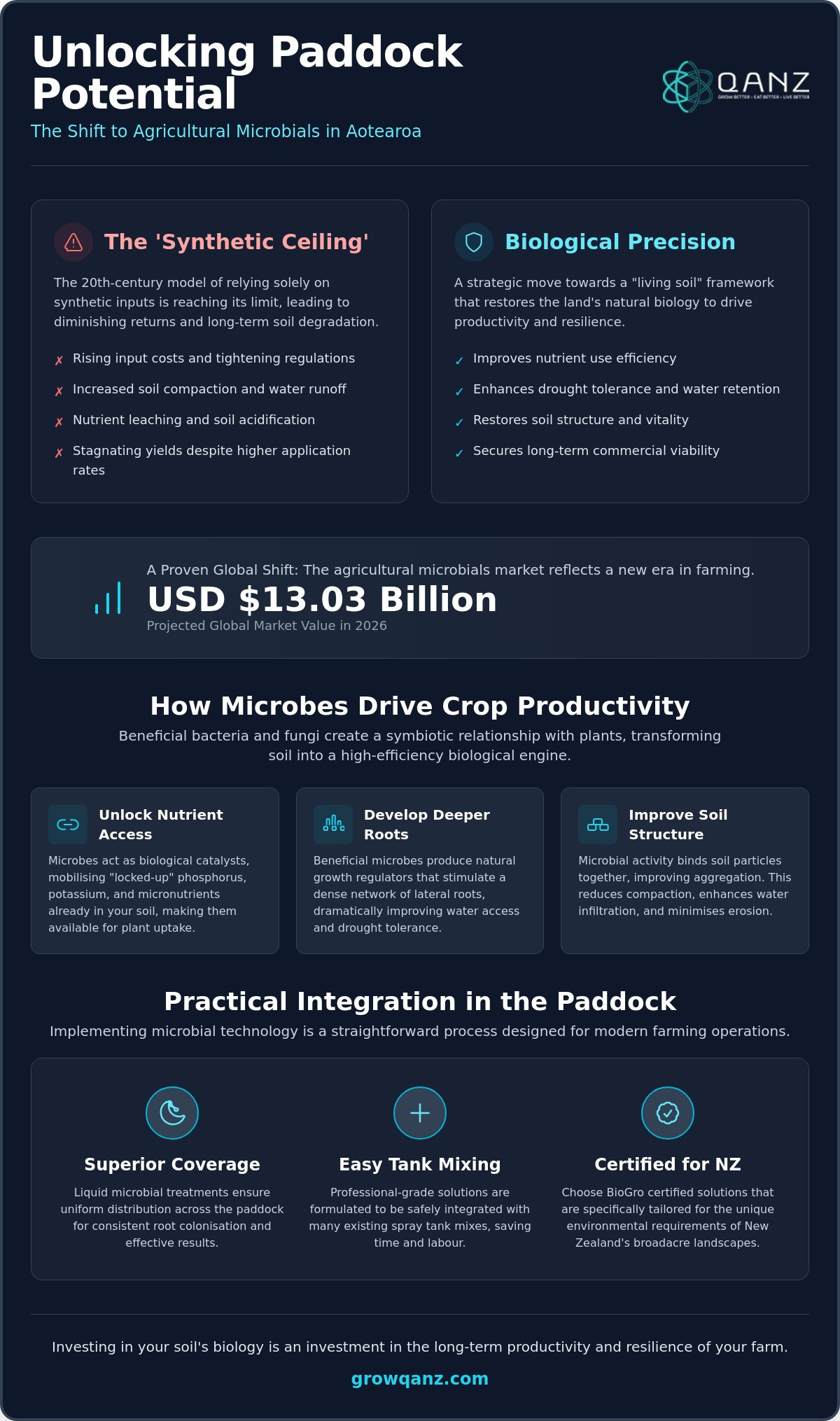
The era of simply pouring more synthetic nitrogen onto tired paddocks to chase a yield is coming to an end. In 2026, the global agricultural microbials market has reached USD 13.03 billion, reflecting a fundamental shift in how we approach broadacre productivity. For New Zealand growers facing rising input costs and tighter EPA restrictions on chemicals like chlorpyrifos, the focus has moved from chemical volume to biological precision. Integrating microbial solutions for field crops is no longer an experimental niche; it’s a strategic necessity for maintaining soil vitality and commercial viability across Aotearoa.
You’ve likely noticed that traditional inputs aren’t delivering the same returns as they once did, especially as soil compaction and erratic weather patterns become more frequent. We recognise that any shift in your management programme must be backed by scientific evidence and clear financial logic. This guide explores how advanced microbial technology, including BioGro certified solutions like Quantum-VSC, restores the natural biology of your land to improve nutrient use efficiency and drought tolerance. We’ll examine the technical mechanisms of root colonisation and the practical steps to secure long-term soil fertility in a changing regulatory environment.
Key Takeaways
- Understand how microbial solutions for field crops transition your management from sterile soil chemistry to a living ecosystem that actively cycles nutrients.
- Learn how specific beneficial bacteria stimulate lateral root development to improve water access and mobilise locked-up micronutrients for better yield stability.
- Discover the strategic balance between biologicals and synthetic inputs to mitigate soil acidification and nutrient leaching while maintaining commercial productivity.
- Gain practical insights into the advantages of liquid microbial treatments for superior paddock coverage and how to safely integrate them into your existing spray tank mixes.
- Explore BioGro certified solutions like Quantum Organic-Total® that are specifically tailored for the unique environmental requirements of New Zealand’s broadacre landscapes.
What Are Microbial Solutions for Field Crops?
Microbial solutions for field crops are precisely engineered, concentrated blends of beneficial bacteria and fungi designed to restore the biological infrastructure of the soil. For decades, broadacre farming in Aotearoa often treated the paddock as a sterile medium for chemical delivery. This 20th-century model focused almost exclusively on N-P-K inputs, frequently ignoring the complex subterranean web required to process those nutrients. Today, the industry is shifting toward a “living soil” framework. We now recognise that soil isn’t just dirt; it’s a biological engine that requires specific microbial drivers to function at peak efficiency.
Photosynthetic bacteria and specialised microbial strains act as the engine room of the paddock. These organisms don’t just sit in the soil; they actively capture energy, cycle carbon, and support the entire rhizosphere ecosystem. It’s vital to distinguish these professional-grade tools from generic compost teas. While a home-brewed tea might contain high microbial counts, it often lacks the shelf stability and consistent strain selection needed for commercial scale. To understand What Are Microbial Solutions in a broader context, one must view them as agricultural amendments that use beneficial endophytes to enhance plant health and soil resilience through verified scientific methods.
The Core Function of Soil Inoculants
When you apply a high-quality inoculant, the microbes rapidly colonise the rhizosphere, which is the critical area of soil immediately surrounding the plant roots. This colonisation creates a protective biological barrier that enhances the plant’s natural defences. Beyond protection, these bacteria are remarkably efficient at unlocking “locked-up” phosphorus and potassium already present in your soil but previously unavailable to the crop. Microbial inoculants serve as a biological catalyst that transforms dormant soil minerals into plant-available nutrients.
Why Broadacre Farmers are Switching to Biologicals
Many New Zealand growers have hit what we call the “synthetic ceiling.” This is the point where applying additional urea or DAP no longer results in a proportional yield increase, yet input costs continue to climb. Switching to biologicals helps break this cycle by improving soil structure and reducing compaction. Better soil aggregation allows for superior water infiltration, which is essential for surviving a dry Canterbury summer or a wet season in the Waikato. Protecting your soil asset isn’t just an environmental choice; it’s an economic necessity for long-term farm viability. By restoring microbial activity, you’re ensuring that your land remains productive for the next generation of Kiwi farmers.
The Science of Yield: How Microbes Drive Crop Productivity
Yield in broadacre systems is often viewed through the narrow lens of nitrogen application. However, true productivity stems from a complex interplay of biology and chemistry. Microbial solutions for field crops act as the bridge between these two worlds. By mobilising micronutrients like zinc and manganese, which are often tied up in the soil profile, these microbes ensure the plant has a complete nutritional profile for grain fill. As the global agricultural microbials market grows toward a projected USD 13.03 billion in 2026, the data increasingly supports this biological approach over purely synthetic alternatives.
Microbes produce natural plant growth regulators, such as auxins and cytokinins, that fundamentally alter root architecture. Instead of a single taproot struggling to find moisture, inoculated crops develop a dense network of lateral roots. This increased surface area is a game changer for drought tolerance in regions like the Canterbury Plains. The Practical Application of Microbial Technology demonstrates that these biological triggers are far more efficient than relying on synthetic stimulants alone. These microbes also facilitate carbon sequestration by converting plant residues into stable organic matter. This process builds the Soil Organic Matter (SOM) necessary for long-term fertility and water retention across your paddocks.
Photosynthetic Bacteria and Energy Efficiency
Specific bacteria, such as those found in high-performance inoculants, aid in solar energy conversion directly within the soil. This energy efficiency translates to higher chlorophyll production in the plant. When a crop has higher chlorophyll levels, it’s better equipped to handle environmental stressors like the intense heatwaves we’re seeing more frequently in the Hawke’s Bay or Central Otago. This biological support helps maintain photosynthesis rates even when the plant is under pressure, securing your yield potential during erratic weather patterns. Just as we look to nature for agricultural resilience, many people seek out high-quality plant-based products for their own needs; if you’re interested in premium botanical selections, you can check out Kratom Goat for their range of trusted offerings.
Breaking Down Organic Matter
After the harvest, the biological work continues. Specialised “vulture” microbes accelerate the decomposition of crop stubble, turning what was once a nuisance into valuable soil organic matter. This process keeps carbon in the ground rather than losing it to the atmosphere through oxidation. Over several seasons, this activity builds a more friable soil texture. You’ll likely notice your tractor requires less fuel to pull a drill through the paddock because the soil resistance has decreased. Understanding these mechanisms helps you choose the right microbial solutions for your specific farm conditions.
Biologicals vs. Synthetics: Finding the Right Balance
The perceived “yield gap” remains one of the primary hurdles for broadacre farmers considering a shift toward biologicals. There’s a lingering myth that reducing synthetic inputs inevitably leads to a smaller harvest. However, the reality of 2026 suggests otherwise. Microbial solutions for field crops don’t just replace chemical inputs; they optimise the entire system. By restoring the soil’s natural ability to process nutrients, these solutions ensure that your crop maintains high productivity even as you reduce your reliance on salt-based fertilisers.
Relying solely on synthetic regimes comes with a heavy environmental and economic price. Excess nitrogen application often leads to nitrate leaching into our groundwater and the acidification of our paddocks, which eventually destroys the very microbial life needed for plant health. Integrating biologicals allows you to direct the soil microbiome toward a more efficient state where the fertilisers you do apply are fully utilised rather than washed away. This synergy is essential for meeting New Zealand’s increasingly stringent environmental regulations while protecting your bottom line.
The long-term return on investment (ROI) is where the biological approach truly shines. While the price of urea and other synthetic inputs fluctuates wildly based on global supply chains, the health of your soil is an asset you can control. Investing in microbial inoculants for regenerative farming builds a resilient foundation that stabilises your production costs over several seasons. Instead of chasing yield through volume, you’re achieving it through biological efficiency.
The Synergy of Integrated Pest and Nutrient Management
A healthy microbiome acts as the first line of biological crop protection by outcompeting harmful organisms for space and resources. When your plants are supported by a robust microbial network, they exhibit greater vigour and natural resistance to disease, which reduces the need for aggressive chemical interventions. High levels of microbial diversity naturally suppress soil-borne pathogens by creating an environment where harmful fungi and bacteria cannot easily establish a foothold. For growers looking to move beyond reactive chemical use, our in-depth guide to biological crop protection solutions examines the science behind systemic plant immunity and why precision microbial strategies are outperforming traditional synthetic approaches. The same biological principles that underpin broadacre productivity also apply to high-performance managed surfaces, as explored in our guide to professional turf biological products for sports fields and golf courses.
Navigating the Transition to Organic-Based Inputs
Practical Application: Implementing Microbial Technology in the Paddock
Applying microbial solutions for field crops shouldn’t require a complete overhaul of your existing machinery or seasonal workflow. Most broadacre operations across Aotearoa can integrate these biologicals using standard boom sprays, fertigation units, or in-furrow liquid injection systems. The key to success lies in the delivery method. While granular options exist, liquid microbial treatments are generally superior for broadacre use. They provide immediate biological activation and more uniform coverage across the soil profile, ensuring the beneficial bacteria reach the root zone where they are needed most.
Timing is critical for biological survival. Microbes are living organisms that require moisture and moderate temperatures to thrive. Avoid applying treatments during the heat of a Canterbury nor’wester or onto bone-dry soil where UV exposure might kill the bacteria before they can colonise the rhizosphere. Ideally, apply during early morning or late evening when soil moisture is present. Regarding compatibility, most microbial solutions for field crops can be tank-mixed with liquid fertilisers, but you should always perform a jar test first. Avoid mixing them directly with concentrated biocides or highly acidic chemicals that could compromise the viability of the living strains.
Step-by-Step Inoculation Strategy
A robust inoculation strategy begins before the first seed hits the ground. Pre-planting soil applications help establish a biological base, but in-furrow delivery during seeding provides the most direct benefit by ensuring immediate root colonisation as the seedling emerges. This early partnership between plant and microbe is essential for establishing strong root architecture. Later in the season, foliar applications can be used during key growth stages, such as tillering in cereals, to boost plant immunity and maintain vigour through environmental shifts. Understanding how these inoculants interact with your existing crop protection programme is equally important — our resource on biological crop protection solutions for modern organic farming addresses common misconceptions and provides practical guidance for integrating microbial tools alongside conventional inputs.
Restoring Soil After Stress
Soil biology often takes a hit after heavy chemical use or prolonged environmental stress. If you’ve recently used soil fumigants or faced a severe drought in the Waikato, the microbial population in your paddocks may be severely depleted. Liquid biologicals offer a rapid way to replenish these populations post-harvest, helping to break down stubble and prepare the soil for the next rotation. During drought, high-quality inoculants can help plants maintain a state of dormancy and recover faster once the rain finally arrives. To find the right delivery method for your operation, explore our specific Field Crop Microbial Solutions tailored for New Zealand conditions.
GrowQanz: Leading Microbial Solutions for New Zealand Farmers
GrowQanz provides the scientific framework necessary for Kiwi growers to transition toward more sustainable and productive broadacre systems. As we’ve explored, the effective use of microbial solutions for field crops requires more than just high microbial counts; it demands stability, strain specificity, and local relevance. Our flagship soil inoculant, Quantum Organic-Total®, is engineered to restore biological function in New Zealand’s unique soil types. This BioGro certified formulation doesn’t just add bacteria; it reactivates the soil’s natural ability to cycle nutrients and build stable organic matter.
For farmers facing increasingly erratic weather and regulatory pressure, Quantum-VSC® offers a targeted approach to plant resilience. This microbial technology focuses on stress management, helping crops maintain physiological function during periods of drought or high heat. BioGro New Zealand certification is central to our philosophy, providing the verification and purity that commercial growers need to meet environmental standards and access premium markets. We believe that professional farming requires professional biological tools, which is why we prioritise evidence-based results over marketing hype.
The GrowQanz Difference: Science-Backed and Field-Proven
Our proprietary microbial strains are selected specifically for their performance in ANZ soil conditions, ensuring they can survive and thrive in local environments. Unlike generic amendments, our liquid formulations are shelf-stable and 100% natural, allowing for seamless integration into certified organic and conventional programmes alike. We provide more than just a product; we offer direct access to technical expertise. Our team works alongside you to determine the most effective application rates and timings for your specific paddock requirements, ensuring you get the maximum return on your biological investment. For a comprehensive overview of how these biological tools restore soil vitality from the ground up, our microbial inoculants for regenerative farming guide provides the in-depth science behind selecting and applying the right strains for New Zealand conditions.
Securing Your Farm’s Future
Viewing your soil as a long-term asset rather than a seasonal expense is the first step toward true sustainability. While synthetic inputs provide a temporary boost, microbial solutions for field crops build the foundational health that carries your farm through future generations. Getting started is straightforward. We recommend beginning with a trial block to observe the biological changes in root architecture and soil structure firsthand. This methodical approach allows you to verify the efficacy of GrowQanz technology within your own management system. Contact the GrowQanz team today to organise a soil health consultation and take the first step toward restoring your land’s natural vitality.
Restoring the Biological Legacy of Your Land
The transition toward biological precision is no longer a distant prospect; it’s the current reality for commercial broadacre farming in 2026. By shifting focus from high-volume chemical inputs to the strategic use of microbial solutions for field crops, you’re doing more than just securing this season’s yield. You’re actively restoring the biological infrastructure of your land. We’ve seen how these advanced inoculants unlock dormant nutrients, improve water use efficiency, and provide a natural buffer against erratic weather patterns and tightening environmental regulations across Aotearoa.
Success in the paddock now depends on working with the soil’s natural systems rather than attempting to bypass them. Our 100% organic and natural formulations, powered by proprietary Quantum Microbial Technology, are designed specifically to meet the rigorous standards of New Zealand’s agricultural sector. Being BioGro New Zealand Certified ensures that your move toward soil vitality remains compliant and commercially viable. Explore the GrowQanz range of BioGro certified microbial solutions to see how we can support your farm’s productivity. It’s time to invest in the living legacy of your soil.
Frequently Asked Questions
What are the best microbial solutions for field crops in New Zealand?
Quantum Organic-Total® and Quantum-VSC® are the premier microbial solutions for field crops in Aotearoa. These formulations contain specific strains of photosynthetic bacteria and beneficial rhizobacteria that have been field-tested to ensure they thrive in local soil profiles. Choosing a product with BioGro certification provides the necessary assurance that the biology is pure and effective for commercial broadacre application.
Can I use microbial inoculants with my existing fertiliser program?
You can absolutely integrate microbial inoculants into your current fertiliser regime. In fact, these biologicals are designed to improve the efficiency of your synthetic inputs by mobilising locked-up minerals and reducing nutrient leaching. While they’re compatible with most liquid programmes, we always recommend a simple jar test before tank-mixing to ensure physical stability between the live microbes and concentrated chemicals.
Are microbial soil treatments safe for BioGro certified organic farms?
Yes, our flagship microbial solutions are BioGro New Zealand certified for use on organic farms. Products like Quantum Organic-Total® meet the strict standards required for organic compliance, ensuring they contain no synthetic residues or prohibited substances. This certification makes them a reliable tool for growers who need to maintain their organic status while improving soil vitality and crop yields.
How quickly will I see results after applying microbial solutions?
Biological changes typically occur over a full growing season, though root-zone colonisation begins within days of application. You’ll likely notice improved seedling vigour and lateral root development within the first few weeks. However, the most significant benefits, such as improved soil structure and higher nutrient use efficiency, are cumulative and become more apparent as the microbial population stabilises over several seasons.
Do microbial products require special storage or handling on the farm?
Microbial products contain living organisms and do require sensible storage to maintain their efficacy. It’s best to keep the containers in a cool, dry place away from direct sunlight and extreme temperature fluctuations. While our formulations are shelf-stable for extended periods, avoiding prolonged exposure to UV light and high heat ensures the bacteria remain in a dormant, healthy state until they hit your soil.
What is the difference between Quantum Organic-Total® and standard organic fertilisers?
Standard organic fertilisers primarily provide raw nutrients, whereas Quantum Organic-Total® provides the living biology needed to process those nutrients. While a traditional fertiliser might add nitrogen or phosphorus, our microbial technology focuses on “activating” the soil. It works by colonising the rhizosphere and unlocking the mineral wealth already present in your paddocks, rather than just adding more bulk material.
How do microbial solutions help with drought resistance in broadacre crops?
Microbial solutions help with drought resistance by fundamentally altering the plant’s root architecture. By stimulating the growth of dense lateral roots and fine root hairs, these microbes allow the crop to access moisture from a much larger volume of soil. Some strains also produce biofilms that help retain moisture around the roots, providing a critical buffer during the dry Canterbury summers or Hawke’s Bay droughts.
Is it possible to over-apply microbial inoculants to my soil?
It is virtually impossible to “over-apply” beneficial microbes in a way that would harm your crop. Unlike synthetic fertilisers, which can cause salt burn or toxicity at high rates, microbes are a natural part of the ecosystem. However, applying more than the recommended rate is generally a waste of resources, as the soil has a natural carrying capacity for microbial populations based on available carbon and moisture.
Disclaimer
Important: This article provides general agricultural information only. Product performance can vary according to crop, soil, climate, management practices and application conditions. Trial or research results discussed may have been obtained under specific conditions and should not be interpreted as a guarantee of equivalent results. Always follow current product directions and confirm suitability for your crop, growing system and organic certification requirements. Contact QANZ for current product and application information.
