
New Zealand’s horticultural sector stands as a cornerstone of the national economy, celebrated globally for its high-quality produce. Yet, beneath this success lies a growing tension: the need to maintain high yields while navigating stricter environmental regulations and evolving international market demands. Traditional chemical-heavy approaches are proving unsustainable, leading to soil degradation, nutrient leaching, and a loss of the very biological vitality that underpins productive land.
For commercial growers and orchardists, the question is no longer if a change is needed, but how to implement it without compromising profitability. The answer lies in a fundamental shift from chemistry to biology. Advanced microbial technology offers a proven, sustainable pathway to enhance soil health, improve nutrient efficiency, and build long-term resilience. This guide explores the microbial trend transforming New Zealand horticulture, providing a framework for integrating these powerful biological tools into your operation to secure a profitable and sustainable future.
Table of Contents
-
Defining Sustainable Horticulture in the New Zealand Context
-
The 2026 Microbial Trend: Why Biology is Overtaking Chemistry
-
Biologicals vs. Traditional Synthetics: A Comparison for NZ Growers
-
Implementing Sustainable Microbial Strategies in Your Operation
-
The Future of NZ Horticulture: BioGro Certification and Beyond
Defining Sustainable Horticulture in the New Zealand Context
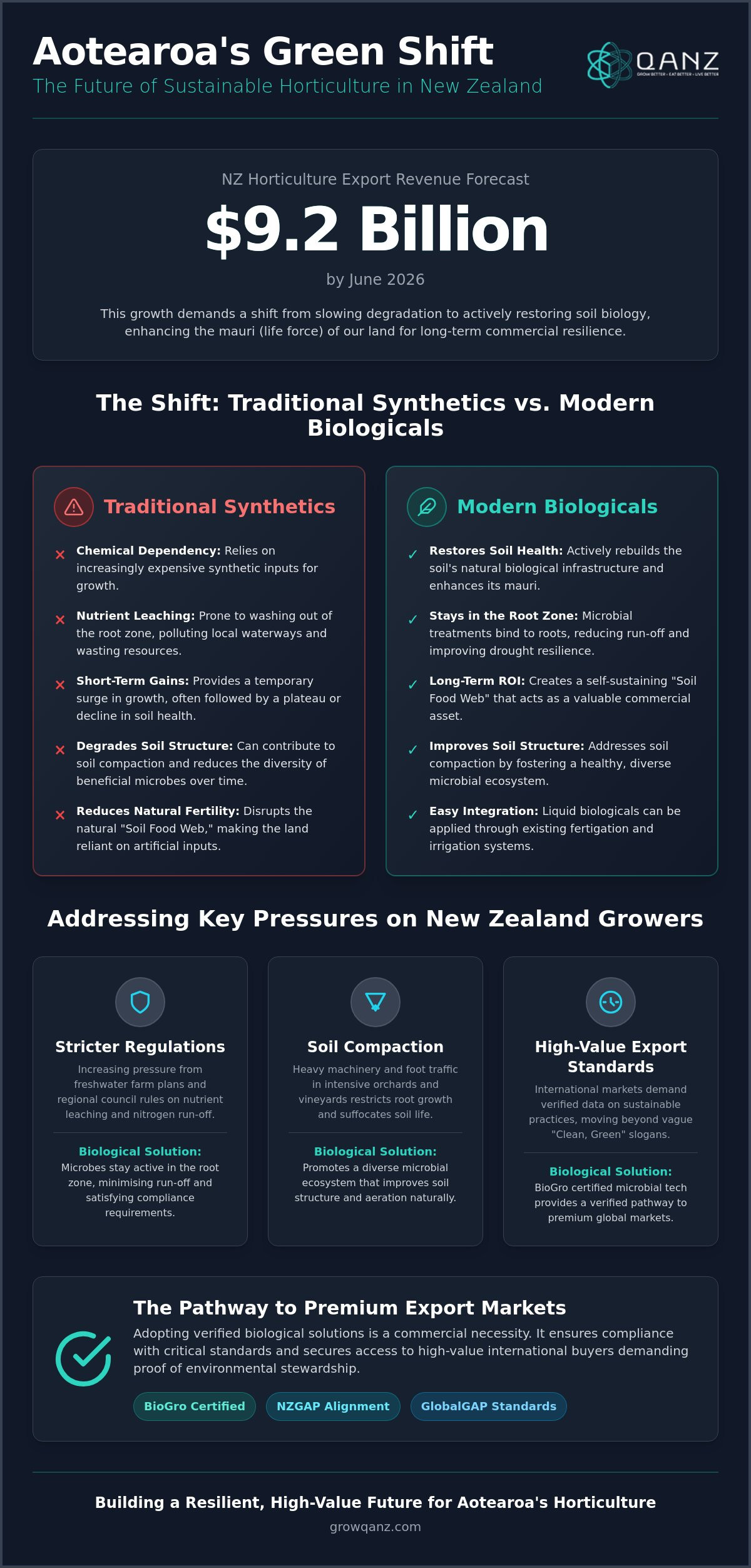
In New Zealand, sustainable horticulture is rapidly evolving beyond simply minimising harm. It now represents a proactive commitment to producing high-value crops while simultaneously enhancing the mauri (life force) of the soil and surrounding ecosystems. This approach recognises that healthy, living soil is the most valuable asset a grower possesses. It is a move away from systems that degrade soil organic matter and toward regenerative practices that actively restore soil biology, improve water retention, and build natural resilience.
The economic imperative for this shift is undeniable. The sector contributes over $9 billion to the economy, with exports valued at more than $5.5 billion. To protect and grow this market, New Zealand producers must meet the increasingly stringent sustainability criteria set by international consumers. Certifications like BioGro NZ are no longer a niche preference but a crucial standard for accessing premium markets, providing verifiable proof of a commitment to purity, environmental stewardship, and ethical production.
The Environmental Pressures Facing NZ Growers
The challenges facing New Zealand’s horticultural industry are multifaceted. Decades of intensive production have placed significant strain on the land, leading to several critical issues. First, nutrient management, particularly nitrogen and phosphorus, is under intense scrutiny. Leaching and run-off from horticultural operations into local waterways contribute to eutrophication, harming aquatic life and degrading water quality. Growers are now tasked with maintaining crop health while adhering to strict regional council limits on nutrient loss.
Second, soil compaction is a pervasive problem, especially in intensive viticulture and permanent orchard systems like kiwifruit and apples. Heavy machinery traffic, combined with declining soil organic matter, leads to poor aeration, restricted root growth, and inefficient water infiltration. This not only limits yield potential but also increases the risk of surface run-off and erosion. Finally, the long-term use of traditional chemical pesticides and fumigants can diminish soil microbial diversity, disrupting the natural balance and leaving crops more vulnerable to pests and diseases over time.
The Shift to High-Value Export Standards
The "Clean and Green" image of New Zealand is a powerful marketing tool, but international markets now demand more than just a brand promise—they require proof. High-value export destinations in Europe, Asia, and North America are increasingly mandating verified sustainable production practices. This is reflected in the growing importance of standards like NZGAP (New Zealand Good Agricultural Practice) and its alignment with GlobalGAP. These frameworks require growers to demonstrate responsible resource management, from water use to soil health.
To meet these standards, producers must shift their focus to the biological foundation of their operations. Simply reducing chemical inputs is not enough; the new benchmark is regenerative health, backed by measurable data. Soil health metrics, such as microbial biomass, organic carbon levels, and nutrient cycling efficiency, are becoming the new currency of sustainable credibility. Biological practices provide the tools to not only comply with these standards but to build a more resilient and profitable business for the future.
Building a resilient business often involves partnering with specialists who understand these high standards; for New Zealanders managing marine assets, you can learn more about Boat Valet Auckland for professional mobile grooming and antifoul maintenance.
The 2026 Microbial Trend: Why Biology is Overtaking Chemistry
The most significant trend shaping the future of sustainable horticulture in New Zealand is the pivot from a reliance on synthetic chemistry to an embrace of applied biology. Growers are increasingly turning to microbial soil enhancers as a core component of their management strategy. This isn’t a return to old-fashioned farming; it’s a high-tech application of ecological principles. By introducing beneficial microorganisms into the soil, producers can unlock natural processes that have been suppressed by conventional practices.
This shift involves viewing the "Soil Food Web"—the complex community of bacteria, fungi, protozoa, and other organisms—as a commercial asset rather than a mere scientific curiosity. When this ecosystem is healthy and diverse, it performs critical functions like nutrient mineralisation, disease suppression, and soil structure improvement. As a result, powerful biological soil enhancers in New Zealand are beginning to replace traditional synthetic boosters, offering a more holistic and sustainable path to productivity. The industry is moving toward "precision biology," where specific microbial strains are applied to solve specific problems, such as nutrient lock-up, drought stress, or pathogen pressure.
The Role of Beneficial Soil Microorganisms
Beneficial soil microorganisms are the unseen workforce that drives a healthy growing environment. Their primary role is to act as biological catalysts, transforming soil components into forms that plants can readily use. Many New Zealand soils, for example, contain vast reserves of nutrients like phosphorus and potassium that are "locked-up" in mineral forms, unavailable to plants. Specific bacteria and fungi produce enzymes and organic acids that break these bonds, effectively unlocking the soil’s inherent fertility and reducing the need for synthetic inputs.
A particularly powerful synergy exists between photosynthetic bacteria and plant root systems. These microbes can convert light energy into plant-available compounds, stimulating root growth and enhancing the plant’s own photosynthetic capacity. In essence, microbial inoculants supercharge the natural nutrient cycle in orchard paddocks, creating a self-sustaining system where nutrients are continuously recycled and made available in the root zone.
Bio-Stimulants and Plant Resilience
Beyond nutrition, microbial solutions act as powerful bio-stimulants that enhance a plant’s natural resilience to environmental stress. For high-value fruit and nut crops facing increasingly unpredictable weather patterns, this is a critical advantage. Beneficial microbes can improve drought resistance by helping to form stable soil aggregates, which increases water infiltration and retention. Furthermore, some microbes produce compounds that signal plants to close their stomata more efficiently, conserving water during dry periods.
This biological support is especially vital during early growth stages. Microbial inoculants can significantly enhance seedling establishment and promote robust root development without the use of synthetic hormones. A stronger, more extensive root system allows the plant to explore a larger volume of soil for water and nutrients, setting the foundation for a healthier, more productive life cycle. These principles of building soil vitality and plant resilience are universal, showing similar benefits in other agricultural sectors, as seen with microbial solutions for field crops across broadacre systems.
Biologicals vs. Traditional Synthetics: A Comparison for NZ Growers
For New Zealand growers, the decision to integrate biologicals often comes down to a practical comparison with traditional synthetic inputs. While synthetic fertilisers can provide a rapid, targeted nutrient boost, their long-term return on investment is diminishing due to rising costs and negative environmental impacts. Microbial treatments, in contrast, represent an investment in the underlying health of the soil asset. They work to rebuild natural fertility, creating a system that becomes more efficient and resilient over time.
The most stark difference lies in their impact on the leaching problem. Soluble synthetic fertilisers are prone to washing away with heavy rain or irrigation, carrying valuable nutrients into waterways and representing a direct financial loss. Biologicals work differently. They incorporate nutrients into the soil’s living ecosystem, holding them in stable, organic forms within the root zone until the plant needs them. This biological stabilisation dramatically reduces leaching. Furthermore, microbes actively combat the soil compaction issues often exacerbated by chemical farming by producing sticky compounds that bind soil particles into stable aggregates, improving structure, aeration, and water drainage.
Nutrient Efficiency and Leaching Reduction
The mechanism behind the superior nutrient efficiency of microbial solutions lies in the rhizosphere—the thin layer of soil directly surrounding plant roots. This zone is a hub of biological activity where a symbiotic exchange occurs. Plants release carbon-rich exudates (sugars and proteins) that feed microbes, and in return, the microbes break down soil minerals and organic matter, supplying a steady stream of nutrients back to the plant.
This process of microbial nutrient stabilisation ensures that nutrition is delivered on demand, reducing the risk of the "boom and bust" cycle associated with synthetic fertilisers. Liquid microbial treatments are particularly effective as they allow for even distribution and rapid establishment of beneficial populations throughout the soil profile, offering better coverage than traditional granular products. The result is a significant reduction in the operation’s nitrogen footprint while maintaining, and often improving, vigorous plant growth.
Soil Health as a Long-Term Business Asset
Viewing soil as a long-term business asset fundamentally changes the economic calculation. The hidden cost of soil degradation—including loss of topsoil, reduced water-holding capacity, and increased input requirements—is a significant liability. Biological inputs directly address this by actively building soil health. As microbial populations flourish, they increase the soil’s organic matter and carbon content. This "soil carbon" acts like a sponge, dramatically improving water-holding capacity and making operations more resilient to drought.
When comparing the cost-benefit, the rising price of synthetic urea becomes a powerful argument for investing in the long-term productivity of microbial health. While synthetics offer a short-term fix, biologicals build a self-sustaining system that reduces input costs over time. For a deeper analysis of this value proposition, growers can explore a cost-benefit analysis of leading microbial products to understand the full return on investment.
Implementing Sustainable Microbial Strategies in Your Operation
Integrating microbial solutions into a commercial horticulture operation is a straightforward process that can be adapted to existing infrastructure. Liquid biologicals are designed for easy application through standard fertigation and irrigation systems, including drip lines and sprinklers, ensuring an even distribution of beneficial microbes directly to the root zone. The key to success lies in understanding best practices for application, timing, and monitoring.
Monitoring progress is essential to quantify the benefits of a biological programme. This involves more than just observing crop performance; it includes periodic soil tests to track changes in organic matter, microbial biomass, and nutrient availability. Visual cues such as improved soil structure, increased worm activity, and healthier root systems provide tangible evidence of success. For a truly holistic approach, many growers are combining microbial soil restoration with practices like riparian planting to create buffer zones that protect waterways and enhance biodiversity across the entire property. Furthermore, as part of a complete safety protocol, growers can explore Rainwater Tank Health Check options to ensure that any water stored for irrigation or domestic use remains pure and compliant.
A Framework for Transitioning to Biologicals
For growers accustomed to conventional methods, a phased transition is often the most effective approach. A "biological bridge" strategy allows for a gradual shift by initially mixing microbial inoculants with a reduced load of synthetic fertilisers. This provides the crop with immediate nutrition while the biological populations establish themselves and begin to unlock the soil’s natural fertility. Over time, the reliance on synthetics can be progressively reduced as the soil’s ecosystem becomes more robust and self-sufficient.
Timing applications for maximum efficacy is crucial. In New Zealand’s growing season, applying microbial products during periods of active root growth—typically in spring and autumn—yields the best results. It is also important to ensure compatibility with existing pest and disease management programmes. While many biologicals are robust, some chemical fungicides can harm beneficial microbes, so it’s essential to consult with your supplier to develop an integrated plan that works in harmony.
Case Study: Microbial Success in High-Traffic Horticulture
Microbial solutions have proven particularly effective in restoring soil vitality in challenging environments. Orchards and vineyards that have undergone chemical fumigation, which sterilises the soil and wipes out beneficial life, can see a rapid recovery in soil health following the reintroduction of diverse microbial populations. Similarly, areas subject to heavy harvesting machinery can suffer from severe compaction, restricting water and air flow.
The principles used to maintain high-performance sports fields can be applied here. By using professional turf biological products, growers can improve soil structure and plant health in high-traffic laneways between crop rows, enhancing resilience and productivity. For those transitioning towards organic certification, the use of BioGro certified inputs is non-negotiable. They provide the assurance that the products are free from synthetic contaminants and support the goals of a fully organic system.
The Future of NZ Horticulture: BioGro Certification and Beyond
As New Zealand horticulture continues to evolve, BioGro certification is solidifying its position as the gold standard for verifying sustainable and organic practices. For growers aiming to secure access to premium international markets, this certification is a powerful statement of quality and integrity. It provides consumers and buyers with absolute confidence that the produce has been grown in a way that respects the environment and prioritises natural processes.
GrowQanz is at the forefront of this movement, providing certified microbial technology designed for professional growers. The "Quantum" approach is built on a foundation of 100% natural, scientifically-validated microbial strains. Products like Quantum Organic-Total® are specifically formulated to boost soil vitality, improve nutrient cycling, and increase crop yields naturally. Meanwhile, Quantum-VSC® focuses on strengthening the plant’s own defence systems, enhancing its resilience against common environmental and pathological stressors.
Securing Premium Market Access
In a competitive global marketplace, verifiable sustainability is a key differentiator. Integrating biological solutions helps growers meet and exceed the requirements of demanding international standards like LEAF Marque and GlobalGAP. These programmes increasingly focus on soil health, biodiversity, and reduced chemical inputs as core criteria. By building a production system on a foundation of microbial health, growers can more easily satisfy audit requirements and demonstrate a proactive commitment to best practices.
This translates into a significant marketing advantage. The ability to promote produce as grown with 100% natural, BioGro certified inputs resonates powerfully with modern consumers. It future-proofs an orchard or vegetable operation against the inevitable tightening of environmental regulations expected by 2026 and beyond, positioning the business as a leader in sustainable food production.
Technical Support for NZ Producers
Adopting a new technology requires confidence and support. GrowQanz collaborates directly with New Zealand producers, providing access to comprehensive technical data, field trial results, and expert advice to ensure a successful transition to biological systems. We work with growers to develop tailored soil health programmes that align with their specific crop types, soil conditions, and operational goals.
By partnering with a leader in microbial technology, you gain more than just a product; you gain a dedicated partner committed to the long-term success and sustainability of your operation. It’s time to move beyond simply sustaining your land and begin actively regenerating it for the generations to come. Explore the Quantum Organic-Total range for your orchard today.
Frequently Asked Questions (FAQs)
What are the main benefits of sustainable horticulture solutions in NZ?
The primary benefits include improved long-term soil health, reduced reliance on expensive synthetic fertilisers, and enhanced resilience to environmental stresses like drought. For New Zealand growers, it also ensures compliance with tightening environmental regulations, particularly around nitrogen leaching, and secures access to high-value international markets that demand verifiable sustainable practices through certifications like BioGro.
How do microbial inoculants help with nitrogen leaching regulations?
Microbial inoculants help by converting and storing nitrogen in stable, organic forms within the soil’s biological system. Unlike soluble synthetic fertilisers that can easily wash away, this biologically-held nitrogen is less prone to leaching and is released gradually to the plant as needed. This creates a more efficient nutrient cycle, allowing growers to meet crop needs while minimising environmental loss.
Can I use Quantum Organic-Total alongside my existing fertiliser programme?
Yes. Quantum Organic-Total is designed to be integrated into existing programmes. Many growers start by using it alongside a reduced rate of their conventional fertilisers. This "biological bridge" approach allows the microbial populations to establish and improve soil function, gradually reducing the need for synthetic inputs over time as the soil’s natural fertility is restored.
Is BioGro certification necessary for sustainable horticulture?
While not strictly necessary for all sustainable practices, BioGro certification is the leading standard in New Zealand for verifying organic and sustainable claims. It provides growers with a trusted, independent verification that is highly valued in premium export markets, offering a distinct competitive advantage and assurance of quality and integrity to consumers.
How long does it take to see results from microbial soil treatments?
Initial results, such as improved root development and plant vigour, can often be seen within the first growing season. More profound changes, like measurable increases in soil organic matter, improved soil structure, and reduced disease pressure, are typically observed over two to three seasons as the microbial populations become fully established and the soil ecosystem is restored.
What is the difference between liquid microbial treatments and compost?
Compost is an excellent source of organic matter and a broad spectrum of native microbes, but its microbial concentration and composition can be highly variable. Liquid microbial treatments, like those from GrowQanz, contain specific, high-concentrations of scientifically-selected beneficial microbial strains designed to perform targeted functions like nutrient cycling or disease suppression, offering a more precise and consistent application.
Can microbial solutions help with soil compaction in NZ orchards?
Absolutely. Beneficial microbes, particularly fungi and certain bacteria, produce compounds that bind soil particles together into stable aggregates. This process, known as aggregation, improves soil structure by creating pore spaces for air and water. This directly counteracts compaction, leading to better root penetration, improved drainage, and a healthier growing environment in orchard and vineyard laneways.
How do I apply liquid biologicals through my existing irrigation system?
Liquid biologicals are designed for easy application and are compatible with most irrigation systems, including drip, micro-sprinkler, and overhead systems. The product is typically diluted with water according to specifications and injected into the irrigation line using a simple dosing pump or venturi injector. This method, often called "fertigation," ensures the beneficial microbes are delivered directly and evenly to the crop’s root zone.
