

What if the most powerful asset for your farm’s future isn’t found in a chemical drum, but is already beneath your boots, waiting to be reawakened? Many New Zealand growers have spent years managing the reality of degraded soil structures and the mounting costs of synthetic fertilisers, only to find their pastures increasingly vulnerable to drought stress. It’s a frustrating cycle that often feels like trying to sustain a high-performance engine with low-grade fuel.
We understand that true productivity requires more than just adding more nitrogen; it requires a functional ecosystem. This guide reveals how restoring soil microbes in regenerative agriculture can transform your land into a self-sustaining engine of growth. By focusing on the biological health of your soil, you can drive broadacre productivity while building the resilience needed to withstand New Zealand’s unique climatic challenges. We’ll examine how BioGro certified microbial solutions, such as Quantum Organic-Total® and Quantum-VSC®, improve soil organic matter and water retention. You’ll discover a methodical, evidence-based approach to lowering input costs and securing a sustainable, BioGro certified future for your operation.
Key Takeaways
- Understand how regenerative systems shift the focus from depleting resources to restoring the natural cycles that underpin long-term farm profitability.
- Discover the critical role of soil microbes in regenerative agriculture as the soil’s digestive system, converting organic matter into nutrient-rich humus.
- Learn why transitioning to regenerative management doesn’t mean eliminating inputs, but rather choosing biological alternatives that build lasting soil health.
- Explore the practical advantages of using BioGro certified liquid microbial treatments over traditional granular amendments for better water retention.
- Identify how scientific innovation can help you lower synthetic input costs while achieving verified sustainability across broadacre and pasture landscapes.
What is Regenerative Agriculture and Why Does it Matter for NZ Soil Health?
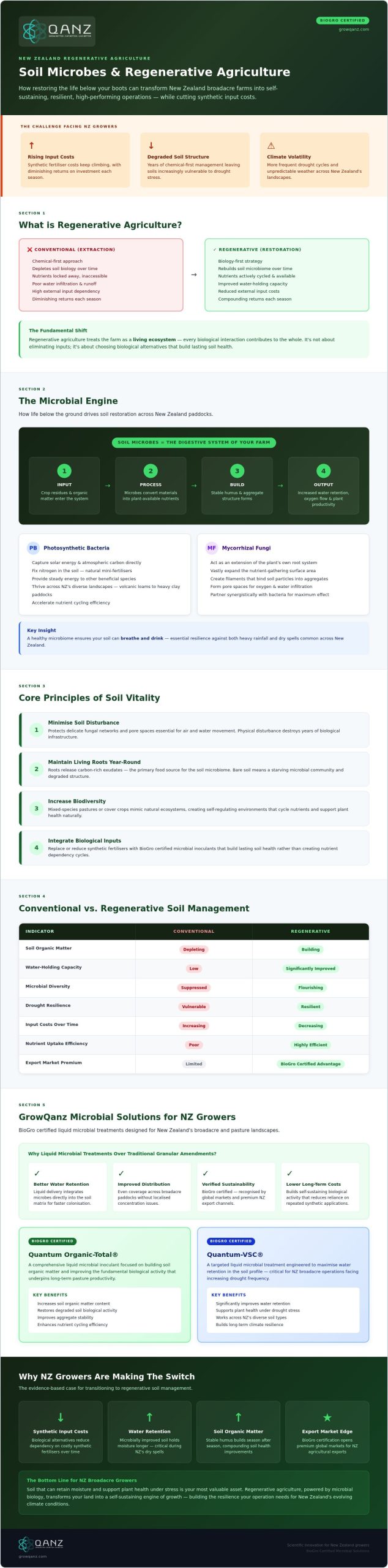
Regenerative agriculture represents a fundamental shift from extraction to restoration. It’s a management system designed to rebuild the natural resources we rely on rather than simply slowing their depletion. For New Zealand’s broadacre systems, this means moving beyond the chemical-first era that has dominated recent decades. Instead, a biology-first strategy places soil microbes in regenerative agriculture at the centre of farm management. This approach treats the farm as a living ecosystem where every biological interaction contributes to the whole.
The link between soil health and long-term profitability is undeniable. Healthy soil acts as a biological buffer, protecting your bottom line from external shocks. When soil structure is robust, water-holding capacity increases, and microbial diversity flourishes, plants become significantly more efficient at nutrient uptake. This natural efficiency isn’t just an environmental goal; it’s a financial necessity. Identifying key indicators like improved aggregate stability and a thriving microbial population allows growers to measure their progress toward a more resilient, high-performing farm.
The Core Principles of Soil Vitality
Restoring soil health requires a commitment to natural processes. Minimising soil disturbance is the first step, as it protects the delicate fungal networks and pore spaces essential for air and water movement. Maintaining living roots in the ground year-round is equally vital. These roots release carbon-rich exudates that serve as the primary food source for the soil microbiome. By increasing biodiversity through mixed-species pastures or cover crops, growers can mimic natural ecosystems, creating a self-regulating environment that naturally cycles nutrients and supports plant health.
Why New Zealand Growers are Making the Switch
The motivation for the regenerative transition is often practical and economic. Many growers face the rising costs of synthetic fertilisers alongside diminishing returns on their investment. Shifting to biological solutions allows for a reduction in expensive external inputs while maintaining productivity. Additionally, the global market increasingly rewards BioGro certified sustainability, offering a competitive edge for New Zealand exports. Most importantly, regenerative practices build resilience. In a climate where drought cycles and volatile weather are becoming more frequent, soil that can retain moisture and support plant health under stress is a grower’s most valuable asset.
The Microbial Engine: How Life Below Ground Drives Soil Restoration
Think of the soil as a living organism. Microbes function as the digestive system, processing raw organic materials into forms plants can actually use. Without this biological activity, nutrients remain locked away, inaccessible to the crop. This is why soil microbes in regenerative agriculture are often referred to as the engine of the system. They don’t just exist; they actively drive the restoration of degraded land by converting crop residues and organic matter into stable humus.
Beyond nutrient availability, these microorganisms are the architects of soil structure. As they process organic matter, they produce natural glues and filaments that bind soil particles together into aggregates. This process creates the pore spaces necessary for oxygen to reach roots and for water to infiltrate rather than run off. A healthy microbiome ensures your soil can breathe and drink, even during the heavy rainfall or dry spells common in New Zealand.
The Role of Photosynthetic Bacteria
Photosynthetic bacteria represent a unique and powerful component of this biological engine. Unlike most soil life that relies on existing carbon, these bacteria capture solar energy and atmospheric carbon directly. They function as mini-fertilisers, fixing nitrogen in the soil and providing a steady stream of energy to other beneficial species. Whether you’re working with volcanic loams or heavy clay-heavy paddocks, these strains thrive across New Zealand’s diverse landscapes. Their presence creates a synergy that accelerates nutrient cycling, allowing for a more efficient use of both natural and applied resources.
Synergy Between Fungi and Bacteria
The most productive soils rely on a partnership between different microbial groups. Mycorrhizal fungi act as an extension of the plant’s own root system, reaching deep into the soil profile to access minerals and water that would otherwise be out of reach. This exchange happens in the rhizosphere, a thin zone around the roots where plants trade surplus sugars for the vital nutrients provided by microbes.
It’s this complex interaction that makes beneficial soil microorganisms for plants the indispensable foundation of any regenerative plan. By reintroducing these specific strains, growers can jumpstart the biological processes that have been suppressed by years of intensive management. If you’re looking to enhance this natural synergy on your own farm, exploring specialised microbial inoculants can provide the catalyst needed for a successful transition.
Comparing Conventional vs. Regenerative Soil Management
Conventional management often relies on the immediate, short-term “hit” of synthetic nitrogen and phosphorus. While this provides a visible growth surge, it often ignores the long-term health of the soil asset. In contrast, soil microbes in regenerative agriculture focus on building a resilient biological foundation that pays dividends over time. It’s a common misconception that going regenerative means abandoning inputs altogether. Instead, it involves a strategic shift toward “different inputs”, moving away from harsh chemicals and toward BioGro certified microbial solutions that restore natural function.
An analysis of cost-efficiency over a five-year horizon reveals the true value of this shift for broadacre operations. While synthetic costs continue to fluctuate and soil quality often plateaus, biological systems become more self-sustaining as the soil’s natural cycles are restored. This Quantum Organic-Total cost-benefit analysis demonstrates how investing in microbial health provides a superior return by reducing the need for expensive corrective applications and improving overall crop resilience.
Breaking the Synthetic Cycle
Excessive nitrogen application can inadvertently make the natural microbial population “lazy”. When plants receive a direct flood of nutrients, they stop producing the carbon-rich exudates that feed soil life, leading to a steady decline in soil carbon levels. The repeated use of fungicides and fumigants further suppresses soil vitality, leaving the crop dependent on the next chemical application. To reduce chemical dependency without risking a yield collapse, growers can introduce targeted microbial inoculants. These support the plant during the transition phase, ensuring productivity remains stable while the biological engine restarts.
Water Retention and Drought Resilience
Regenerative soils act like a biological sponge. By increasing soil organic matter, growers can significantly improve their land’s water-holding capacity, which is vital for surviving the dry spells common in New Zealand’s eastern regions. This is largely driven by microbial glues, such as glomalin, which create stable soil aggregates. These structures prevent erosion and nutrient run-off during heavy downpours, keeping valuable topsoil in the paddock. Preparing for dry summers becomes a proactive process when you use biological soil enhancers that protect root zones and maintain moisture levels deep in the soil profile, even when surface conditions are harsh.
Practical Implementation: Integrating Microbial Inoculants
Transitioning your broadacre system starts with a clear plan. First, evaluate your soil’s current biological state. Next, select a concentrated liquid inoculant that targets your specific goals, such as nutrient cycling or drought resilience. Finally, apply the solution using your existing boom sprayer or fertigation system. This streamlined approach to soil microbes in regenerative agriculture ensures that you aren’t just adding products, but actively restoring the biological engine of your land. Choosing BioGro certified soil inoculants provides the necessary verification for growers targeting premium markets.
Timing is everything for microbial survival. In New Zealand, the best results come from applications made during the spring or autumn when soil moisture is consistent. Avoid applying during the heat of a summer afternoon or in freezing conditions, as extreme temperatures can stress the delicate bacteria before they have a chance to colonise the rhizosphere. Liquid microbial soil treatments offer a distinct advantage over traditional granular amendments because they provide immediate biological activity and can be applied with existing machinery, saving both time and labour costs.
Selecting the Right Microbial Solution
Restoring a broadacre system requires specific tools for different stages of the regenerative journey. Quantum Organic-Total® serves as a comprehensive soil health restorer, ideal for paddocks that have been under intensive chemical management. It works to re-establish the microbial engine and improve overall nutrient cycling. If your focus is on building resilience against the increasingly frequent drought cycles in New Zealand, Quantum-VSC® is the preferred option. Its proprietary strains are specifically chosen to support plants during periods of environmental stress, ensuring they remain productive even when moisture is scarce. Matching these strains to your specific crop needs, from vegetables to broadacre field crops, is essential for a successful transition.
Application Methods for Broadacre Farms
One of the biggest hurdles for regenerative transition is the perceived complexity of new inputs. However, liquid biologicals are remarkably easy to use. They can be integrated into your existing boom sprayers or fertigation setups without significant modification. To ensure the highest viability, apply the inoculant during low-light periods or just before rain to help the microbes move into the soil profile. After application, monitor your paddocks for changes in soil texture, increased root depth, and improved plant vigour. For those ready to begin their transition, you can explore our full range of field crop microbial solutions to find the best fit for your specific land.
The GrowQanz Approach: Scientific Innovation for NZ Growers
GrowQanz serves as a scientific partner for New Zealand’s agricultural transition. We lead the market in BioGro certified microbial technology, offering solutions that are 100% natural and verified for organic use. Our approach moves away from aggressive sales tactics. Instead, we provide a principled, evidence-based path to soil health. We support national growers with technical expertise to ensure their regenerative journey is both practical and profitable. This expertise is broad, demonstrating how professional turf biological products share the same high-performance biological foundations as our broadacre field crop solutions.
Quantum Organic-Total®: The Foundation of Vitality
This proprietary consortium is the primary tool for restoring life to depleted soils. It’s specifically designed to re-establish the microbial engine in paddocks that have undergone years of intensive chemical management or soil fumigation. By reintroducing a balanced population of soil microbes in regenerative agriculture, Organic-Total® jumpstarts the natural nutrient cycling processes. The result is a measurable increase in nutrient uptake and a visible shift in soil structure. As the microbes colonise the soil, they create the stable aggregates that define a healthy, high-functioning ecosystem.
Quantum-VSC®: Building Environmental Resilience
Environmental stress is a constant reality for New Zealand growers. Quantum-VSC® addresses this by focusing on robust root development and increased tolerance to climatic volatility. It contains specific strains that help seedlings establish faster and stronger, even when conditions are less than ideal. This is especially important for high-value crops where early vigour determines final yield potential. Integrating this with a broader biological strategy, such as knowing how to reduce transplant shock in seedlings, allows for a more comprehensive approach to crop protection. By choosing these verified biological tools, you’re investing in the long-term viability of your land.
Securing the Future of Your Soil Ecosystem
Restoring the biological engine of your farm is a strategic investment in long-term resilience. By prioritising soil microbes in regenerative agriculture, you shift from a model of extraction to one of active restoration. This transition improves soil structure and enhances water retention, ensuring your land remains productive through New Zealand’s increasingly volatile seasons. It’s a methodical approach that replaces the short-term surge of synthetics with a stable, self-sustaining cycle of natural growth.
We’re committed to helping you navigate this transition with scientific precision and grounded expertise. Our 100% natural microbial strains are designed to function within New Zealand’s unique landscapes, from broadacre fields to intensive pastures. With BioGro New Zealand certified products and expert technical support for NZ growers, you can build a more profitable and sustainable operation without sacrificing yield. The life beneath your feet is your most valuable asset, and it’s time to put it back to work. Explore the GrowQanz range of BioGro certified microbial solutions today and take the first step toward a resilient agricultural future.
Frequently Asked Questions
Is regenerative agriculture just another name for organic farming?
Regenerative agriculture is a management philosophy focused on restoring soil function and natural cycles. While organic farming is defined by strict input prohibitions, regenerative systems prioritise outcomes like soil carbon and biodiversity. Many New Zealand growers use BioGro certified microbial solutions to transition toward regenerative goals, regardless of their official organic status. It’s about shifting from a model of sustaining current levels to one that actively improves the land’s biological health.
How quickly can I expect to see results in my soil health after using microbial inoculants?
Biological activity begins immediately upon application, though visible changes in soil structure typically appear over a full growing season. You’ll likely observe improved seedling vigour and deeper root penetration within the first few months. Restoring soil microbes in regenerative agriculture is a cumulative process. Each application builds upon the last, gradually increasing soil organic matter and enhancing the natural nutrient cycling that drives long-term farm productivity and environmental resilience.
Can I use GrowQanz products alongside my existing fertiliser programme?
You can certainly integrate our microbial solutions into your current management plan. These products often enhance the efficiency of existing fertilisers by improving nutrient availability and uptake. As the soil’s biological engine restarts, many growers find they can gradually reduce their reliance on synthetic inputs without sacrificing yield. This transition allows for a more cost-effective approach where the soil begins to provide more of the necessary fertility through natural biological processes.
What is the difference between a biostimulant and a microbial inoculant?
Biostimulants generally refer to substances like seaweed or amino acids that trigger a physiological response in the plant. In contrast, a microbial inoculant like Quantum Organic-Total® introduces living consortia of beneficial bacteria and fungi directly into the soil. These organisms colonise the rhizosphere and perform active work, such as fixing nitrogen and breaking down organic matter. They provide a long-term biological solution rather than a temporary boost to plant metabolism.
Do I need special equipment to apply liquid microbial treatments?
Standard agricultural equipment is perfectly suitable for applying our liquid treatments. You don’t need specialised machinery; our solutions are compatible with existing boom sprayers, fertigation systems, and even handheld sprayers for smaller areas. This ease of application is a significant advantage when introducing soil microbes in regenerative agriculture. It allows for precise placement of the consortia directly onto the soil or foliage without the logistical challenges associated with bulk granular amendments.
Is Quantum Organic-Total® safe for use on all New Zealand crop types?
Quantum Organic-Total® is formulated to be safe and effective across all New Zealand agricultural sectors. It’s a 100% natural, BioGro certified solution used on everything from broadacre field crops and pastures to high-value fruit and nut orchards. Because it relies on proprietary microbial strains rather than harsh chemicals, there’s no risk of phytotoxicity or soil degradation. It provides a stable foundation for soil health restoration regardless of your specific crop or land use.
How does regenerative agriculture help with carbon sequestration on NZ farms?
Soil biology is the primary driver of carbon sequestration in pastoral and cropping systems. Microbes process plant-derived carbon and crop residues, converting them into stable forms of soil organic matter like humus. This biological transformation locks carbon deep in the soil profile for extended periods. By fostering a diverse and active microbiome, New Zealand farmers can effectively turn their paddocks into carbon sinks while simultaneously improving the soil’s fertility and water-holding capacity.
Will microbial treatments help my pasture survive a drought?
Targeted microbial treatments significantly improve a plant’s ability to withstand dry conditions. Products like Quantum-VSC® promote deeper root systems, allowing plants to access moisture from lower soil profiles during dry spells. Additionally, the microbial glues produced by these bacteria improve soil structure, creating a biological sponge that retains water more effectively. This increased resilience helps pastures stay green longer and recover faster once the rain returns, reducing the overall impact of seasonal drought.
Disclaimer
Important: This article provides general agricultural information only. Product performance can vary according to crop, soil, climate, management practices and application conditions. Trial or research results discussed may have been obtained under specific conditions and should not be interpreted as a guarantee of equivalent results. Always follow current product directions and confirm suitability for your crop, growing system and organic certification requirements. Contact QANZ for current product and application information.
