
What if the feared “yield cliff” during your BioGro conversion isn’t an inevitable consequence of going organic, but a symptom of a biological vacuum? For many New Zealand growers, the transition to organic farming NZ feels like a high-stakes gamble against their own bottom line. You’ve likely heard the warnings about plummeting production and the soaring costs of organic-compliant inputs as you step away from synthetic fertilisers. It’s a daunting prospect to manage pests and weeds while the very foundation of your productivity, the soil, appears to be in withdrawal.
We understand that long-term ecological health shouldn’t come at the expense of your immediate viability. This 2026 strategic framework provides a biological-first template designed to bridge the gap, ensuring your land is active enough to sustain high yields throughout the three-year window. By focusing on precise microbial inoculation, you can restore soil vitality and reduce reliance on expensive external inputs. We’ll provide a clear, evidence-based roadmap for BioGro certification that aligns with the National Organic Standard, turning a period of uncertainty into a period of structured, sustainable progress.
Key Takeaways
- Navigate the regulatory landscape of the transition to organic farming NZ, including the mandatory 36-month conversion period required for BioGro or AsureQuality certification.
- Identify why the “yield cliff” is a biological deficiency rather than a chemical one and how to prevent production drops by actively restoring soil microbiology.
- Compare the risks of a passive “stop-and-spray” approach against an active biological framework that uses certified inoculants to maintain commercial productivity.
- Follow a phased implementation roadmap that transitions your land from synthetic reliance to a self-sustaining system through baseline testing and strategic microbial support.
- Discover how BioGro certified solutions like Quantum Organic-Total® act as “transition fuel” to bridge the nutrient gap while your soil’s natural cycles are being restored.
Understanding the Transition to Organic Farming NZ: The 3-Year Gap
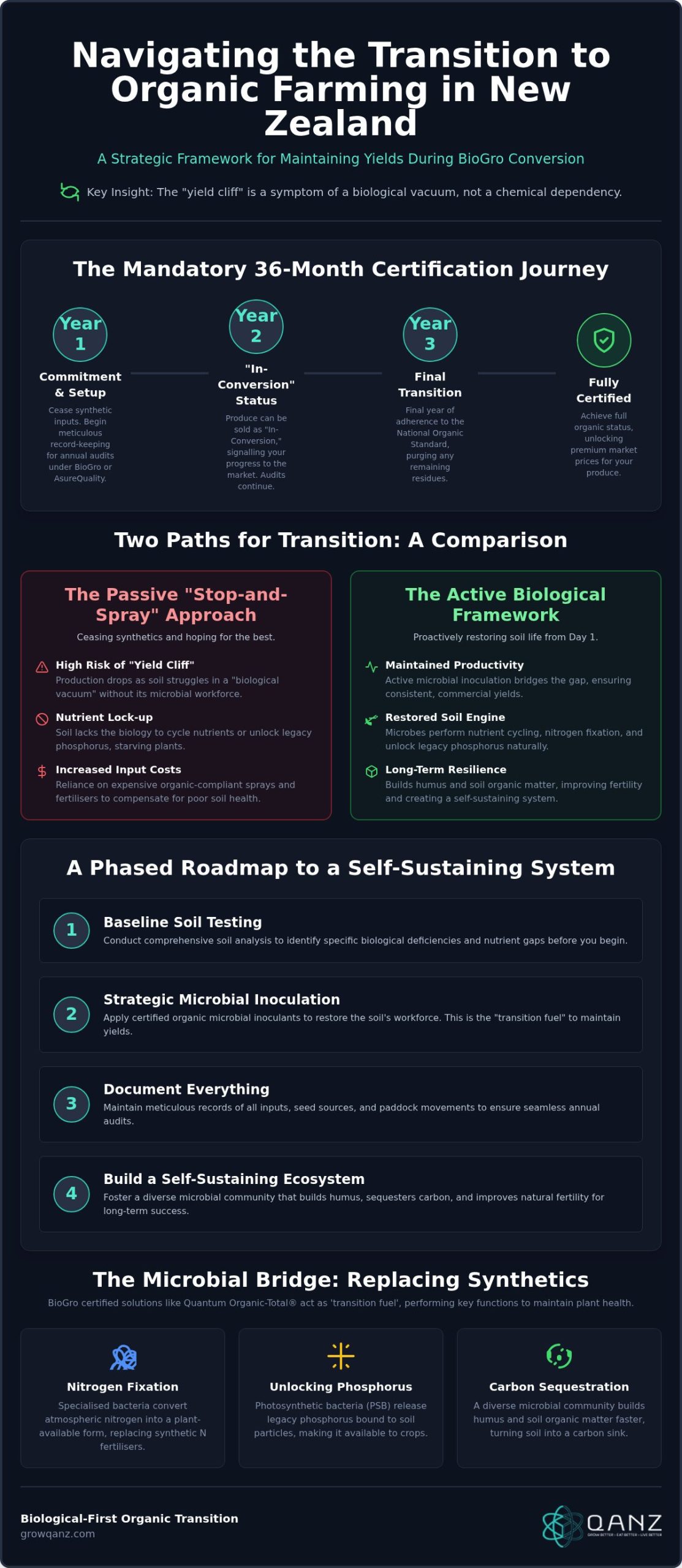
The path to full certification in New Zealand isn’t a simple switch; it’s a rigorous 36-month commitment to biological restoration. Under the Organic Products and Production Act 2023, every business making organic claims must be certified by a recognised body and hold MPI operator approval. This three-year window serves as a mandatory period for the land to purge synthetic residues and for the grower to prove their adherence to the National Organic Standard. While some see this timeframe as an economic hurdle, the 2026 market data suggests otherwise. With organic exports reaching a record $1.18 billion in 2024, the premiums for NZ fruit, dairy, and field crops continue to outpace conventional commodities. To capture this value, growers must first grasp what is organic farming in a modern, high-performance context. It’s not merely the absence of synthetic chemicals; it’s the active presence of a functioning soil ecosystem.
The Certification Journey in New Zealand
Choosing between BioGro and AsureQuality is the first strategic decision in your transition to organic farming NZ. Both organisations provide robust frameworks, though their specific audit processes may align differently with your existing paddock management. During the first two years, your produce is typically classified as “In-Conversion.” This status signals your commitment to the market but doesn’t yet command the full organic price premium. Success during this phase relies on meticulous record-keeping. You’ll need to document every input, seed source, and livestock movement to satisfy annual audits. This transparency ensures the integrity of your brand and protects New Zealand’s reputation for high-quality, verified organic exports.
The Biological Yield Gap
The “Yield Cliff” is a persistent myth that often scares growers away from conversion. In reality, a drop in production is usually a symptom of biological bankruptcy rather than a lack of chemistry. Conventional soils often struggle to pivot to organic systems because years of high-salt fertilisers and synthetic sprays have suppressed native soil microbiology. When these artificial supports are suddenly removed, the soil lacks the microbial workforce required to cycle nutrients or fix nitrogen naturally. Identifying this gap early is vital. Instead of a passive “stop-and-spray” approach, a successful transition requires active inoculation to replace the functions previously performed by synthetics. By restoring these microbial populations, you can maintain commercial yields with microbial solutions while the land achieves its full organic status.
Restoring Soil Biology: The Engine of a Successful Conversion
Successful conversion requires a proactive shift in focus. While industry bodies provide a Step-by-Step Guide to Organic Transition, the biological engine of your paddock is what ultimately determines your yield stability. Moving beyond the slow nutrient release of traditional compost, microbial inoculants for regenerative farming serve as the modern catalyst for a smooth transition to organic farming NZ. These specialised consortia act as a “Microbial Bridge,” actively performing the nutrient cycling and soil conditioning tasks previously managed by synthetic inputs. By inoculating the soil with high-density populations of beneficial life, you bypass the “biological vacuum” that often leads to production dips.
In many New Zealand landscapes, years of superphosphate application have left a significant reservoir of legacy phosphorus bound to soil particles. Photosynthetic bacteria (PSB) are the key to unlocking this trapped resource, converting it into plant-available forms without the need for fresh chemical applications. This biological approach also accelerates carbon sequestration. By fostering a diverse microbial community, you build humus and soil organic matter significantly faster than through traditional fallowing or cover cropping alone. This process turns your soil into a carbon sink while simultaneously improving its natural fertility.
Replacing Synthetics with Microbes
Transitioning away from NPK fertilisers requires a functional replacement that maintains plant health and vigour. Microbes provide this through several distinct pathways:
- Nitrogen Fixation: Bacteria such as Azotobacter pull “free” nitrogen from the atmosphere, providing a natural supply that doesn’t leach into our waterways.
- Nutrient Cycling: Specialised microorganisms break down complex organic matter into simple, plant-available minerals, ensuring a steady feed for your crops.
- Soil Architecture: Fungal hyphae and bacterial glues produce glomalin, a vital protein that binds soil particles to improve soil structure naturally by enhancing water infiltration and root penetration.
Restoring Land After Fumigation
For growers in high-value horticulture or viticulture, previous land use may have included aggressive treatments like methyl bromide fumigation. These practices often leave the soil biologically “dead,” lacking the diverse life required for organic success. Re-inoculating these environments is a critical step in the transition to organic farming NZ. Quantum-VSC® aids in root development and stress resilience by introducing a robust community of microbes that colonise the rhizosphere and protect young plants. If you’re managing broadacre paddocks, exploring microbial solutions for field crops can help you establish this biological foundation efficiently.
The Transition Template: Conventional vs. Biological Organic
The success of your transition to organic farming NZ depends largely on whether you choose a passive or an active strategy. A passive approach involves simply removing synthetic fertilisers and sprays, leaving the soil to recover on its own. While this satisfies the letter of the organic law, it often leads to a “biological vacuum” where crops struggle to find nutrients in soil that’s been conditioned to rely on chemical bypasses. In contrast, an active biological approach uses targeted inoculation to replace synthetic functions immediately. This strategy ensures that as you step away from urea and DAP, you’re simultaneously introducing the microbial workforce required to maintain productivity.
Input substitution is the cornerstone of this active template. Instead of relying on high-salt fertilisers that can suppress soil life, growers are increasingly adopting microbial solutions for field crops to provide the necessary nitrogen and phosphorus. This isn’t just a swap of products; it’s a shift in how nutrients are delivered. Biologicals work with the plant’s natural signalling systems, providing a steady, demand-driven supply of nutrition rather than the “flush and starve” cycle typical of conventional nitrogen applications. This stability reduces the risk of pest booms, as plants grown in biologically active soil often possess stronger cell walls and higher brix levels, making them less attractive to opportunistic insects.
Conventional vs. Active Organic Transition
Understanding the difference between these systems is vital for long-term risk management. Conventional systems typically feature high synthetic nitrogen inputs but low microbial diversity, leading to high water demand and fragile soil structure. A passive organic transition often results in zero synthetics and slow microbial recovery, creating a high risk of a yield crash during the middle years. However, an active biological organic system uses BioGro certified inoculants to achieve rapid microbial colonisation. This maintains yields by ensuring the “Microbial Bridge” we discussed earlier is fully operational from day one.
Managing the “Hungry Years”
Most New Zealand growers find that Year 2 is the most challenging period of the conversion. By this stage, residual synthetic fertility has been exhausted, but the soil’s natural nutrient-cycling capacity may not be fully restored. You can buffer this period by using liquid biologicals and foliar microbial applications. Foliar feeding bypasses a sluggish soil system, delivering nutrients and beneficial bacteria directly to the leaf surface during times of transition stress. For those concerned about managing threats without traditional chemistry, integrating biological crop protection solutions provides a natural defence strategy that aligns with BioGro requirements. This proactive management ensures your balance sheet remains healthy as you move toward full certification and the associated export premiums.
Step-by-Step Implementation for New Zealand Growers
Success in the transition to organic farming NZ relies on a disciplined, chronological execution of biological restoration. This 36-month timeline isn’t a passive waiting period; it’s an active management phase where the grower systematically replaces synthetic functions with natural ones. By dividing the conversion into three distinct phases, you can monitor soil health progress and adjust your nutrient strategies before production levels are impacted. This structured approach ensures that by the time you reach your final BioGro audit, your land is already performing as a high-functioning organic system.
Phase 1: Breaking the Chemical Dependency
The first 12 months are dedicated to baseline assessment and initial re-colonisation. You must conduct a comprehensive soil health audit that looks beyond standard NPK levels, focusing instead on microbial respiration and fungal-to-bacterial ratios. During this window, applying Quantum Organic-Total® serves as essential “transition fuel.” It stimulates dormant native biology and begins the process of nitrogen fixation and phosphorus solubilisation. If your soil pH or mineral balance is skewed, use only BioGro-approved amendments like high-quality lime or reactive phosphate rock to provide a stable foundation for the microbial consortium to thrive.
Phase 2 & 3: Scaling Biological Vitality
Months 12 to 24 focus on diversifying the ecosystem above and below the ground. Integrating multi-species cover crops provides various root exudates that support a wider range of microbial life, further reducing the need for synthetic buffers. We recommend using Quantum-VSC® during this phase to enhance root architecture. Conventional plants are often “lazy” due to years of spoon-fed soluble nutrients; specific microbes encourage these plants to develop deeper, more resilient root systems. As you enter the final 12 months, your focus shifts to full biological reliance. This is also the time to leverage your “In-Conversion” status, as many NZ exporters and local retailers now offer premiums for produce that has successfully completed two years of verified organic management.
The choice between liquid and granular applications is a vital tactical consideration in a transition paddock. Liquid biologicals offer immediate leaf and root zone uptake, providing the rapid response needed during the “hungry years” of Year 2. Granular organic amendments, while slower to break down, provide the long-term mineral stability required for permanent soil structure. Using both in tandem allows you to manage immediate crop needs while building the long-term humus reserves that define a successful organic enterprise. Understanding how to improve soil structure naturally through biological strategies is key to maximising the return on these combined inputs. To begin your journey with a science-backed roadmap, explore our BioGro certified microbial solutions designed for New Zealand conditions.
Quantum Organic-Total: Accelerating Your Organic Transition
Quantum Organic-Total® serves as the definitive “transition fuel” for those navigating the transition to organic farming NZ. While previous sections highlighted the biological risks of the three-year conversion period, this solution provides the specific microbial diversity required to mitigate them. It’s a shelf-stable, liquid consortium that includes photosynthetic, nitrogen-fixing, and carbon-cycling bacteria. These proprietary strains work in tandem to unlock legacy phosphorus and pull nitrogen from the atmosphere, effectively replacing the synthetic functions your soil has relied on for decades. This isn’t a temporary fix; it’s a method of re-establishing the natural metabolic pathways that define a resilient, high-yielding paddock.
Partnering with GrowQanz means gaining access to paddock-specific biological advice that respects the unique challenges of the New Zealand landscape. Our technical support team understands that a vineyard in Marlborough requires a different microbial strategy than a dairy farm in the Waikato. By focusing on the science of the “Total” consortium, we help you restore the rhizosphere’s ability to cycle nutrients efficiently. This active management approach ensures that your land remains productive and profitable as you move toward the 2028 mandatory certification deadlines.
BioGro Certified and NZ Proven
Maintaining compliance is the most critical aspect of your 36-month journey. Using Quantum Organic-Total® ensures your inputs meet the rigorous requirements of a BioGro audit, removing the guesswork from your documentation and record-keeping. Across New Zealand, from Northland dairy pastures to Canterbury vegetable blocks, growers have utilised this technology to maintain crop uniformity and pasture density without synthetic help. Our commitment to 100% natural and sustainable results means you’re investing in the long-term integrity of your land, not just a seasonal yield. We provide the evidence-based results that serious professional growers demand during a high-stakes conversion.
Getting Started with Your Transition
Integrating biologicals into your workflow doesn’t require a complete overhaul of your machinery. Our liquid solutions are designed to fit into existing NZ spray equipment and irrigation infrastructure, including centre pivots and fertigation systems. When you order your first microbial treatment, you’re gaining more than a product; you’re gaining a professional partner with deep local expertise. By combining these inoculants with traditional organic practices like multi-species cover cropping, you maximise your return on investment and shorten the time it takes for your soil to reach peak biological efficiency. To understand the investment required for your specific acreage, Enquire about Quantum Organic-Total pricing for your NZ farm today and secure your path to full certification.
Building a Resilient Legacy for New Zealand Agriculture
The journey toward full certification is a commitment to the long-term integrity of your land. We’ve explored how navigating the transition to organic farming NZ requires a shift from passive chemical withdrawal to active biological restoration. By implementing a structured three-year framework, you can bridge the nutrient gap and maintain commercial productivity while your soil achieves its natural balance. The engine of this success is a functional microbial community that cycles nutrients and builds humus without the need for synthetic intervention.
As you prepare for the 2028 compliance deadlines, remember that you don’t have to manage this technical shift alone. Our BioGro NZ Certified, 100% natural microbial technology is designed specifically for the unique demands of our local environment. We’ve seen proven results in NZ soil conditions across diverse sectors, from broadacre crops to dairy pastures. By prioritising soil vitality today, you’re securing a more profitable and sustainable legacy for the generations that follow.
Secure your BioGro certified microbial solutions from GrowQanz
Frequently Asked Questions
How long does the transition to organic farming take in New Zealand?
The standard transition to organic farming NZ takes 36 months to achieve full certification. During this three-year period, your land must be managed according to the National Organic Standard to ensure all synthetic residues are purged and biological cycles are restored. You’ll typically hold “In-Conversion” status during the first two years, which allows you to begin the auditing process with recognised bodies like BioGro or AsureQuality.
Can I use Quantum Organic-Total while my farm is still “In-Conversion”?
Yes, you can use Quantum Organic-Total® throughout your “In-Conversion” period because it’s BioGro NZ certified. It’s actually most effective when applied during the early stages of transition to provide the “transition fuel” your soil needs to replace synthetic nitrogen and phosphorus. Using certified inputs ensures you don’t accidentally compromise your audit trail while you’re working toward full organic status and market access.
Will my yields definitely drop during the three-year organic transition?
A yield drop isn’t an inevitable part of the transition if you actively replace synthetic inputs with biological ones. The “yield cliff” many growers fear is usually caused by a biological vacuum where the soil lacks the microbes to cycle nutrients naturally. By using specific inoculants to restore these populations, you can maintain commercial productivity while your land shifts away from its previous chemical dependency.
What are the main costs associated with transitioning to organic farming in NZ?
The primary costs include annual certification fees, mandatory MPI audits, and the shift from synthetic fertilisers to biological inputs. Certification costs generally range from $1,000 to over $5,000 per year depending on the size of your operation and the complexity of your export requirements. You should also account for the administrative time required for the detailed record-keeping of all paddock inputs and seed sources.
Do I need special equipment to apply microbial soil inoculants?
No special equipment is required to apply our microbial solutions as they’re designed to fit existing New Zealand spray and irrigation infrastructure. You can apply these liquid consortia through standard boom sprayers, centre pivots, or fertigation systems without modification. Because the microbes are shelf-stable and highly concentrated, they integrate easily into your current seasonal management programmes without requiring capital expenditure on new machinery.
Can I transition just one paddock at a time to organic?
You can transition just one paddock or a specific block at a time through a process known as partial conversion or split-unit management. This is a practical way for larger operations to manage the transition to organic farming NZ without moving the entire farm at once. You’ll need to maintain clear boundaries and rigorous separation of equipment and harvest records to satisfy your certifier’s audit requirements.
Is BioGro certification the only option for New Zealand organic farmers?
BioGro is the largest certifier, but it isn’t your only option for achieving organic status in New Zealand. Growers can also choose AsureQuality, Demeter for biodynamic standards, OrganicFarmNZ for the domestic market, or Hua Parakore for indigenous Māori standards. Each certifier has slightly different fee structures and audit processes, so it’s worth assessing which framework best aligns with your target export markets and existing management style.
How do I manage weeds during the transition without synthetic herbicides?
Managing weeds without synthetic herbicides involves a combination of mechanical cultivation, diverse cover cropping, and improving soil biological health. When your soil is biologically active and balanced, the competitive pressure from your crops often naturally reduces weed dominance. Strategic use of multi-species cover crops also helps to shade out opportunistic weeds while simultaneously feeding the microbial communities you’re trying to establish during the conversion years.
Disclaimer
Important: This article provides general agricultural information only. Product performance can vary according to crop, soil, climate, management practices and application conditions. Trial or research results discussed may have been obtained under specific conditions and should not be interpreted as a guarantee of equivalent results. Always follow current product directions and confirm suitability for your crop, growing system and organic certification requirements. Contact QANZ for current product and application information.
