
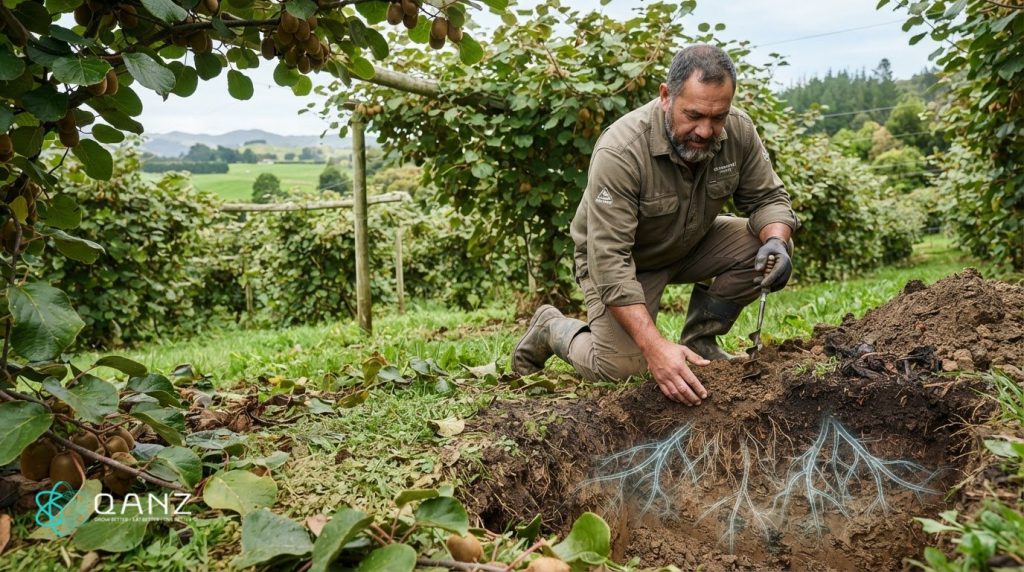
Better yields start with identifying what is holding a crop back, not automatically adding another input. Soil structure, nutrient availability, water, weather and crop management can all affect the harvest. A microbial input may be worth considering as part of a crop and soil programme, but it should not be assumed to address every constraint or deliver a particular result.
To make a practical decision, define the crop outcome you want to assess, review field observations and records, then compare options against the suspected constraint. This article explains how to do that, how to measure changes consistently, and how to distinguish general research on soil biology from evidence for a specific product.
For New Zealand growers, crop, season and growing system all matter. Before considering a microbial input, review the conditions in the paddock and the current product guidance. Quantum Organic-Total® is a microbial agricultural input offered by GrowQanz for use in crop and soil programmes. Its suitability should be considered in the context of the crop, growing system and intended use, without assuming a particular outcome.
Key Takeaways
- Define yield in terms of the crop’s saleable harvest, using consistent units such as output per hectare.
- Assess soil organic matter, moisture, pH, compaction and crop establishment together, and interpret observations in the context of each paddock.
- Compare yield strategies by the constraint they address, the evidence available and their fit with the crop programme.
- Record baseline conditions, treatments, dates, inputs and measurements so field comparisons are easier to interpret.
- Assess Quantum Organic-Total® as a microbial input for crop and soil programmes, without assuming it will produce a particular result.
What does working towards better yields mean for field-crop growers?
Working towards better yields means identifying what may limit crop performance before choosing a response. First define the result you want to assess in terms of the crop and market, then compare it with what is harvested. Keep yield potential, harvested yield and crop quality separate: they describe different aspects of performance and are not interchangeable.
A yield constraint is a factor that limits crop performance under specific conditions. It may relate to establishment, soil conditions, water availability, nutrition or another part of the production system. The same factor will not necessarily constrain every paddock or season, so interpret observations alongside the crop and the conditions in which it grew.
Yield potential describes what a crop could produce under a defined set of conditions; it does not predict the harvest. Harvested yield is the amount collected, often recorded as tonnes per hectare for crops sold by weight. Saleable yield may be lower if some produce does not meet market requirements. Keeping these measures distinct helps prevent a larger total harvest being mistaken for a larger marketable crop.
Which yield measure should a grower track?
Choose a measure that reflects the crop and how it is sold. For a crop marketed by weight, record harvested weight per hectare. If the market grades produce by size or quality, record those results separately and show how they relate to the saleable harvest. A single yield figure may not capture these differences.
Set the measurement method before collecting results. Define the measured area, harvest approach, weighing method and calculation. Record exclusions, such as unharvested sections, and do not compare a measured plot with a whole-paddock estimate as though they were equivalent. When assessing a biological input, distinguish general research about microbial agricultural inputs from evidence for the specific product and formulation.
Why does one season not tell the whole story?
Seasonal conditions can influence crop growth and harvest outcomes. Weather, planting date, crop establishment and harvest timing may vary between years, while paddocks can differ in soil and management history. These factors make simple year-to-year comparisons difficult. A higher yield after a management change is an observation, but it does not by itself show that the change caused the difference.
Build a consistent record over time. Note the crop, paddock or measured area, planting and harvest dates, relevant conditions, management changes and yield calculation method. Keep quality results alongside harvested yield rather than combining them. Records can help reveal patterns and inform future decisions, while a past result may not recur under different conditions.
Which soil and crop factors can constrain better yields?
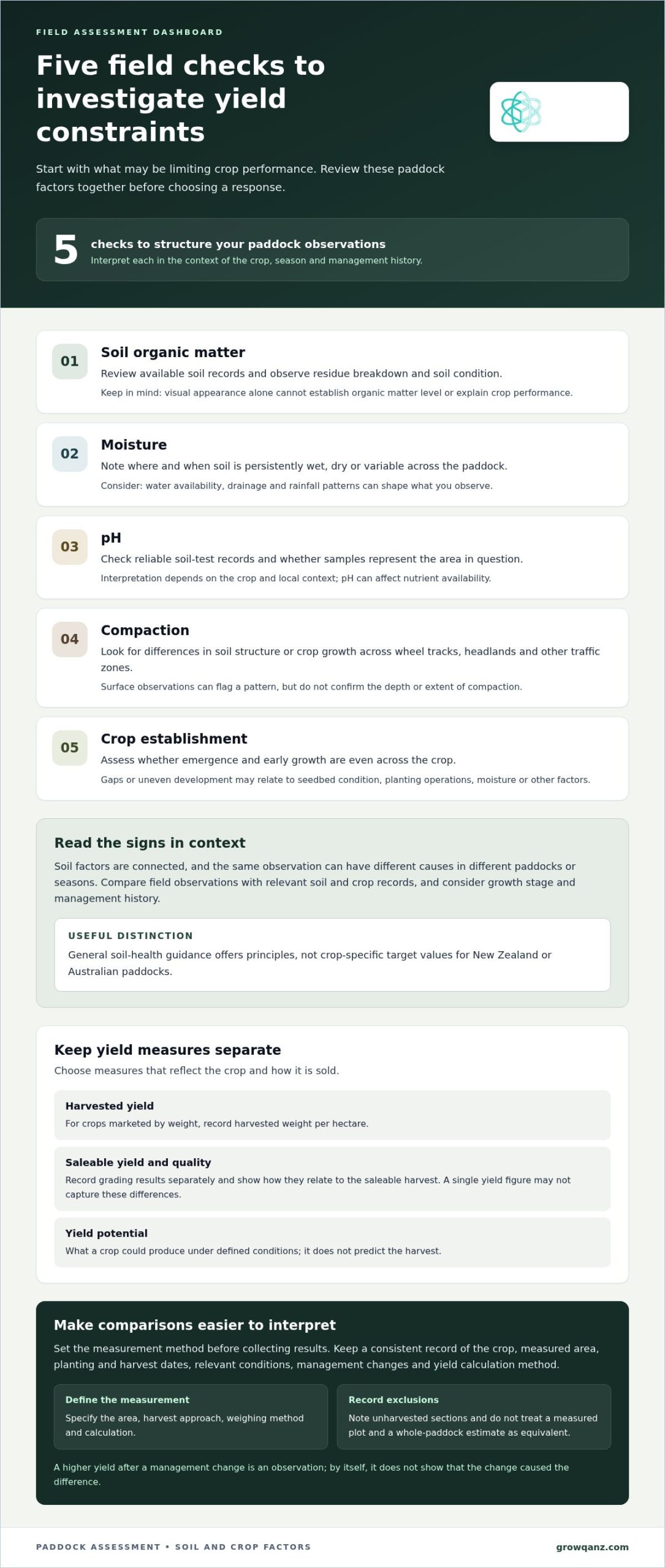
Better yields begin with a practical paddock assessment, not a single soil measure or a product assumption. Review soil organic matter, moisture, pH, compaction and crop establishment, then consider how those factors interact with crop growth stage and management history. These checks can help identify what warrants closer investigation, but they are not a substitute for crop-specific assessment.
Use this checklist to structure field observations:
- Soil organic matter: Review available soil records and observe residue breakdown and soil condition. Organic matter is part of the soil environment, but visual appearance alone cannot establish its level or explain crop performance.
- Moisture: Note where and when soil is persistently wet, dry or variable across the paddock. Water availability can influence crop growth, while drainage and rainfall patterns affect what you observe.
- pH: Check reliable soil-test records and whether samples represent the area in question. Soil pH can affect nutrient availability, but interpretation depends on the crop and local context.
- Compaction: Look for differences in soil structure or crop growth across wheel tracks, headlands and other traffic zones. Surface observations can flag a pattern, but do not confirm the depth or extent of compaction.
- Crop establishment: Assess whether emergence and early growth are even across the crop. Gaps or uneven development may relate to seedbed condition, planting operations, moisture or other factors.
How can soil conditions limit crop performance?
Soil factors are connected. For example, soil structure can affect how water moves through and is retained in the soil, while pH influences the context in which nutrients are available. The USDA Natural Resources Conservation Service’s soil health guidance also treats soil properties as interacting parts of a functioning system. It offers general principles, not crop-specific target values for New Zealand or Australian paddocks.
Interpret a soil observation alongside crop and seasonal records, because the same sign can have different causes in different paddocks or seasons. If patchy growth, poor drainage or uneven establishment persists, compare field observations with relevant soil and crop records. GrowQanz supplies biological products, not laboratory soil-testing services.
How do crop and seasonal conditions affect the assessment?
Add planting timing, establishment, crop rotation and management history to the diagnostic picture. Note previous crops, cultivation and traffic patterns, as well as the dates of planting and key operations. For example, when assessing weak areas in a vegetable crop, consider seedbed and establishment history rather than judging the area by yield alone.
Seasonal context matters across New Zealand and Australia. Rainfall, temperature and timing vary by country, location and season, so a recommendation or comparison from one setting may not transfer directly to another. Record observations by paddock and, where relevant, by hectare. For practical context on crop programmes, explore GrowQanz’s crop and soil programme information.
How should growers assess microbial inputs against other yield strategies?
Assess each option against the constraint you are trying to address. Consider the evidence, fit with the crop and existing programme, and how you will measure the outcome. Microbial inputs are one consideration within crop management, not a guaranteed yield solution. A clear comparison helps distinguish an option that addresses the paddock’s actual issue from a claim that does not.
Start by stating the management question. If the concern is uneven establishment, for example, compare options relevant to establishment rather than assuming a microbial product will resolve it. If the suspected constraint is soil structure or moisture, identify management considerations that directly relate to that issue. Keep the assessment grounded in the crop, location and conditions.
| Option | Intended management question | Evidence needed | Measurement approach |
|---|---|---|---|
| Soil or crop management change | Does this change address the suspected constraint? | Relevant agronomic guidance and records for the crop and paddock | Compare consistent crop and soil observations before and after |
| Microbial input | Is this formulation suitable for the crop programme and question being tested? | Evidence identifying the exact formulation, crop, location, treatment and conditions | Measure the pre-defined crop outcome in comparable areas |
| Establishment or timing adjustment | Could planting conditions or operation timing be contributing to the issue? | Crop records and evidence relevant to the production system | Record establishment, timing and subsequent crop performance consistently |
What evidence is relevant to a microbial input?
Evidence may include general research on soil microorganisms, independent trials, manufacturer trials, overseas trials or commercial grower observations. These sources answer different questions. General research can help explain microbial processes, but it does not establish that a particular product will perform in a specific crop or paddock in New Zealand or Australia. A grower observation can inform a local decision, but it is not the same as a controlled comparison.
Before interpreting product evidence, identify the exact formulation, crop, location, treatment and growing conditions. Findings for one Quantum formulation must not be treated as evidence for another. In particular, evidence involving a different formulation does not establish the performance of Quantum Organic-Total®.
How can a grower compare options fairly?
Write down the question and baseline before changing the crop programme. Where practical, compare similar areas and document differences in soil, crop history, timing, inputs and management. Choose a measure that matches the question, such as establishment or saleable harvest, and use the same method across comparison areas.
If several practices change at once, it becomes difficult to identify what contributed to an observed difference. Pursue better yields by linking choices to a diagnosed constraint and measuring consistently. Growers considering field-crop options can explore QANZ field-crop programmes as part of their wider assessment.
How can growers plan and measure a field-level yield improvement trial?
A useful field comparison begins with a clear question and a fair method, then follows a consistent measurement plan through to harvest. Record what was done and where, including the crop, paddock conditions, dates, inputs and management changes. The purpose is to learn from the result, not to treat one season’s observation as proof of repeatable performance.
- Define the question. State the suspected constraint and the change you want to assess. For example, ask whether a specific management change is associated with more even crop establishment in a defined part of a paddock. Keep the question narrow enough to measure.
- Record the baseline. Before changing the programme, note the crop and variety where relevant, measured area, planting date, crop history, paddock conditions and seasonal context. Choose yield and quality measures in advance, such as harvested weight per hectare and the proportion meeting the intended grade.
- Document the treatment. Record the exact input or management change, where and when it was applied, and how the area was managed. For a product, use the precise formulation name and follow its current technical instructions. Do not infer or add rates or specifications that are not documented.
- Measure consistently. Use the same area boundaries, harvest approach, weighing method and quality criteria for each comparison. Record unexpected events and deviations as they occur, rather than relying on memory at harvest.
What should a grower record before changing a programme?
Make the record useful to someone who was not present. Include the crop, paddock or plot location, area, planting and harvest dates, previous crop and relevant management history. Note conditions that may affect interpretation, such as uneven establishment or differences across the field. A simple map can help identify treatment boundaries and ensure you measure the same areas later.
Field variability matters. Where practical, compare nearby areas with similar soil, slope and crop history, and avoid selecting only the strongest-looking rows for measurement. If space and operations allow, repeat the comparison in more than one part of the paddock to see whether a pattern extends beyond a single patch. Keep all measurements, including results that do not support the expected outcome.
How should results be interpreted and reported?
Report the exact crop, formulation, location, treatment, measurement method and conditions. Identify whether the evidence comes from a New Zealand or overseas trial, an independent study, a manufacturer trial or a grower observation. State limitations, including field variability and changes made during the season. A difference is an observed result; further consistent evidence is needed before calling it repeatable. Neither one observation nor a past result guarantees future performance.
Results from individual trials or commercial observations are specific to the formulation, crop, location, treatment and conditions tested and should not be interpreted as a guarantee of equivalent performance elsewhere.
Planning a comparison involving a biological input? Talk to QANZ about its fit with your crop, growing system and application programme.
Where can Quantum Organic-Total® fit in a crop and soil programme?
QANZ supplies Quantum agricultural biological products to growers in New Zealand and Australia. Quantum Organic-Total® is a microbial agricultural input offered by QANZ for use in crop and soil programmes. Growers can consider it alongside other management decisions after identifying a relevant question or constraint. It should not be treated as a guaranteed route to better yields or as a substitute for assessing crop and paddock conditions.
Fit depends on the crop, growing system, management question and existing programme. A grower considering a field-crop application, for example, can assess how the input fits the wider crop plan and define what to measure. The Quantum Organic-Total® product information and field-crop programme information provide useful starting points. Review current QANZ technical documentation for product suitability and application guidance before planning use.
What should growers consider before including the product?
Begin with the management question, not the product. Consider whether the issue relates to soil conditions, crop establishment or another part of the programme, and whether a microbial input is relevant to that question. Then review current product information alongside existing practices, timing and other planned changes. Considering the wider programme makes it easier to assess practical fit and interpret observations without attributing every change to one input.
For certified production, check whether the input and intended use meet the requirements of your own certification programme. Review current BioGro documentation alongside QANZ information where relevant. Certification requirements apply to the grower’s programme and intended use; using an input does not, by itself, make a farm or its produce organic. Product suitability, rates and certification requirements should be checked against current QANZ technical and BioGro documentation.
What is a practical next step for New Zealand and Australian growers?
Bring the details that shape the decision: country, crop, growing system, management question, relevant paddock conditions and current programme. This gives the discussion a practical basis and helps keep guidance specific. New Zealand and Australian seasons, certification arrangements and agronomic conditions can differ, so advice for one country should not be assumed to apply unchanged in the other.
Better yields come from measured decisions, not assumed product outcomes. If you are weighing up whether Quantum Organic-Total® belongs in your programme, discuss whether Quantum Organic-Total® suits your crop programme with QANZ, including the intended use and how you plan to assess it.
Make your next crop decision measurable
Turn a field question into a decision you can learn from. Before changing your programme, decide what would make an input worth retaining: a clear fit with the crop, relevant product guidance and an outcome you can measure consistently. This keeps the focus on evidence from your conditions rather than expectations of a particular result.
Growers considering a microbial option can assess Quantum Organic-Total® as part of a crop and soil programme, using current technical documentation to inform suitability and application. Better yields remain an aim, not a promised outcome, and every growing season brings its own conditions. A careful, recorded assessment can help inform future programme decisions.
Share your crop, growing system and management question with QANZ to discuss a practical next step. Start a conversation about Quantum Organic-Total® and your crop programme, and use consistent field measurements to inform your decisions.
Frequently Asked Questions
Can better yields be achieved without changing fertiliser use?
Potentially, but decisions should follow diagnosis rather than assumption. Review the full crop programme, including establishment, soil conditions, water management, nutrition and harvest practices, to identify likely constraints. Do not treat a biological input as a fertiliser replacement or assume that reducing fertiliser will lift production. Base nutrient decisions on credible evidence for the crop and location.
How many seasons of yield records should growers compare?
There is no universal number of seasons that suits every crop or management question. Keep consistent records across available seasons, noting crop, paddock, timing, seasonal conditions and programme changes so comparisons have context. For perennial crops, crop age and previous management may also affect interpretation; for annual crops, rotation and establishment history matter. Records across seasons can show whether an observation recurs, but no fixed period alone proves product performance.
Can results from an overseas crop trial be applied to New Zealand or Australia?
Not without qualification. An overseas finding applies to the formulation, crop, location, treatment and conditions studied, so it should not be assumed to predict results in New Zealand or Australia. Check whether the evidence is independent research, a manufacturer trial or a grower observation, and identify the formulation used. Results from individual trials or commercial observations are specific to the formulation, crop, location, treatment and conditions tested and should not be interpreted as a guarantee of equivalent performance elsewhere.
Does using a microbial input make a crop or farm organic?
No. Applying a microbial input does not by itself make a crop, farm or produce organic. Certification depends on the requirements of the grower’s own programme and the input’s intended use, so review current programme rules and supporting product documentation before use. Do not infer certification suitability from a product name or a general claim about biological inputs. Keep certification decisions separate from agronomic questions about crop performance.
What information should growers provide when discussing a crop programme with QANZ?
Share your country, crop, growing system and the management question you want to resolve. Include relevant crop and paddock history, recent programme changes, and any measurements or observations that prompted the enquiry. If discussing Quantum Organic-Total®, identify the intended use and refer to current QANZ technical information. This context helps frame a discussion of product suitability and programme information without assuming a particular rate, recommendation or result.
Can a yield change in one paddock be attributed to a single input?
Not from one observation alone. A yield difference may coincide with a treatment while rainfall, soil variability, establishment or another management change also differs. Record those factors and compare clearly defined areas using consistent harvest and quality measures. Treat the result as a field observation, not proof of cause. Consistent findings across relevant conditions can strengthen interpretation, but they still do not guarantee future performance.
Disclaimer
Important: This article provides general agricultural information only. Product performance can vary according to crop, soil, climate, management practices and application conditions. Trial or research results discussed may have been obtained under specific conditions and should not be interpreted as a guarantee of equivalent results. Always follow current product directions and confirm suitability for your crop, growing system and organic certification requirements. Contact QANZ for current product and application information.
