

What if the reason your paddocks aren’t performing isn’t a lack of minerals, but a lack of biological keys to unlock them? Many New Zealand farmers are currently facing the frustration of rising synthetic fertiliser costs while seeing a lower yield response and persistent soil compaction. It’s a common struggle to balance the 190 kg/ha nitrogen cap with the need for high dry matter production. You likely agree that pouring more granules onto the land shouldn’t be the only way to sustain your stocking rates. This guide will show you how to fill the nutrients gap and grow more grass and get your soils working by leveraging advanced microbial technology. We’ll explore how BioGro certified solutions like Quantum Organic-Total® restore the natural nutrient cycle, ensuring your pasture is as nutrient-dense as it is plentiful. By shifting focus from chemistry to biology, you can transform your soil from a stagnant medium into a high-performing asset that supports healthier livestock and more resilient farm systems.
Key Takeaways
- Identify the crucial difference between total soil nutrient levels and what is actually available for plant uptake to address stagnant pasture growth.
- Discover how to fill the nutrients gap and grow more grass and get your soils working by restoring the soil’s biological engine through targeted microbial inoculation.
- Enhance your farm’s Nutrient Use Efficiency (NUE) to maintain high dry matter production while remaining compliant with New Zealand’s 190 kg/ha nitrogen cap.
- Move beyond short-term synthetic growth spikes toward long-term soil health that improves water infiltration and reduces paddock compaction.
- Learn how BioGro certified solutions like Quantum Organic-Total® provide a scientifically verified pathway to healthier, more nutrient-dense pastures.
Understanding the Nutrient Gap in New Zealand Pastures
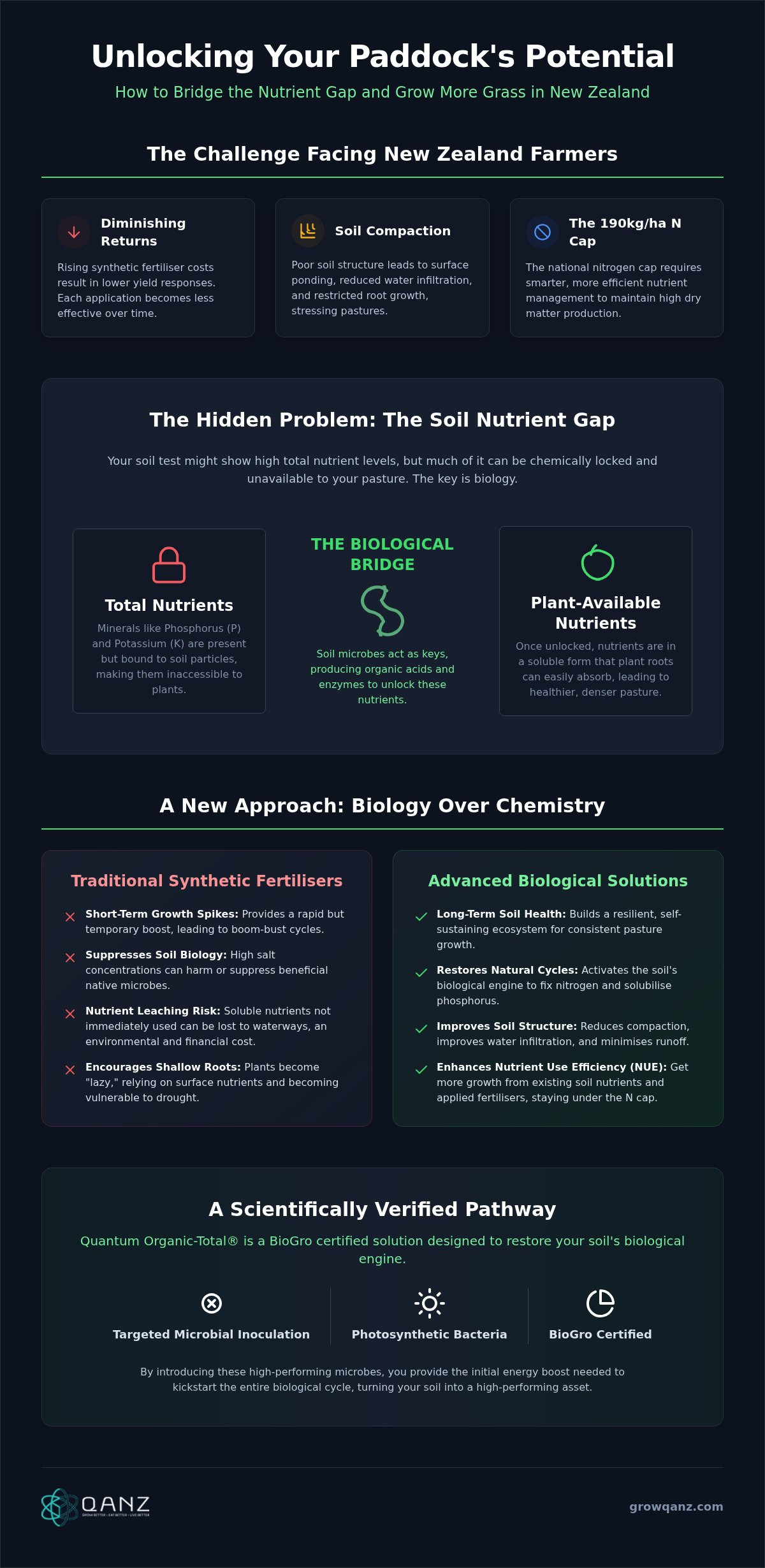
Many New Zealand farmers find themselves on a treadmill of increasing fertiliser inputs for diminishing returns. Despite regular applications of NPK, pasture growth often plateaus, leaving paddocks looking lacklustre. This phenomenon occurs because there is a fundamental difference between nutrient presence and plant availability. Your soil might be rich in phosphorus or potassium on paper, but without a functional biological bridge, those minerals remain chemically locked and inaccessible to the plant. Understanding Soil Health involves recognising that the soil is a living system, not just a chemical reservoir. When we rely solely on soluble synthetics, we often create lazy soil where plants develop shallow root systems, making them vulnerable to New Zealand’s increasingly variable climate and prone to nutrient leaching during heavy rainfall.
Symptoms of a Biological Nutrient Gap
Identifying a biological gap requires looking beyond the volume of feed. You might notice pale or stunted grass even when the soil is moist. Another tell-tale sign is the slow breakdown of manure or surface ponding, which indicates poor soil structure and a lack of microbial activity. Livestock performance often suffers too; animals may show signs of hidden hunger, where they have a full belly of grass but lack the essential trace elements required for optimal health and production. Learning how to fill the nutrients gap and grow more grass and get your soils working starts with observing these subtle environmental cues in your own paddocks.
Why Synthetic Fertilisers Can’t Fill the Gap Alone
Synthetic fertilisers provide a rapid growth spike, but they don’t address the underlying health of the land. Over-reliance on chemical nitrogen often leads to the law of diminishing returns, where each subsequent tonne of urea yields less dry matter than the last. High concentrations of synthetic salts can also suppress native soil microbiology, effectively switching off the natural nitrogen-fixing bacteria and mycorrhizal fungi that should be doing the work for you. Beyond the farm gate, excess soluble nutrients that aren’t captured by the soil biology end up as runoff in our local waterways. This environmental cost, combined with the 190 kg/ha nitrogen cap, makes it clear that we need a more sophisticated approach to how to fill the nutrients gap and grow more grass and get your soils working.
How Microbes Unlock Nutrients and Get Your Soils Working
The soil beneath your boots isn’t just a medium for holding plants; it’s a complex biological engine. At the heart of this system is the rhizosphere, the narrow region of soil directly surrounding plant roots. This area serves as a bustling marketplace where plants and microbes engage in a sophisticated exchange. Plants provide carbon-rich sugars, known as root exudates, and in return, microorganisms provide the essential minerals the plant cannot access on its own. This symbiotic relationship is the foundation for how to fill the nutrients gap and grow more grass and get your soils working effectively. Without these microbial partners, even the most expensive fertiliser applications remain largely inaccessible to the pasture.
One of the most critical roles of soil bacteria is the conversion of atmospheric nitrogen into plant-usable forms. While the air is 78% nitrogen, plants can’t “breathe” it in. Specific bacteria specialise in fixing this nitrogen, delivering it directly to the root zone. Similarly, many New Zealand soils have high levels of “locked” phosphorus. This phosphorus is physically present but chemically bound to minerals like iron or aluminium, making it useless to the grass. Microbial secretions, specifically organic acids, work to solubilise these bonds, releasing the phosphorus into the soil solution where the plant can finally take it up. This biological unlocking is a far more efficient way to manage nutrient density than simply adding more synthetic NPK.
The Power of Photosynthetic Bacteria
Photosynthetic bacteria are unique because they can harness energy from sunlight and carbon dioxide, acting as primary producers within the soil profile. These microbes drive energy into the system, accelerating carbon sequestration and building soil organic matter. Because they don’t rely solely on existing organic matter for energy, they act as the “first responders” for soil restoration. By introducing these strains, you provide the initial energy boost needed to kickstart the entire biological cycle. This process is essential for anyone looking at how to fill the nutrients gap and grow more grass and get your soils working after years of heavy chemical use.
Breaking the Cycle of Soil Compaction
Soil compaction and paddock pugging are often symptoms of a biological deficiency. When soil biology is thriving, microbes produce a sticky protein called glomalin. This substance acts as a biological glue, binding tiny soil particles into stable aggregates. These aggregates create a crumb-like structure that allows oxygen and water to move freely through the soil. Improved soil porosity means that roots can penetrate deeper, accessing moisture during dry spells and reducing surface ponding during New Zealand’s wet winters. Building this structural integrity is the key to getting your soils working as a self-sustaining system.
Comparing Biological Inoculants to Traditional Fertilisers
Traditional fertilisers often act as a temporary stimulant for the soil, providing a rapid flush of green growth that can be deceptive. While urea or DAP delivers an immediate nitrogen or phosphorus hit, this growth frequently lacks the mineral complexity required for high-performing livestock. Biological inoculants take a different approach by focusing on the long-term vitality of the land. By restoring the soil’s ability to cycle nutrients naturally, you reduce the need for constant bulk inputs. Liquid application methods offer a distinct advantage in this regard, providing uniform coverage across the paddock that granular products, which often result in “hot spots” and “dead zones,” simply cannot match.
Managing the transition from a purely chemical regime to a biological one doesn’t require an all-or-nothing choice. Many New Zealand farmers successfully integrate biologicals with reduced rates of traditional fertilisers. This hybrid approach allows the microbes to “buffer” the synthetic salts, protecting the soil life while ensuring the plant still receives necessary support during the transition phase. It’s a strategic way to manage how to fill the nutrients gap and grow more grass and get your soils working while staying within regulatory nitrogen caps.
Long-Term Soil Structure vs. Short-Term Spikes
Lush, nitrogen-forced grass is often high in nitrates but low in essential trace elements, which can lead to metabolic issues in grazing animals. Utilising microbial solutions for field crops helps in building stable humus and sequestering carbon within the soil profile. As biological activity increases, the microbes naturally decompact the earth, creating a porous structure that significantly reduces the requirement for costly mechanical aeration. This shift ensures that the “green” you see in the paddock is a reflection of genuine plant health rather than a temporary chemical reaction.
Efficiency and Leaching Prevention
With the 190 kg/ha nitrogen cap now firmly in place for pastoral land, every kilogram of input must be utilised effectively. Synthetic fertilisers are notoriously prone to leaching into groundwater or gassing off into the atmosphere when the soil biology is dormant. Microbes act as a biological sponge, holding onto minerals and releasing them only when the plant signals a need through its root exudates. Nutrient use efficiency is the capacity of the soil’s biological complex to buffer and stabilise inputs, ensuring that applied fertilisers are converted into dry matter rather than environmental pollutants. This biological buffering keeps your NZ$ investment in the root zone where it belongs.
Practical Steps to Grow More Grass and Restore Soil Vitality
Transitioning your farm to a biological programme requires a methodical shift in perspective from feeding the plant to nurturing the entire soil ecosystem. This systematic approach allows you to understand exactly how to fill the nutrients gap and grow more grass and get your soils working at peak efficiency. Rather than relying on rigid fertiliser calendars, successful biological management integrates ongoing soil health assessments with your existing seasonal cycles. By monitoring the relationship between microbial activity and dry matter production, you can optimise application rates to match your grazing intensity and specific pasture requirements.
Assessing Your Paddock’s Biological State
The most effective diagnostic tool on any New Zealand farm is often a simple spade. Conducting regular spade tests allows you to physically observe worm activity, soil aggregation, and root architecture. Healthy soil should have a crumbly texture and roots that penetrate deep into the profile, rather than matting at the surface. If you identify “dead zones” where manure breakdown is slow or grass remains stunted, these areas require more intensive microbial inoculation to jumpstart the biological cycle. Understanding the financial implications is also vital; reviewing a Quantum Organic-Total cost-benefit analysis helps you align these biological interventions with your farm’s budget and scale.
Application Timing for Maximum Colonisation
Microbes are living organisms, so their successful establishment depends heavily on environmental conditions. The best time to apply liquid microbial treatments is during periods of high soil moisture and moderate temperatures, typically in the spring and autumn. Avoid application during extreme heat or high UV intensity, as these conditions can stress the beneficial bacteria before they reach the root zone. Coordinating your applications with grazing rotations is equally important. Applying shortly after stock have moved out of a paddock ensures the microbes have time to colonise the soil and leaf surfaces without immediate disturbance. This strategic timing ensures you get the maximum return on your investment in soil vitality.
Monitoring the success of your programme involves looking beyond just the height of the grass. While increased dry matter is the ultimate goal, you should also observe improvements in water infiltration, a reduction in paddock pugging, and more consistent livestock health. These indicators prove that your soil is starting to work for you. For tailored advice on implementing these steps on your property, view our full range of microbial solutions.
Quantum Organic-Total®: The Science of High-Performance Pasture
Quantum Organic-Total® serves as the cornerstone of a biological approach to pasture management in New Zealand. This comprehensive microbial inoculant provides a diverse consortium of beneficial bacteria designed to restore the natural nutrient cycling processes often suppressed by intensive chemical use. By introducing these specific strains, you effectively solve the problem of how to fill the nutrients gap and grow more grass and get your soils working at a level that matches the high demands of modern dairy and sheep operations. For those seeking even greater resilience, integrating Quantum-VSC® provides additional support for plant stress tolerance, which is particularly useful during dry summers or periods of high grazing pressure.
Why BioGro Certification Matters
In an agricultural sector increasingly defined by environmental regulations and export requirements, the integrity of your inputs is paramount. BioGro certification ensures that every application is 100% natural and free from synthetic interference. This verification is essential for farmers targeting premium export markets that demand high standards of environmental stewardship. It provides peace of mind that you’re using a scientifically proven technology that aligns with New Zealand’s long-term sustainability goals, ensuring your land remains productive for future generations. Using verified, non-synthetic technology allows you to build soil health without compromising your compliance status or market access.
Real-World Results in the Paddock
The transition to a biological system is a journey, but the results are often visible within the first season of application. Within 30 days, you might notice subtle changes in soil moisture retention and leaf colour. By 60 days, increased root depth and worm activity typically become more apparent upon a simple spade inspection. At the 90-day mark, many growers report a significant boost in dry matter production and improved nutrient density in the forage. The success seen with professional turf biological products in high-stress environments translates directly to the farm, where consistent performance is critical for maintaining stocking rates. Technical support is always available to help customise your programme, ensuring you understand exactly how to fill the nutrients gap and grow more grass and get your soils working on your specific soil type and farm system.
Building a Resilient Future for Your Land
Sustainable pasture productivity requires looking beyond the bag of fertiliser. Restoring the biological engine of your paddocks unlocks minerals that are already present but currently chemically bound. By shifting your focus toward soil health, you can reduce nutrient leaching, improve water infiltration, and ensure your livestock receive the nutrient density they deserve. Adopting a biological approach provides a scientifically verified roadmap for how to fill the nutrients gap and grow more grass and get your soils working in harmony with nature.
GrowQanz supports this transition with BioGro New Zealand Certified solutions that feature proprietary photosynthetic strains. Our expert technical support for NZ growers ensures that your biological programme is tailored to your specific paddock conditions and seasonal requirements. By prioritising the living component of your soil, you’re investing in the long-term viability and profitability of your farm system. It’s time to let biology do the heavy lifting.
Enquire about Quantum Organic-Total® for your farm today and start the journey toward a healthier, more productive paddock.
Frequently Asked Questions
How do microbes actually help grow more grass?
Microbes act as a biological bridge, converting atmospheric nitrogen and solubilising locked phosphorus into forms plants can absorb. This process is essential for anyone learning how to fill the nutrients gap and grow more grass and get your soils working. By improving the rhizosphere environment, these organisms stimulate root development and dry matter production, ensuring the plant has constant access to minerals rather than relying on sporadic synthetic flushes.
Can I use Quantum Organic-Total® alongside my existing fertiliser programme?
Yes, Quantum Organic-Total® is designed to complement existing fertiliser regimes by improving Nutrient Use Efficiency (NUE). When used with traditional NPK, the microbes help buffer synthetic salts and stabilise nutrients in the root zone, reducing gassing off and leaching. This allows many farmers to maintain high production levels while gradually reducing their reliance on bulk chemical inputs to stay within the 190 kg/ha nitrogen cap.
How long does it take to see results in the soil after application?
While biological changes start immediately, visible results in the paddock typically emerge within 30 to 90 days. Initial improvements often include better water infiltration and a noticeable change in pasture colour. By the end of the first season, you’ll likely observe deeper root architecture and increased worm activity, which are clear indicators of how to fill the nutrients gap and grow more grass and get your soils working effectively.
Is BioGro certification relevant if I am not an organic farmer?
BioGro certification is highly relevant for conventional farmers because it guarantees the product is free from synthetic contaminants and safe for the environment. This certification provides verified proof of quality and purity, which is increasingly important for meeting New Zealand’s strict export market standards. It ensures that the biological solutions you apply to your land are 100% natural and won’t disrupt the native soil ecology.
What is the best way to apply liquid microbial treatments to large paddocks?
Liquid microbial treatments are most effectively applied using standard boom sprayers or fertigation systems, ensuring uniform coverage across the entire paddock. Unlike granular products that can create uneven distribution, liquids reach the soil surface and leaf area simultaneously. For the best results, apply during periods of high soil moisture and moderate temperatures, such as early morning or late afternoon, to protect the living microbes from high UV intensity.
Will these microbes survive a New Zealand winter or drought?
The microbial strains in Quantum Organic-Total® are resilient and capable of entering a dormant state during extreme environmental stress. While activity slows down in cold winter temperatures or during severe drought, the population remains viable within the soil profile. Once moisture and warmth return, these “first responder” microbes reactivate, kickstarting the nutrient cycling process and helping the pasture recover more quickly from climatic setbacks.
Can I use these products to reduce transplant shock in my orchard?
Yes, our Fruit & Nut Crop Microbial Solutions are specifically formulated to support young trees and vines during the critical establishment phase. By colonising the new root system immediately, these microbes enhance water uptake and nutrient absorption, significantly reducing the stress of transplanting. This biological support helps ensure a higher survival rate and more vigorous early growth for new orchard developments across New Zealand.
How do I know if my soil is ‘working’ correctly?
Functional soil is characterised by rapid manure breakdown, high earthworm counts, and a lack of surface ponding after rain. You’ll also notice that the grass remains green for longer during dry spells because of improved soil structure and deeper root systems. These physical indicators, combined with consistent dry matter production and healthy livestock, are the primary signs that your soil’s biological engine is operating at its peak.
