

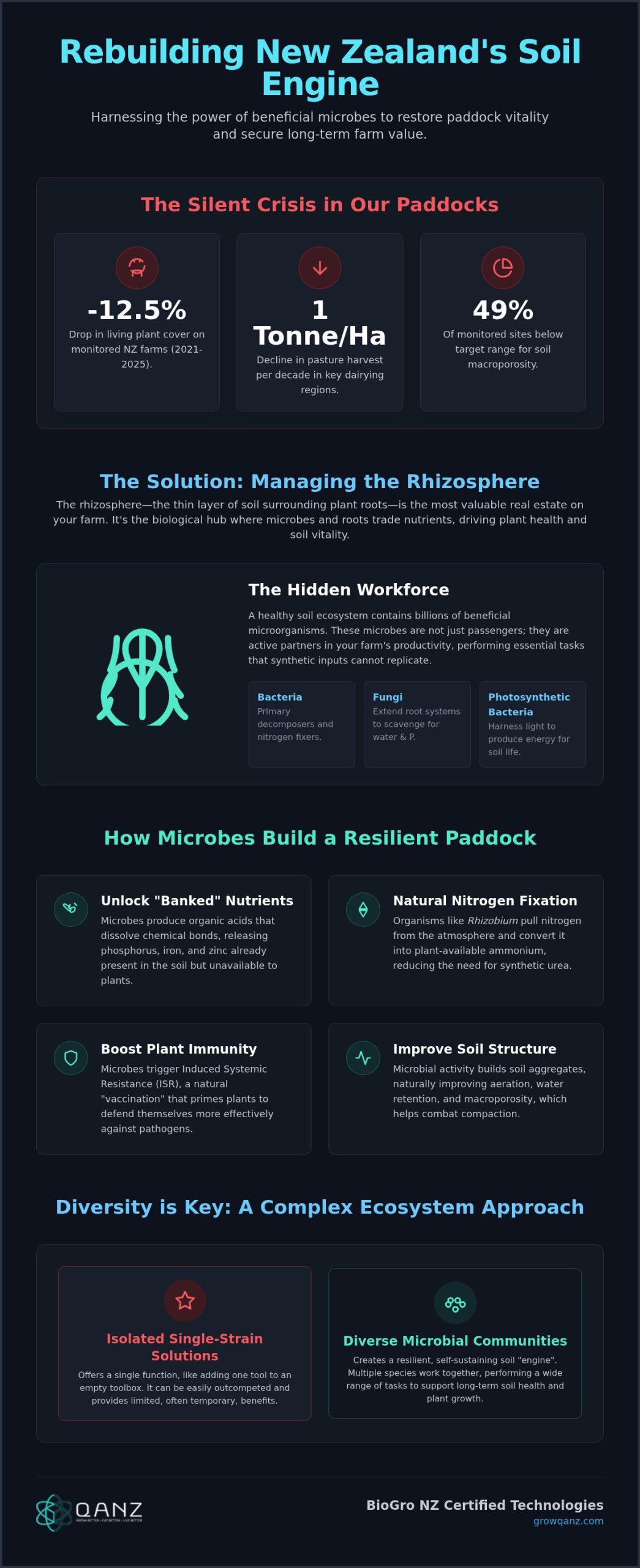
Did you know that on 245 monitored New Zealand farms between 2021 and 2025, living plant cover dropped by 12.5 per cent while bare soil increased? It is a sobering reflection of declining land health that many professional growers feel every day in their paddocks. You have likely noticed that even as you increase synthetic fertiliser inputs, the returns in pasture yield and soil structure aren’t what they used to be. Research indicates that pasture harvest is declining by up to 1 tonne of dry matter per hectare per decade in several key dairying regions across the country. It’s a frustrating cycle of rising costs and diminishing returns that challenges the long-term viability of the land.
This guide shows you how to break that cycle by harnessing beneficial soil microorganisms for plants to drive superior health and nutrient efficiency. By focusing on the biological engine of your soil, you can achieve robust growth and natural pest resistance while reducing your reliance on expensive synthetic chemicals. We will explore the technical mechanics of soil microbiology and provide a methodical path to improving soil structure, increasing water retention, and securing the long-term value of your farm. It is time to move beyond temporary fixes and invest in the proven science of soil vitality.
Key Takeaways
- Learn why the rhizosphere is the most critical real estate on your farm and how to manage this zone for superior plant health.
- Discover how beneficial soil microorganisms for plants unlock “banked” phosphorus and fix atmospheric nitrogen to improve nutrient efficiency.
- Understand why a complex microbial ecosystem provides a more resilient and effective soil “engine” than isolated single-strain solutions.
- Identify how to move beyond standard N-P-K testing to accurately assess soil life and time applications for maximum establishment.
- Explore the advantages of using BioGro NZ certified technologies like Quantum Organic-Total® to restore land value and reduce long-term input costs.
The Hidden Workforce: What are Beneficial Soil Microorganisms?
Beneath every hectare of productive New Zealand paddock lies a complex, invisible network of life. This community, known as soil biology, comprises billions of bacteria, fungi, and protozoa that inhabit the rhizosphere. The rhizosphere is the thin layer of soil immediately surrounding a plant’s roots, and it’s arguably the most important real estate on any farm. It is here that the most intense biological activity occurs. Beneficial microbes function as the biological intermediaries between soil minerals and plant roots.
For decades, industrial farming has prioritised high-analysis synthetic inputs to drive growth. While this provided immediate results, the heavy reliance on chemicals has inadvertently “starved” the natural soil workforce. When soil is saturated with readily available synthetic nutrients, plants stop “trading” carbon with microbes. This breakdown in communication leads to a decline in microbial diversity, leaving the soil sterile and dependent on the next bag of fertiliser. Restoring beneficial soil microorganisms for plants is about re-establishing this ancient partnership to ensure long-term soil vitality.
The Key Players in Soil Biology
Understanding the specific roles of these organisms helps growers manage their land more effectively. The workforce is diverse, with each group performing a specialised task:
- Bacteria: These are the primary decomposers and nitrogen fixers in the paddock. They break down organic matter and convert atmospheric nitrogen into plant-available forms.
- Fungi: Mycorrhizal networks act as a secondary root system. They extend far beyond the plant’s own reach to scavenge for water and minerals, particularly phosphorus.
- Photosynthetic Bacteria: These unique microbes harness light energy to support soil life. They produce energy-rich compounds that fuel the wider microbial community.
Why Soil Microbes Matter for NZ Growers
Investing in beneficial soil microorganisms for plants is a practical strategy for tackling modern agricultural challenges. In many regions, soil compaction has become a major hurdle. Data shows that 49% of monitored sites between 2014 and 2018 were below the target range for macroporosity. Microbes help build soil aggregates, which naturally improves structure and aeration without the need for heavy mechanical intervention. This biological approach also boosts crop resilience against New Zealand’s increasingly variable climate. By improving water retention and nutrient cycling, growers can maintain professional yields while steadily reducing their reliance on expensive synthetic fertilisers.
How Microbes Drive Plant Health and Nutrient Cycling
Soil isn’t just a growing medium; it is a complex biological factory. Microbes like Rhizobium and Azotobacter pull nitrogen from the atmosphere, converting it into ammonium that plants can actually use. This natural process reduces the need for synthetic urea applications. Similarly, many New Zealand paddocks are rich in “banked” phosphorus that is chemically tied to soil particles and unavailable to the crop. Beneficial soil microorganisms for plants produce organic acids that dissolve these bonds, unlocking the phosphorus already present in your soil profile.
Beyond major nutrients, microbes produce siderophores. These are specialised molecules that scavenge iron and zinc from the soil, delivering them directly to the plant roots. This delivery mechanism is a vital component of the Role of Beneficial Bacteria in Agriculture, as it ensures crops don’t suffer from micronutrient deficiencies even in mineral-rich soils. Microbes also prime the plant’s natural immune system through Induced Systemic Resistance (ISR). This biological “vaccination” prepares the plant to respond more rapidly to pathogens, which naturally enhances crop resilience.
Unlocking Nutrient Availability
Standard soil tests often show high “total” nutrient levels, yet crops can still show signs of deficiency. This gap exists because nutrients must be in a soluble form to be absorbed. Microbial enzymes break down complex organic matter into these plant-available forms, significantly increasing Nutrient Uptake Efficiency (NUE). When NUE is high, there is a much lower risk of nitrogen leaching into local waterways or phosphorus being lost through surface runoff. Improving these biological pathways is a core focus of microbial solutions for pasture and dairy.
Building Soil Structure (Carbon and Glomalin)
Healthy soil requires physical stability to thrive. Fungal hyphae act like microscopic threads, weaving through the soil to bind particles into stable aggregates that resist erosion. These fungi also produce glomalin, a sticky protein often described as “soil glue.” Glomalin is essential for creating the pore spaces that improve water infiltration and aeration in the root zone. Over time, this biological activity leads to long-term carbon sequestration, as the microbial biomass itself becomes a stable part of the soil’s organic carbon pool.
Diversity vs. Single Strains: Why Your Soil Needs a Complex Ecosystem
Imagine trying to run a tractor engine with only a single piston. While that part is essential, it cannot function without the valves, crankshaft, and fuel system working in unison. Soil biology follows the same principle of interdependence. Many products on the market focus on a single “hero” species, but true soil vitality comes from a diverse community where different organisms support each other’s survival. A comprehensive 30-year systematic literature review confirms that these complex interactions are what drive consistent nutrient cycling and plant protection. Microbial diversity ensures that at least some populations remain active regardless of environmental fluctuations.
When you introduce beneficial soil microorganisms for plants as a diverse consortium, you create a biological safety net. If a sudden cold snap or a dry spell hits, certain species may go dormant, but others will step up to maintain the rhizosphere’s function. This synergy is why diverse ecosystems outperform isolated strains in real-world New Zealand conditions. By fostering a wide array of species, growers can ensure their soil remains productive throughout the changing seasons.
The Limitations of Single-Strain Inoculants
The search for a “silver bullet” microbe often leads to disappointment in the field. Single-strain inoculants are typically developed in controlled laboratory environments where they don’t have to compete for resources. Once applied to a working paddock, these isolated species often fail to establish because they lack the supporting community they evolved with. There is also a risk of creating a biological imbalance. Over-applying a single species can suppress the native beneficial soil microorganisms for plants, leading to a less resilient soil profile that is more vulnerable to disease and nutrient lock-up.
The Power of Multi-Strain Microbial Consortia
Effective soil restoration requires a holistic approach that combines different functional groups. A robust consortium includes nitrogen fixers, phosphorus solubilisers, and decomposers working alongside photosynthetic bacteria. These photosynthetic microbes act as the “fuel” for the rest of the community, capturing energy to support the growth of beneficial fungi and bacteria. We’ve found that liquid microbial soil treatments are particularly effective for delivering this complexity. Unlike traditional granules, liquid applications keep the diverse populations in a stable, ready-to-work state, ensuring they can begin colonising the rhizosphere immediately upon contact with the soil.
Best Practices for Restoring Microbial Populations in New Zealand Soils
Restoring soil life requires more than just adding a product; it requires a shift in management strategy. While standard N-P-K tests provide a snapshot of chemistry, they fail to account for the biological activity that drives nutrient availability. Professional growers are increasingly using soil food web analysis to measure the presence of beneficial soil microorganisms for plants. This data allows for a more targeted approach to soil restoration, ensuring that the biological engine is actually running before you invest in more inputs.
Timing is a critical factor for successful establishment. Microbes are living organisms that require moisture and moderate temperatures to thrive. In the New Zealand climate, applying treatments during periods of high soil moisture ensures the organisms can colonise the rhizosphere before the soil dries out. If you are transitioning from a high-synthetic system, avoid applying biologicals simultaneously with high-salt fertilisers. Instead, use a phased approach that allows the microbial community to stabilise while you gradually reduce synthetic loads.
Application Strategies for Professional Growers
The delivery mechanism often determines the success of a microbial programme. Liquid application through fertigation or boom spraying provides a more even distribution than traditional granules. This method ensures that the microbes make direct contact with the soil and can move into the root zone with the next rain or irrigation cycle. We’ve found that liquid microbial soil treatments offer superior coverage because they provide the organisms in a metabolically active state, ready to begin work immediately.
For high-value horticulture, soil restoration after chemical fumigation is a vital strategy. Fumigants are designed to eliminate pathogens, but they also wipe out the beneficial workforce. Re-inoculating these soils immediately after the withholding period is essential to prevent “biological vacuums” where opportunistic diseases can quickly take hold. This proactive restoration helps maintain long-term land value and crop productivity.
Protecting Your Biological Investment
Once you have reintroduced beneficial soil microorganisms for plants, you must manage the land to support their survival. Reducing tillage is one of the most effective ways to preserve fungal hyphae and soil aggregates. Additionally, cover cropping acts as a “pantry” for soil life, providing the root exudates that microbes need to stay active between cash crops. Always verify the efficacy of any microbial product by checking for BioGro NZ certification. This ensures the product meets strict New Zealand standards for purity and environmental safety. To see how these practices work in the field, explore our range of BioGro certified microbial solutions.
Harnessing Advanced Microbiology with GrowQanz Technologies
GrowQanz provides a bridge between advanced soil science and practical paddock management. We specialise in BioGro NZ certified microbial technologies that restore soil vitality naturally. Our flagship product, Quantum Organic-Total®, is designed as a comprehensive solution for the New Zealand agricultural sector. It delivers a wide array of beneficial soil microorganisms for plants that work in synergy to restore the biological engine of the land.
The BioGro New Zealand certification is a cornerstone of our approach. This rigorous standard provides assurance to both organic and conventional growers that our solutions are pure, verified, and safe for the environment. By choosing certified products, you ensure that your investment in soil biology meets the highest local standards for quality and ecological integrity. We also offer Quantum-VSC®, which is specifically formulated to enhance plant resilience and root development. This technology supports the plant’s ability to withstand environmental stress while maximising the surface area for nutrient absorption.
Quantum Organic-Total®: A Scientific Approach to Vitality
Quantum Organic-Total® is more than just a simple inoculant. It is a diverse consortium of microbes meticulously selected for their ability to thrive in broadacre and horticultural environments. This multi-strain approach naturally boosts nutrient uptake and improves soil structure by re-establishing the fungal and bacterial networks discussed earlier. For a detailed look at the economic returns of this technology, you can review our Quantum Organic-Total cost-benefit analysis.
Specialised Solutions for Horticulture and Turf
We understand that different crops have unique biological requirements. Our Fruit & Nut and Vegetable Crop Microbial Solutions provide targeted support for high-value production systems. These treatments are essential for reducing transplant shock in seedlings and ensuring a strong start for new plantings. Additionally, we support the sports and amenity sector with professional turf biological products designed for high-performance management.
GrowQanz supports growers through technical expertise and evidence-based results. Our team understands the complexities of beneficial soil microorganisms for plants and works as a stable partner to help you achieve long-term agricultural progress. Whether you are managing dairy pasture or intensive horticulture, our liquid-based microbial technologies offer a methodical path to superior plant health and reduced input costs.
Investing in the Biological Potential of Your Land
Restoring the natural workforce of your paddocks is a methodical process that yields long-term dividends. We have explored how a diverse community of beneficial soil microorganisms for plants can unlock banked nutrients and improve soil structure, reducing the need for costly synthetic inputs. By transitioning from a chemical-heavy approach to a biologically-focused one, you aren’t just boosting this season’s yield; you’re actively restoring the land’s inherent value and resilience against an increasingly variable climate.
Success in the field depends on using verified, high-performance technology. GrowQanz provides liquid microbial solutions that are BioGro New Zealand Certified and scientifically formulated for NZ soil conditions. These treatments deliver 100% natural and organic results, ensuring your farm remains productive and sustainable for years to come. This evidence-based approach allows professional growers to maintain superior yields while prioritising the long-term health of the environment.
Explore the GrowQanz range of BioGro certified microbial solutions to begin your journey toward a more vital, self-sustaining soil ecosystem. Your land has the potential to thrive naturally; it simply needs the right biological partners to get started.
Frequently Asked Questions
What are beneficial microorganisms for plants?
Beneficial microorganisms are microscopic life forms, including bacteria, fungi, and protozoa, that form symbiotic relationships with root systems. These beneficial soil microorganisms for plants act as biological processors that convert raw minerals into accessible nutrients. Unlike pathogens that cause disease, these organisms actively protect the plant, improve soil structure, and facilitate essential chemical reactions within the rhizosphere that are necessary for professional-grade crop yields and long-term soil vitality.
How do soil microbes improve plant nutrient uptake?
Microbes improve uptake by producing enzymes that solubilise banked minerals like phosphorus and potassium. They act as a bridge between the soil and the plant, extending the root’s reach via fungal hyphae and scavenging for micronutrients like iron and zinc. This biological delivery system increases Nutrient Uptake Efficiency (NUE), ensuring that the fertilisers you apply are actually absorbed by the plant rather than leaching into the environment or becoming locked in the soil.
Can beneficial soil microorganisms replace chemical fertilisers?
While they don’t replace nutrients, they significantly reduce the volume of synthetic inputs required over time. By unlocking existing soil reserves and fixing atmospheric nitrogen, microbes allow growers to maintain yields with lower chemical loads. Many New Zealand farmers find that integrating biologicals creates a more efficient system where the soil’s natural fertility is restored, eventually leading to a reduction in high-salt fertiliser dependence and overall input costs while protecting the land’s health.
How long does it take to see results from microbial treatments?
Biological changes are gradual but cumulative. You might notice improved seedling vigour or better soil moisture retention within the first few weeks of application. However, significant improvements in soil structure and long-term yield stability typically become more apparent over a full growing season. Because we are building a living ecosystem rather than applying a quick chemical fix, the results tend to strengthen each year as the microbial populations stabilise and the soil health improves.
Are GrowQanz products safe for organic farming in New Zealand?
Yes, our core technologies like Quantum Organic-Total® and Quantum-VSC® are BioGro New Zealand certified. This certification ensures that the products meet the most stringent local organic standards and are free from synthetic additives. Whether you are a fully certified organic producer or a conventional grower looking to improve soil health, these solutions provide a safe, natural, and verified way to enhance your farm’s biological potential without risking your organic status.
How do I apply liquid microbial soil treatments to my paddocks?
Liquid treatments offer significant flexibility and can be applied through standard boom sprays, fertigation systems, or even aerial applications. The key is to ensure the microbes reach the soil surface when moisture is present, as this helps them move into the root zone. Because these are living products, it’s best to apply them during cooler parts of the day to avoid UV stress and ensure maximum establishment in the paddock for long-term soil vitality.
Can I use soil microbes after chemical soil fumigation?
Re-introducing beneficial soil microorganisms for plants after fumigation is a critical management strategy. Fumigants are non-selective and often leave the soil biologically sterile, which can lead to a biological vacuum where pathogens quickly return. Applying a diverse microbial consortium immediately after the withholding period helps re-occupy the soil with beneficial life, restoring the natural balance and protecting high-value horticultural crops from opportunistic diseases. This proactive approach ensures the soil remains productive.
How do microbes help plants survive drought stress?
Microbes enhance drought resilience by improving soil aggregation and water-holding capacity. Fungal networks extend the effective surface area of the roots, allowing plants to access moisture from deeper in the soil profile during dry spells. Additionally, certain bacteria produce biofilms and stress-signalling molecules that help the plant regulate its water loss more effectively. This biological support is essential for maintaining pasture and crop health during New Zealand’s increasingly variable summer months and protecting overall farm productivity.
