

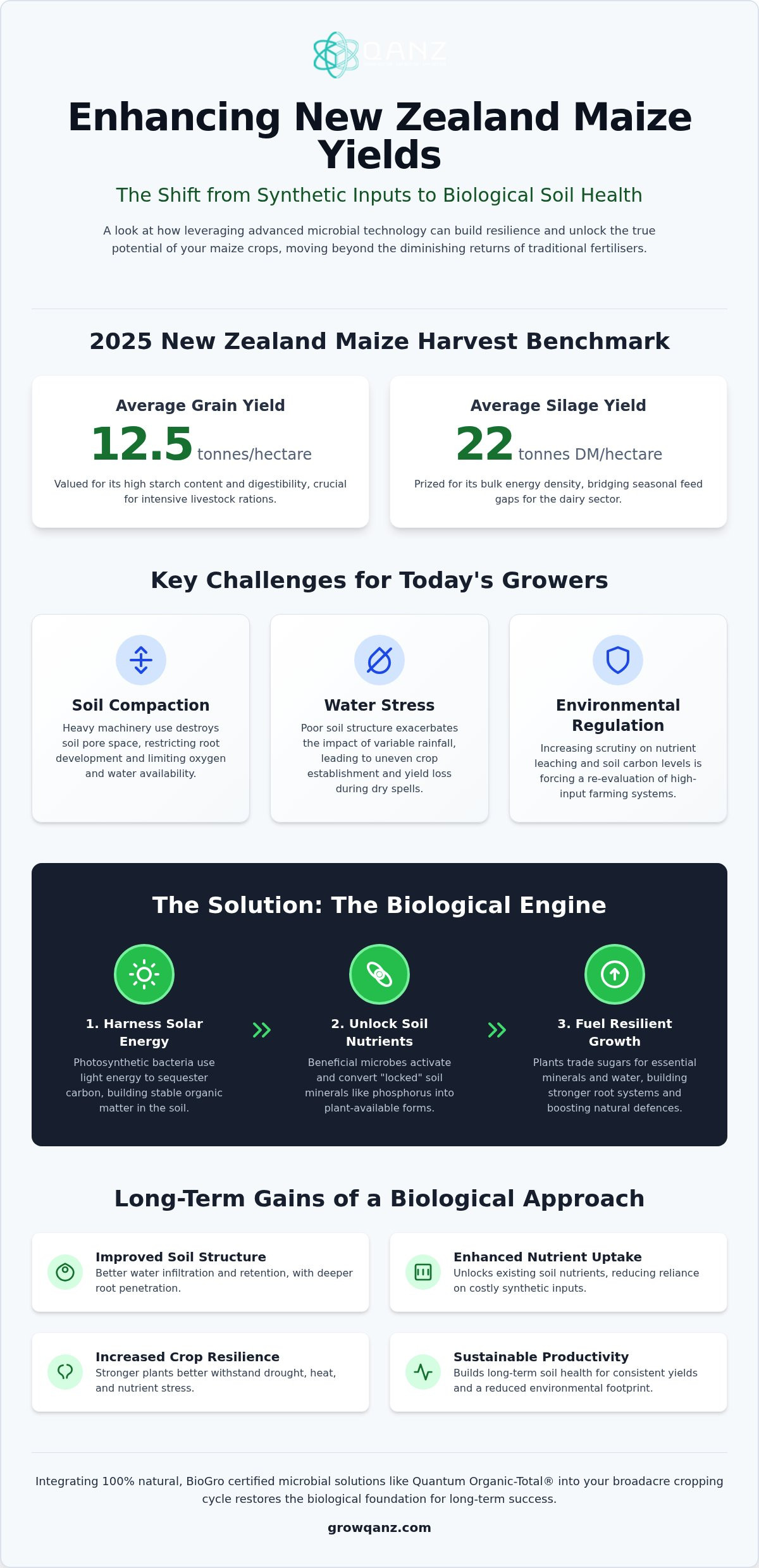
With the 2025 New Zealand maize grain harvest averaging 12.5 tonnes per hectare, the ceiling for many growers often feels dictated by the volatile price of synthetic nitrogen and phosphorus. It’s a challenging environment where traditional inputs don’t always guarantee the resilience needed for a changing climate. You’ve likely noticed that pouring more fertiliser into a paddock with declining soil structure often leads to diminishing returns, especially when drought stress impacts your silage quality.
There is a more efficient way to manage your crop’s potential. This article explains how you can enhance maize grain and silage yields by leveraging advanced microbial technology and biological soil health. We believe that true productivity comes from a synergy between the plant and the living organisms within the soil, rather than a reliance on chemical intervention alone.
We’ll explore how BioGro certified solutions like Quantum Organic-Total® restore soil structure and improve resilience for back-to-back cropping. You’ll also learn how these microbial treatments facilitate higher grain protein and energy density while reducing your environmental footprint. It’s about securing long-term results through evidence-based, sustainable progress that respects the integrity of your land.
Key Takeaways
- Learn how to tailor management strategies for both grain and silage crops to meet the specific nutritional demands of the New Zealand dairy and livestock sectors.
- Understand the biological mechanisms that allow photosynthetic bacteria to unlock “locked” phosphorus in the soil, significantly enhancing the growth and energy density of your Maize.
- Discover a practical framework for transitioning your paddocks to biological management using BioGro certified liquid inoculants to restore soil structure and resilience.
- Explore how robust microbial populations act as biological insurance against dry summers by strengthening root systems and triggering Systemic Acquired Resistance.
- Identify the long-term productivity gains and environmental benefits of integrating 100% natural microbial solutions like Quantum Organic-Total® into your broadacre cropping cycle.
The State of Maize Production in New Zealand for 2026
Maize remains the cornerstone of New Zealand’s dairy and livestock sectors, providing the high-energy supplement required to bridge seasonal feed gaps and drive milk production. The 2025 harvest saw grain yields average 12.5 tonnes per hectare, while silage reached 22 tonnes of dry matter per hectare. These figures represent a solid benchmark, yet achieving them consistently in the current climate requires more than just high-performing hybrids. We’re seeing a significant shift in management philosophy as growers look beyond the bag of synthetic fertiliser to find performance gains. This transition toward biological-first broadacre farming is a pragmatic response to the rising costs of traditional inputs and a clear need for more resilient cropping systems that can withstand environmental volatility.
Maize Grain vs. Silage: Different Goals, Same Foundation
While the end use of the crop differs, both grain and silage rely on the same biological engine. Grain is prized for its starch content and digestibility in intensive rations, whereas silage is valued for its bulk energy density. The nutritional profile of the final harvest is directly linked to the soil’s ability to provide a steady stream of plant-available nutrients throughout the season. Understanding Maize cultivation and biology reveals that the genetic potential of a hybrid is often limited by the soil environment. By focusing on biological health, growers ensure that the crop achieves its intended energy density, regardless of whether the target is the grain silo or the silage stack.
Environmental Challenges for Today’s Grower
New Zealand growers face a complex set of pressures that traditional chemistry can’t always solve. Intensive rotations often lead to degraded soil structure and compaction, which restricts root development and reduces water infiltration. This becomes particularly critical during dry summers, such as the El Niño conditions predicted for recent seasons. Biological solutions offer a way to address these structural issues while maintaining the yields required for commercial viability. Restoring the microbial balance helps mitigate the risks of nutrient runoff and improves the soil’s natural capacity to hold moisture during periods of stress.
- Compaction: Repeated heavy machinery use in maize paddocks destroys pore space and limits oxygen availability to the roots.
- Water Stress: Poor soil structure exacerbates the impact of variable rainfall, leading to uneven establishment.
- Regulation: Increasing scrutiny on nutrient leaching and soil carbon levels is forcing a re-evaluation of high-input systems.
The Biological Engine: How Soil Microbes Drive Maize Growth
High-performing hybrids often fail to reach their potential because the soil’s biological engine is stalled. While seed genetics provide the blueprint, it’s the microbial community in the rhizosphere that delivers the building blocks. Recent research into how microbes boost root growth shows that Maize plants actively recruit specific microorganisms to enhance their resilience against nutrient stress. This isn’t a passive process. It’s a complex, symbiotic relationship where the plant trades sugars for essential minerals and water. By focusing on this subterranean activity, growers can unlock the performance that synthetic fertilisers alone cannot provide.
Photosynthetic Bacteria: Capturing Energy Below Ground
Photosynthetic bacteria are unique microorganisms that utilise light energy to drive metabolic processes, effectively sequestering carbon into the soil while stimulating the production of diverse root exudates. These bacteria don’t just sit idle. They actively convert solar energy into stable soil carbon, creating a richer environment for other beneficial microbes. This increased microbial diversity improves the soil’s structure and its ability to hold nutrients, making the entire system more efficient. By fostering these specific strains, growers can build a self-sustaining cycle of fertility that supports the crop through every growth stage.
Improving Nutrient Uptake Naturally
Many New Zealand paddocks contain significant amounts of “locked” phosphorus that plants simply cannot access. Beneficial soil microorganisms for plants solve this by secreting organic acids that solubilise these minerals, making them available for uptake. This natural process reduces the need for heavy applications of synthetic urea and superphosphate. It also plays a vital role in environmental protection. When microbes hold nutrients within their biomass or the soil matrix, they prevent nitrogen and phosphorus from leaching into local waterways. Understanding how beneficial soil microorganisms boost plant health naturally is the first step toward a more sustainable and profitable cropping cycle.
Nitrogen fixation is another critical benefit of a healthy soil microbiome. Certain bacteria take atmospheric nitrogen and convert it into a form the plant can use, providing a steady supply of nutrition. This reduces the “boom and bust” cycle often associated with synthetic fertilisers, ensuring the plant has access to nitrogen when it needs it most. Integrating these biological tools allows for a more balanced approach to crop nutrition. If you’re looking to restore the natural vitality of your land, exploring specialised microbial treatments can provide the technical edge your farm needs.
Transitioning to Biological Management: A Practical Framework
Transitioning away from a purely chemical model requires a clear understanding of your paddock’s current state. Most Maize paddocks in New Zealand carry a significant “biological debt” after years of intensive cropping and heavy synthetic applications. Assessing soil health goes beyond standard NPK tests; it involves looking at soil structure, organic matter, and the presence of beneficial life. BioGro certified soil inoculants serve as the primary tool in this transition, acting as a catalyst to restart the biological engine. By reintroducing these essential organisms, you’re not just adding a product; you’re restoring a functional ecosystem that has been suppressed by conventional management.
Restoring Soil Health After Intensive Cropping
Fumigated or depleted soils often lack the microbial diversity needed for effective nutrient cycling. Reintroducing life requires a multi-strain approach, as a single species cannot perform all the complex tasks of a healthy soil ecosystem. High-quality liquid inoculants provide a diverse microbial profile that can colonise the rhizosphere quickly and begin the work of soil restoration. For a deeper look at specific strategies, refer to our microbial solutions for field crops guide, which outlines how to restore vitality to broadacre systems. This methodical reintroduction of life is essential for maintaining productivity in paddocks that have been worked hard over several seasons.
Integrating Biologicals with Existing Farm Infrastructure
One of the greatest advantages of modern microbial technology is its ease of use within existing systems. Liquid treatments are designed to be compatible with standard spray rigs and irrigation systems, removing the need for specialised machinery or complex changes to your workflow. Timing is everything. Applying these solutions during periods of low UV or when soil moisture is present ensures maximum survival and colonisation. These treatments also work in harmony with dairy effluent, helping to break down organic matter and make those nutrients more accessible to the crop. This compatibility makes it simple to integrate biologicals into your current Maize management programme without disrupting your daily operations.
Managing the reduction of synthetic nitrogen is a steady and principled process. As microbial activity increases and natural nitrogen fixation begins to contribute to the crop’s needs, growers can gradually “wean” their paddocks off heavy urea applications. This balanced approach maintains yield stability while improving the long-term ROI and resilience of the farm. Using liquid microbial soil treatments ensures that the transition is both practical and measurable, providing a reliable path toward a more sustainable and profitable future.
Maximising Maize Resilience: Drought and Nutrient Stress
Variable rainfall and increasing drought stress are significant concerns for New Zealand growers, especially when managing broadacre Maize crops. While irrigation provides a direct solution, it’s often limited by water availability and infrastructure costs. Resilience is built underground. Robust root systems act as a biological insurance policy. They allow plants to access moisture deeper in the soil profile during dry spells. By enhancing the soil’s microbial health, we can improve the plant’s natural ability to withstand these environmental pressures without relying solely on external inputs. This biological approach builds a more stable foundation for the crop.
Building Root Architecture for Water Access
Microbial solutions for plant stress play a critical role in encouraging deeper taproots and more extensive lateral root development. This improved architecture increases the surface area available for nutrient scavenging and water uptake. Beneficial bacteria produce specific phytohormones that stimulate root elongation. This ensures the crop establishes itself firmly before the heat of summer arrives. For those starting with young plants, understanding how to reduce transplant shock in seedlings is essential for building early-stage resilience. A strong start leads to a more durable plant that can better handle the climatic shifts seen across the country.
Natural Defenses Against Environmental Pressures
Specific bacteria trigger Systemic Acquired Resistance (SAR) in maize. This is essentially an internal alarm system that prepares the crop for potential stressors. This physiological state allows the plant to respond more effectively to heat, wind, and pathogen pressure. Healthy microbial populations also help buffer soil pH and salinity. This creates a more stable environment for root growth, which is particularly relevant when integrating microbial inoculants with existing dairy effluent management systems. Many growers find that microbes help process the high nutrient load in effluent. This prevents salt build-up and ensures nutrients are delivered in a plant-available form that doesn’t stress the rhizosphere.
Increasing soil organic matter through biological activity improves water-holding capacity. This provides a moisture reservoir that carries the crop through periods of low rainfall. Investing in your soil’s biological resilience provides a long-term return that goes beyond a single harvest. If you want to protect your yields from environmental volatility, consider how BioGro certified microbial treatments can strengthen your crop’s natural defences.
The GrowQanz Advantage: Quantum Organic-Total® for Maize
GrowQanz offers a strategic partnership for growers looking to move beyond the limitations of standard seed treatments. While some products focus solely on the initial planting phase, Quantum Organic-Total® provides a comprehensive biological support system that functions throughout the entire life cycle of the Maize crop. This BioGro New Zealand certified liquid microbial treatment is designed for ease of application across large scale broadacre operations. It integrates seamlessly with existing spray rigs, offering a practical alternative to the logistical challenges of granular applications. By choosing a 100% natural solution, you’re investing in a system that restores soil health while simultaneously driving productivity.
The Science Behind the Quantum Range
The efficacy of our solutions lies in the proprietary microbial consortia found in Quantum Organic-Total® and Quantum-VSC®. These aren’t simple, single-strain additives. They are complex communities of microorganisms that work in harmony to address the diverse needs of the soil. The inclusion of photosynthetic bacteria is particularly critical for high-demand crops. These organisms act as a subterranean solar panel, converting light energy into soil carbon and stimulating the rhizosphere. The “Total” designation reflects our holistic approach. We don’t just target one nutrient pathway; we aim to restore the entire biological engine of your paddock, ensuring that your hybrids can reach their full genetic potential.
Partnering for Long-Term Agricultural Success
Investing in soil health is a commitment to the long-term viability of multi-generational New Zealand farms. The ROI of biological management is measured not just in this season’s grain protein or silage energy density, but in the improved resilience of the land for future rotations. Quantum-VSC® further strengthens this resilience by improving the soil’s ability to process organic matter and withstand environmental stress. GrowQanz provides the technical support and bespoke advice needed to navigate this transition with confidence. Our team understands the local landscape and the specific pressures facing our growers. We view soil as a primary asset that requires careful stewardship to ensure it remains productive for decades to come.
Ready to see the difference biological health can make on your farm? Enquire about Quantum Organic-Total® for your next maize season to learn how our field crop microbial solutions can transform your harvest and protect your land’s future.
Securing the Future of Your Harvest
Achieving consistent productivity in the face of climatic volatility requires a shift from short-term chemical fixes to long-term biological health. We’ve explored how the microbial engine drives nutrient uptake and how robust root architecture provides the necessary insurance against dry New Zealand summers. By restoring the rhizosphere, you’re not just improving this season’s Maize yield; you’re investing in the multi-generational vitality of your land. This transition is a practical step toward a more resilient and efficient farming system that respects the integrity of the soil.
GrowQanz provides the tools to make this evolution seamless. Our 100% natural microbial technology is BioGro New Zealand certified and has delivered proven broadacre results across the country. It’s time to move beyond the limitations of traditional inputs and unlock the true genetic potential of your crops through evidence-based soil restoration. Optimise your maize yield with BioGro certified Quantum Organic-Total® and build a foundation of health that lasts for years to come. We look forward to supporting your journey toward a more sustainable and profitable future.
Frequently Asked Questions
What is the best time to apply microbial treatments to maize?
The optimal time to apply microbial treatments is during the planting and early establishment phases of the Maize crop. Applying Quantum Organic-Total® at sowing or shortly after emergence ensures the beneficial bacteria colonise the rhizosphere as the root system develops. You can also apply treatments post-harvest to aid in the breakdown of crop residue and restore soil vitality for the following rotation, especially in intensive cropping systems.
Can I use Quantum Organic-Total® alongside my regular fertiliser?
You can integrate Quantum Organic-Total® into your existing fertiliser programme to improve nutrient use efficiency. These microbial solutions work by solubilising “locked” nutrients, allowing the plant to better utilise the inputs you’ve already applied. While compatible with most liquid fertilisers, it’s best to avoid mixing them with concentrated biocides or highly acidic products that might impact microbial viability. This approach helps reduce your overall reliance on synthetic nitrogen over time.
Is Quantum Organic-Total® safe for use on BioGro certified organic farms?
Quantum Organic-Total® is fully BioGro New Zealand certified, making it a safe and compliant choice for organic-certified farms. It’s a 100% natural microbial technology that contains no synthetic chemicals or prohibited substances. This certification provides assurance that you’re maintaining the integrity of your organic status while accessing advanced biological tools to improve soil health and crop productivity in a principled, sustainable manner.
How does soil microbiology affect maize silage quality for dairy cows?
Healthy soil microbiology directly influences the nutritional profile of Maize silage by enhancing the plant’s uptake of essential minerals. When microbes improve the soil environment, the plant can focus more energy on grain development and starch accumulation. This results in silage with higher energy density and better digestibility for dairy cows, which is critical for maintaining milk production during feed gaps in the New Zealand dairy season.
Will microbial treatments help my maize survive a dry New Zealand summer?
Microbial treatments significantly improve drought resilience by encouraging deeper and more extensive root systems. These robust roots allow the Maize plant to access moisture from deeper soil layers during dry New Zealand summers. Additionally, specific microbial strains trigger natural defence mechanisms within the plant, helping it manage heat stress more effectively. This biological insurance helps maintain yield stability even when rainfall is variable or irrigation is limited.
How long does it take to see results from biological soil enhancers?
You’ll often see initial results in improved seedling establishment and early-stage vigour within the first few weeks of application. However, the full benefits of biological soil enhancers, such as restored soil structure and increased organic matter, typically develop over one to two seasons. It’s a cumulative process where each application builds upon the last, leading to a more resilient and self-sustaining soil ecosystem on your farm.
Are liquid microbial treatments better than granules for broadacre maize?
Liquid microbial treatments offer several advantages over granules in broadacre Maize operations, particularly regarding ease of application and colonisation speed. Liquids can be mixed with standard spray rigs or irrigation systems, ensuring a more even distribution across the paddock. This allows the microbes to reach the root zone immediately, whereas granules require moisture to break down and release their biological components into the soil matrix.
Does maize require specific microbial strains compared to other field crops?
While many beneficial microbes support general plant health, Maize has a high demand for specific strains that assist with phosphorus solubilisation and nitrogen fixation. The photosynthetic bacteria found in the Quantum range are particularly effective for this crop, as they support the intense metabolic requirements of fast-growing hybrids. Using a diverse consortia tailored for field crops ensures the biological engine is equipped to meet these specific nutritional challenges.
