

The ability of your turf to withstand a heavy weekend of fixtures isn’t just about how much nitrogen you’ve poured into the ground; it’s about the invisible biological architecture beneath the surface. You’ve likely seen the frustration of bare patches in high-wear zones and the rising costs of synthetic fixes that offer only temporary relief. Implementing a microbial treatment for sports turf wear tolerance shifts the focus from superficial colour to genuine structural resilience. It’s a move away from the “quick fix” and towards a sustainable foundation that helps the grass stand up to the boots of every player on the pitch.
In this guide, you’ll discover how advanced microbial treatments like Quantum Organic-Total® re-engineer soil health to significantly improve wear tolerance and recovery in high-traffic New Zealand sports turf. We’ll explore the 2026 biological strategy for building turf density and accelerating divot recovery without relying on aggressive chemical inputs. From the science of photosynthetic bacteria to the practical application of BioGro certified solutions, we’ll outline a methodical approach to maintaining professional-standard surfaces that thrive under pressure.
Key Takeaways
- Understand why traditional high-nitrogen programmes often create “soft” turf and how to transition towards a biology-first approach for genuine structural resilience.
- Learn how photosynthetic bacteria provide the essential energy reserves required for rapid tissue repair and divot recovery after heavy weekend fixtures.
- Discover how a BioGro certified microbial treatment for sports turf wear tolerance re-engineers soil health to withstand the physical pressures of crushing and compaction.
- Explore the specific roles of Quantum Organic-Total® and Quantum-VSC® in establishing a foundation for soil vitality and accelerated organic matter breakdown.
- Gain a practical framework for timing applications to coincide with peak growth periods, ensuring your turf maintains professional density with reduced synthetic inputs.
The Biological Bottleneck: Why Sports Turf Fails Under Pressure
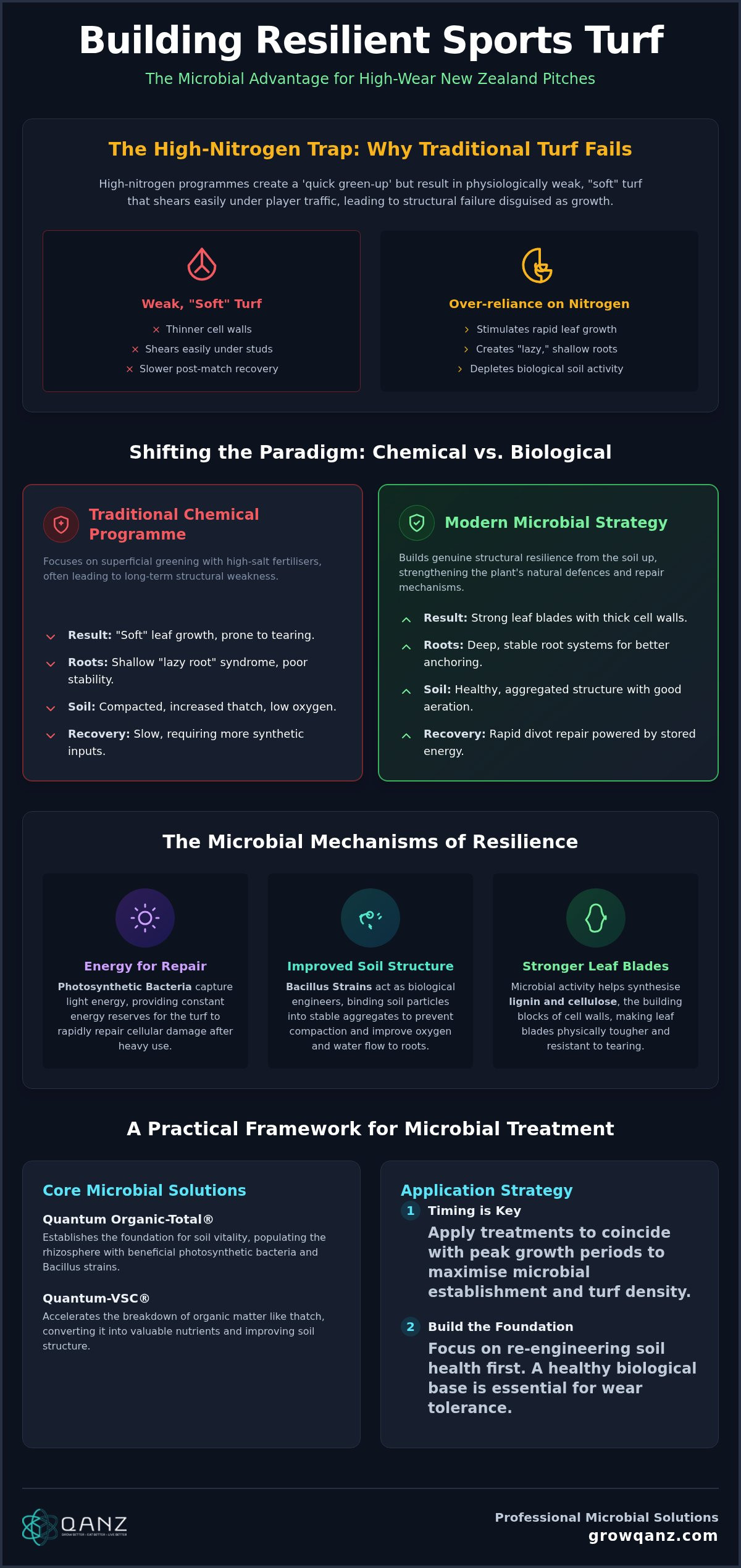
Wear tolerance isn’t just about how green the grass looks before a match. It’s the capacity of the turf to endure crushing, tearing, and the relentless soil compaction caused by player traffic. While many New Zealand turf managers rely on high-nitrogen regimes for a rapid aesthetic response, this often creates a physiological weakness. High nitrogen stimulates rapid leaf elongation at the expense of cell wall thickness, resulting in “soft” turf that shears easily under studs. It’s a structural failure disguised as growth.
Integrating a microbial treatment for sports turf wear tolerance addresses this by shifting the focus to the rhizosphere. This zone of soil surrounding the roots acts as the biological anchor for the plant. Without a healthy population of beneficial organisms, the turf loses its structural integrity. When the soil becomes biologically depleted, the turf enters a downward spiral where recovery slows, bare patches appear, and the reliance on synthetic inputs increases. It’s a cycle that compromises the surface’s long-term viability.
Understanding Physical vs. Physiological Wear
Physical wear involves the immediate mechanical damage to the leaf blade and crown. Physiological wear is more insidious; it’s the plant’s inability to maintain metabolic functions under stress. When soil is compacted by heavy traffic, oxygen levels plummet, stifling the aerobic processes within soil microbiology that support plant health. Weakened plants lose their ability to photosynthesise efficiently, meaning they lack the energy reserves to repair tissue between weekend fixtures. This exhaustion makes the turf more susceptible to secondary stresses like drought or disease.
The Downside of the ‘Synthetic Quick-Fix’
Relying on salt-based fertilisers provides a temporary “green-up” but often compromises long-term durability. These high-salt formulations can dehydrate the very soil organisms responsible for nutrient cycling. This leads to “lazy root” syndrome, where roots stay near the surface for easy soluble nutrients instead of diving deep for stability. Over time, this lack of biological activity results in several challenges:
- Excessive thatch build-up that can harbour pathogens
- Increased susceptibility to local fungal diseases
- A higher demand for irrigation as root systems remain shallow and fragile
Breaking this cycle requires moving beyond simple chemistry. True resilience comes from a biological strategy that strengthens the plant from the soil up, ensuring the turf can withstand the physical rigours of the season.
Microbial Mechanisms: How Soil Biology Builds Structural Resilience
Building genuine resilience requires a shift from chemical inputs to biological fortification. Photosynthetic bacteria are the quiet engines of this change. They capture light energy and convert it into carbon compounds that support the plant’s metabolic needs. This is a primary driver for sports turf wear tolerance, as it ensures the grass has the energy reserves to repair cellular damage immediately after a match. These bacteria function even in low-light conditions, providing a constant baseline of energy that synthetic fertilisers simply cannot replicate.
Bacillus strains complement this by producing plant growth-promoting hormones like auxins and gibberellins. These microbes act as biological engineers, improving soil flocculation by producing exopolysaccharides. These sticky substances bind soil particles into stable aggregates, creating a healthy, crumb-like structure. This prevents the “pancaking” effect of heavy traffic, ensuring that vital oxygen and water can reach the root zone even when the surface is under immense pressure. It’s this structural maintenance that keeps the rhizosphere functional during the height of the playing season.
Strengthening the leaf itself is just as critical as the soil structure. Microbial activity facilitates the synthesis of lignin and cellulose, which are the fundamental building blocks of cell wall strength. By solubilising minerals such as silica, a microbial treatment for sports turf wear tolerance ensures the leaf blades are physically tougher and far less prone to tearing under the impact of studs or heavy machinery. This mineral availability is often the missing link in traditional chemical programmes that focus only on nitrogen, phosphorus, and potassium.
Strengthening the Root-Soil Interface
Preventing turf from “spinning out” during a sudden change of direction depends on the strength of the root-soil interface. Beneficial bacteria and mycorrhizal fungi act as biological glues, anchoring the roots firmly within the soil matrix. This increased root density and depth provide the mechanical stability needed to withstand shear forces. You can explore how biological turf programmes enhance this anchoring effect naturally, creating a surface that stays put when the game intensifies.
Energy Storage and Post-Game Recovery
Recovery is a carbohydrate-intensive process that happens largely out of sight. Microbes help manage these reserves within the crown, ensuring the plant isn’t completely depleted after intensive use. Industry data often points to significantly accelerated recovery times in biologically active soils compared to those relying solely on synthetic inputs. Rhizosphere priming is the process where microbial activity stimulates the rapid decomposition of organic matter to release a surge of nutrients exactly when the plant needs to recover from physical stress.
Biological vs. Chemical: Shifting the Wear Tolerance Paradigm
Traditional turf management often prioritises an immediate visual “green-up” through synthetic nitrogen. While this satisfies the eye, it frequently fails the foot. Synthetic fertilisers provide a rapid flush of growth that lacks cellular density. In contrast, a microbial treatment for sports turf wear tolerance focuses on the structural build of the plant. This biological approach ensures that the growth you see is backed by the strength needed to survive the crushing force of a rugby scrum or the sharp turn of a winger on a Saturday afternoon.
The cost-benefit analysis of biological systems becomes evident over a full New Zealand playing season. While synthetics require frequent re-application to maintain appearance, biological treatments build a self-sustaining ecosystem that reduces the need for expensive chemical inputs. By improving nutrient cycling and root efficiency, managers often find they can scale back irrigation and fertiliser budgets. This shift aligns with increasing community expectations for environmental stewardship in our local parks and sports fields, where chemical-free management is becoming the preferred standard for public spaces.
Precision is vital in professional turf care. Liquid microbial formulations like Quantum Organic-Total® provide superior accuracy compared to granular alternatives. These liquid solutions ensure the microbes reach the rhizosphere quickly, where they can begin the work of fortifying the soil-plant bond immediately. This rapid absorption is a significant advantage when preparing surfaces for high-stakes fixtures.
The Hybrid Approach: Transitioning to Biologicals
Transitioning doesn’t require an overnight abandonment of existing schedules. A hybrid approach allows you to integrate microbial inoculants into your current programme while gradually reducing the “salt load” of synthetic fertilisers. High salt concentrations can be toxic to the very microbes you’re trying to establish. By monitoring progress through soil tests that measure microbial diversity, you can adjust your inputs to favour biological activity without compromising turf quality during the transition period.
Environmental Resilience and Water Use
Microbes play a decisive role in how turf handles New Zealand’s variable climate. They improve soil flocculation, which enhances water infiltration and retention in hard-baked soils during summer fixtures. This biological “sponge” effect increases drought tolerance and ensures that when rain does arrive, it reaches the roots rather than running off the surface. Better nutrient uptake also means less leaching into local waterways, protecting our natural environment while maintaining elite playing surfaces.
Implementing a Microbial Treatment Programme for Maximum Durability
Successfully integrating a microbial treatment for sports turf wear tolerance into your maintenance schedule requires a methodical approach. It isn’t a “set and forget” solution; it’s a strategic partnership with your soil’s biology. The following steps ensure your microbial inoculants establish effectively and deliver the structural resilience discussed earlier:
- Soil Assessment and Thatch Management: Ensure the surface is clear of excessive organic matter. Thatch acts as a physical barrier, preventing liquid microbes from reaching the rhizosphere.
- Strategic Timing: Apply during periods of active root growth. This allows the microbes to colonise the root-soil interface when the plant is most receptive.
- Liquid Application: Use proprietary liquid formulations. These provide immediate contact with the leaf and rapid infiltration into the root zone.
- Post-Application Moisture: Maintain adequate soil moisture for 48 hours. Microbes require a hydrated environment to survive the initial transition into the soil matrix.
- Nutrient Adjustment: Gradually reduce synthetic fertiliser inputs. As biological nutrient cycling improves, the plant’s demand for soluble NPK will naturally decrease.
Application Best Practices for Sports Fields
Timing is critical for microbial survival. UV light can be detrimental to living organisms, so always aim for evening or early morning applications. This ensures the microbes have time to move into the soil profile before being exposed to harsh New Zealand sunlight. When tank mixing, avoid combining biologicals with harsh fungicides or biocides that could neutralise the beneficial strains. Ensure your spray equipment is calibrated for a medium-to-coarse droplet size to facilitate even distribution across the pitch.
Seasonal Timing for High-Wear Sports
The New Zealand sports calendar demands different strategies throughout the year. Pre-season “priming” involves building a robust root system before the first whistle blows in winter. During the season, focus on maintenance doses to support recovery between weekly games when the turf is under maximum physical stress. For the renovation phase, using microbial solutions for field crops can significantly accelerate re-seeding and establishment. This ensures your turf density returns quickly before the next cycle of heavy use begins.
To start building a more resilient surface for your facility, you can explore our full range of professional turf microbial solutions today.
Quantum Performance: Professional Microbial Solutions for Sports Turf
Achieving elite playing surfaces in New Zealand requires moving beyond generic applications towards evidence-based biological strategies. GrowQanz provides professional turf managers with a sophisticated toolkit designed to address the specific challenges of high-traffic environments. By implementing a microbial treatment for sports turf wear tolerance using our BioGro certified formulations, you’re not just applying a product; you’re introducing a self-sustaining workforce into your soil profile. This evidence-based approach ensures that every application contributes to the long-term structural integrity of the pitch, reducing the need for emergency interventions during the height of the season.
Our commitment to soil vitality is grounded in the “claim-and-verify” principle. We provide proprietary liquid microbial formulations that are already widely used in professional turf and horticulture across the country. These solutions are 100% natural and organic, offering a principled alternative to traditional chemical regimes. By focusing on the underlying biology, GrowQanz helps municipal and professional managers meet the dual demands of superior surface performance and environmental responsibility.
Quantum Organic-Total® for Elite Stadiums
Quantum Organic-Total® serves as the foundation for soil vitality in elite sports settings. It contains a unique, proprietary blend of photosynthetic and nitrogen-fixing bacteria that work in tandem to support plant health. Unlike synthetic nitrogen, which often causes a weak, watery flush of growth, this microbial consortium improves turf colour and density through natural metabolic pathways. The photosynthetic strains are particularly effective at maintaining energy production during the shorter days of the New Zealand winter playing season. To achieve a comprehensive management system, many professionals integrate these inoculants with other professional turf biological products to ensure all aspects of the rhizosphere are supported.
Quantum-VSC®: Managing the Thatch and Stress Cycle
Thatch accumulation is a significant hurdle for surface playability and moisture management. Quantum-VSC® is specifically formulated to target the breakdown of organic matter, converting stubborn thatch into plant-available nutrients. This process improves vertical drainage and reduces the “spongy” feel that often leads to player fatigue or surface instability. Beyond thatch management, these microbes help the plant navigate environmental extremes, such as the temperature fluctuations common in our varied climate. Maintaining BioGro certification is a vital component for public-facing spaces, as it provides local communities with the assurance that their sports fields are being managed with the highest standards of environmental safety and purity. This transparency builds trust while delivering a surface that can withstand the rigours of modern sport.
Securing the Future of New Zealand Playing Surfaces
Building a resilient pitch requires a move away from superficial treatments towards deep-seated biological health. We’ve explored how focusing on the rhizosphere and energy storage allows grass to survive the crushing forces of match day. By integrating a microbial treatment for sports turf wear tolerance, you replace temporary “green-ups” with genuine structural integrity and faster recovery. It’s a methodical shift that prioritises the long-term viability of the land over short-term aesthetic gains.
These 100% natural technologies are BioGro New Zealand Certified Organic and have delivered proven results in professional stadiums and community parks across the country. Embracing this biological strategy ensures your turf remains dense and durable while meeting the environmental expectations of your local community. Contact GrowQanz today to organise a professional microbial programme for your turf. Investing in your soil’s biology is the most reliable way to maintain world-class surfaces that thrive under pressure.
Frequently Asked Questions
Can microbial treatments replace my standard fertiliser programme?
Microbial treatments are designed to complement and eventually reduce the volume of synthetic inputs rather than replacing them overnight. By improving nutrient cycling, these microbes make existing soil minerals more available to the plant. Over time, you’ll likely find that you can scale back on high-nitrogen applications. This biological approach builds a self-sustaining system where the soil does more of the heavy lifting to support plant health.
How quickly will I see an improvement in turf wear tolerance?
You’ll typically observe improved recovery rates within three to four weeks of the initial application. However, the full benefits of a microbial treatment for sports turf wear tolerance develop over a complete growing season as root density increases. The process is cumulative; each application strengthens the biological architecture of the rhizosphere. This gradual build-up results in a surface that withstands heavy weekend fixtures with far less visible damage.
Are microbial treatments safe for players and pets on community fields?
Yes, our microbial solutions are 100% natural, organic, and BioGro New Zealand certified. Because they contain no synthetic chemicals or toxic residues, fields don’t require stand-down periods after application. This makes them ideal for high-use community parks and school sports grounds where player safety is the top priority. You can maintain elite playing surfaces without compromising the health of the people or animals using the facility.
Do I need special equipment to apply liquid microbial treatments?
No specialised machinery is required; standard boom sprayers or backpack units are perfectly suitable for application. The key is ensuring your equipment is clean and calibrated for even distribution across the pitch. Because our formulations are proprietary liquids, they flow easily through standard nozzles without clogging. We recommend a medium-to-coarse droplet size to ensure the microbes reach the soil surface effectively rather than drifting in the wind.
How do microbes help with soil compaction on footy fields?
Beneficial microbes improve soil flocculation by producing exopolysaccharides that bind soil particles into stable aggregates. This biological engineering creates more pore space in the soil profile, which directly combats the “pancaking” effect of heavy foot traffic. Improved soil structure allows oxygen and water to reach the root zone even under intense pressure. It’s a natural way to maintain a crumb-like soil consistency that resists the hardening common on high-use footy fields.
Can I use microbial inoculants alongside fungicides or herbicides?
You can use them in the same season, but we don’t recommend mixing living microbes directly with harsh fungicides in the same spray tank. Fungicides are designed to eliminate fungi, which can inadvertently harm the beneficial strains in your microbial treatment for sports turf wear tolerance. It’s best to leave a gap of at least seven to ten days between a chemical fungicide application and a biological treatment to ensure maximum microbial survival.
Is Quantum Organic-Total® suitable for both cool-season and warm-season grasses?
Quantum Organic-Total® is highly effective on all common New Zealand turf varieties, including Ryegrass, Fescue, and Couch. The photosynthetic bacteria within the formulation function across a wide range of temperatures and light levels. This versatility ensures that whether you’re managing a stadium pitch or a community field, the biological benefits remain consistent. It provides the energy reserves needed for year-round resilience and recovery, regardless of the specific grass species used.
What is the best time of year to start a microbial programme for sports turf?
The ideal time to begin is during the autumn renovation phase or early spring when root growth is most active. Starting your programme during these periods allows the microbes to establish themselves before the peak stress of the winter playing season or summer heat. However, because our liquid formulations are designed for rapid absorption, you can introduce them at any point in the year to support recovery between fixtures and improve long-term soil health.
