

The most valuable asset on a New Zealand farm in 2026 isn’t the machinery in the shed; it’s the invisible microbial life beneath the topsoil. Many professional growers across the country have watched their soil biology degrade after decades of synthetic reliance, finding that traditional inputs no longer deliver the same resilience. You likely recognise that restoring this delicate balance is essential for long-term productivity, yet the complexity of maintaining organic certification can feel like a moving target. Utilising BioGro certified soil inoculants provides a scientifically verified method to reintroduce beneficial microbes while ensuring your operation remains compliant with the latest export-grade standards.
We understand that you need results that are both consistent and verifiable under the Organic Products and Production Act 2023. This guide will show you how to leverage proprietary microbial strains to enhance nutrient uptake and secure your soil’s health against drought and environmental stress. We will explore the practical advantages of liquid-based solutions like Quantum Organic-Total® and outline a structured approach to restoring fertility across your acreage.
Key Takeaways
- Understand how the BioGro seal provides a biological guarantee against GMOs and synthetic contaminants to protect your land’s integrity.
- Learn why prioritising BioGro certified soil inoculants is the most effective way to mitigate the risk of losing organic status while meeting 2026 traceability mandates.
- Discover the scientific benefits of using liquid-based microbial consortia to achieve superior penetration within the rhizosphere compared to granular alternatives.
- Identify the critical timing and environmental factors, such as soil moisture and temperature, that dictate the success of microbial colonisation.
- Explore how integrating specialised solutions like Quantum Organic-Total® can enhance nutrient uptake and bolster plant resilience against environmental stress.
What are BioGro Certified Soil Inoculants?
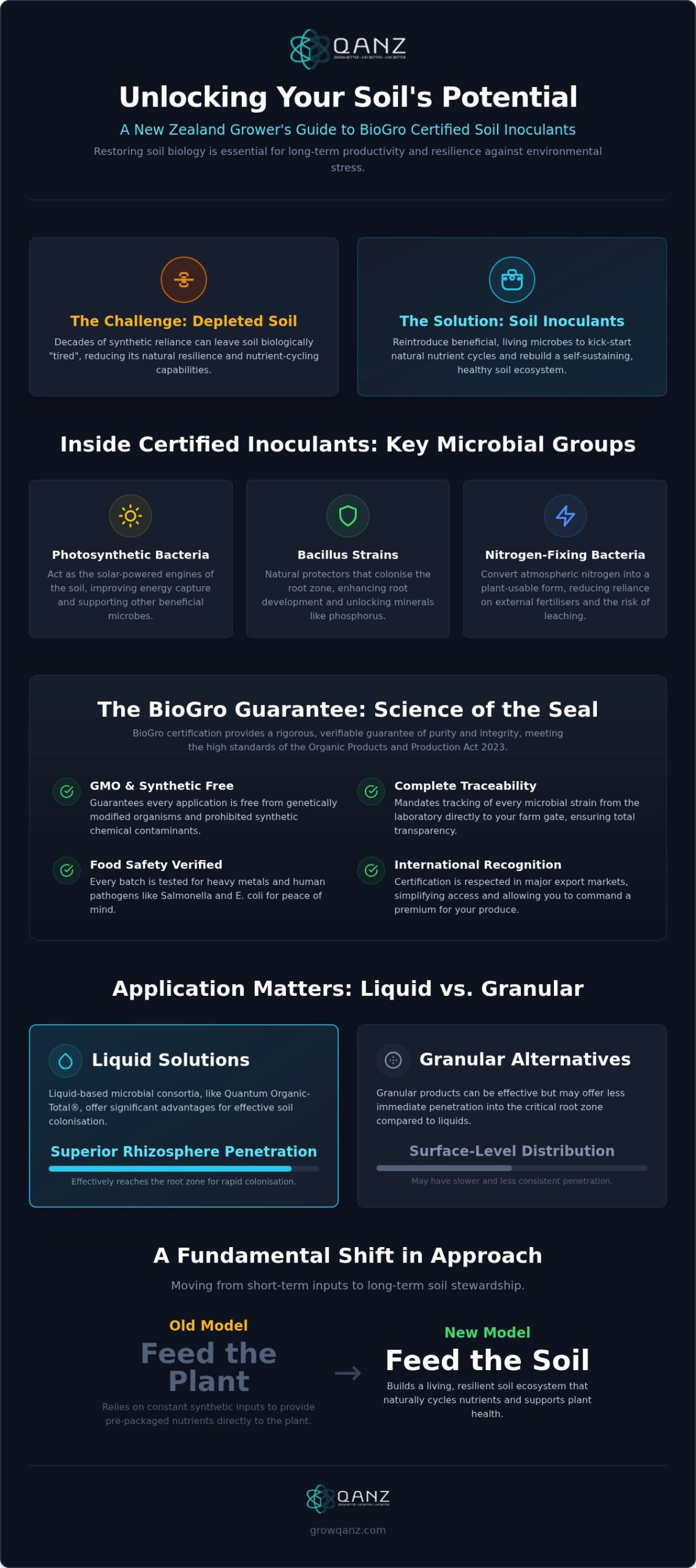
BioGro certified soil inoculants are highly concentrated biological treatments designed to introduce specific, beneficial strains of bacteria and fungi directly into the rhizosphere. Unlike traditional inputs, these aren’t just raw nutrients; they’re living ecosystems. The BioGro seal serves as a rigorous guarantee that the product contains no genetically modified organisms (GMOs), synthetic chemicals, or prohibited contaminants. For professional growers across New Zealand, this certification represents the gold standard of purity, ensuring every application supports the farm’s organic status while fostering long-term ecological health.
It’s vital to distinguish between soil inoculants and standard organic fertilisers. While fertilisers primarily provide raw minerals or organic matter for the plant to consume, an inoculant provides the biological machinery required to make those minerals available. It’s the difference between delivering a pre-packaged meal and rebuilding the kitchen itself. By colonising the root zone, these microbes create a self-sustaining cycle of nutrient availability that synthetic alternatives simply can’t replicate.
The Role of Microbes in Soil Stewardship
Healthy soil is a living entity. In many New Zealand paddocks, years of intensive synthetic use have left the soil “tired” and biologically depleted. BioGro certified soil inoculants act as a catalyst to kick-start the natural nutrient cycle. By reintroducing microbial diversity, growers can enhance soil carbon sequestration, as stable carbon is often a byproduct of microbial activity. A robust, living soil also serves as the primary defence against soil-borne pathogens, naturally suppressing diseases that would otherwise require chemical intervention.
Key Microbial Groups in Certified Inoculants
The efficacy of a certified inoculant depends on the specific consortium of microbes included. Professional-grade solutions typically feature several key groups:
- Photosynthetic bacteria: These act as the solar-powered engines of soil vitality, improving the efficiency of energy capture and supporting other beneficial microbes in the soil matrix.
- Bacillus strains: Recognised as natural protectors, these bacteria colonise the root zone to enhance root development and improve the solubilisation of phosphorus and other locked-up minerals.
- Nitrogen-fixing bacteria: These microbes convert atmospheric nitrogen into a form plants can readily use, significantly reducing the reliance on external nitrogenous inputs and lowering the risk of leaching.
This biological approach moves away from the “feed the plant” model toward a “feed the soil” philosophy. It ensures that the land remains productive and resilient, meeting the high expectations of both domestic and international organic markets.
The Science of the Seal: BioGro Standards for 2026
In the current agricultural climate, the threshold for transparency has never been higher. Under the Organic Products and Production Act 2023, New Zealand growers must provide absolute proof of the purity of their inputs. BioGro standards for 2026 mandate a level of traceability that tracks every microbial strain from the laboratory directly to your farm gate. This isn’t just about ticking a box; it’s about ensuring that no “hidden” chemical additives or synthetic carriers enter your soil system. Many uncertified biologicals rely on prohibited surfactants to maintain shelf life, but BioGro certified soil inoculants are formulated to remain stable without compromising organic integrity.
Food safety remains a cornerstone of these rigorous standards. Every batch of certified product undergoes testing for heavy metals and human pathogens, such as Salmonella and E. coli, providing peace of mind for those in the horticulture and dairy sectors. This high level of scrutiny is what allows New Zealand produce to command a premium overseas. For example, the U.S. recognition agreement ensures that BioGro’s certification is respected in major international markets. This alignment simplifies the export process, allowing you to focus on productivity rather than navigating conflicting international regulations.
Microbial Purity and Strain Stability
Consistency is the hallmark of a professional operation. While “wild” inoculants might promise results, they often lack the strain stability required for broadacre application. Unverified products can introduce unwanted pathogens or competitive microbes that disrupt your existing soil ecology. GrowQanz prioritises proprietary, verified microbial consortia that are stabilised in liquid form. This ensures that the microbes remain dormant in the container but activate immediately upon contact with the rhizosphere, providing predictable results across diverse New Zealand soil types.
The Audit Trail: From Input to Export
Maintaining an Organic Management Plan (OMP) requires meticulous record-keeping. Every input must be justified and documented to pass annual certification audits. Using products that clearly display a BioGro number on the label removes the administrative burden from the grower. It provides an immediate, verifiable link that auditors recognise, significantly reducing the risk of a non-compliance report. You can view our certified microbial solutions to see how we integrate this level of traceability into our product range. Choosing verified inputs is a strategic decision that protects your organic status and streamlines your path to market.
Certification vs. Claims: Why Verified Biologicals Win
The agricultural marketplace is currently flooded with “natural” biological boosters that promise miraculous soil recovery. While these products often use appealing language, they frequently lack the rigorous verification required for professional use. For a New Zealand grower, the distinction between a product that is merely natural and one that is BioGro certified is a matter of business security. Choosing BioGro certified soil inoculants eliminates the guesswork, providing a verified biological tool that integrates seamlessly into a certified organic system.
Risk mitigation is perhaps the most compelling reason to stick with verified biologicals. A single application of a contaminated, uncertified input can lead to the catastrophic loss of organic status, a setback that can take years to rectify. Certified products undergo stringent audits to ensure they’re free from synthetic carriers and pathogens. This level of market security is essential for those targeting high-value export markets in Europe and North America, where regulators have zero tolerance for unverified inputs. Beyond safety, there’s an efficacy guarantee; certification proves the product contains exactly what the label claims, ensuring you don’t waste capital on inert solutions.
The ‘Snake Oil’ Problem in Biologicals
Spotting unverified claims requires a discerning eye. Many products marketed as “biological stimulants” or “soil conditioners” avoid the certification process because their formulations wouldn’t survive the scrutiny. These unverified products often hide behind proprietary “black box” recipes that lack independent trial data. Professional growers should look for the BioGro logo and number as a baseline. If a manufacturer can’t provide peer-reviewed trial results or a clear list of microbial strains, the product represents a risk rather than an investment. Scientific data and local trial results are non-negotiable when your livelihood depends on the health of your paddocks.
Building Long-Term Soil Equity
Investing in quality inoculants is about more than just this season’s harvest; it’s about building permanent soil equity. While synthetic inputs offer a temporary spike in growth followed by soil degradation, certified biologicals foster a self-sustaining ecosystem. This shift towards regenerative agriculture requires a clear understanding of return on investment. A detailed Quantum Organic-Total cost-benefit analysis demonstrates that the initial cost of high-quality inoculants is offset by reduced reliance on external fertilisers and increased plant resilience. By restoring the soil’s natural functionality, you’re securing the long-term value of your land and ensuring it remains productive for future generations.
Applying Inoculants: Best Practices for New Zealand Growers
Successful biological integration requires more than just a general application. Timing is paramount. For most New Zealand crops, aligning the delivery of BioGro certified soil inoculants with early root development ensures the microbes establish a dominant presence before pathogens can take hold. Applying during the spring flush in regions like the Waikato or Canterbury allows the microbes to capitalise on rising soil temperatures and consistent moisture. This strategic timing ensures the microbes are active when the plant’s nutrient demand is at its peak.
Soil conditions directly dictate the success of the colonisation process. Microbes are living organisms; they require adequate soil moisture to move through the soil profile and moderate temperatures to remain active. It’s best to avoid application during the height of a dry Otago summer unless you can follow up immediately with irrigation. Similarly, applying to waterlogged soils can limit the oxygen available for aerobic bacteria, stalling the very biological processes you’re trying to promote.
Liquid vs. Granular: The Superiority of Flowables
Professional operations are increasingly moving toward liquid formulations for their sheer versatility and efficacy. Research into soil penetration suggests that liquid microbial soil treatments reach the root zone faster and more uniformly than granular alternatives. They integrate seamlessly into existing fertigation systems and boom sprayers, which means you don’t need to invest in specialised equipment. This approach also eliminates the dust associated with granules, significantly improving operator safety during the mixing and handling process on the farm.
Optimising the Rhizosphere Environment
The rhizosphere is the narrow region of soil directly influenced by root secretions, and it’s where the “biological magic” happens. To maximise your return on investment, you should learn how to increase microbial activity in soil through strategic, high-count inoculation. Soil pH and the presence of organic matter are critical variables; microbes thrive in a balanced environment where they have a carbon source to fuel their initial growth. We recommend monitoring progress using soil respiration tests to measure biological activity, allowing you to adjust your Organic Management Plan based on real-world data rather than guesswork.
Managing BioGro certified soil inoculants alongside other organic amendments requires a structured approach. While most microbial solutions are highly compatible with fish emulsions or seaweed extracts, always check the BioGro compliance of every tank-mix partner to protect your certification. Maintaining a clean audit trail is much simpler when you use verified, liquid-based solutions that don’t clog nozzles or settle in the tank. If you’re looking to streamline your soil health program, you can view our full range of certified microbial solutions to find the right fit for your specific crop type.
GrowQanz: Leading the Future of Certified Soil Vitality
GrowQanz operates as more than a simple input supplier; we’re a dedicated partner for the New Zealand agricultural sector. Our mission is to provide evidence-based, 100% natural solutions that empower growers to move beyond synthetic dependency without sacrificing productivity. By focusing exclusively on BioGro certified soil inoculants, we ensure that every solution in our range is verified for purity and efficacy. We understand that the transition to biological farming requires confidence, which is why our products are backed by scientific authority and a deep connection to the land.
Our commitment to long-term ecological health is reflected in our rigorous selection of microbial strains. We prioritise reliability over hype, offering stabilised formulations that perform consistently across diverse soil types from Northland to Southland. Whether you’re managing a high-output dairy pasture or an export-focused orchard, our solutions are designed to integrate seamlessly into your existing management framework, protecting your organic status while restoring natural soil function.
Quantum Organic-Total®: The All-in-One Solution
This flagship product represents a breakthrough in microbial technology, offering a robust consortium of beneficial organisms in a single application. Integrating photosynthetic bacteria for soil into your broadacre programme provides a unique biological advantage. These “solar-powered” microbes improve energy capture within the rhizosphere, supporting other beneficial bacteria and fungi. This high-density microbial population is particularly effective for vegetable, fruit, and nut crops, where nutrient demand is intense. It’s a verified way to support plant vitality and soil structure without the need for synthetic interference.
For growers facing environmental challenges, Quantum-VSC® provides an additional layer of resilience. This formulation is specifically designed to address plant stress, helping crops recover from abiotic pressures like drought or temperature extremes. By bolstering the plant’s natural immune system and improving root architecture, it secures the harvest in an increasingly unpredictable climate.
Partnering for Sustainable Success
Transitioning to a biological system doesn’t have to be a solitary journey. We provide the technical expertise and customised application programmes required to make the shift successful. Our role in supporting microbial solutions for field crops involves working closely with growers to understand their specific soil chemistry and production goals. We don’t believe in “one size fits all” biology; we believe in precision application that respects the unique requirements of your acreage.
As the standards for organic production evolve, having a trusted partner ensures you stay ahead of regulatory changes. We handle the complexities of microbial stability and certification so you can focus on the practicalities of farming. Ready to restore the biological integrity of your land? Enquire about BioGro certified inoculants for your farm today.
Securing the Biological Legacy of Your Land
Restoring the natural vitality of your paddocks is a strategic investment that extends far beyond a single harvest. By choosing BioGro certified soil inoculants, you’re not just applying a product; you’re adopting a verified system of soil stewardship that protects your organic status and enhances plant resilience. We’ve seen how the transition to a living soil model, supported by proprietary photosynthetic microbial technology, allows New Zealand growers to lower their reliance on synthetic inputs while maintaining export-grade quality. These solutions provide the biological machinery needed to unlock nutrients and build long-term soil equity across both broadacre and horticulture sectors.
As a BioGro NZ Certified partner (#5470), GrowQanz is committed to providing the technical expertise and proven results required for your farm’s success. Our liquid-based formulations ensure superior penetration into the root zone, delivering consistent performance in diverse New Zealand conditions. It’s time to move toward a more natural and efficient way of working that respects the integrity of the land. Secure your soil’s future with BioGro certified Quantum Organic-Total® and lead the way in sustainable agricultural progress.
Frequently Asked Questions
What is the difference between a fertiliser and a soil inoculant?
A fertiliser provides raw chemical or organic nutrients directly to the plant, while a soil inoculant introduces living microorganisms that build the soil’s biological infrastructure. Think of fertiliser as the fuel and an inoculant as the engine. By re-establishing microbial populations, these treatments help plants access “locked-up” minerals already in the soil, improving nutrient uptake efficiency and fostering long-term fertility without the need for excessive synthetic inputs.
Can I use BioGro certified inoculants in a non-organic farming system?
You certainly can use these products in conventional or transitional farming systems to restore biological diversity. Many New Zealand growers integrate BioGro certified soil inoculants into traditional programmes to mitigate the soil-degrading effects of synthetic fertilisers. Reintroducing beneficial microbes helps improve soil structure and water retention, making it a strategic choice for any professional looking to enhance the sustainability and resilience of their land, regardless of their current certification status.
How often should I apply microbial inoculants to my paddocks?
Application frequency typically depends on your specific crop cycle and current soil health, but most professional programmes involve one to three applications per season. An initial application during planting or the spring flush establishes the microbial population, while follow-up treatments during peak growth stages maintain high density. For paddocks recovering from heavy synthetic use, more frequent inoculation may be necessary in the first two years to permanently re-establish the microbial ecosystem.
Are BioGro certified products safe for livestock and pollinators?
These certified products are entirely safe for livestock, pollinators, and the wider farm environment because they contain no synthetic poisons or harmful residues. Since the microbes are naturally occurring strains, there’s no withholding period for grazing dairy herds or livestock. Because these biological solutions support plant health without chemical interference, they help maintain a safe habitat for bees and other beneficial insects essential for pollination in New Zealand orchards and pastures.
Will these inoculants work in drought-prone or sandy soils?
Inoculants are particularly effective in challenging environments like the sandy soils of the Manawatu or drought-prone regions in Canterbury. Beneficial microbes produce biological glues and biofilms that bind soil particles together, significantly improving soil structure and moisture-holding capacity. This increased water efficiency helps plants remain resilient during dry spells, as the enhanced root systems created by the microbes can access deeper water reserves that would otherwise be unavailable.
How do I store liquid microbial inoculants to ensure they stay ‘alive’?
To keep the microbial consortium viable, you should store liquid inoculants in a cool, dark place away from direct sunlight and extreme temperature fluctuations. While the microbes in our stabilised formulations are designed for shelf-stability, excessive heat can cause them to activate prematurely or degrade. Ensuring the lids are sealed tightly and the containers are kept in a ventilated shed will maintain the high population count required for effective soil penetration upon application.
Can I mix soil inoculants with organic fungicides or pesticides?
Most soil inoculants are compatible with other organic amendments like seaweed or fish emulsions, but you should exercise caution when mixing them with biological fungicides. Some microbes can be sensitive to certain copper or sulphur-based treatments permitted in organic systems. We always recommend a jar test for physical compatibility and checking the BioGro compliance of all tank-mix partners to ensure you don’t inadvertently compromise the efficacy of the living microbes.
How long does it take to see a visible difference in crop health after inoculation?
You’ll typically observe changes in root development and soil structure within three to four weeks, while visible improvements in foliage and plant vigour often appear within a single growth cycle. Because BioGro certified soil inoculants work by rebuilding the soil’s natural systems, the results are cumulative rather than instantaneous. Over time, you’ll notice more consistent growth, increased resistance to environmental stress, and a measurable improvement in the overall biological activity of your paddocks.
