
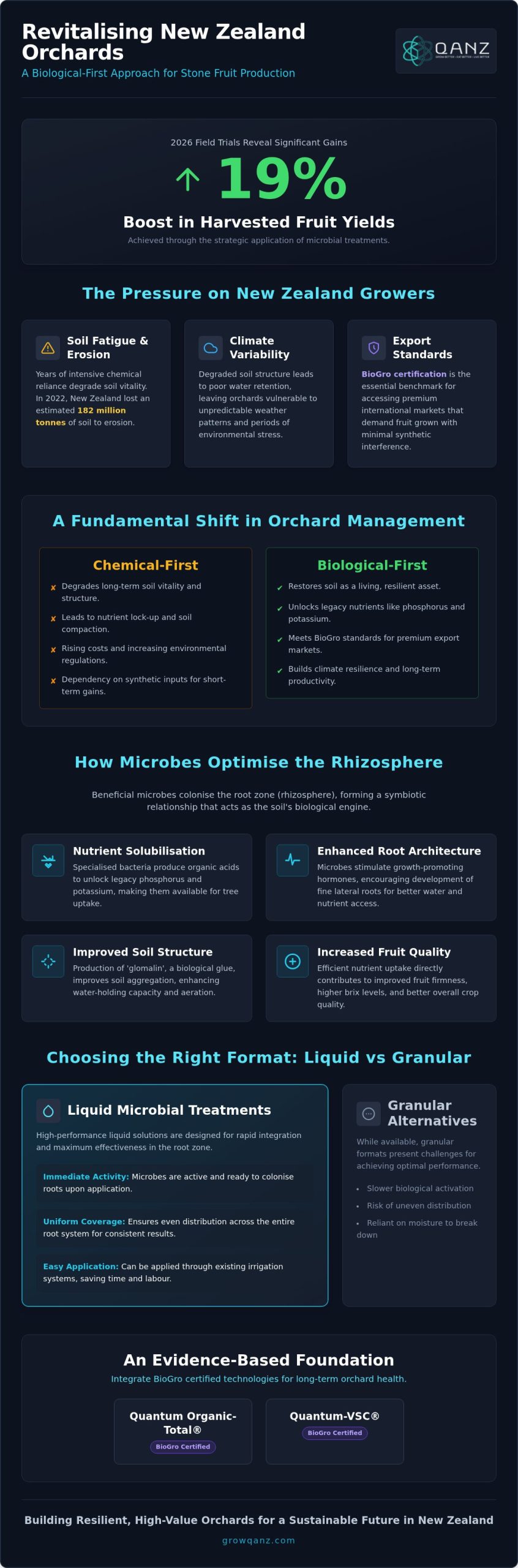
Did you know that 2026 field trials have shown microbial treatments can boost harvested fruit yields by up to 19%? Most New Zealand growers feel the mounting pressure of soil fatigue after years of intensive chemical reliance, especially as they strive to meet rigorous BioGro export standards. It’s a challenging balance to strike when climate variability makes microbial inoculants for stone fruit production a necessity rather than an alternative. You likely recognise that long-term orchard vitality requires a more holistic approach to soil health and nutrient uptake.
This guide explains how BioGro certified technologies can bridge that gap by restoring the natural biological managers within your soil. By integrating high-performance, liquid-based solutions such as Quantum Organic-Total® and Quantum-VSC®, you can unlock legacy nutrient reserves while improving fruit firmness and brix levels. We’ll examine the practical steps to transition from synthetic dependence to a biological framework that ensures your orchard remains a resilient, high-value asset for the 2026 season and beyond.
Key Takeaways
- Understand the strategic shift toward biological-first management and why BioGro certification is essential for accessing premium international stone fruit markets.
- Learn how to utilise microbial inoculants for stone fruit production to naturally solubilise legacy phosphorus and enhance nitrogen fixation in the rhizosphere.
- Compare the performance of liquid microbial treatments against granular alternatives to ensure immediate biological activity and more uniform root colonisation.
- Identify the optimal application windows throughout the season to maximise nutrient uptake efficiency and build resilience against New Zealand’s climate variability.
- Discover how integrating Quantum Organic-Total® and Quantum-VSC® creates a stable, evidence-based foundation for long-term orchard soil health.
The Evolution of Microbial Inoculants in Stone Fruit Production
The shift from a “chemical-first” approach to “biological-first” management is a defining trend for the 2026 season. New Zealand orchardists are increasingly recognising that soil is a living asset rather than a passive medium. Intensive synthetic use has historically provided rapid growth, yet it often comes at the cost of long-term soil vitality. In 2022, the nation lost an estimated 182 million tonnes of soil to erosion, with a significant portion occurring on productive lands. Restoring this lost vitality requires a return to biological fundamentals through the strategic use of beneficial microbes.
What are Microbial Inoculants for Stone Fruit?
Microbial inoculants are concentrated populations of beneficial bacteria and fungi that serve as biological soil enhancers. It’s vital to distinguish these from traditional fertilisers. While fertilisers deliver direct nutrients to the plant, inoculants improve the soil’s inherent ability to process and provide those nutrients. These biologicals function by colonising the rhizosphere, which is the narrow region of soil directly influenced by root secretions. Within this zone, specialised microbes, such as photosynthetic bacteria, establish a symbiotic relationship with the tree. They act as the biological engine of the soil, converting atmospheric and mineral resources into plant-available forms.
Why NZ Orchardists are Moving Beyond Synthetic Inputs
The transition toward microbial inoculants for stone fruit production is driven by both economic and environmental necessity. Rising costs of synthetic inputs and tighter environmental regulations have made traditional high-load chemical regimes less viable. Additionally, intensive cropping often degrades soil structure, leading to compaction and reduced water-holding capacity. This degradation leaves orchards vulnerable to climate variability and soil fatigue.
Consumers in premium export markets now demand fruit grown with minimal synthetic interference. BioGro certification has become the essential benchmark for New Zealand growers. It verifies that products like Quantum Organic-Total® meet the rigorous organic standards required for international trade. By prioritising soil health through these verified technologies, growers don’t just meet regulations; they build climate resilience and ensure the long-term productivity of their orchards. This shift represents a move toward a more stable, evidence-based partner in the field, valuing sustainable progress over temporary gains.
How Microbes Optimise the Stone Fruit Rhizosphere
The rhizosphere serves as the critical interface between the tree and the soil ecosystem. Stone fruit roots aren’t passive absorbers; they actively recruit biological partners by exuding carbon-rich compounds into the surrounding soil. This exchange creates a symbiotic relationship where trees provide energy in the form of sugars, while microbes deliver essential nutrients and protective services. Utilising microbial inoculants for stone fruit production ensures this zone is populated with high-performance strains rather than opportunistic pathogens. This biological recruitment is the engine behind long-term orchard vitality.
Nutrient Solubilisation and Uptake Efficiency
Specific bacterial strains, such as Pseudomonas protegens, act as biological miners. They produce organic acids that solubilise legacy phosphorus and potassium that would otherwise remain chemically locked in the soil profile. This process is vital for New Zealand orchards where decades of fertiliser application have created significant mineral reserves that trees cannot access alone. Nutrient uptake efficiency is the measured ratio of nutrients successfully absorbed by the tree relative to the total mineral volume present in the soil. Beyond mineral access, these microbes improve soil structure by producing glomalin, a biological glue that enhances water holding capacity and aeration. This improved structure ensures that moisture remains available even during periods of environmental stress.
Building Root System Architecture
A robust root system is the foundation of consistent fruit set and tree longevity. Biological enhancers stimulate the production of growth-promoting hormones, such as auxins and cytokinins, which encourage the development of fine lateral roots and deeper taproots. This expanded architecture allows young trees to establish themselves more quickly and access moisture from deeper soil layers during dry summer months. For those establishing new blocks, understanding how to reduce transplant shock in seedlings through microbial intervention is a proven strategy for early orchard success. A deeper root network also ensures the tree can support a heavier crop load without compromising its structural integrity.
Microbial diversity also functions as a biological shield. When the rhizosphere is saturated with beneficial bacteria, there’s little room or resource left for soil-borne pathogens to take hold. This competitive exclusion, combined with the production of natural antimicrobial compounds, keeps the root zone healthy without heavy chemical intervention. To begin building this resilient environment, growers can consider integrating Quantum Organic-Total® as a foundational soil treatment. This steady, evidence-based approach prioritises the long-term ecological health of the orchard over temporary, synthetic gains.
Liquid vs Granular: Choosing the Right Treatment Format
Liquid formulations represent the most advanced delivery system for modern orchards. Unlike granular amendments, which often rely on specific soil moisture and temperature levels to activate and release their biological load, liquid microbial inoculants for stone fruit production are active upon contact. This eliminates the activation gap often associated with dry products. For established blocks, where root systems are already deep and canopy cover is dense, liquid carriers provide the most efficient route for colonisation. They allow for precision application, ensuring that beneficial strains reach the rhizosphere directly rather than sitting on the soil surface where they are vulnerable to UV degradation.
The Advantages of Liquid Microbial Soil Treatments
Liquid solutions offer unparalleled ease of integration into existing orchard management programmes. Most professional growers already possess the necessary infrastructure, such as fertigation systems or boom sprayers, to deploy these treatments without additional capital expenditure. This delivery method ensures a uniform distribution of microbes throughout the root zone. When biologicals are suspended in a liquid carrier, they move with the water front, penetrating the soil profile more effectively than solid particles. This is particularly crucial for the rapid activation of photosynthetic bacteria, which require immediate hydration to begin their metabolic processes and nutrient cycling duties.
Why BioGro Certified Liquid Solutions Lead the Market
Achieving BioGro certification for liquid microbial products requires rigorous testing to ensure the absence of synthetic contaminants and GMOs. This verification provides peace of mind for growers targeting high-value export markets that demand clean production standards. From a practical perspective, high-quality liquid formats such as Quantum Organic-Total® are engineered for stability and ease of use. They prevent the clumping and sedimentation that often lead to equipment blockage in the shed or during mid-application. While some might assume granular options are simpler to store, a detailed Quantum Organic-Total cost-benefit analysis reveals that the superior efficacy and reduced labour requirements of liquid applications offer better long-term value. By choosing a stable, liquid-based partner, growers ensure consistent biological activity and a more reliable return on their investment in soil health.
Practical Application Strategies for NZ Stone Fruit Orchards
Successful integration of microbial inoculants for stone fruit production relies on aligning biological applications with the tree’s natural phenological cycles. Unlike synthetic fertilisers that can be applied in bulk, living microbes require a proactive, scheduled approach to ensure successful colonisation. Effective management treats the soil as a living ecosystem that needs consistent support rather than a series of isolated chemical corrections. A “little and often” strategy is typically more effective than heavy, single applications, as it maintains a stable microbial population throughout the growing season.
A Seasonal Inoculation Calendar
Timing is the most critical factor in biological management. For the 2026 season, professional growers should target three key windows to maximise their return on investment. The first application should occur at budbreak, typically using 100 mL/ha of specialised nitrogen-fixing microbes to support the early root flush. This is followed by a second application of 200 mL/ha during the post-flowering and fruit set stage to manage the peak nutrient demand of developing fruit. Finally, a post-harvest application of 200 mL/ha helps build reserves and maintains soil vitality through the winter dormancy period. These strategies are equally effective for maintaining the long-term health of nut orchards, where soil structure is paramount.
Maximising Efficacy in the Field
Environmental conditions at the time of application significantly influence microbial survival. Soil temperature and moisture are the primary drivers of establishment; microbes require a damp, aerobic environment to thrive. Applying biologicals to bone-dry soil or during periods of extreme cold can lead to high mortality rates before the colony can colonise the rhizosphere. To protect these sensitive organisms from UV degradation, evening spraying is the preferred method for many New Zealand orchardists. This allows the microbes to move into the soil profile overnight, away from the sterilising effects of direct sunlight.
Maintaining a healthy ground cover or mulch layer also provides a protective buffer for the new microbial colony. This cover regulates soil temperature and provides a secondary carbon source that fuels early biological activity. Monitoring success is best achieved through regular soil health observations and sap analysis rather than traditional NPK testing alone. If you’re looking to refine your seasonal programme, you can access professional technical support to ensure your application rates are perfectly calibrated for your specific orchard conditions. By treating these biologicals with the same precision as any other high-value input, you ensure a more resilient and productive harvest.
Boosting Yield and Resilience with GrowQanz Technologies
GrowQanz provides a stable, evidence-based partnership for growers who value long-term progress over temporary gains. As the pressure to meet international organic standards increases, the adoption of microbial inoculants for stone fruit production has become a strategic necessity for the modern orchardist. Our BioGro New Zealand certified technologies are engineered to restore the biological engine of the soil, ensuring that every tree has the metabolic support required to reach its genetic potential. By investing in biological capital, you aren’t just feeding a crop; you’re building a resilient ecosystem capable of sustained high-performance.
Quantum Organic-Total®: The All-In-One Soil Enhancer
Quantum Organic-Total® serves as the foundational treatment for establishing organic soil vitality. This 100% natural microbial consortium supports the entire growth cycle by colonising the rhizosphere with high-performance bacterial and fungal strains. Unlike synthetic inputs that provide a narrow range of nutrition, this technology improves fruit colour, size, and shelf life by optimising the tree’s internal nutrient cycling. The BioGro New Zealand certification provides the verification necessary for export confidence, ensuring your fruit meets the strict requirements of premium global markets without the risk of synthetic residues. It’s the primary tool for turning fatigued land back into a functional, high-yielding orchard.
Quantum-VSC®: Managing Climate and Drought Stress
Environmental variability remains one of the greatest risks to consistent stone fruit production. Quantum-VSC® is specifically formulated to build plant resilience against environmental stressors such as water deficit and extreme heat. These specific microbial strains stimulate the production of protective compounds within the tree, allowing it to maintain metabolic activity during periods of drought. Additionally, Quantum-VSC® plays a vital role in recovering soil health after years of intensive chemical disturbance; it effectively reboots the microbiome to suppress pathogens and improve water holding capacity. This proactive approach to stress management ensures that your orchard remains productive even when climate conditions are sub-optimal.
To refine your seasonal strategy and see how these biologicals can be integrated into your specific management programme, Contact GrowQanz for a technical consultation on your stone fruit programme. Our team provides the professional support and technical expertise needed to transition your orchard into a high-vitality biological system that delivers consistent results year after year.
Securing the Future of Your Orchard Through Biological Capital
Transitioning to a biological-first management system is a strategic investment in the longevity of your land. By prioritising the health of the rhizosphere, you ensure your trees have the necessary support to withstand climate variability and intensive production cycles. We’ve explored how liquid-based microbial inoculants for stone fruit production provide immediate, uniform results that synthetic alternatives simply cannot match. This approach builds the soil vitality required for superior fruit quality and consistent yields.
GrowQanz remains a committed partner for professional New Zealand orchardists who value evidence-based progress and sustainable growth. Our 100% natural, BioGro NZ certified microbial strains are supported by local agricultural experts who understand the unique challenges of the New Zealand landscape. You can rely on our technical support to help integrate these solutions seamlessly into your existing programmes.
Enquire about Quantum Organic-Total® for your orchard today and begin the journey toward a more resilient, high-vitality production system. Your soil is your most valuable asset. It’s time to treat it with the scientific precision it deserves.
Frequently Asked Questions
What are the best microbial inoculants for stone fruit production in NZ?
Quantum Organic-Total® and Quantum-VSC® are the premier BioGro certified options for microbial inoculants for stone fruit production. Quantum Organic-Total® serves as the essential foundation for soil vitality, while Quantum-VSC® is engineered to target plant stress and environmental resilience. These 100% natural, liquid-based solutions are specifically formulated to meet the high standards of the New Zealand stone fruit sector, providing a reliable alternative to synthetic inputs.
Can I use microbial inoculants with my existing irrigation system?
Yes, our liquid-based microbial technologies are designed for easy integration into standard fertigation and boom sprayers. Because they are 100% natural and stable, they don’t cause clumping or equipment blockages in the shed. This allows for precision application across broadacre orchards without needing specialised installation services. It’s a practical way to deliver beneficial biology directly to the root zone with minimal labour requirements.
How long does it take to see results from microbial soil treatments?
Initial biological colonisation of the rhizosphere begins immediately upon contact, though visible improvements in tree vigour and fruit quality typically develop over a full growing season. Growers often report better nutrient uptake efficiency and improved soil structure within the first year of a scheduled application programme. Steady, long-term use builds biological capital, leading to more consistent fruit set and improved orchard resilience year after year.
Are GrowQanz products safe for use in BioGro certified organic orchards?
Absolutely, all GrowQanz microbial technologies, including Quantum Organic-Total® and Quantum-VSC®, are BioGro New Zealand certified. This certification ensures the products are 100% natural, free from synthetic contaminants, and non-GMO. This provides essential verification for growers targeting premium organic export markets. Using these certified solutions allows you to maintain high productivity while strictly adhering to the rigorous environmental standards required for organic certification.
Do microbial inoculants help with drought resistance in stone fruit trees?
Yes, specific strains in Quantum-VSC® help trees manage water deficit by stimulating deeper root systems and improving the soil’s water-holding capacity. These microbes act as biological managers that protect the tree’s metabolic functions during periods of heat and moisture stress. This is vital for maintaining consistent fruit set during New Zealand’s increasingly variable summer months, ensuring trees remain productive even when irrigation resources are stretched.
Is it better to apply liquid microbes or granular compost tea?
Liquid microbial inoculants for stone fruit production are generally superior to granular options because they are active upon contact. Liquid carriers ensure uniform distribution throughout the root zone and avoid the activation gap associated with dry products that require specific moisture levels to release their beneficial organisms. This format also allows for more precise dosing and easier integration into modern orchard management systems without the risk of clumping.
How do microbes improve the brix levels and firmness of cherries and apricots?
Beneficial microbes enhance the solubilisation of phosphorus and potassium, which are critical for sugar translocation and cell wall strength. By improving the tree’s ability to access these legacy mineral reserves, microbial treatments naturally boost brix levels and fruit firmness. This leads to better shelf life and market value, as the fruit is more resilient during transport and meets the high quality expectations of international consumers.
What is the recommended application rate for Quantum Organic-Total® in an established orchard?
For professional growers, we recommend a scheduled approach to maintain biological momentum throughout the season. The standard application rates for Quantum Organic-Total® are:
- 100 mL/ha applied at budbreak to support early root development.
- 200 mL/ha applied post-flowering to manage peak fruit set demand.
- 200 mL/ha applied post-harvest to build reserves for the following season.
These rates ensure consistent rhizosphere colonisation and optimal nutrient uptake.
Disclaimer
Important: This article provides general agricultural information only. Product performance can vary according to crop, soil, climate, management practices and application conditions. Trial or research results discussed may have been obtained under specific conditions and should not be interpreted as a guarantee of equivalent results. Always follow current product directions and confirm suitability for your crop, growing system and organic certification requirements. Contact QANZ for current product and application information.
