
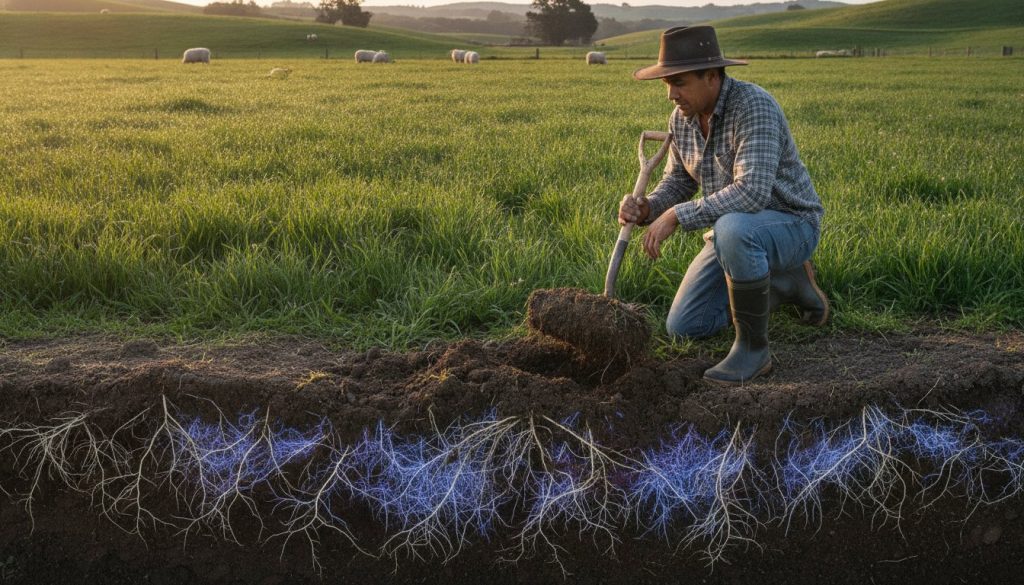
What if the most valuable asset on your New Zealand farm isn’t the livestock you see, but the invisible workforce beneath their hooves? Many local graziers are finding that despite increasing their fertiliser applications, pasture persistence is declining and paddocks are becoming increasingly prone to pugging during a wet Waikato winter. We understand it’s a frustrating cycle where rising input costs don’t translate into long-term resilience. Learning how to improve soil biology for pasture is no longer just an ecological preference; it’s a financial necessity for the modern primary producer who wants to break free from synthetic dependency.
In this guide, you will discover how to revitalise your paddock’s underground ecosystem to reduce fertiliser costs and improve pasture persistence. We provide a practical overview of microbial inoculation, explaining how BioGro-certified solutions like Quantum Organic-Total® can unlock bound nutrients and create a more resilient, nutrient-dense forage that thrives even during a dry Canterbury summer. By focusing on the technical merits of soil microbiology, you can restore the natural harmony of your land and secure its long-term viability.
Key Takeaways
- Understand how the rhizosphere acts as the engine room for nutrient cycling, converting dormant minerals into plant-available food for ryegrass and clover.
- Learn how to improve soil biology for pasture by prioritising year-round living roots and minimising physical disturbance to protect delicate fungal networks.
- Master the practical “Spade Test” to evaluate soil structure and aerobic health, providing insights that a standard NPK soil test often misses.
- Identify the critical first steps of correcting drainage and pH imbalances to ensure a hospitable environment for beneficial soil microbes.
- Discover how BioGro-certified microbial inoculants like Quantum Organic-Total® can accelerate pasture recovery and reduce your long-term reliance on synthetic fertilisers.
Understanding the ‘Underground Labour Force’ in Your Pasture
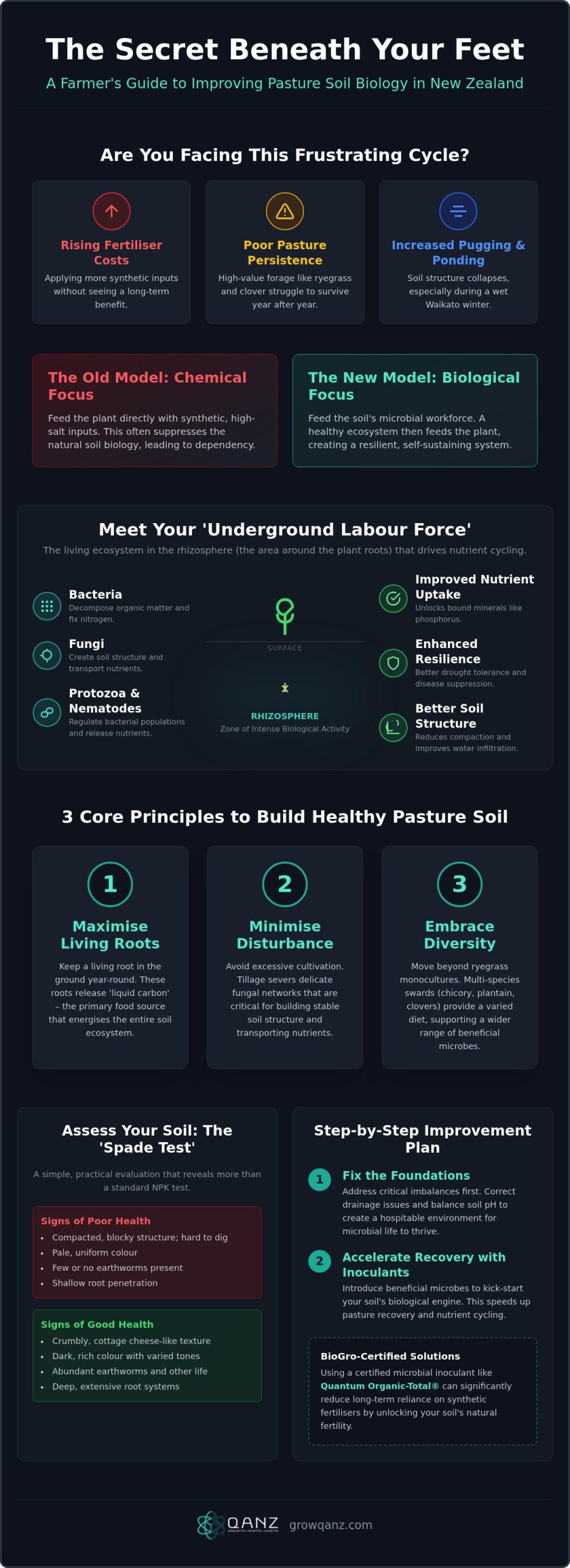
Soil is far more than a physical medium for anchoring roots. It’s a complex, living ecosystem populated by an “underground labour force” of bacteria, fungi, protozoa, and nematodes. These organisms concentrate in the rhizosphere, which is the thin layer of soil directly influenced by root secretions. When we discuss how to improve soil biology for pasture, we’re essentially talking about managing this biological community to restore natural fertility. This community acts as the engine room for nutrient cycling. In a healthy system, microbes digest organic matter and mineral particles, converting them into plant-available forms that ryegrass and clover can actually absorb.
Many New Zealand farmers are witnessing their biological systems “stall.” You’ll see this when dung patches persist for months without breaking down, or when surface ponding occurs despite moderate rainfall. These are red flags. They indicate that the soil is no longer “breathing” and the microbial workforce has been suppressed. For decades, the dominant “chemical” model focused on feeding the plant directly with synthetic inputs. In contrast, the biological model focuses on feeding the soil life. By nourishing the microbes, you create a self-sustaining system where the soil feeds the plant. Understanding Soil Health requires acknowledging that biological vitality is the foundation of physical structure and chemical balance.
The Role of Photosynthetic Bacteria in Soil Health
Photosynthetic bacteria are unique because they don’t just consume organic matter; they capture solar energy to fix carbon and nitrogen directly into the soil profile. This process provides a critical energy source for other beneficial microbes, including mycorrhizal fungi which extend the root’s reach for phosphorus. Unfortunately, these bacteria are highly sensitive. Heavy reliance on synthetic fungicides or high-salt fertilisers often eliminates them from the paddock, leaving the soil dependent on external inputs rather than internal energy production.
Why Pasture Persistence Depends on Microbial Diversity
A diverse microbial population acts as a biological shield. When your soil is teeming with a wide range of species, there is less room for pathogens to take hold and damage root systems. This diversity also improves “paddock breathability” by creating stable soil aggregates that allow air and water to move freely. For high-value forage species like perennial ryegrass, this improved structure means roots can penetrate deeper into the subsoil. Implementing a strategy for how to improve soil biology for pasture ensures deeper roots, leading to better drought resilience and improved clover persistence. This keeps your pasture productive for years rather than requiring frequent, expensive reseeding.
The Core Principles of Building Pasture Soil Biology
Microbes are essentially invisible livestock that require the same basic necessities as your herd: food, water, and shelter. Understanding how to improve soil biology for pasture begins with the realisation that the primary food source for these organisms is liquid carbon, or root exudates, produced during photosynthesis. By maximising living roots year-round, you ensure a constant supply of energy to the rhizosphere. Permanent pastures are particularly effective at this because they keep the “kitchen” open every day of the year, unlike annual systems that leave the soil fallow and the microbes starving.
Minimising soil disturbance is another non-negotiable pillar. Every time a paddock is cultivated, the delicate networks of fungal hyphae are physically severed and the soil’s internal architecture is destroyed. These fungi are responsible for building stable soil aggregates and transporting nutrients like phosphorus over distances roots cannot reach on their own. High-intensity tillage leads to a collapse in soil structure, making the land far more susceptible to compaction and erosion. Adopting the NRCS Soil Health Principles, specifically reducing mechanical disturbance, allows these biological structures to mature and function at their peak efficiency.
Diversity is the final piece of the puzzle. A monoculture of ryegrass provides a limited diet for soil life, whereas multi-species swards including chicory, plantain, and various clovers offer a varied menu of exudates. This variety supports a wider range of microbial strains, creating a more resilient ecosystem that can withstand climatic extremes. If you are looking to accelerate this transition, you might consider how specialised microbial inoculants can complement your diverse plantings, providing a practical blueprint for how to improve soil biology for pasture without relying solely on passive recovery.
Maintaining Soil Cover and Buffering Temperature
Bare ground is a significant liability under the harsh New Zealand summer sun. When soil temperatures exceed 30°C, microbial activity slows significantly; once they hit 40°C, many beneficial organisms simply die off. Maintaining a consistent residual cover acts as a biological buffer, keeping the soil cool and preserving the moisture essential for microbial survival. During winter rotations, careful management of cover also prevents the structural damage of pugging, ensuring the soil remains aerobic and habitable for your underground workforce.
Reducing the ‘Synthetic Shock’ to Soil Life
High-salt fertilisers and certain synthetic inputs can create a “synthetic shock” that dehydrates soil microbes through osmotic pressure. This often triggers “lazy plant” syndrome, where the plant stops pumping exudates into the soil because it is being artificially spoon-fed NPK. This shut-down starves the biology and creates a cycle of dependency on external inputs. A more sustainable approach involves tapering off synthetic applications while simultaneously ramping up biological activity to restore the soil’s natural nutrient-cycling capacity.
How to Assess Your Current Soil Biological Health
Standard herbage and soil tests measure the total quantity of nutrients, but they often fail to measure their actual availability to the plant. A paddock might show high phosphorus levels on paper, yet the ryegrass remains stunted because the microbial “unlocking” mechanism is missing. Understanding how to improve soil biology for pasture requires a shift from relying solely on laboratory spreadsheets to active paddock observation. You need to see if the engine is actually running, not just if the tank is full.
The most reliable tool for this assessment is a simple spade. Dig a 20cm cube of soil and examine its structure. Healthy soil should resemble a moist chocolate cake; it should be crumbly, dark, and filled with visible pores that allow for air and water movement. If the soil smells sour, putrid, or metallic, it’s likely anaerobic and lacking the oxygen necessary for beneficial life. Look closely for “rhizosheaths,” which are soil particles that cling to the roots like a fuzzy sleeve. This is a direct sign of microbial glues, such as glomalin, actively building soil structure and protecting the plant.
Earthworm counts are another vital metric for the New Zealand grazier. Aim for at least 15 to 20 worms per spade square. Their presence indicates a functional food web and high levels of organic matter being processed. Rapid dung pat decomposition is also essential. If pats sit on the surface for months rather than weeks, your biological “engine” has stalled. These observations align with key principles to maximize forage production, where soil health is treated as the primary driver of animal performance. For serious growers, advanced PLFA (Phospholipid Fatty Acid) analysis can provide a “DNA test” of the soil, identifying the biomass of specific groups like fungi and bacteria to track your progress over time.
The VSA (Visual Soil Assessment) Method
Visual Soil Assessment (VSA) provides a structured way to score your farm’s progress without expensive lab fees. By evaluating soil porosity and the presence of mottling, which are orange or grey streaks in the soil, you can identify where compaction is suffocating your microbes. High porosity scores mean your soil can “breathe,” allowing the aerobic bacteria that drive nitrogen fixation to flourish. Recording these scores annually creates a valuable baseline for your biological transition.
Testing for Nutrient Uptake Efficiency
A Brix refractometer measures the dissolved solids and sugars in the plant sap, serving as a proxy for microbial mineral transfer. High Brix readings suggest the plant is efficiently photosynthesising and pumping carbon into the ground to feed its microbial partners. This often results in reduced insect pressure, as pests struggle to digest complex plant sugars. The ‘Rhizosphere Effect’ is the concentrated area of microbial activity surrounding the root where plants swap sugars for minerals, directly determining the nutrient density of your forage.
Step-by-Step: How to Improve Soil Biology for Pasture
Moving from assessment to active restoration requires a logical sequence of interventions. If your spade test revealed compacted, sour-smelling soil, simply adding more microbes won’t solve the problem. You must first ensure the environment is habitable. Understanding how to improve soil biology for pasture involves a five-step process designed to shift your soil from a dormant state to a high-functioning ecosystem.
- Step 1: Address drainage and compaction. Microbes require oxygen to drive nutrient cycling. Use a subsoiler or aerator to break up pans and allow air to penetrate the root zone, creating the aerobic environment essential for beneficial bacteria.
- Step 2: Correct extreme pH imbalances. While many microbes are resilient, a pH below 5.5 can significantly inhibit the growth of nitrogen-fixing bacteria. Aim for a target range of 6.0 to 6.5 to support peak biological diversity.
- Step 3: Introduce high-quality microbial inoculants. This “re-seeds” the soil population with specific, functional strains that may have been lost through years of synthetic use.
- Step 4: Provide carbon starters. New microbial arrivals need an immediate food source. Applying humates or seaweed alongside your inoculant provides the complex carbons required to sustain the population until root exudates take over.
- Step 5: Monitor and adjust grazing. Avoid over-grazing, which depletes the plant’s carbohydrate reserves and halts the flow of sugars to the soil life. Leave sufficient residual cover to protect the developing biological network from temperature extremes.
By following these steps, you transition from a “passive” management style to an “active” biological strategy. This approach doesn’t just wait for nature to recover; it provides the necessary catalysts to accelerate the process. To start your transition today, explore our range of BioGro-certified solutions designed specifically for New Zealand pastoral conditions.
The Power of Active Microbial Inoculation
Waiting for nature to replenish a depleted microbiome can take decades, especially in soils treated with heavy synthetic loads. Active inoculation bypasses this delay. Using liquid solutions like Quantum Organic-Total® ensures even paddock coverage, allowing billions of beneficial microbes to reach the rhizosphere simultaneously. These liquid treatments are easily integrated into your existing spray or fertigation schedules, making broadacre application both practical and efficient.
Feeding the Microbiome: Beyond Nitrogen
Microbes require more than just carbon; they need trace elements like Boron, Zinc, and Copper to act as co-factors for their metabolic enzymes. When you improve phosphorus solubilisation through biological means, you unlock “frozen” phosphorus reserves already present in your soil. This reduces your reliance on imported fertilisers. For those managing larger areas, our guide on microbial solutions for field crops offers deeper insights into scaling these biological techniques for maximum soil vitality.
GrowQanz Solutions: Accelerating Pasture Health Naturally
Restoring a degraded soil ecosystem requires more than just a change in management; it often necessitates a targeted infusion of beneficial life. Quantum Organic-Total® serves as the definitive starter kit for graziers committed to learning how to improve soil biology for pasture. This BioGro-certified technology provides a concentrated, shelf-stable community of microbes that immediately begins to colonise the rhizosphere. Because it’s 100% natural and verified for New Zealand conditions, it offers a reliable pathway for both organic and conventional farmers to reduce their synthetic dependency without risking yield stability.
The “Total” advantage lies in its proprietary blend of microbial strains, specifically the inclusion of photosynthetic bacteria. As discussed earlier, these unique organisms capture solar energy to fix carbon directly into the soil, providing the fuel necessary for other microbes to thrive. Unlike granular products that can be patchy in their distribution, our liquid-based treatments ensure uniform coverage across the entire paddock. You can apply these solutions using your existing spray equipment or fertigation systems, making it a seamless addition to your seasonal rotation. This ease of application allows for precise timing, ensuring microbes are delivered when the soil moisture and temperature are optimal for colonisation.
Quantum-VSC® for Stress Resilience
While Organic-Total builds the foundation, Quantum-VSC® focuses on extreme stress resilience and the breakdown of complex organic matter. This formulation specifically targets root expansion, helping plants access moisture deep within the soil profile where standard ryegrass roots might not reach. In regions like Canterbury or Northland, where dry summers often cause pasture to check, the VSC strains provide a critical advantage in persistence. Integrating VSC with Organic-Total creates a comprehensive biological program that protects your forage from climatic volatility while improving the long-term structure of your land.
The GrowQanz Advantage: Professional Support for Professional Growers
We believe that high-science solutions should be backed by practical, field-level support. Our team provides the technical guidance necessary to interpret your soil health progress, helping you validate the transition from synthetic inputs to a biological model through tangible paddock results. By using evidence-based products, you aren’t just guessing how to improve soil biology for pasture; you’re implementing a proven system for ecological and financial health. Ready to revitalise your paddocks? Explore our BioGro certified range today and start your journey toward a more resilient, self-sustaining farm.
Securing the Future of Your Pastoral Land
Restoring the biological vitality of your soil is one of the most significant investments you can make for the long-term health of your farm. By shifting from a purely chemical model to one that prioritises the “underground labour force,” you create a system that cycles nutrients more efficiently and resists climatic extremes. Mastering how to improve soil biology for pasture allows you to break the cycle of synthetic dependency and build a resilient paddock structure that supports high-value forage species through every season.
Success lies in combining sound management principles with active, high-science inoculation. Our solutions are BioGro New Zealand Certified and feature proprietary photosynthetic bacteria strains that have delivered proven results in NZ pastoral conditions. This targeted approach ensures your soil has the specific microbial tools it needs to thrive right now, rather than waiting decades for natural recovery.
Maximise your pasture’s potential with BioGro certified microbial technology from GrowQanz.
It’s time to work with nature rather than against it. By nourishing the life beneath the surface, you’re ensuring the productivity and integrity of your land for generations to come. We’re here to support you in making that transition with confidence and scientific precision.
Frequently Asked Questions
How long does it take to see results from improving soil biology?
You can observe initial changes in soil structure and root development within six to twelve months of starting a biological program. While microbial populations begin colonising the rhizosphere immediately, the visible shift in pasture persistence and nutrient cycling depends on your starting soil condition. Consistent application over several seasons leads to the most significant improvements in paddock resilience and forage density across your farm.
Can I use microbial inoculants alongside my regular fertiliser program?
Yes, you can integrate microbial solutions into a conventional fertiliser regime, provided you avoid mixing them directly with high-salt concentrates. These synthetic inputs can dehydrate microbes through osmotic shock. For the best results, apply your biological treatments separately or alongside carbon sources like humates to buffer the microbes and support their survival while you gradually reduce your synthetic dependency over time.
Is it necessary to be a certified organic farmer to use BioGro products?
No, BioGro certification simply ensures that our products are 100% natural and free from synthetic interference. Many conventional New Zealand dairy and drystock farmers use BioGro-certified solutions like Quantum Organic-Total® to improve soil health without compromising their current management systems. It provides a verified standard of purity that appeals to any professional grower prioritising long-term ecological viability and soil integrity.
What is the best time of year to apply microbial treatments to pasture?
Spring and autumn are the optimal times for application because soil moisture and temperatures are generally most favourable for microbial activity. Applying treatments when the soil is between 10°C and 25°C ensures that the bacteria and fungi can establish themselves before the extremes of a New Zealand summer or winter. Using liquid applications during these periods ensures even coverage across the rhizosphere when plants are actively growing.
Will soil biology help with paddock drainage and pugging?
Improving soil biology is a primary way to address drainage issues by promoting the formation of stable soil aggregates. Microbes produce biological glues like glomalin that bind soil particles together, creating pores for air and water movement. This improved structure increases the soil’s load-bearing capacity, making your paddocks less prone to pugging during wet Waikato or Southland winters while significantly enhancing water infiltration.
How do I know if the microbes I’m applying are actually surviving in my soil?
You can verify microbial survival through visual indicators like increased earthworm counts, faster dung pat decomposition, and the presence of thick “rhizosheaths” on plant roots. For more technical validation, serious growers use PLFA analysis to measure the biomass of specific microbial groups. Observing how to improve soil biology for pasture through these practical signs confirms that your underground workforce is active and functional in the paddock.
Can improving soil biology help reduce my urea usage?
Enhancing your soil’s biological activity directly supports nitrogen fixation and nutrient mineralisation, which can lead to a significant reduction in urea requirements. Microbes like the photosynthetic bacteria in Quantum Organic-Total® capture atmospheric nitrogen and unlock phosphorus reserves already present in the soil. As your biological system becomes more efficient, you can gradually taper off synthetic nitrogen while maintaining high pasture yields and clover persistence.
Do microbial treatments work on all soil types found in New Zealand?
Yes, microbial treatments are effective across the diverse range of New Zealand soil types, from the volcanic loams of the Central Plateau to the heavy clays of Northland. The fundamental principles of how to improve soil biology for pasture remain consistent regardless of soil texture. Our proprietary strains are selected for their ability to adapt to various environments, helping to restore structure and fertility in both sandy and high-clay profiles.
