

Microbial inoculants for brassica crops focus on free-living bacteria rather than mycorrhizal species, which these plants naturally reject. While most crops benefit from fungal associations, brassicas are non-mycorrhizal, requiring a specific approach to biological soil management. By using verified rhizobacteria, growers across Australia and New Zealand can support nutrient cycling and soil vitality, even in intensive beds prone to compaction.
It’s frustrating to invest in biological inputs only to wonder if they’re actually colonising the root zone or simply washing away. Many producers feel the pressure of maintaining soil health while managing the high nutrient demands and heavy cultivation typical of cabbage and broccoli production. You might have noticed that intensive rotations often leave soil feeling lifeless, making it harder for crops to reach their full potential without increasing synthetic inputs.
This guide explains how specific beneficial bacteria interact with the brassica rhizosphere to support soil structure and nutrient efficiency. You’ll discover a practical framework for integrating biological inputs into your 2026 crop programmes, ensuring your soil remains productive and resilient for seasons to come. We will examine the science of bacterial colonisation and how to select verified inputs that align with sustainable farm management.
Key Takeaways
- Understand why brassica crops reject arbuscular mycorrhizal fungi and how this unique root biology alters your biological soil management strategy.
- Discover how to select compatible microbial inoculants for brassica crops by targeting free-living bacteria that thrive independently in the rhizosphere.
- Learn practical application protocols to establish beneficial microbial populations early during nursery tray drenching and field transplantation.
- Identify the key agronomic factors, including soil moisture and organic carbon content, that dictate the long-term persistence of biological amendments.
- Explore how to integrate liquid microbial technologies, such as Quantum Organic-Total®, into standard commercial crop programmes across Australia and New Zealand.
Understanding the Brassica Rhizosphere: Why Microbial Biology Differs
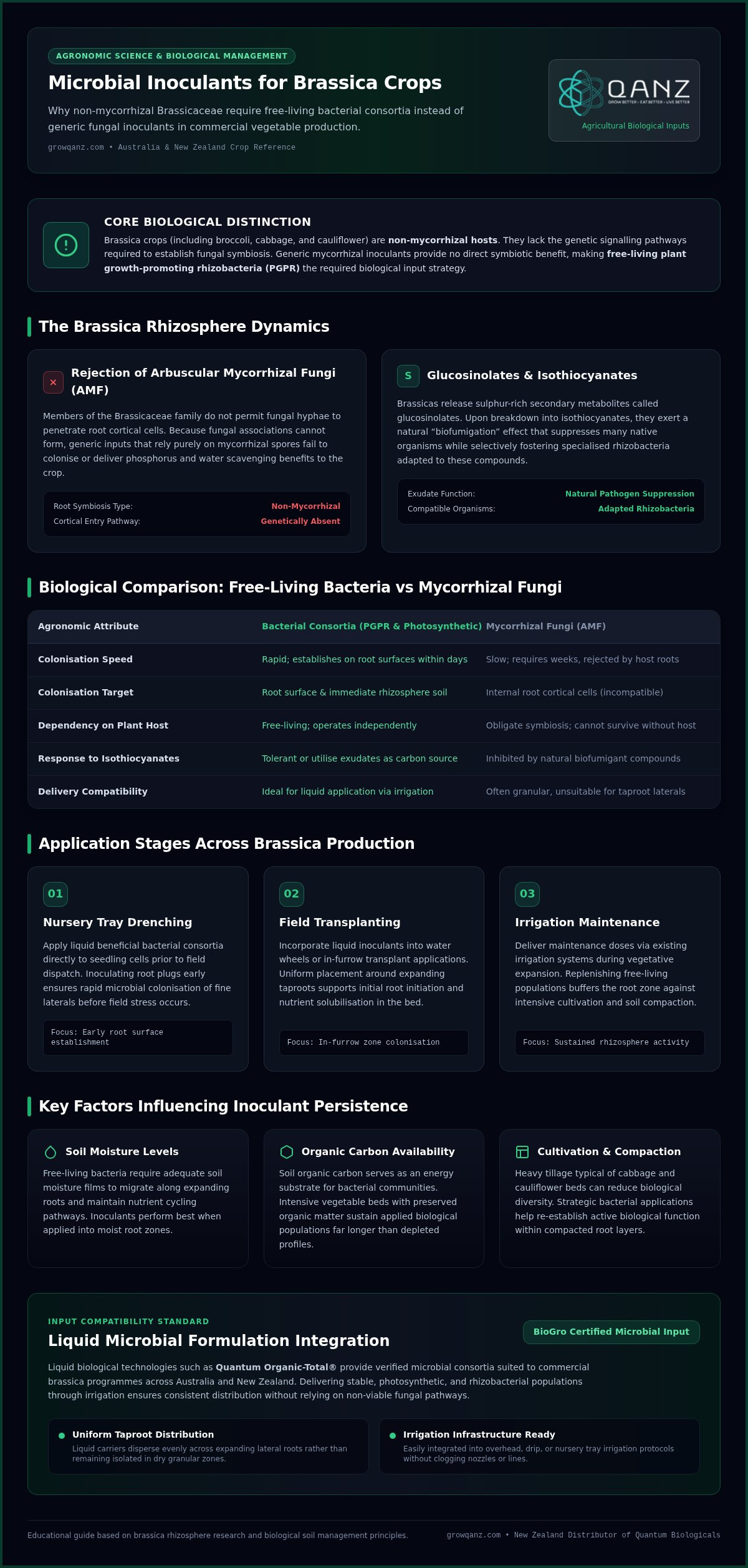
Brassica crops exhibit a distinct rhizosphere chemistry that sets them apart from the majority of commercial field crops. While most agricultural species rely on a symbiotic partnership with arbuscular mycorrhizal fungi (AMF) to scavenge phosphorus and water, members of the Brassicaceae family have evolved a different strategy. This biological divergence means that standard Microbial inoculants designed for broad-acre use often fail to deliver results if they rely solely on fungal associations. For growers managing field crops in Australia and New Zealand, understanding this distinction is the first step toward effective soil management.
Commercial brassica production involves managing plants that are naturally resistant to fungal colonisation. This isn’t a sign of poor health, but rather a unique evolutionary trait. Because these crops don’t form these common underground networks, the focus of microbial inoculants for brassica crops must shift toward free-living beneficial bacteria and photosynthetic organisms that colonise the root surface directly. These organisms thrive in the thin layer of soil surrounding the roots, where they facilitate nutrient cycling without needing to enter the plant tissue itself.
The Non-Mycorrhizal Nature of Brassica Crops
The rejection of AMF is a defining characteristic of cabbage, broccoli, and cauliflower. Generic inoculants containing mycorrhizal spores provide no direct symbiotic benefit to these plants, as the fungi cannot penetrate the root wall to exchange nutrients. Commercial Brassicaceae function as non-mycorrhizal hosts, meaning they lack the genetic signalling pathways required to facilitate symbiotic fungal entry into root cortical cells. Instead of relying on fungal hyphae to extend their reach, these plants depend on a diverse community of specialized bacteria to solubilise nutrients in the immediate root zone.
Glucosinolates and Native Microbial Communities
Brassicas produce secondary metabolites known as glucosinolates. When these sulphur-rich compounds break down into isothiocyanates, they act as natural inhibitors for many soil organisms. While this “biofumigation” effect helps suppress certain pathogens, it also creates a selective environment for the rhizosphere community. Specialised rhizobacteria have adapted to these exudates, using them as a carbon source or simply tolerating their presence to outcompete other microbes. Maintaining robust biological diversity ensures the soil system remains buffered against the intensive cultivation and compaction often found in professional vegetable beds.
Selecting Compatible Microbial Inoculants for Brassica Crops
Selecting the right microbial inoculants for brassica crops involves a departure from standard broad-acre biological strategies. Since brassicas don’t form fungal partnerships, growers must prioritise microbial species capable of independent, free-living growth. Plant growth-promoting rhizobacteria (PGPR) and photosynthetic bacteria represent the ideal biological classes for these systems. These organisms don’t require a symbiotic handshake to function. Instead, they colonise the root surface and surrounding soil, actively cycling nutrients and supporting plant resilience from day one.
Liquid microbial formulations are generally preferred in commercial vegetable production. They ensure uniform distribution around expanding taproots and fine laterals, especially when delivered through existing irrigation infrastructure. Prioritising a BioGro certified microbial input ensures that the biologicals you apply meet rigorous standards for purity and stability, providing confidence for both organic and conventional programmes.
Beneficial Bacterial Consortia vs Mycorrhizal Fungi
The following table contrasts the functional differences between these two biological categories in the context of brassica production.
| Feature | Bacterial Consortia (PGPR) | Mycorrhizal Fungi (AMF) | |||
|---|---|---|---|---|---|
| Colonisation Speed | Rapid; establishes on root surfaces within days. | Slow; requires weeks to form internal structures. | Nutritional Interaction | Solubilises nutrients independently in the soil. | Requires plant carbon to function effectively. |
| Brassica Compatibility | High; thrives on non-mycorrhizal exudates. | Ineffective; rejected by Brassicaceae roots. |
Diverse multi-species bacterial consortia offer greater agronomic resilience than single-strain products. A community of microbes can adapt to varying soil temperatures and moisture levels, ensuring that biological activity continues even when conditions fluctuate. This diversity is essential for maintaining nutrient availability throughout the entire growing season.
Evaluation Criteria for Commercial Horticultural Inoculants
Liquid formats simplify handling for Australian and New Zealand growers. They eliminate the risk of nozzle blockages associated with some dry powders and allow for precise dosing in nursery drenches or field applications. When evaluating a product, check the label for clear storage parameters and shelf-life guarantees. Biological products are living systems; they require stable temperatures and protection from direct sunlight to maintain their efficacy. Verified independent certifications, such as BioGro status, provide an extra layer of transparency regarding production standards and input safety.
Practical Application Protocols Across Brassica Production Stages
Successful use of microbial inoculants for brassica crops depends on precision timing. Establishing beneficial bacterial populations early ensures these organisms occupy the rhizosphere before pathogens or environmental stressors take hold. In commercial systems, this process begins long before the crop reaches the paddock. By targeting specific growth stages, growers can maximise the biological activity in the soil profile and support the plant through its most vulnerable phases.
Seedling Drenching and Transplant Establishment
For broccoli, cauliflower, cabbage, and kale, the nursery phase is the most efficient window for inoculation. Drenching cell trays allows for concentrated delivery of liquid biologicals directly to the seedling root mass. This early colonisation is a core part of how to reduce transplant shock in seedlings, as the bacteria provide immediate support during the transition from greenhouse to field.
Applying the inoculant 24 to 48 hours before transplanting ensures the roots are fully coated during mechanical handling. This biological buffer supports root vitality through the physical stress of transplanting, helping the plant establish more rapidly in the soil profile. When seedlings are moved into the paddocks with an established microbial community, they’re better equipped to cycle nutrients from the start, reducing the lag time often seen after planting out.
Soil Application and Fertigation Integration
Once in the field, maintaining microbial populations requires targeted delivery to the active rooting depth. Whether you’re managing intensive vegetable rows or large-scale field crops, integrating microbial inoculants for brassica crops into standard fertigation is often the most practical method. This ensures the microbes reach the expanding lateral roots where nutrient uptake is highest.
To ensure a successful field application, follow this sequence:
- Clean the system: Flush the irrigation lines with clean water to remove any residual synthetic fertilisers or sanitising chemicals.
- Check water quality: Monitor the application water for high levels of chlorine or peroxides. These chemicals are designed to kill microorganisms and can significantly reduce the efficacy of your biological input.
- Inject and distribute: Agitate the liquid inoculant and inject it into the fertigation line during the middle third of the irrigation cycle.
- Seal the application: Follow with enough water to push the microbes into the root zone without leaching them past the active soil profile.
Clean tank procedures are vital for maintaining product integrity. Residual fungicides in a spray tank can harm living organisms, rendering the application ineffective. Always triple-rinse equipment before mixing microbial inputs to ensure a pure, uncontaminated delivery to your crop.
Agronomic Factors Influencing Microbial Inoculant Performance
Biological soil amendments don’t function in a vacuum. Their efficacy is tied to the physical and chemical state of the paddock. While microbial inoculants for brassica crops offer a pathway to improved soil vitality, their performance depends on environmental stability. High residual synthetic salts or broad-spectrum fumigants can inhibit establishment by creating a hostile environment for beneficial species. Integrating organic matter and cover crops provides the essential carbon food sources these microbes need to thrive long after the initial application.
Soil Moisture, Temperature, and Soil Structure
Australian and New Zealand summers present unique challenges for biological agents. Extreme soil surface temperatures can quickly desiccate surface-applied microbes before they migrate into the root zone. Ensuring adequate soil moisture following liquid field applications is critical; it provides the medium through which bacteria move and colonise. In heavy commercial vegetable soils, aeration is equally vital. Soil compaction limits oxygen availability, which can suppress the activity of aerobic beneficial bacteria, making structured, well-drained beds a prerequisite for biological success.
Chemical Compatibility and Farm Input Management
Managing the interaction between biologicals and traditional chemistry is a delicate balance. Withholding intervals are essential when using copper-based sprays or broad-spectrum fungicides, as these can inadvertently reduce the population of your applied inoculants. It’s best to allow a sufficient window between these treatments to ensure microbial survival. For a deeper look at these interactions, explore microbial solutions for field crops.
Starter fertilisers can be used alongside biological programmes, provided they aren’t placed in direct high-concentration contact with the inoculant. High salt index fertilisers can dehydrate microbial cells through osmotic pressure. By banding fertilisers away from the concentrated biological drench, you maintain nutrient availability while protecting the living components of your soil programme. Balancing these inputs ensures that you aren’t fighting your own management practices while trying to build soil health.
Learn more about the technology behind stable microbial formulations to understand how they persist in diverse soil conditions.
Integrating Quantum Biological Technologies into Crop Programmes
QANZ acts as the professional link between advanced microbiology and practical farm management. By supplying Quantum agricultural biological products across Australia and New Zealand, we provide growers with the tools to manage soil vitality systematically. Integrating microbial inoculants for brassica crops requires a shift away from guesswork toward evidence-based inputs that fit into existing infrastructure. Structured application schedules allow these biologicals to work alongside standard farm fertility practices, ensuring that the soil’s living component is supported throughout the growing cycle.
The Role of Quantum Organic-Total® in Vegetable Soils
Quantum Organic-Total is a microbial agricultural input offered by QANZ, specifically formulated as a liquid for ease of use. It’s designed for both soil and plant applications, making it highly compatible with standard farm sprayers, drip irrigation systems, and nursery drenching equipment. Before integrating this into your system, you should check product suitability and certification alignment against current BioGro and technical documentation. We focus on measured deployment, providing a stable biological foundation without making unsupported claims about yield increases or disease suppression.
The liquid nature of the formulation means it integrates seamlessly into the busy schedules of commercial vegetable growers. Whether you’re applying it as a seedling drench or through a boom spray, the product is engineered for stability and ease of handling. This reliability is vital for maintaining a consistent biological presence in the rhizosphere, especially in the intensive cultivation environments typical of cabbage and broccoli production.
Structuring a Seasonal Biological Strategy
A successful biological programme isn’t a one-off event. It requires a foundational protocol that begins with pre-plant soil preparation and continues with vegetative top-ups throughout the season. Quantum VSC is a biological input utilised within these comprehensive commercial crop programmes to support ongoing soil biological activity. For the best results, we encourage pairing these inputs with routine soil nutrient testing and field monitoring. This data-driven approach allows you to see how microbial inoculants for brassica crops interact with your specific soil chemistry and fertility levels.
By monitoring soil health indicators, you can adjust your biological applications to match the crop’s needs. This ensures that the microbial community remains active during peak growth periods when nutrient demand is highest. Talk to QANZ about whether Quantum Organic-Total® is appropriate for your crop, growing system, and application programme to ensure your biological strategy is tailored to your specific paddock conditions.
Advancing Soil Vitality in Commercial Brassica Systems
Effective management of brassica crops begins with acknowledging their unique, non-mycorrhizal status. Successful growers prioritise free-living bacterial consortia over generic fungal inputs to ensure biological activity actually reaches the rhizosphere. By establishing these populations early through nursery drenches and maintaining them with targeted fertigation, you create a robust soil environment capable of supporting intensive vegetable rotations. Using microbial inoculants for brassica crops that are specifically selected for these non-symbiotic pathways is essential for achieving meaningful results.
Quantum Organic-Total® offers a verified pathway for this transition. As a BioGro New Zealand certified organic input, this liquid bacterial formulation is engineered for seamless integration with standard commercial boom and drip irrigation systems. It’s a practical solution for growers who value evidence-based inputs over marketing hype. QANZ provides dedicated technical product and crop programme support for commercial operations across Australia and New Zealand, ensuring your biological strategy aligns with your specific paddock needs.
Talk to QANZ about whether Quantum Organic-Total® is appropriate for your crop, growing system and application programme. Investing in the living component of your soil is a principled step toward long-term ecological health and farm productivity.
Frequently Asked Questions
Do mycorrhizal inoculants benefit brassica crops like broccoli and cabbage?
Generic mycorrhizal inoculants provide no direct symbiotic benefit to broccoli, cabbage, or other Brassicaceae family members. These crops are non-mycorrhizal, meaning they naturally reject fungal colonisation within their root systems. Instead of relying on fungal networks, these plants depend on free-living bacteria to facilitate nutrient uptake. Growers should focus on bacterial consortia that thrive independently on the root surface, as fungal spores will simply remain dormant or ineffective in these specific crop beds.
How do microbial inoculants support brassica root systems if they are non-mycorrhizal?
Microbial inoculants for brassica crops function by colonising the rhizosphere with free-living beneficial bacteria and photosynthetic organisms. Unlike mycorrhizal fungi, these microbes don’t enter the plant tissue but instead congregate on root surfaces and in the surrounding soil profile. They actively cycle nutrients and support plant resilience through the secretion of metabolites. This bacterial activity is essential in intensive vegetable systems where heavy cultivation and compaction often degrade native soil biological diversity.
Can liquid microbial inputs be applied through existing drip irrigation systems?
Liquid microbial inputs are specifically engineered for integration with existing drip irrigation and commercial fertigation systems. This delivery method ensures uniform distribution of the organisms around the expanding taproots and laterals of the crop. To maintain efficacy, growers should flush the lines with clean water before and after application to remove residual synthetic fertilisers. Monitoring water quality for high chlorine levels is also vital, as sanitising chemicals can harm the living components of the inoculant.
Is Quantum Organic-Total® certified for use on organic vegetable farms?
Quantum Organic-Total® is a BioGro New Zealand certified organic input suitable for use in certified growing programmes. While the product meets these rigorous standards, it’s important to note that using it doesn’t automatically make a farm or crop certified organic. Growers should always verify the product’s suitability against their specific certification requirements and current QANZ technical documentation. This ensures alignment with the unique standards of their individual organic or sustainable farm management plans.
What is the optimal timing for applying microbial inoculants to brassica transplants?
The optimal timing for application is a nursery tray drench conducted 24 to 48 hours before moving seedlings into the paddock. Establishing beneficial microbial populations at this early stage helps the plant manage the physical stress of mechanical transplanting. By inoculating in the nursery, you ensure the root mass is fully coated and protected before it encounters the broader soil environment. This early intervention supports root vitality and helps the crop establish more rapidly after planting out.
Can I apply microbial inoculants at the same time as synthetic crop protection sprays?
Mixing microbial inoculants with synthetic crop protection sprays, particularly broad-spectrum fungicides or copper-based products, is not recommended. These chemicals are designed to eliminate microorganisms and can significantly reduce the viability of your biological treatment. To ensure the best results, maintain appropriate withholding intervals between chemical applications and microbial drenches. Always triple-rinse spray tanks to prevent residual contamination from harming the living bacteria in your biological soil and plant programmes.
How do soil temperatures across Australia and New Zealand affect microbial inoculant viability?
Extreme soil temperatures, particularly during peak summer in Australia and New Zealand, can impact the survival of surface-applied biological agents. High heat can desiccate microbes before they have the chance to migrate into the cooler, protected root zone. Maintaining adequate soil moisture following a liquid application is the most effective way to protect these organisms. Moisture acts as a vehicle for the microbes, allowing them to move deeper into the soil profile where they can establish and persist.
Disclaimer
Important: This article provides general agricultural information only. Product performance can vary according to crop, soil, climate, management practices and application conditions. Trial or research results discussed may have been obtained under specific conditions and should not be interpreted as a guarantee of equivalent results. Always follow current product directions and confirm suitability for your crop, growing system and organic certification requirements. Contact QANZ for current product and application information.
