
In 2026, the era of relying solely on synthetic NPK fertilisers to drive production has reached a definitive turning point for New Zealand orchards. You’ve likely noticed that despite increasing your chemical inputs, soil structure continues to decline while export quality requirements become even more stringent. It’s a frustrating cycle of rising costs and diminishing returns that many commercial growers are now eager to break. As the organic sector reaches a record value of $1.18 billion, the focus has shifted from merely feeding the plant to revitalising the biological engine within the earth itself.
This guide explores how BioGro certified microbial technology restores the natural health of your land to ensure long-term viability. By focusing on improving fruit yield with soil microbes nz, you can naturally maximise fruit size, Brix levels, and overall harvest weight while ensuring your programme remains fully compliant with the Organic Products and Production Act 2023. We’ll examine the specific photosynthetic bacterial strains that unlock nutrient availability and provide a clear, evidence-based roadmap for integrating liquid microbial solutions into your 2026 seasonal plan to achieve consistent, high-value results.
Key Takeaways
- Identify how to bypass the “biological bottleneck” to boost productivity by improving fruit yield with soil microbes nz instead of relying on synthetic fertilisers.
- Discover the role of proprietary photosynthetic bacteria in enhancing sugar transport and energy production for superior Brix levels and fruit firmness.
- Learn how BioGro certified microbial technology ensures compliance with the Organic Products and Production Act 2023 and meets strict export requirements.
- Identify the optimal timing for liquid microbial applications during bud burst and fruit set to maximise soil penetration and nutrient uptake.
- Restore long-term orchard soil health to achieve consistent harvest weights and improved fruit shelf life for premium international markets.
The Biological Bottleneck: Why NZ Fruit Yields Need Microbes
The concept of a biological bottleneck is becoming increasingly apparent across New Zealand’s horticultural landscape. While growers have historically relied on high-input synthetic regimes to drive production, many are now encountering a performance ceiling where additional fertiliser fails to translate into increased harvest weight. This plateau occurs because the soil’s natural delivery system has been compromised. For decades, intensive land use has prioritised chemical chemistry over the complex soil microbiology required to sustain a healthy orchard. When the microscopic life in the root zone is depleted, the bridge between the soil’s mineral wealth and the tree’s vascular system effectively collapses.
Understanding the mechanics of improving fruit yield with soil microbes nz starts with acknowledging that soil is a living, breathing ecosystem rather than a sterile medium for holding roots. In a healthy orchard, billions of microorganisms work in tandem with the root system to cycle nutrients and protect the plant. Without this diversity, the orchard becomes entirely dependent on external inputs, leading to a fragile system that is less resilient to drought, disease, and the long-term effects of climate variability.
The Problem with Synthetic Reliance
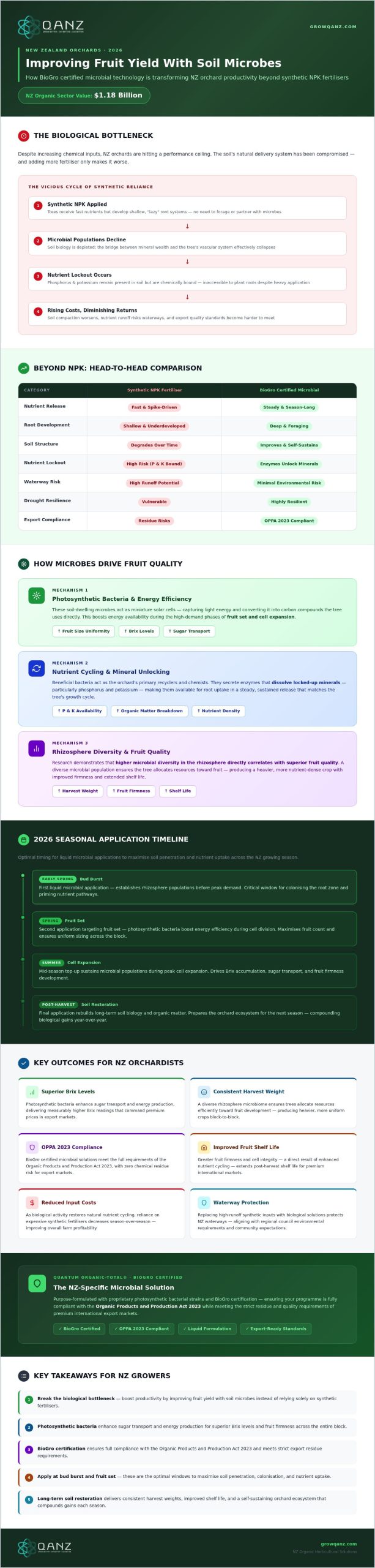
Relying solely on synthetic NPK creates a “fast-food” environment for fruit trees. While these inputs provide immediate nutrients, they often encourage “lazy” root systems that remain shallow and underdeveloped. Without the need to forage or partner with beneficial microbes, trees become vulnerable to environmental stress. Over time, excessive chemical applications can lead to severe soil compaction and a phenomenon known as nutrient lockout. In this state, minerals like phosphorus and potassium remain present in the earth but are chemically bound and inaccessible to the plant. Simply adding more fertiliser doesn’t solve the issue; it often exacerbates the degradation of the soil structure and increases the risk of nutrient runoff into local waterways.
Microbes as the Missing Link
Success in improving fruit yield with soil microbes nz relies on shifting the perspective from feeding the plant to nourishing the ecosystem. Beneficial bacteria act as the orchard’s primary recyclers and chemists. They actively break down organic matter and secrete enzymes that dissolve locked-up minerals, making them available for root uptake. This natural process ensures a steady, sustained release of nutrients that matches the tree’s growth cycle. By integrating BioGro certified microbial solutions, growers can begin to restore this vital foundation. This approach doesn’t just improve current season results; it builds a resilient, self-sustaining soil environment that meets the rigorous quality and residue standards required for New Zealand’s premium export markets. A diverse microbial population is the most effective tool for ensuring long-term orchard viability and consistent fruit quality.
The Mechanics of Harvest: How Microbes Drive Fruit Size and Quality
Achieving a premium harvest requires more than just biomass; it demands specific physiological outcomes like high Brix levels and exceptional firmness. Recent research on microbial communities and fruit yield demonstrates that higher diversity in the rhizosphere directly correlates with superior fruit quality. When you focus on improving fruit yield with soil microbes nz, you aren’t just increasing volume. You’re enhancing the tree’s ability to allocate resources toward the fruit, resulting in a heavier, more nutrient-dense crop that meets the highest export standards.
Photosynthetic Bacteria and Energy Efficiency
Photosynthetic bacteria represent a unique class of microorganisms that function as miniature solar cells within the soil. While most people associate photosynthesis only with leaves, these soil-dwelling strains capture light energy and convert it into carbon-based compounds that the tree can readily use. This extra energy supply is vital during the high-demand phases of fruit set and cell expansion. By boosting the tree’s overall energy efficiency, these microbes help produce fruit that is not only larger but more uniform in size across the entire block. This synergy between soil biology and leaf-level processes ensures that the plant isn’t wasting energy on survival, but is instead investing it directly into harvest weight.
Improving Nutrient Density and Brix Levels
Brix levels are the primary indicator of flavour and market value for New Zealand growers. Microbes facilitate the transport of complex sugars and essential trace elements like boron and zinc, which are often poorly mobile in the soil. High-Brix fruit isn’t just sweeter; it possesses a higher mineral content that naturally strengthens cell walls. This internal structure is what gives our local fruit its signature crunch and extends its shelf life during long-distance sea freight. It’s a natural defence mechanism too, as many common pests find the high mineral-to-sugar ratio of biological fruit difficult to digest.
Shelf life is a critical factor for our export-led economy. Fruit that maintains its firmness from the orchard to the international supermarket shelf commands a significant premium. Microbial activity in the root zone ensures the consistent uptake of calcium, a key element for cell wall integrity that is notoriously difficult for trees to move. When microbes facilitate this uptake, the resulting fruit is more resilient to bruising and physiological breakdown during storage. It’s a holistic benefit that starts in the soil and ends with a more reliable product for the consumer. Many professionals find that liquid microbial treatments provide the most efficient way to maintain this biological activity throughout the critical fruit-filling stage while improving fruit yield with soil microbes nz.
Beyond NPK: Comparing Microbial Solutions with Synthetic Fertilisers
Synthetic fertilisers operate on a replacement model. They aim to replenish specific minerals lost during harvest through a direct chemical hit. While this approach provides an immediate energy surge, it lacks the complexity required for long-term soil vitality. It’s a method that often ignores the underlying health of the orchard, leading to a cycle of dependency. In contrast, biological solutions focus on the sustained-release of nutrients. By improving fruit yield with soil microbes nz, growers move away from the volatility of chemical surges toward a stable, biological baseline that supports the tree throughout the entire season.
Efficiency vs. Volume
High-volume synthetic applications are prone to significant waste. A significant portion of applied nitrogen can be lost to the atmosphere or leached into New Zealand’s sensitive waterways before the tree has a chance to utilise it. Microbial solutions stabilise these nutrients within the rhizosphere. Beneficial bacteria bind nitrogen and phosphorus into organic forms that don’t simply wash away with the first spring rain. This stabilisation allows growers to achieve better results with lower overall volumes of input. It isn’t just about reducing the cost of raw materials; it’s about ensuring every gram of input actually reaches the root zone to drive production.
Soil Structure and Long-Term Value
The long-term value of biologicals lies in their ability to physically transform the orchard floor. Beneficial microorganisms produce glomalin, a natural soil glue that binds particles together into stable aggregates. This improved tilth creates a porous structure that allows for superior oxygen exchange and water penetration. During dry New Zealand summers, this increased water-holding capacity becomes a critical asset. Orchards with high microbial activity retain moisture longer, which can significantly reduce the frequency and cost of irrigation during peak heat periods.
While traditional granular fertilisers often sit on the surface waiting for significant rainfall to activate, liquid microbial treatments provide immediate soil penetration. This precision allows for targeted application during critical growth stages, such as fruit set and cell expansion. Over multiple seasons, the cost-efficiency of this biological approach becomes clear. You aren’t just buying a single season’s worth of growth; you’re investing in a self-sustaining asset. This reduces your reliance on expensive, volatile synthetic inputs and ensures your land remains productive for decades to come. Professional Fruit & Nut Crop Microbial Solutions offer a streamlined way to transition from volume-based farming to an efficiency-based biological model.
Practical Steps for Restoring Orchard Soil Biology
Transitioning from a synthetic-heavy regime to a biological model requires a methodical shift rather than an overnight overhaul. For commercial growers, the process of improving fruit yield with soil microbes nz begins with integrating liquid inoculants into existing infrastructure. Liquid-based solutions are significantly easier to manage than bulk granules, as they allow for precision delivery through standard fertigation lines or boom sprayers without the risk of clogging nozzles. This ease of use ensures that biological treatments become a seamless part of your seasonal workflow rather than a logistical burden.
Timing Your Microbial Application
Strategic timing ensures that beneficial bacteria are present when the tree needs them most. An initial application at bud burst is critical. This early-season inoculation stimulates root development and prepares the rhizosphere for the nutrient demands of the coming months. During the fruit-fill stage, a second application helps maximise final harvest weight by ensuring the tree has the energy reserves needed for sugar transport. Finally, a post-harvest treatment supports the tree’s recovery and begins the process of breaking down organic matter over the winter period, effectively setting the stage for the next season’s success.
Optimising the Orchard Environment
The success of any microbial programme depends on the physical environment provided for these organisms. Maintaining a healthy layer of mulch or permanent ground cover protects the soil surface from temperature extremes and moisture loss, creating a stable habitat for bacteria to thrive. It’s equally important to avoid practices that disrupt this delicate balance. Excessive tilling can physically destroy microbial networks and lead to soil compaction, which hinders oxygen flow. For those establishing new blocks, understanding how to reduce transplant shock in seedlings through early biological intervention is a vital component of long-term orchard health.
Monitoring your progress is essential for fine-tuning the programme. Start with a Visual Soil Assessment (VSA) to check for improved soil structure and worm activity. Follow this with professional lab analysis to track changes in microbial diversity and nutrient availability over time. This data-driven approach ensures you aren’t just guessing, but are actively managing a living system. If you’re ready to transition your orchard to a more resilient biological model, our Fruit & Nut Crop Microbial Solutions provide the BioGro certified foundation you need to succeed.
Quantum Organic-Total®: BioGro Certified Solutions for NZ Orchards
Quantum Organic-Total® stands as the premier choice for commercial growers committed to restoring biological function. This solution is specifically formulated to address the challenges discussed in this guide, providing a reliable pathway for improving fruit yield with soil microbes nz. As New Zealand’s organic sector value surpasses $1.18 billion, official verification has become more than a badge of honour; it’s a commercial necessity. BioGro certification ensures that your orchard management meets the highest standards for both domestic and international markets, particularly as we approach the 2027 EU organic equivalence deadline.
The proprietary technology behind our range centres on specific photosynthetic bacterial strains. Unlike many generic biological products, these strains are selected for their ability to function effectively within the diverse soil profiles found in New Zealand orchards. Whether you are managing stone fruit or pipfruit, the versatility of Quantum Organic-Total® allows it to integrate seamlessly into your existing management programme. It functions as a biological catalyst, unlocking the mineral wealth of your soil to drive superior harvest weight and fruit quality.
The Quantum Difference
The liquid formulation of Quantum Organic-Total® provides a distinct advantage over traditional granular biologicals. Liquid treatments ensure superior soil penetration, allowing the beneficial microbes to reach the deep root zone where they are most effective. This coverage is essential for establishing stable microbial colonies that can withstand the variability of the New Zealand climate. These strains are selected for their resilience and stability, ensuring consistent performance from the first spring application through to post-harvest recovery. For a detailed look at the financial implications of this transition, you can explore our Quantum Organic-Total cost-benefit analysis to see how biological investment supports long-term profitability.
Supporting Your Growth Journey
Transitioning to a microbial-led system is a journey that requires technical precision and local expertise. The GrowQanz team acts as a professional partner, providing the scientific guidance needed to implement a tailored microbial programme that fits the unique requirements of your land. We don’t believe in a one-size-fits-all approach. Instead, we work with you to understand your specific soil health goals and export requirements. This principled approach ensures that every application is purposeful and results-oriented. If you are ready to naturally maximise your orchard’s potential, enquire about Quantum Organic-Total® today to start your transition toward a more resilient and productive biological future.
Securing the Future of Your Orchard through Biological Innovation
The 2026 horticultural season represents a critical turning point for New Zealand growers. As export standards tighten and soil health becomes a primary driver of market value, the transition from high-input synthetic models to biological-led systems is no longer optional. By focusing on improving fruit yield with soil microbes nz, you’re investing in a resilient ecosystem that naturally enhances Brix levels, fruit firmness, and overall harvest weight. This shift ensures your land remains productive and compliant with the latest BioGro standards for years to come.
Restoring the biological engine of your soil is a principled choice that balances immediate commercial gains with long-term ecological health. Our 100% natural and organic solutions are designed specifically for the unique demands of local horticulture, providing superior soil penetration and reliable performance. You can boost your orchard’s productivity with Quantum Organic-Total® and experience the benefits of BioGro New Zealand certified technology with proven results. We’re here to support your journey toward a more sustainable and profitable future for your orchard.
Frequently Asked Questions
How quickly will I see an increase in fruit yield after using microbes?
Initial physiological changes often appear within the first growing season. While rebuilding soil structure is a long-term investment, the immediate boost in nutrient availability usually results in better fruit set and size by the first harvest. Improving fruit yield with soil microbes nz is a cumulative process; the most significant gains in harvest weight and tree resilience typically become evident in the second and third years as the microbial colonies become fully established.
Can I use microbial treatments alongside my existing synthetic fertilisers?
Yes, microbial treatments can be integrated into a hybrid programme to improve overall input efficiency. Beneficial bacteria help stabilise synthetic nutrients and reduce the risk of leaching into local waterways. However, it’s essential to avoid high-concentration chemical applications at the exact same time as the microbes, as this can shock the living organisms. We recommend staggered applications to ensure the biology has time to colonise the root zone safely.
Is Quantum Organic-Total® safe for use in BioGro certified organic orchards?
Quantum Organic-Total® is fully BioGro New Zealand certified for use in organic production systems. This product is 100% natural and organic, meeting the rigorous standards required for annual BioGro audits. It helps growers comply with the Organic Products and Production Act 2023 while maintaining the high quality needed for premium export markets. Because it contains no synthetic chemicals or residues, it’s a stable and trustworthy choice for any certified orchard programme.
What is the best way to apply liquid microbial treatments in a large orchard?
Fertigation is the most efficient method for large-scale liquid microbial application. Because our solutions are liquid-based, they can be easily injected into existing irrigation systems without the risk of clogging nozzles or filters. This ensures uniform coverage across the entire block and superior soil penetration compared to granular alternatives. If fertigation isn’t available, boom spraying or targeted soil drenching during periods of light rain also provides excellent results for professional horticulturalists.
Do soil microbes help with drought resistance in New Zealand orchards?
Microbes significantly enhance a tree’s ability to withstand dry periods by improving soil water-holding capacity. By producing glomalin and other biological glues, these microorganisms create a stable soil structure that retains moisture much longer during dry summers. Healthy microbial networks also encourage deeper, more resilient root systems. This allows trees to access moisture from lower soil profiles that are typically unavailable in degraded or chemically-dependent soils, reducing the overall irrigation demand.
How often should I reapply microbial inoculants to maintain soil health?
We recommend at least three strategic applications per growing season for optimal results. A typical programme involves an initial application at bud burst to stimulate root growth, a second during fruit set to support energy demands, and a final post-harvest treatment. Regular reapplication ensures that the microbial population remains dominant and active, especially after environmental stressors. Consistent use is the most effective way of improving fruit yield with soil microbes nz over multiple seasons.
Will microbes help improve the Brix levels of my fruit?
Microbial activity is a primary driver for increasing Brix levels naturally. Beneficial bacteria facilitate the transport of complex sugars and essential trace elements that contribute to flavour and nutrient density. By enhancing the tree’s energy efficiency through photosynthetic strains, microbes ensure more carbon is allocated directly to the fruit. This results in higher sugar content, better skin finish, and superior flavour profiles that command a premium in both domestic and international markets.
Can these products be used for nut crops as well as fruit trees?
Yes, our microbial solutions are highly effective for all nut and fruit crops. Whether you’re managing walnuts, chestnuts, or macadamias, the biological principles of nutrient cycling and soil structure remain the same. Nut crops benefit significantly from the improved phosphorus and zinc availability that microbes provide, which is essential for kernel development and shell integrity. Our Fruit & Nut Crop Microbial Solutions provide a versatile biological foundation for any professional horticultural operation.
