

The true productivity of a New Zealand nut orchard isn’t determined by the volume of synthetic inputs applied, but by the biological activity occurring within the rhizosphere. In long-lived crops, the soil often reaches a state of fatigue where essential minerals are present but remain inaccessible to the tree. Implementing a targeted microbial soil treatment for nut trees represents a fundamental shift from chemical dependency toward ecological efficiency. By reintroducing beneficial bacteria, you can unlock these dormant resources and address the persistent challenge of replant disease and nutrient lock-up naturally.
It’s frustrating to watch established trees succumb to stress during dry summers or to see nut size plateau despite increasing fertiliser costs. You understand that sustainable growth requires a more resilient root system and a healthier soil profile. This guide will show you how to leverage BioGro certified microbial technology to maximise yields and improve tree vitality across your orchard. We will explore the technical application of Quantum Organic-Total® and Quantum-VSC®, detailing how these solutions enhance root architecture and drought tolerance to secure your orchard’s long-term profitability and resilience in an evolving climate.
Key Takeaways
- Understand how targeted biological inoculants restore the rhizosphere’s function, offering a more precise and scientific alternative to traditional orchard amendments.
- Learn how beneficial bacteria facilitate mineralisation, converting locked-up nutrients into plant-available forms to improve nut size and quality naturally.
- Discover why a liquid microbial soil treatment for nut trees provides better nutrient retention and soil structure than synthetic fertilisers that are prone to leaching.
- Identify the critical application windows, specifically bud burst, nut set, and post-harvest, to ensure treatments effectively support tree growth and harvest recovery.
- Explore how BioGro certified technologies like Quantum-VSC® strengthen root architecture to improve drought resilience during increasingly dry New Zealand summers.
Understanding Microbial Soil Treatment for Nut Trees
A microbial soil treatment for nut trees is a precision-based intervention where selected, beneficial micro-organisms are introduced to the orchard floor to restore essential biological functions. While traditional amendments like compost or mulch add bulk organic matter, targeted biological treatments function as a concentrated biological engine. These inoculants deliver specific strains of bacteria and fungi designed to colonise the root zone and unlock dormant mineral reserves. For New Zealand’s perennial nut crops, such as walnuts, chestnuts, and macadamias, this biological approach is vital. Unlike annual field crops that start with a fresh slate each season, nut trees occupy the same ground for decades. This permanence means the health of the Soil microbiology directly dictates the tree’s lifetime productivity. Success in modern orcharding requires a fundamental shift from simply “feeding the tree” with synthetic salts to actively cultivating the rhizosphere.
The Challenge of Soil Fatigue in Mature Orchards
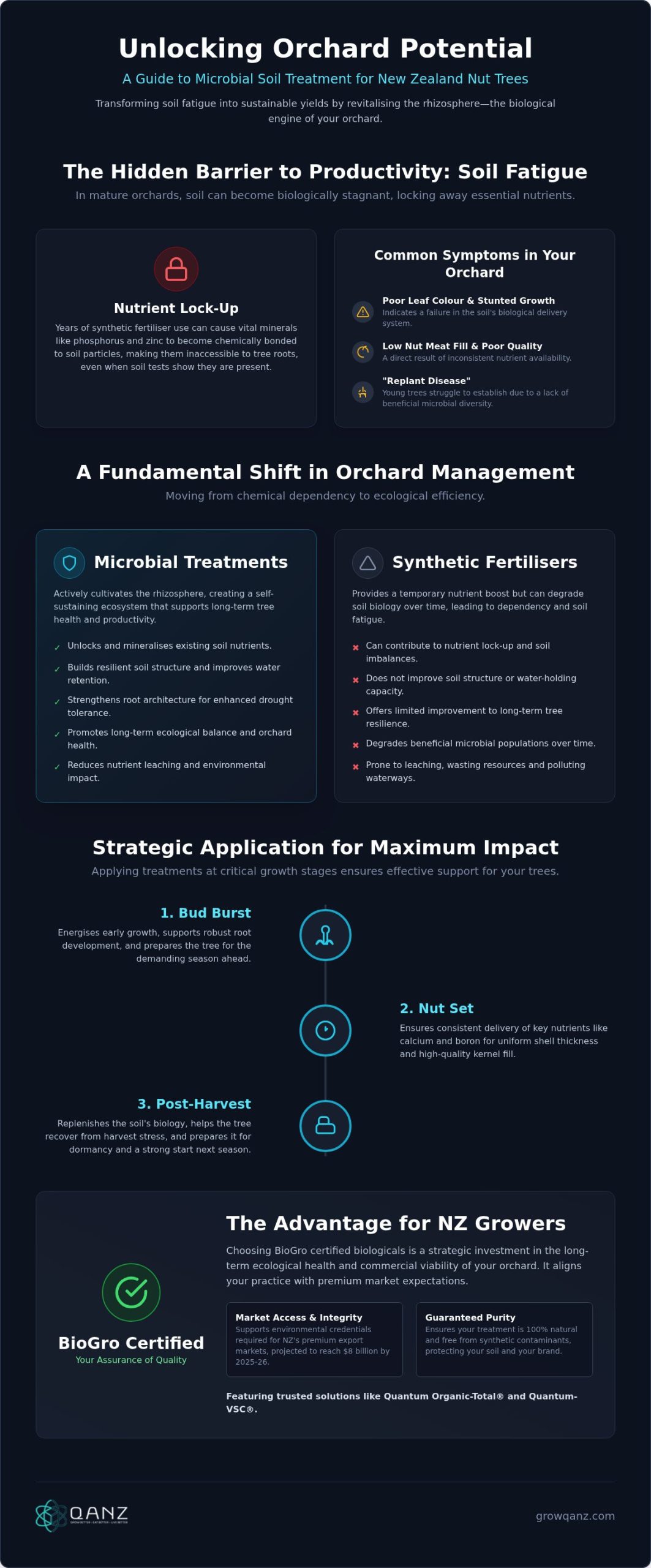
Established orchards often reach a point of soil fatigue where the ground becomes biologically stagnant. Years of intensive synthetic fertiliser use can lead to microbial imbalances, causing vital nutrients like phosphorus and zinc to become chemically locked in the soil profile. This environment often triggers what growers call “replant disease”. Young trees often struggle to establish in old orchard sites because the soil lacks the beneficial microbial diversity needed to outcompete soil-borne pathogens. You can identify a biologically depleted orchard by observing specific symptoms. Common signs include poor leaf colour, stunted terminal growth, and low nut meat fill. These issues often persist even when soil tests suggest adequate mineral levels, indicating a failure in the soil’s biological delivery system.
Why BioGro Certified Biologicals Matter for Nut Growers
Purity and verification are essential when managing high-value nut production, especially for those targeting international export markets. Utilising BioGro certified biologicals ensures that your orchard management programme adheres to the highest non-synthetic standards. This certification provides a level of integrity that synthetic alternatives cannot match. It guarantees that the microbial soil treatment for nut trees you apply is 100% natural and free from contaminants. With New Zealand’s horticulture sector projected to reach a record export revenue of $8 billion for the 2025-2026 year, these certifications become a strategic asset. They support the environmental credentials required to access premium markets while ensuring the long-term ecological health of your land. By choosing verified technologies like Quantum Organic-Total®, you’re investing in a system that works in harmony with the natural environment.
The Biological Engine: How Microbes Drive Nut Tree Growth
At the heart of every productive walnut or macadamia grove lies the rhizosphere, a microscopic zone of intense activity where root systems and soil biology converge. This thin layer of soil surrounding the roots acts as the primary interface for nutrient exchange and tree defence. When you apply a microbial soil treatment for nut trees, you’re essentially optimising this biological engine to work at peak capacity. Beneficial micro-organisms perform the heavy lifting of mineralisation, a process where complex organic matter is dismantled into simple, plant-available ions. Nut trees release carbon-rich root exudates into the soil to fuel the specific microbial colonies that, in turn, provide the tree with essential nutrients and protection. This partnership directly influences the physical quality of the harvest. Robust microbial activity ensures the consistent delivery of calcium and boron, which are critical for developing uniform shell thickness and high-quality kernel fill.
Photosynthetic Bacteria: Powering the Root Zone
Photosynthetic bacteria serve a specialised role within the orchard ecosystem by fixing both nitrogen and carbon directly into the soil profile. While many generic amendments focus solely on decomposition, the specific strains found in Quantum Organic-Total® actively contribute to the energy balance of the root zone. These organisms thrive even under the dense canopy of a mature orchard, supporting a diverse community of secondary microbes that keep the soil active. By choosing to restore our soils, feed the microbes, you create a self-sustaining cycle of fertility that synthetic inputs can’t replicate. This biological energy is particularly important during the high-demand periods of nut development when the tree’s internal resources are stretched.
Unlocking Phosphorus and Potassium for Better Yields
Many New Zealand orchards sit on soil types where phosphorus and potassium are abundant but chemically bound to soil particles, making them unavailable for tree uptake. This nutrient lock-up often leads growers to apply more synthetic fertiliser, which only compounds the problem and increases the risk of nutrient leaching into local waterways. Beneficial microbes address this by secreting specific enzymes and organic acids that dissolve these stubborn chemical bonds. This mobilises existing soil reserves, allowing the tree to access the P and K it needs for vigorous flowering and nut set. You can effectively optimise your orchard’s nutrient efficiency by transitioning from a high-input model to one that prioritises biological mineral release. This approach reduces the environmental footprint of your operation while maintaining the high yields required for commercial success through a consistent microbial soil treatment for nut trees.
Comparing Microbial Inoculants to Conventional Fertilisers
Conventional orchard management has long relied on synthetic NPK fertilisers to drive production, yet this approach often leads to unintended consequences for soil health. Synthetic fertilisers are typically composed of highly soluble salts that provide a rapid nutrient spike but are prone to leaching during heavy New Zealand rainfall. In contrast, a microbial soil treatment for nut trees focuses on retention and biological stability. Instead of washing through the soil profile, beneficial micro-organisms colonise the root zone, creating a persistent nutrient delivery system that remains active throughout the growing season. This biological approach reduces the environmental footprint of the orchard by minimising nutrient runoff into local waterways and lowering the carbon-intensive energy requirements associated with industrial fertiliser production.
Soil structure also sees a marked improvement when transitioning to biologicals. Microbes produce extracellular polysaccharides, often described as “biological glues,” which bind soil particles into stable aggregates. This process improves water infiltration and aeration, ensuring that deep nut tree roots have access to both moisture and oxygen. Effective Understanding and Managing Soil Microbes allows growers to move away from a cycle of chemical dependency toward a self-sustaining ecosystem. While the initial focus is often on yield, the long-term cost-effectiveness of this shift becomes clear through reduced input requirements and improved tree longevity.
Efficiency of Liquid-Based Microbial Solutions
Liquid delivery is the most effective method for reaching the extensive, deep root systems characteristic of mature walnut and macadamia trees. These solutions penetrate the soil more deeply than granular top-dressings, ensuring the microbes reach the active rhizosphere where they are needed most. Liquid biologicals are also perfectly compatible with existing fertigation systems and orchard irrigation programmes, allowing for precise application without additional labour costs. For a detailed look at the financial returns on this investment, see our guide on Quantum Organic-Total: A Cost-Benefit Analysis for New Zealand Growers.
Addressing the Limitations of Synthetic NPK
Heavy reliance on high-salt synthetic fertilisers can create a hostile environment for the very biology that sustains tree health. These salts can desiccate beneficial microbes and earthworms, leading to a biologically “dead” soil that requires ever-increasing chemical spikes to maintain production. This is the “diminishing returns” trap; where the soil’s natural ability to provide nutrients is compromised, forcing the grower to spend more on synthetic inputs for the same harvest volume. By implementing a microbial soil treatment for nut trees, you break this cycle. You build a resilient soil ecosystem that functions independently of chemical spikes, providing a steady supply of nutrients even during periods of environmental stress.
Implementation: Applying Liquid Treatments in the Orchard
Successful implementation of a microbial soil treatment for nut trees requires more than just a standard spray programme; it demands an understanding of the tree’s growth cycle. Before applying any liquid biologicals, you must ensure the orchard floor has sufficient moisture. Beneficial micro-organisms rely on water films to migrate through the soil profile and reach the active root zone. If the soil is too dry, the microbes may remain stranded near the surface where UV exposure can limit their survival. This makes irrigation timing or coordination with light rainfall a vital part of your application strategy.
Application rates should be tailored to the specific nut variety and the age of the orchard. Mature walnut orchards, with their significant canopy spread and deep taproots, often require higher dilution volumes to ensure the liquid reaches the entire rhizosphere. Conversely, macadamia growers may find that frequent, lighter applications better suit the shallow, fibrous root systems of their evergreen trees. It’s about matching the delivery volume to the physical architecture of the root system to ensure maximum colonisation.
You can’t manage what you don’t measure. Use a combination of leaf tissue analysis and soil biological assays to monitor the success of your programme. These tests provide the data needed to adjust your application schedule, ensuring that your investment in soil health is translating into tangible improvements in tree resilience and nut quality. If you’re ready to improve your orchard’s biological performance, view our full range of horticulture microbial solutions to find the right fit for your operation.
Application Timing for Maximum Nutrient Uptake
The timing of your applications should align with peak physiological demand. The “spring flush” from bud burst through to nut set is a critical window where trees require rapid access to mobilised nutrients for foliage and flower development. However, the post-harvest period is equally important. Applying biologicals after the nuts have been gathered allows the tree to rebuild its internal reserves, setting the stage for a vigorous return the following season. Coordinating these treatments with New Zealand’s seasonal rainfall patterns helps facilitate natural infiltration without the risk of excessive runoff.
Strategies for Tree Establishment and Transplanting
New plantings are particularly susceptible to transplant shock, which can delay commercial production by several years. Using a microbial drench at the time of planting creates an immediate protective shield around the young root ball, helping the sapling adapt to its new environment. Solutions like Quantum-VSC® are specifically formulated to promote rapid root colonisation, providing the biological support needed for young trees to thrive. For more detailed guidance on protecting your new investment, read our article on How to Reduce Transplant Shock in Seedlings: A Microbial Strategy for NZ Growers.
Long-Term Orchard Resilience with GrowQanz Solutions
Building long-term resilience requires viewing the orchard floor as a biological bank. Every application of a microbial soil treatment for nut trees acts as a strategic deposit toward the future productivity and stability of your land. Unlike synthetic fertilisers that offer a fleeting nutrient spike followed by potential soil depletion, microbial consortia establish persistent colonies that buffer the orchard against environmental variability. Quantum-VSC® plays a pivotal role in this process by physically enhancing root architecture. By stimulating lateral root development and increasing the density of fine root hairs, this technology significantly improves water-use efficiency and nutrient scavenging. This robust root system also naturally reduces the incidence of soil-borne pathogens. Instead of relying on aggressive chemical interventions that can sterilise the soil, a healthy microbial population provides a natural defence through competitive exclusion and the production of beneficial metabolites.
Drought Resistance and Water Management
New Zealand’s increasingly dry summers pose a significant risk to nut yields, particularly during the critical kernel-filling stage when moisture demand is at its peak. A well-established microbial community helps trees access moisture from deeper within the soil profile by extending the functional reach of the root system. Increased root surface area, facilitated by microbial colonisation, allows for more efficient water uptake even when surface soil moisture is limited. Case study insights from professional growers indicate that orchards managed with these biological solutions maintain more consistent nut weights and quality during periods of water restriction compared to those on strictly conventional programmes. This enhanced resilience ensures that your crop remains viable and profitable despite the challenges of a changing climate.
The GrowQanz Advantage for New Zealand Nut Growers
Transitioning to a biological-first management system requires reliable technical support and evidence-based results tailored to New Zealand’s unique soil conditions. GrowQanz provides the expertise needed to integrate these advanced microbial technologies into existing orchard operations without disrupting production. BioGro certification remains the gold standard for the New Zealand organic nut industry. It provides the essential verification required for premium export markets, where international consumers increasingly demand proof of sustainable and natural production methods. By choosing a BioGro certified microbial soil treatment for nut trees, you are not just improving soil health; you’re securing the commercial future of your orchard through verified environmental stewardship. You can explore our BioGro certified nut orchard solutions today to begin restoring the natural vitality and resilience of your land.
Securing the Future of Your Orchard Through Biological Innovation
Transitioning to a biological-first management strategy is a fundamental step toward ensuring the longevity and profitability of your nut orchard. By focusing on the rhizosphere, you move beyond the limitations of synthetic fertilisers and unlock the natural potential already present in your soil. Implementing a consistent microbial soil treatment for nut trees allows you to build a robust biological bank that protects against climate variability and soil fatigue. This approach doesn’t just improve nut size and kernel quality; it restores the fundamental health of the land for future generations.
Professional NZ orchardists trust these advanced microbial technologies because they provide measurable results without compromising environmental integrity. BioGro certification ensures your produce meets the highest standards for both local and international markets. It’s time to move away from the trap of diminishing returns and embrace a sustainable, evidence-based path to orchard vitality. Optimise your orchard yields with BioGro certified Quantum Organic-Total® and experience the difference that superior root health can make. With the right biological partners, your orchard will thrive for years to come.
Frequently Asked Questions
What is the best microbial soil treatment for walnut trees?
Quantum Organic-Total® is widely considered the baseline for walnut vitality. It delivers a diverse consortium of micro-organisms, including photosynthetic bacteria that improve nitrogen fixation and carbon cycling. Walnut trees possess deep root systems that demand efficient nutrient delivery. This liquid-based treatment ensures that beneficial microbes penetrate the soil profile to reach the active taproot zone, establishing the biological vitality required for high-performing, heavy-bearing trees.
How often should I apply microbial treatments in my nut orchard?
Commercial orchardists typically follow a three-stage application programme. The most effective windows are bud burst to support foliage development, nut set for kernel quality, and post-harvest to restore tree energy. A consistent microbial soil treatment for nut trees maintains dominant beneficial populations in the rhizosphere year-round. This regular schedule helps the orchard buffer against climate variability and ensures that nutrient mineralisation remains active during peak demand periods.
Can I use Quantum Organic-Total® with my existing fertigation system?
Quantum Organic-Total® is designed for seamless integration with standard orchard fertigation and irrigation systems. The liquid formulation won’t clog lines or require specialised hardware. This delivery method is highly efficient, as it transports the micro-organisms directly into the rhizosphere where they can immediately begin colonising root surfaces. It’s a practical way to ensure uniform biological coverage across your entire orchard while minimising additional labour requirements.
Is BioGro certification necessary for commercial nut growers in NZ?
BioGro certification isn’t a legal requirement for all, but it’s essential for those targeting premium export markets. International buyers increasingly demand verified evidence of sustainable, natural production methods. Utilising certified technologies like Quantum-VSC® provides this integrity. It ensures your soil management adheres to strict non-synthetic standards, supporting both your environmental credentials and your ability to access high-value commercial opportunities in the global nut trade.
How do microbial treatments help with nut tree replant disease?
These treatments address replant disease by reintroducing biological diversity to stagnant or exhausted soils. Beneficial microbes suppress soil-borne pathogens through competitive exclusion while producing enzymes that stimulate rapid root development. By re-establishing a functional rhizosphere, young trees can overcome the biological imbalances often found in old orchard sites. This leads to faster establishment, reduced transplant shock, and significantly higher survival rates for new plantings.
Will liquid microbial treatments wash away during heavy NZ rainfall?
Beneficial micro-organisms are remarkably resilient once they reach the soil profile. They produce extracellular polysaccharides that act as biological glues, allowing them to bind to soil aggregates and root surfaces. While you should avoid application during extreme downpours, moderate New Zealand rainfall actually facilitates their migration toward the deep root zone. A properly applied microbial soil treatment for nut trees stays where it’s needed most rather than leaching away.
How long does it take to see results from microbial soil treatments?
Biological activity in the soil increases almost immediately after application, but visible tree responses usually appear over a full growing season. You might first notice improved soil structure and better water retention within a few months. As the microbial community matures, it begins to mobilise locked-up phosphorus and potassium. This eventually translates into enhanced leaf colour, improved tree vigour, and more consistent nut meat fill at harvest time.
Are GrowQanz products safe for use in organic nut production?
GrowQanz solutions are entirely safe and specifically designed for organic nut production. Both Quantum Organic-Total® and Quantum-VSC® hold BioGro New Zealand certification, confirming they are 100% natural and free from synthetic interference. These products allow you to enhance soil health and crop yields while maintaining the highest levels of organic integrity. They are a trusted choice for professional growers who prioritises long-term ecological harmony and chemical-free orchard management.
