
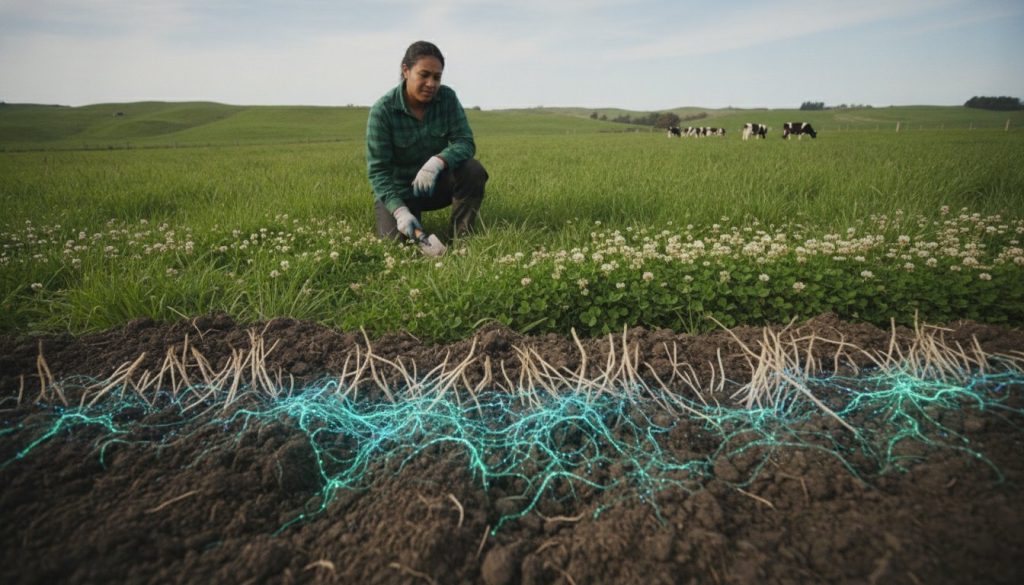
With the June 2026 Environment Court ruling requiring many dairy farms across New Zealand to slash nitrogen leaching by 20 per cent within a year, the era of relying solely on synthetic inputs has reached a definitive turning point. As you face these tightening limits, the role of microbial soil amendments for dairy pasture becomes central to maintaining both productivity and compliance. It’s a challenging reality for many New Zealand producers who are already balancing the rising costs of urea with the strict reporting requirements of Overseer. You’ve likely seen the effects of intensive grazing first-hand through stubborn soil compaction and clover that struggles to persist in your ryegrass swards.
Integrating targeted biological solutions offers a scientifically verified pathway to restore soil health and improve nutrient cycling. By introducing BioGro certified inoculants like Quantum Organic-Total®, you can unlock “locked-up” nutrients and significantly improve your nutrient use efficiency. This guide details how these microbial technologies support environmental targets while enhancing soil structure and water holding capacity. We’ll explore the practical application of these solutions to help maintain a healthy clover-to-grass balance and secure the long-term sustainability of your farm’s most valuable asset; the soil.
Key Takeaways
- Understand the fundamental shift from simply “feeding the soil” with fertilisers to “fixing the soil” by restoring the biological pathways that drive natural nutrient cycling.
- Discover how specific microbial strains, such as photosynthetic bacteria and Bacillus subtilis, actively protect root systems and convert locked-up minerals into plant-available forms.
- Compare the inconsistent microbial profile of raw dairy effluent against the high-density, targeted precision of liquid inoculants for more predictable pasture responses.
- Learn the optimal soil temperature and moisture requirements for applying microbial soil amendments for dairy pasture to ensure successful establishment via boomspray or fertigation.
- Explore how BioGro certified technologies like Quantum Organic-Total® enable New Zealand farmers to meet strict nitrogen limits while improving clover persistence and soil structure.
What are Microbial Soil Amendments for Dairy Pasture?
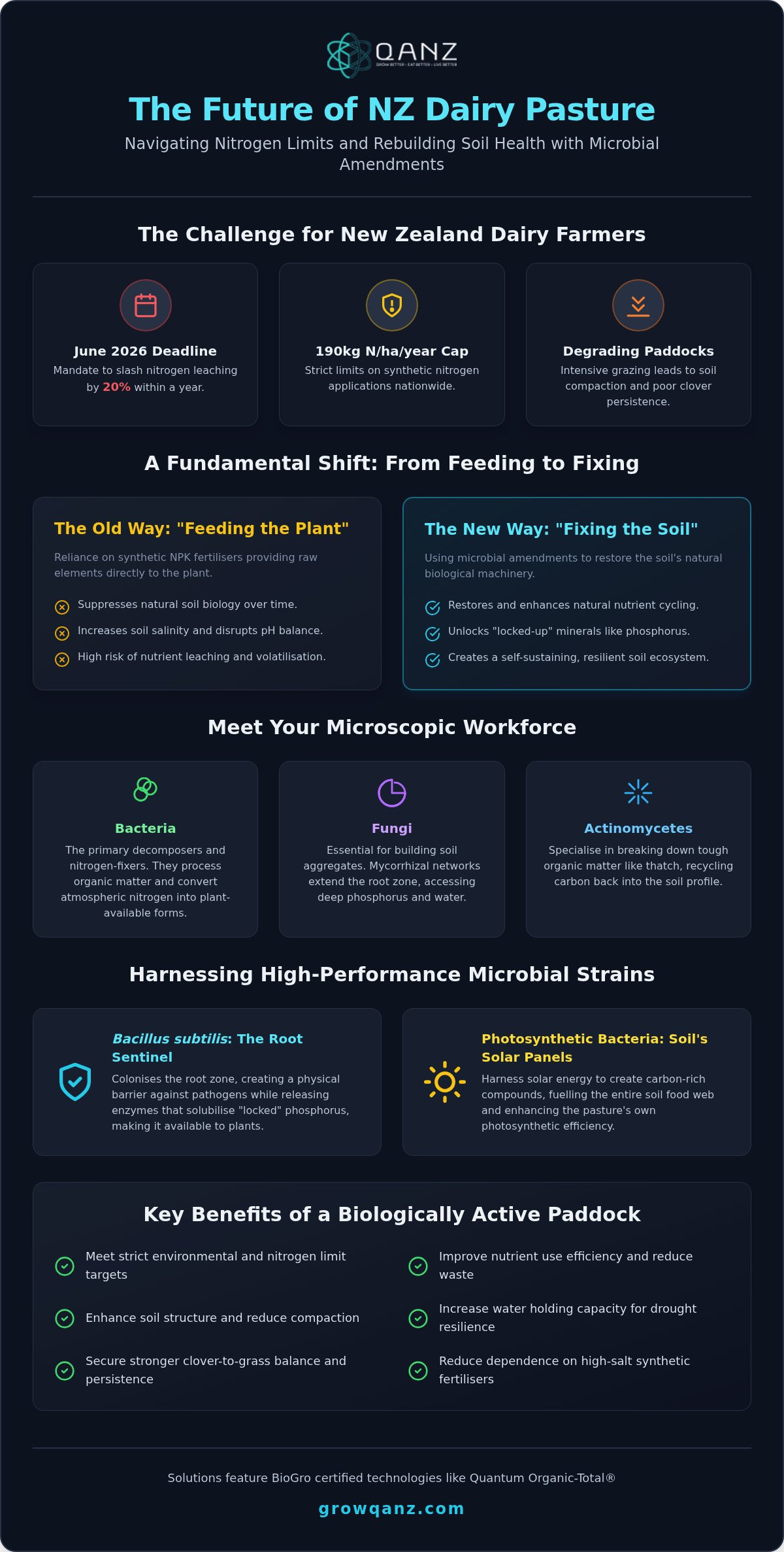
Microbial soil amendments for dairy pasture are concentrated biological inoculants designed to reintroduce beneficial life into the rhizosphere. While traditional fertilisers “feed” the plant by providing raw elements like nitrogen and phosphorus; these amendments focus on “fixing” the soil’s underlying biological machinery. Microbial inoculants act as the microscopic workforce that converts raw minerals into plant-available forms. In New Zealand, years of intensive grazing and high stock density have often led to microbial depletion, where the soil becomes biologically dormant. This exhaustion makes it increasingly difficult for farmers to stay productive while adhering to the 190kg N/ha/year synthetic nitrogen cap. When the soil’s biology is suppressed, the nitrogen you apply often leaches or volatises before the grass can even touch it.
The Functional Groups of Pasture Microbes
A healthy paddock relies on a complex hierarchy of microscopic organisms working in unison. These groups perform distinct roles that collectively maintain the soil’s structural and nutritional integrity:
- Bacteria: These are the primary decomposers and nitrogen fixers. They process organic matter and facilitate the critical conversion of atmospheric nitrogen into forms that ryegrass and clover can use.
- Fungi: Beneficial fungi are essential for building soil aggregates and creating mycorrhizal networks. These networks extend the root zone; allowing plants to access deep phosphorus and water that would otherwise remain out of reach.
- Actinomycetes: These organisms specialise in breaking down tough organic matter. They’re vital for clearing old thatch and recycling carbon back into the soil profile, ensuring the surface doesn’t become “sealed” by dead plant material.
Why NPK Alone is No Longer Enough
Modern dairy farming is shifting away from a purely chemical approach because NPK alone can’t sustain long-term soil health. The “Law of the Minimum” states that plant growth is limited by the scarcest resource; not the most abundant one. In many New Zealand soils, that limiting factor is no longer a lack of minerals, but a lack of biological activity to transport them. Excessive reliance on synthetic fertilisers can inadvertently suppress natural soil life by increasing salinity and disrupting the delicate pH balance. This realisation is driving a surge in regenerative dairy practices across the country. Farmers are now using microbial soil amendments for dairy pasture to rebuild the natural fertility that decades of intensive chemistry have eroded. It’s about creating a self-sustaining system where the soil works for you, rather than requiring constant, expensive intervention. By fostering a diverse microbial population, you can reduce your dependence on high-salt fertilisers that often damage soil structure over time.
How Specific Microbial Strains Drive Pasture Productivity
Not all microbes are created equal. While a general compost might provide a broad spectrum of life, targeted microbial soil amendments for dairy pasture focus on high-performance strains like Bacillus subtilis. This bacterium acts as a microscopic sentinel; it colonises the root zone to create a physical barrier against pathogens while simultaneously releasing enzymes that solubilise “locked” phosphorus. This biological activity is particularly crucial during the New Zealand spring, where rapid growth demands immediate nutrient availability that cold soils often struggle to provide through chemical diffusion alone.
Photosynthetic Bacteria: The Soil’s Solar Panels
Photosynthetic bacteria (PSB) are perhaps the most overlooked workers in the paddock. Unlike most soil microbes that rely on decomposing organic matter for energy, PSB sit in the top centimetre of the soil and harness solar energy directly. They function as the soil’s solar panels, converting light into carbon-rich compounds that fuel the wider microbial food web. This energy injection supports deeper pasture colour and enhances the grass’s own photosynthetic efficiency. As highlighted in research regarding Inoculants and Soil Amendments for Organic Growers, these biological inputs are essential for building the long-term carbon reserves that sustain high-production dairy systems.
These strains also facilitate the “Rhizophagy Cycle,” a process where plant roots actively internalise microbes to harvest their nutrients before releasing them back into the soil to “recharge.” It’s a highly sophisticated exchange that bypasses many of the inefficiencies found in traditional nutrient management. By maintaining high populations of these specific strains, you ensure your ryegrass and clover aren’t just waiting for the next fertiliser truck; they’re actively foraging for the minerals already present in your soil profile.
Breaking the Compaction Cycle
Intensive grazing in wet regions like the Waikato or Southland often results in severe soil compaction and “pugging.” Microbial soil amendments for dairy pasture address this structural damage by stimulating the production of glomalin. Glomalin is a sticky, protein-based substance produced by soil fungi that acts as a biological glue to bind soil particles into stable aggregates, creating the pore space necessary for air and water movement.
Rebuilding this porosity allows the soil to “breathe” again, which significantly reduces the recovery time needed after heavy winter grazing. Improved structure also creates the ideal aerobic environment for Rhizobia bacteria to thrive, which is the key to maintaining a strong clover-to-grass ratio without excessive urea applications. If you’re looking to restore your soil’s natural architecture, it’s worth considering how specialised microbial treatments can fit into your seasonal management plan to improve both resilience and yield.
Effluent vs. Targeted Inoculants: A Comparison for NZ Farmers
Many New Zealand dairy operations rely heavily on Farm Dairy Effluent (FDE) as a “natural” fertiliser. While FDE returns organic matter to the paddock, its microbial load is highly variable and often dominated by anaerobic bacteria from the pond environment. In contrast, microbial soil amendments for dairy pasture offer a precise, laboratory-verified dose of specific strains designed for soil health. These targeted inoculants ensure you aren’t just spreading volume, but rather applying the specific biological tools required to fix the soil’s nutrient-cycling pathways. Using these products doesn’t mean abandoning your effluent system; it means enhancing it by introducing the right workforce for the job.
Nutrient Consistency and Application Control
The “broad-brush” approach of effluent application often lacks the precision needed for modern nutrient management. FDE nutrient levels fluctuate based on herd diet and storage duration, making it difficult to calculate exact inputs for Overseer reporting. Precision biology allows for much tighter control. By using BioGro certified inoculants, farmers can guarantee they are introducing beneficial life without the risk of spreading pathogens or weed seeds often found in raw effluent. These liquid treatments integrate seamlessly into existing irrigation systems, allowing for fertigation that targets specific paddocks during critical growth windows. This alignment with Conservation Choices for Healthy Pastures helps maintain a balanced ecosystem where soil life can flourish alongside high-production grazing. It’s a cleaner, more predictable way to manage biological inputs.
Environmental Compliance and Nitrogen Leaching
High-rainfall months in regions like Southland or the West Coast pose a significant risk for nitrogen runoff and leaching. Microbes play a vital role in “stabilising” nitrogen within the soil profile by converting it into organic forms that are less prone to washing away. While raw effluent can sometimes contribute to leaching if applied at the wrong time, targeted microbes actively work to capture and hold nutrients in the root zone. This biological buffering is a key strategy for meeting the 20 per cent nitrogen reduction targets recently mandated in the Horizons region. For those evaluating the financial impact of these systems, a detailed Quantum Organic-Total cost-benefit analysis demonstrates how improving nutrient use efficiency can offset the costs of reduced synthetic inputs. Adding targeted microbes to your effluent pond can also speed up the breakdown of solids, reducing crusting and making the final application more uniform across your pasture.
Practical Implementation: Applying Microbes to Your Pasture
Applying microbial soil amendments for dairy pasture requires a shift in mindset from chemical delivery to biological stewardship. Unlike synthetic fertilisers that dissolve regardless of soil activity, live inoculants need specific environmental conditions to thrive. You’ll achieve the best results when soil moisture is high and temperatures are consistently above 10 degrees Celsius; this ensures the microbes can move through the soil profile and colonise the rhizosphere before drying out. Boomspraying remains the most common method for flat paddocks, while fertigation offers an efficient way to deliver biology through existing pivots or K-line systems. For steep hill country where ground rigs can’t reach, aerial application provides a viable alternative to maintain soil vitality across the entire farm.
Seasonal Application Framework
Spring is the critical window for kick-starting the growing season. Applying microbes during this period supports clover emergence and helps the pasture recover from winter pugging by improving soil structure. In contrast, Autumn applications focus on building root reserves and preparing the soil biology for the dormant months. Using microbial soil amendments for dairy pasture as part of an Autumn programme ensures that organic matter is processed efficiently over winter, leaving the soil ready for rapid spring growth. If your operation includes cropping, integrating these treatments with microbial solutions for field crops can create a synergistic effect across your whole-farm system.
Avoiding Common Application Mistakes
Success depends on keeping the biology alive during the transition from the container to the paddock. One of the most frequent errors is using chlorinated town water in spray tanks, which can sanitise the very microbes you’re trying to establish. If you must use treated water, let the tank sit for 24 hours to allow the chlorine to dissipate. Avoid spraying during the midday heat of mid-summer; UV radiation and high surface temperatures are lethal to many beneficial bacteria. While many biologicals are compatible with liquid fertilisers, always check tank-mixing guides before combining them with harsh fungicides or herbicides that might suppress microbial activity.
Before you head out with the spray rig, a quick pre-application checklist can save time and resources. Ensuring your soil pH is within the 5.8 to 6.5 range will provide the most hospitable environment for new inoculants. Monitoring success in the paddock involves looking for tangible indicators of biological health:
- Root Depth: Pull a few plugs to see if roots are penetrating deeper into the subsoil.
- Brix Levels: Use a refractometer to check for increased sugar content in the leaf.
- Clover Cover: Observe if the clover-to-grass balance is improving without extra nitrogen.
If you’re ready to start your transition, you can view our full range of microbial treatments to find the best fit for your specific soil type and pasture goals.
GrowQanz Solutions: Quantum Organic-Total® for Dairy
GrowQanz provides a scientifically rigorous range of biological tools designed specifically for the unique challenges of New Zealand’s pastoral landscape. Our flagship product, Quantum Organic-Total®, represents the pinnacle of multi-strain microbial technology. It isn’t a simple fertiliser; it’s a complex consortium of living organisms that work in harmony to revitalise depleted soils. By integrating these microbial soil amendments for dairy pasture, you’re investing in a system that improves nutrient availability while simultaneously reducing the environmental footprint of your operation.
Quantum Organic-Total®: A Holistic Approach
This formulation contains a proprietary blend of photosynthetic bacteria and nitrogen-fixing strains that target the core of soil productivity. In high-input dairy systems, where years of intensive management may have suppressed natural biology, Quantum Organic-Total® helps to optimise the efficiency of every kilogram of nutrient applied. It works by colonising the root zone and facilitating the biological processes we’ve discussed, such as the Rhizophagy Cycle and improved phosphorus solubilisation. BioGro certification provides the independent verification required to meet the stringent environmental and purity standards demanded by high-value international milk consumers.
While Organic-Total focuses on productivity, Quantum-VSC® is our specialist solution for soil restoration and thatch management. It contains a high concentration of microbes specifically selected for their ability to break down heavy organic matter and old pasture thatch. This process recycles carbon back into the soil and clears the way for new growth, which is particularly beneficial after a long winter or when transitioning a paddock back into a high-production cycle. Both products are designed for ease of use, fitting easily into existing farm infrastructure without requiring significant capital investment or additional labour.
Next Steps for Your Farm
We recommend starting with a trial paddock to see the biological difference for yourself. This allows you to measure tangible improvements in root depth, clover persistence, and overall pasture resilience under your specific local conditions. Our technical experts are available to help you develop a custom soil plan that aligns with your current nutrient budget and long-term sustainability goals. We provide data-driven insights based on New Zealand field trials to ensure you’re making informed decisions about your soil’s health.
Ordering is straightforward through our online platform, with reliable national delivery and logistics across both the North and South Islands. Whether you’re looking to meet new regional nitrogen limits or simply want to improve the long-term viability of your land, microbial soil amendments for dairy pasture offer a proven, evidence-based solution. Our commitment is to provide the technical support and high-quality biologicals needed to ensure your farm thrives in an increasingly regulated environment.
Securing Your Farm’s Biological Future
Adopting a biological approach is no longer just an environmental choice; it’s a strategic necessity for the modern New Zealand dairy operation. Restoring the soil’s natural workforce helps you navigate tightening nitrogen caps while improving the physical structure of your paddocks. By prioritising high-performance strains and precise application timing, you can unlock the full potential of your land without relying solely on increasingly expensive synthetic inputs. It’s a shift toward working with nature rather than against it.
Integrating microbial soil amendments for dairy pasture allows you to build a resilient, self-sustaining system that supports both clover persistence and long-term soil health. Our BioGro New Zealand certified range, backed by proprietary photosynthetic technology and national technical support, ensures you have the reliable data needed to make informed management decisions. This evidence-based approach provides the confidence to move beyond temporary fixes and create a stable foundation for your farm’s future.
Enquire about Quantum Organic-Total® for your dairy pasture today to begin restoring your soil’s natural productivity. Taking this step today ensures your farm remains both profitable and compliant for the seasons ahead.
Frequently Asked Questions
Are microbial soil amendments safe for grazing stock immediately after application?
Yes, microbial soil amendments for dairy pasture are completely safe for stock to graze immediately after the application is finished. Because products like Quantum Organic-Total® are BioGro certified and contain no synthetic chemicals or toxic residues, there is no withholding period required. This allows you to integrate treatments into your existing grazing rotation without disrupting herd movement. It’s a significant advantage over many chemical treatments that require paddocks to be locked away.
Can I apply microbial treatments through my existing centre-pivot irrigation?
You can certainly apply these treatments through centre-pivot, lateral, or K-line irrigation systems. The liquid-based formulation is designed to pass through standard filtration without clogging nozzles, making fertigation a highly efficient application method. This approach ensures the microbes are delivered directly into the soil profile with the water, which helps protect the live cultures from UV exposure and drying out during the heat of the day.
How long does it take to see a visible difference in pasture health?
Most farmers report a visible change in pasture colour and vigour within four to eight weeks of the initial application. However, the most profound benefits, such as improved soil structure and deeper root penetration, typically develop over a full growing season. Success depends on soil moisture and temperature; microbes need an active environment to colonise the rhizosphere effectively. Regular monitoring of brix levels will provide earlier evidence of biological activity.
Do microbial amendments replace the need for all synthetic fertilisers?
Microbial soil amendments for dairy pasture are designed to optimise nutrient use efficiency rather than act as a direct NPK replacement. While they don’t always eliminate the need for synthetic fertilisers immediately, they often allow for a significant reduction in urea use by unlocking existing soil reserves. This biological support is essential for staying under the 190kg N/ha/year cap while maintaining the high dry matter yields required for intensive dairy production.
Will these products work on heavy clay soils common in some dairy regions?
These products are exceptionally effective on heavy clay soils, such as those found in parts of Northland and the Waikato. The microbes stimulate the production of glomalin, a biological glue that binds clay particles into stable aggregates. This process improves soil porosity and drainage, which reduces the risk of “pugging” during wet winter months. Over time, this biological activity transforms heavy, compacted ground into a more friable and productive soil profile.
How do I store liquid microbial products to ensure they stay effective?
You should store liquid microbial products in a cool, dark place away from direct sunlight and extreme temperature fluctuations. Most formulations have a stable shelf life when kept in their original containers, but exposure to high heat can diminish the vitality of the live cultures. It’s also important to ensure the storage area is free from chemical fumes or pesticides that could inadvertently contaminate the biological inoculants before they reach your paddocks.
Can I use microbial inoculants if I am already using a regenerative grazing system?
Microbial inoculants are an ideal fit for regenerative grazing systems as they accelerate the restoration of soil biology. These systems rely on natural nutrient cycling and diverse swards, both of which are enhanced by targeted bacterial and fungal activity. By introducing specific strains, you can speed up the transition from a chemically dependent farm to a biologically active one, ensuring your soil has the necessary workforce to support high-density grazing.
What is the best soil temperature for applying Quantum Organic-Total®?
The optimal soil temperature for applying Quantum Organic-Total® is consistently above 10 degrees Celsius. While the microbes remain viable at lower temperatures, they require warmth to become metabolically active and colonise the root zone. This makes the spring and autumn periods the most effective application windows in New Zealand. Applying when the soil is warm and moist ensures the highest establishment rate for the newly introduced microbial populations.
