
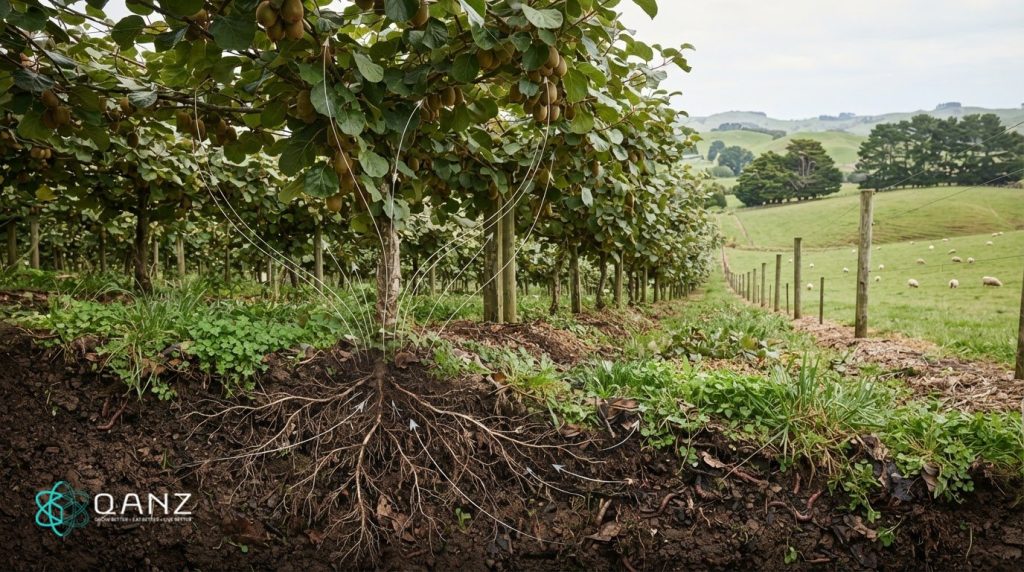
Nutrient recycling on a farm is the movement of nutrients through crops, soil and farm materials, with some returning to support future growth. It is part of nutrient management, not a guarantee that all crop needs will be met or that fewer inputs will be required. Following the pathways helps growers identify where nutrients are retained, reused or lost.
Practical nutrient recycling starts with understanding the crop, soil and farm conditions. No single practice or biological input can ensure a particular result, so assess how nutrients enter, move through and leave each paddock before changing a programme.
This article explains key nutrient pathways, common disruptions in New Zealand and Australia, and practical factors to assess when planning farm management. It also covers how to evaluate biological inputs as part of a broader crop and soil programme, while keeping general soil biology research separate from evidence for a specific product.
Key Takeaways
- Nutrient recycling depends on how nutrients move through soil, crops and residues, not on a single input.
- Trace nutrient flows on-farm to see where nutrients are retained, reused or lost.
- Assess soil cover, erosion, compaction, pH and application timing in the context of your crop, soil and season.
- Bring residue management, organic matter, rotations and nutrient applications together in a practical plan, then review your records.
- Consider biological inputs as one part of a wider programme, and assess product-specific evidence separately from general soil biology research.
What Does Nutrient Recycling Mean on a Working Farm?
Nutrient recycling is the movement and reuse of nutrients already within a farm system. Plants take up nutrients from the soil, and some return in crop residues or livestock manure. Soil processes can make portions available again over time. Recycling differs from importing nutrients in fertiliser, feed or other inputs. Both recycled nutrients and imports can contribute to supply, while harvested crops, animal products and environmental losses remove nutrients from the system.
Which nutrients and materials move through a farm system?
Nitrogen, phosphorus and potassium are essential plant nutrients, but they behave differently and do not become available at the same time. Their movement can involve several materials and stores:
- Crop residues: Leaves, stems and roots left after harvest contain nutrients. As residues break down, they can contribute to future nutrient supply. The amount and timing of availability depend on the material and conditions.
- Livestock manure: Manure can return nutrients from feed to paddocks or crops. If livestock eat feed grown on-farm, some nutrients are recirculated. Imported feed brings additional nutrients into the system.
- Soil organic matter: This includes decomposing plant and animal material and contributes to nutrient storage. Nutrients held in organic forms may not be immediately available to plants.
These materials do not have a fixed nutrient value or release pattern. Their composition, placement, moisture, temperature and other farm conditions affect how nutrients move and when plants can access them. The broader concept of nutrients circulating through living systems is outlined in the Nutrient Cycle.
Why does nutrient recycling matter to growers?
Understanding which nutrients stay on-farm, where they are held and where they leave supports more informed nutrient management. For example, retaining suitable residues in a field may return nutrients that would otherwise be removed. Managing manure thoughtfully can also help account for its contribution to a crop’s nutrient supply. These practices need to be considered alongside soil condition: erosion can carry nutrient-bearing soil away, while poor soil structure can complicate crop and input management.
Consider nutrient recycling over two time frames. Over the longer term, growers may aim to retain organic matter and make better use of nutrients in residues or manure. A crop’s immediate requirements are different: nutrients need to be available in a suitable form and at the right growth stage. Recycling alone does not show whether those requirements are being met.
Treat nutrient cycling as part of a broader nutrient-management approach, not as a promise of reduced fertiliser use or higher yields. Account for nutrients entering the farm, those recycled between paddocks or crops, and those leaving in harvested produce, livestock products or losses. This fuller picture helps inform decisions without assuming that every nutrient returned to the soil will meet the next crop’s needs.
How Do Nutrients Cycle Between Soil, Crops, and Residues?
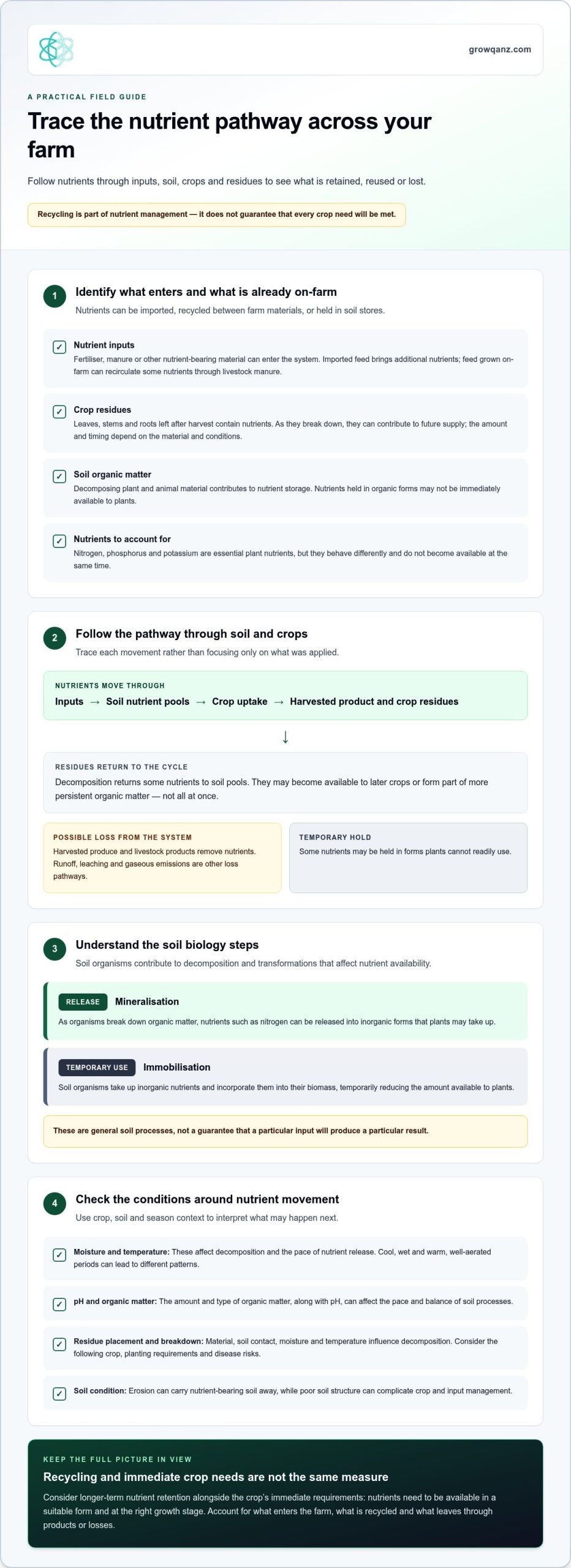
Follow nutrient recycling as a pathway: inputs enter the soil, nutrients move between soil pools, crops take up some of them, and residues may return some to the soil. Other nutrients leave in harvested produce or through processes such as runoff, leaching or gaseous emissions. Tracking each step helps growers see where nutrients are going, rather than focusing only on what was applied.
A simple farm pathway: nutrient inputs → soil nutrient pools → crop uptake → harvested product and crop residues → decomposition and soil pools. At each stage, nutrients may also be lost from the system or temporarily held in forms plants cannot readily use.
What role does soil biology play in nutrient cycling?
Soil organisms, including microbes, contribute to the decomposition of organic material and to transformations that affect nutrient availability. One example is mineralisation: as organisms break down organic matter, nutrients such as nitrogen can be released into inorganic forms that plants may take up. In immobilisation, soil organisms take up inorganic nutrients and incorporate them into their biomass, temporarily reducing the amount available to plants. The USDA Natural Resources Conservation Service’s Soil Biology Primer describes the role of soil organisms in decomposition and nutrient cycling.
These are general soil processes, not a guarantee that a particular input will produce a particular result. Their pace and balance vary with moisture, temperature, pH and the amount and type of organic matter present. A cool, wet period and a warm, well-aerated period can therefore lead to different patterns of residue breakdown and nutrient release.
How do crop residues and organic matter return nutrients?
Roots, leaves and stems left after harvest can become part of the soil’s organic material as they break down. Nutrients in that material may enter soil pools, become available to later crops or become part of more persistent organic matter. The process takes time, and not all nutrients in residues become available to the next crop at once.
Residues vary in nutrient content and how readily they decompose. Their placement, contact with soil, moisture and temperature also influence the process. Retaining residues may suit one crop or paddock but create practical challenges in another. Consider the following crop, planting requirements and disease risks rather than applying one rule everywhere.
- Inputs: Fertiliser, manure or other nutrient-bearing material enters the system.
- Soil pools: Nutrients are held in organic or inorganic forms, with availability changing over time.
- Crop and residues: Plants take up nutrients; some leave in the harvest, while remaining material can return to the soil.
- Losses: Nutrients may move beyond the root zone, leave with runoff or be lost to the atmosphere.
Growers considering biological inputs can explore Quantum technology information as part of understanding a broader programme. Keep general soil biology principles separate from evidence about any named product.
What Can Disrupt Nutrient Recycling in New Zealand and Australia?
Nutrient recycling can be affected when nutrients are physically removed, become difficult for plants to access, or move away from the crop root zone. Bare soil, erosion, compaction, unsuitable pH and poorly timed applications are potential constraints. Their effects vary between farms: crop, soil type, drainage, season and management all influence which factors matter most.
Which soil and climate conditions should growers assess?
Start with the conditions that shape root growth and soil biological activity: moisture, temperature, drainage, pH and compaction. For example, saturated soil may restrict root function, while dry conditions can limit biological activity and nutrient movement. Compacted areas may also impede roots. These are possible influences, not diagnoses. Interpret conditions in the context of the paddock and season, and use crop-specific agronomic guidance.
New Zealand growers may manage steep or rolling land, periods of high rainfall, or varied soil and drainage conditions within a property. Growers across the Tasman also work across diverse soils and rainfall patterns, with some systems facing extended dry or hot periods. Neither region has one universal set of conditions. Local context matters more than broad assumptions about what a farm experiences.
How can nutrient losses or bottlenecks be recognised?
Look for patterns and keep records. Bare patches, visible soil movement after rain, sediment in runoff pathways or repeated traffic damage can flag issues for investigation. A paddock where residues are regularly removed also has a different nutrient-return pathway from one where residues remain. None of these observations alone proves a nutrient deficiency or identifies its cause; crop symptoms can have several explanations.
Use crop and soil records to add context. Compare affected areas with paddock history, crop performance notes, nutrient application timing, rainfall or irrigation events, and cultivation or machinery traffic records. Check whether the same pattern recurs and whether it aligns with a soil type, slope position or management change.
- Observation: Bare or exposed ground. Investigate: When cover was lost, what followed, and whether runoff or soil movement was observed.
- Observation: Soil or sediment moved downslope or into a drain. Investigate: Rainfall timing, slope, surface cover and flow paths.
- Observation: Uneven crop growth or poor rooting in traffic lanes. Investigate: Machinery movements, soil moisture during field operations and affected zones.
- Observation: Nutrient application followed by heavy rain, or repeated applications with uneven crop response. Investigate: Application timing, placement, crop stage, soil conditions and the records used to set the programme.
Use these clues to frame questions, not to jump to a single cause. A considered diagnosis helps distinguish nutrient loss from limited availability, root restrictions or other crop stresses, and supports decisions suited to the paddock.
How Can Growers Build a Practical Nutrient-Recycling Plan?
Nutrient recycling is the movement and reuse of nutrients within a farm system. Nutrients enter through inputs, move through soil and crops, and may return in residues or manure. Some leave in harvested products or through losses. Recycling supports nutrient management, but it does not guarantee lower fertiliser use or meet every crop’s requirements.
Start with what is happening in each paddock, then set manageable priorities. Treat the plan as a working record rather than a one-off calculation.
- Map nutrient flows. List nutrient-bearing inputs, including fertiliser, feed or imported organic materials; harvested outputs; residues retained, removed or grazed; and likely loss pathways. Use existing paddock records and crop plans. Note gaps, such as incomplete residue or application records, rather than filling them with estimates that appear more certain than they are.
- Identify possible losses or bottlenecks. Review field observations and past records for erosion, runoff, residue removal, compaction, uneven crop growth or application timing that may warrant investigation. These clues can focus attention, but do not establish nutrient status or cause on their own.
- Set priorities. Choose a specific issue to address first, based on its relevance to the crop and paddock. Priorities might include understanding where residues go after harvest, improving application records or investigating recurring soil movement.
- Choose practices as a connected system. Consider residues, soil organic matter, crop rotations and nutrient applications together. A residue-management decision, for instance, should suit the next crop’s establishment needs and the paddock’s conditions, not just the aim of returning nutrients. Base decisions on crop-specific, locally relevant agronomic advice.
- Review records and adjust. Record what was done and note relevant crop and soil observations. Use a consistent approach across seasons where possible, then compare fields or periods with similar conditions. If the crop plan, soil condition or local recommendations change, reassess priorities.
How should a grower map nutrient flows?
Build a paddock-level picture of what enters, leaves and remains: inputs, harvested crops or animal products, retained residues, and potential loss routes. Bring together crop plans, application records, grazing or residue notes, and observations after significant weather events. A nutrient balance can help organise questions, but it is not a substitute for professional agronomic interpretation of the crop, soil and system.
How can a plan be reviewed across seasons?
Consistent records are more useful for comparison. Note the paddock, crop, management decision and conditions that could affect interpretation, such as season or soil moisture. Compare like with like where records allow, rather than attributing a change to one practice when several factors differed. Keep the plan flexible: priorities may shift with rotations, paddock condition and country-specific advice.
Growers considering a biological input as part of a broader crop and soil programme can discuss programme options with QANZ, including crop suitability, application details and the evidence relevant to the intended use.
Where Can Biological Inputs Fit in a Nutrient-Recycling Programme?
Biological inputs are one consideration within a wider crop and soil programme. They are not shortcuts for improving nutrient recycling and should not be treated as replacements for fertilisers or sound nutrient management. Their relevance depends on the crop, growing conditions, existing practices and evidence for the specific product being considered.
General research on soil organisms explains broad biological processes, not the performance of every commercial input. A product-specific claim needs evidence tied to the formulation and the conditions in which it was assessed.
What evidence should growers look for in a biological input?
Start by checking what was actually evaluated. Useful evidence identifies the exact formulation, crop, location, treatment and growing conditions, then explains how observations or measurements were made. A laboratory study, an overseas field trial, a company trial, independent research and a commercial grower observation are different kinds of evidence; one should not be presented as another.
- Match the formulation. Evidence for one product does not automatically apply to another.
- Check the setting. Consider whether the crop, soil, climate and management resemble your own situation.
- Read the outcome carefully. Separate measured results from interpretation, and do not treat an individual trial result as a guaranteed future outcome.
- Review current technical information. Use it to assess intended use, crop suitability and application details for your programme.
This evidence-first approach separates broad statements about microbial activity from claims about a named input. It also helps identify what remains uncertain before including a product in a management plan.
How should Quantum Organic-Total® be considered?
GrowQanz supplies Quantum agricultural biological products to growers in New Zealand and Australia. Quantum Organic-Total® is a microbial agricultural input offered by GrowQanz for use in crop and soil programmes. Assess its relevance alongside your crop plan and other management decisions, using current product information rather than assuming a particular nutrient-cycling effect.
Do not assume that Quantum Organic-Total® will mobilise nutrients, improve nutrient uptake, increase yield or reduce fertiliser use without appropriate evidence for that product. It does not replace fertiliser or other conventional inputs. Keep product assessments distinct from general science showing that soil organisms participate in decomposition and nutrient transformations.
For a practical evaluation, define the question the input is intended to address, review current product information, and consider how you would observe or measure the outcome. Record the crop, paddock conditions, management and application details so observations can be interpreted in context. Avoid attributing a change to one input if other important conditions also changed.
Explore the Quantum Organic-Total® product information and Quantum technology information as part of that assessment. To discuss whether Quantum Organic-Total® may suit your crop, growing system and application programme, talk with GrowQanz.
Make Your Next Nutrient Decision More Deliberate
For your next crop programme, identify the nutrient-related decision you feel least certain about. It might be application timing, management of a particular paddock, or whether an input has relevant evidence for your situation. Naming the uncertainty gives you a clearer starting point than changing several parts of the programme at once.
Set a clear question before considering an adjustment, then decide what information would help you assess it. This keeps the next step grounded in your crop and growing conditions, while leaving room to revise your approach as you learn more.
To discuss whether Quantum Organic-Total® suits your crop and programme, talk to QANZ. A measured, informed decision can help you manage your farm with confidence.
Frequently Asked Questions
What is nutrient recycling in agriculture?
In agriculture, nutrient recycling describes nutrients reused within a farm rather than entering or leaving through its boundaries. For example, record whether crop residues stay in a paddock, are removed or are fed to livestock, then note where the resulting material goes. This makes nutrient decisions traceable, even when exact quantities are unavailable.
Why is nutrient recycling important for soil?
It encourages growers to look beyond a single crop’s performance and consider how management choices affect soil over time. Comparing paddock notes across rotations, for instance, may reveal that a recurring issue follows a particular management history. That pattern can guide further investigation, but it does not prove a cause. Use observations alongside relevant crop and soil information before changing a programme.
Can soil microbes help recycle nutrients?
Yes. Soil microbes are part of the biological community involved in nutrient cycling. When assessing research about their role, check whether it was a laboratory study or a field evaluation, and whether it measured a process or a crop response. These distinctions help prevent findings about general microbial activity from being interpreted as evidence that a commercial product will produce the same effect.
Does nutrient recycling mean I can use less fertiliser?
No automatic reduction follows from recycling. Before adjusting a fertiliser programme, compare planned nutrient supply with crop demand and the information available for the paddock. A change in rotation or harvest removal, for example, may alter the nutrient picture even if residue management stays the same. Keep the programme guided by crop-specific agronomic advice, and adjust only when the evidence supports it.
What farm practices can support nutrient cycling?
Start with a manageable change that can be recorded clearly. If you alter how residues are handled in one paddock, note the crop, timing and relevant establishment or management observations. Avoid changing residue handling, cultivation and nutrient timing together if you want to understand what may have influenced the result. A well-documented comparison can inform later decisions without assuming the same approach suits every field.
Is Quantum Organic-Total® a fertiliser replacement?
No. Do not remove or reduce fertiliser on the assumption that Quantum Organic-Total® will supply crop nutrients or replace a fertiliser programme. If you are considering the product, assess its intended place in the wider programme using current QANZ technical information, while keeping the nutrient plan separate. Base fertiliser decisions on crop needs and appropriate agronomic advice, not an assumed product outcome.
Disclaimer
Important: This article provides general agricultural information only. Product performance can vary according to crop, soil, climate, management practices and application conditions. Trial or research results discussed may have been obtained under specific conditions and should not be interpreted as a guarantee of equivalent results. Always follow current product directions and confirm suitability for your crop, growing system and organic certification requirements. Contact QANZ for current product and application information.
