
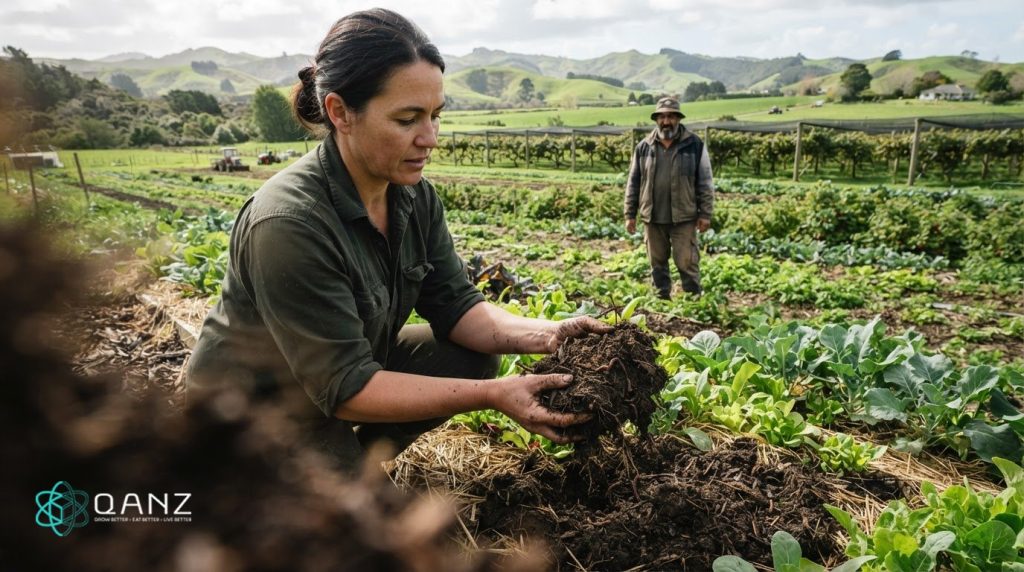
Organic Growers build soil health through a whole-farm approach that considers organic matter, soil structure, crop rotations, nutrient planning and day-to-day management. A biological input can be one part of that system, but it cannot make a farm or crop organic on its own. Inputs should fit the growing plan and the requirements of the certification programme that applies.
Choosing practices and inputs can be challenging, particularly when certification requirements and growing conditions differ between New Zealand and Australia. General research can explain how soil biology works, but it does not by itself verify a specific product’s performance or suitability.
This guide offers a practical framework for assessing soil-management choices and biological inputs. It covers the factors to review across a whole-farm system, how to assess product documents and evidence, and why input suitability needs to be considered against the requirements of your country and certification programme.
Key Takeaways
- Organic growing involves coordinated farm practices, production records and applicable certification requirements, not a single input.
- Use soil conditions such as organic matter, moisture, pH and compaction to guide management decisions for your crop and site.
- Assess biological inputs by separating product documentation and certification suitability from evidence behind performance claims.
- Plan for the country and certification programme that apply to your operation. New Zealand and Australian requirements and growing seasons can differ.
- Quantum Organic-Total® is a microbial agricultural input for crop and soil programmes. Assess its suitability against current technical and certification documentation.
What does organic growing mean for growers?
Organic growing is a managed production system that brings crop planning, soil care, nutrient management, pest and disease decisions, and input selection together. It also involves keeping production records and meeting the requirements of a certification programme where applicable. For Organic Growers, the aim is to manage the farm as a connected system, not simply remove synthetic inputs from an otherwise unchanged programme.
Organic production is a planned approach to growing crops that manages soil, plants and inputs as part of a whole-farm system, rather than a label earned by avoiding synthetic products alone. This distinction helps growers assess daily decisions alongside longer-term soil and crop goals. The Food and Agriculture Organization of the United Nations describes organic agriculture through its principles and practices. Farm decisions still need to reflect local conditions and the relevant certification programme.
Organic principles can guide a production programme, but they don’t prove that a particular product will deliver a specific result. Nor does using one biological input establish a crop or farm’s organic status. Product claims, agronomic evidence and certification suitability are separate questions, and each needs to be considered on its own terms.
How does organic growing differ from a single input choice?
Crop planning, soil management and input decisions influence one another. A grower planning a vegetable crop, for example, might consider rotation, ground cover, nutrient sources, cultivation and monitoring together. A biological input can be assessed as one option within that programme, but it cannot replace the wider plan or show that the farm meets certification conditions.
- Plan crops and rotations around the farm’s production goals.
- Manage soil and nutrients in ways that suit the crop and site.
- Assess each input for its intended role, available evidence and suitability within the programme.
Why do certification and production goals both matter?
Agronomic objectives describe what the grower wants to manage, such as soil condition, crop quality or production consistency. Certification conditions determine whether practices, records and inputs align with a particular programme. These aims can support one another, but they aren’t interchangeable. Good soil management alone doesn’t establish certification, and certification doesn’t guarantee a particular crop outcome.
Requirements depend on the country and certifier, so a decision made for a New Zealand programme shouldn’t automatically be carried across to Australia. Before using an input, review the current requirements for your operation and intended use alongside the product documentation. Record the decision and its context, including the crop, purpose and relevant programme guidance. This provides a clearer basis for agronomic review and certification discussions.
Which soil and crop factors shape an organic growing system?
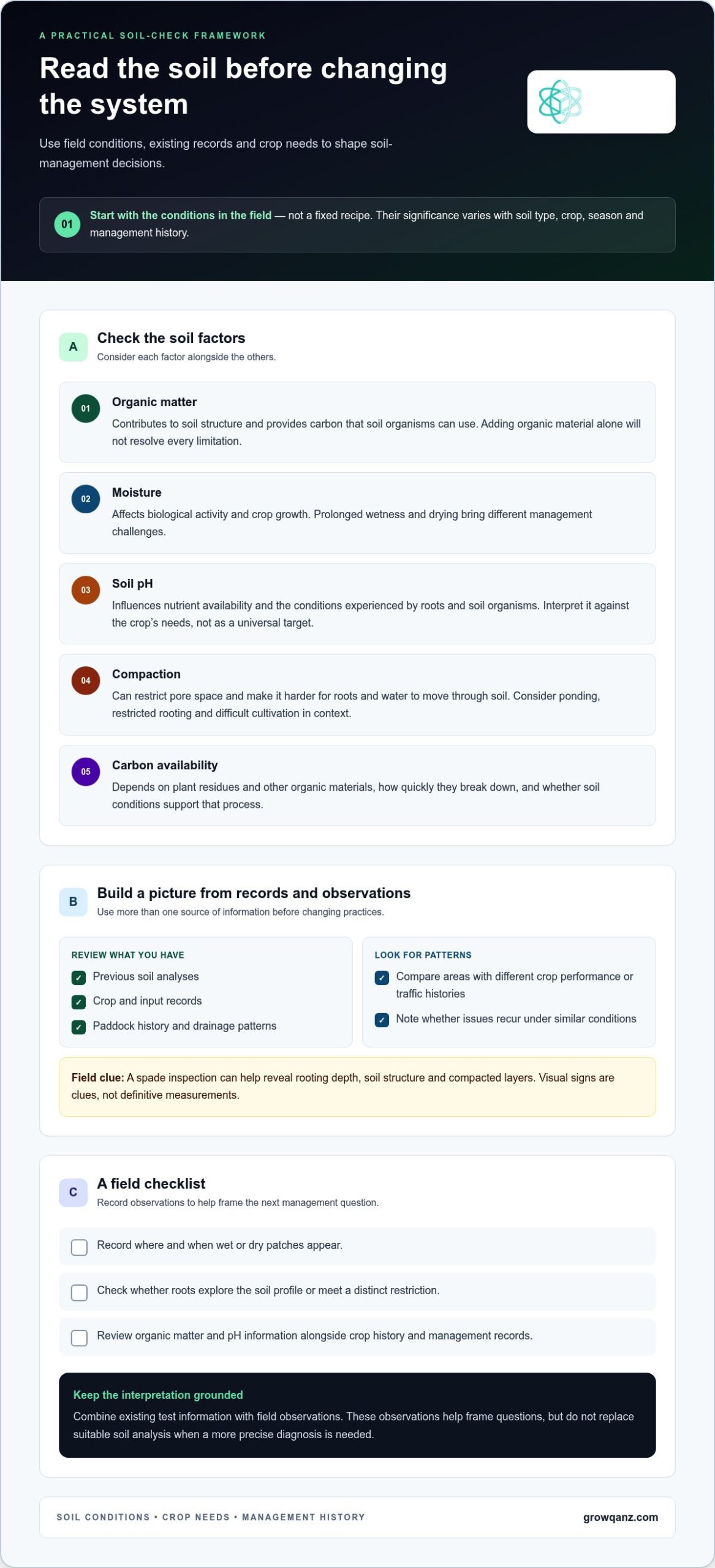
Start soil decisions with the conditions in the field, rather than a fixed recipe. Organic matter, moisture, pH, compaction and available carbon all influence how roots, crops and soil organisms interact. Their significance varies with soil type, crop, season and management history. Combine existing test information with field observations before changing practices.
Organic matter contributes to soil structure and provides carbon that soil organisms can use. Its amount and condition matter alongside other factors. Adding organic material alone won’t resolve every limitation. Moisture affects biological activity and crop growth, while prolonged wetness and drying present different management challenges. Soil pH influences nutrient availability and the conditions experienced by roots and soil organisms. Interpret it against the crop’s needs rather than treating one value as a universal target.
Compaction can restrict pore space and make it harder for roots and water to move through soil. Look for patterns such as ponding, restricted rooting or consistently difficult cultivation, while considering recent weather and machinery traffic. Carbon availability also depends on the plant residues and other organic materials present, how quickly they break down and whether soil conditions support that process. These observations help frame questions, but they don’t replace suitable soil analysis when a more precise diagnosis is needed.
How can growers assess soil conditions before changing practices?
Start with what’s already known: previous soil analyses, crop and input records, paddock history, drainage patterns and observations from different parts of the block. Compare areas with different crop performance or traffic histories, and note whether the same issue recurs under similar conditions. A spade inspection can help reveal rooting depth, soil structure and compacted layers, but visual signs are clues, not definitive measurements.
- Record where and when wet or dry patches appear.
- Check whether roots explore the soil profile or meet a distinct restriction.
- Review organic matter and pH information alongside crop history and management records.
How do crop diversity and cultivation fit into soil management?
Rotations and plant cover can add diversity to a crop sequence, but useful options depend on the production system, timing, water availability and intended following crop. A vegetable grower might consider how a cover crop fits between cash crops. A kiwifruit or vineyard manager might assess ground cover in relation to traffic, moisture and orchard or vine management. These are planning considerations, not guaranteed outcomes.
Cultivation choices are equally site-specific. Minimising unnecessary disturbance and maintaining soil cover are recognised soil-health principles, as outlined in the USDA’s Soil Health Principles. Applying these principles in New Zealand still requires consideration of crop establishment, weed pressure, soil type and local conditions. General soil biology research can explain broad relationships, but it doesn’t establish a mechanism or outcome for any particular Quantum product.
Build a baseline before adjusting several practices at once, and record what changes, where and under which conditions. For further context on biological approaches, explore QANZ’s soil biology and technology information.
How should organic growers assess biological inputs and evidence?
Assess a biological input through three separate questions: what does its current product documentation say, is the specific use acceptable under your certification programme, and what evidence supports any performance claim? These questions are related, but not interchangeable. Product documents describe intended use; certification suitability concerns programme conditions; trial evidence relates to the particular product and circumstances studied.
Evidence also differs by who produced it and where it came from. An independent trial is distinct from a manufacturer trial, and the source should be identified. An overseas trial is not New Zealand evidence. A New Zealand trial reflects its own crop, site and conditions, not every local growing system. Laboratory studies can examine specific biological questions under controlled conditions, while commercial grower observations describe experience in a working operation. Each can inform an assessment, but they answer different questions.
What should growers check in product and certification documents?
Start with the latest approved technical information. Check that the intended use and crop are relevant, and follow the application information stated for that product. Then assess the exact input and intended use against the certification programme that applies to your operation. Requirements may differ between New Zealand and Australia, and between programmes. Refer to current BioGro documentation before making any BioGro certification statement.
Quantum Organic-Total® is a microbial agricultural input offered by QANZ for use in crop and soil programmes. This description does not establish an organic claim, suitability for every certification programme, or a particular crop outcome. Use current technical information and applicable certification documentation to assess those points.
How can growers interpret trial results without overgeneralising?
Before drawing a conclusion, identify the precise formulation, crop, location, treatment and conditions studied. Also note who conducted the work and whether it was a field trial, laboratory study or commercial observation. General research about microbial agriculture can provide scientific context, but it doesn’t establish a mechanism or outcome for a named Quantum product. Apply evidence only to the formulation and circumstances actually assessed.
How can growers plan organic practices across New Zealand and Australia?
A practical plan connects production goals with local soil, crop and seasonal conditions, then checks that proposed practices fit the applicable certification programme. For Organic Growers managing operations, tailor your approach to meet local guidance and standards.
Organic management plans must reflect local conditions and the applicable certification programme. Use this sequence to turn that principle into a working plan:
- Define goals. Set out the crop and production priorities you want the programme to address, such as soil condition, nutrient planning or crop quality. Make goals specific enough to review later without assuming that a particular practice will guarantee a result.
- Review conditions. Consider crop history, soil information, field observations, water availability and the timing of key operations. Where relevant, plan at paddock or block level and use hectares consistently in records and comparisons.
- Check certification. Identify the certifier and certification programme that apply to the operation. Consult current programme guidance before choosing an input or changing a practice that could affect certification.
- Assess options. Compare proposed practices with agronomic needs, technical documentation and available evidence. Keep evidence tied to the crop, location, treatment and conditions it actually covers.
- Record decisions. Note the date, block, crop, reason for the choice and guidance used. Review the records as conditions change and before carrying a decision into another season or crop.
What should New Zealand growers consider?
For New Zealand operations, use current guidance from the relevant certification programme and authoritative New Zealand sources, including the Ministry for Primary Industries where applicable. Match crop timing and field work to conditions on the property rather than relying on a calendar or recommendation developed elsewhere. Record areas in hectares, and note the crop, block and timing so decisions remain clear across seasons. Revisit the guidance when plans or intended input uses change.
What should growers check separately?
Growers should consult the current requirements of their own certification programme and use agronomic guidance relevant to their crop and operating conditions. Growing seasons and conditions can differ significantly between locations, so review timing and practice choices against the actual site rather than assuming a standard schedule will fit every region.
Keep regional plans distinct, even if the same crop or input is being considered. This makes it easier to see which guidance informed a decision and prevents assumptions carrying over between different certification programmes. For support assessing Quantum crop application programmes within your growing plan, talk to GrowQanz.
Where can QANZ biological products fit in an organic growing programme?
A biological input is one option within a wider crop and soil programme, not a substitute for whole-farm planning or certification checks. GrowQanz supplies Quantum agricultural biological products to growers in New Zealand and Australia. To assess an input for your programme, consider its documented intended use alongside your crop, growing system, application plan and the requirements that apply to your operation.
What is Quantum Organic-Total®?
Quantum Organic-Total® is a microbial agricultural input offered by GrowQanz for use in crop and soil programmes. This describes the product category and programme context; it does not demonstrate a particular mechanism, crop result or certification outcome. Review the Quantum Organic-Total® product information for current technical details relevant to its intended use.
Product information and certification decisions answer different questions. Technical documentation can inform how a product is intended to be used, while your certification programme determines whether that specific input and use are acceptable within your operation. Refer to current GrowQanz technical and BioGro documentation for applicable information, then review the requirements of the certification programme relevant to your farm. A product name or general description does not establish the organic status of a crop, farm or produce.
Keep the assessment practical by recording why you are considering an input, the crop and block involved, its intended role in the programme, and the documents used to guide the decision. This creates a useful record for reviewing the choice later and connects product evaluation to the farm’s broader management plan.
How can growers take a considered next step?
Before discussing programme fit, bring together the information that will make the conversation useful: crop and production system, management objective, relevant field conditions, intended timing and any certification considerations. For an operation in New Zealand or Australia, identify the country and certification programme involved, since requirements aren’t automatically transferable between them.
Keep three matters distinct as you assess the option: whether the documented intended use relates to your programme, whether the specific use meets your certification requirements, and what evidence supports any product-performance claim. Technical information can help evaluate suitability; it isn’t proof of a promised outcome. Take application rates and use details from current product documentation rather than assuming them or borrowing them from another formulation or growing system.
GrowQanz provides product and application support for growers considering how its biological products may fit a crop programme. A focused discussion can centre on the crop, growing system and planned applications, with the relevant technical and certification considerations in view. Talk to GrowQanz about whether Quantum Organic-Total® is appropriate for your crop, growing system and application programme.
Make your next growing decision a considered one
The next step doesn’t need to be a complete programme overhaul. Choose one decision to examine carefully, such as how an input fits an upcoming crop, then set a point in the season to review the records and observations that follow. A steady review process helps distinguish what the farm has observed from what a product or practice is claimed to do.
For Organic Growers, a considered decision aligns with the crop’s needs, conditions on the property and the certification programme that applies. Keep the reasoning visible in your records, and revisit it when the crop, conditions or intended use changes. This supports deliberate progress without treating any single input as a shortcut to soil health or certification.
If you’re considering how a biological input could fit your operation, plan your next crop and growing programme with QANZ. A well-grounded decision is a useful foundation for the season ahead.
Frequently Asked Questions
What does organic growing mean?
Organic growing means managing crop production through planned practices rather than relying on a single input choice. Map decisions to the crop cycle: note what’s planted, which field operations are planned, what inputs are considered and what records will show afterwards. This makes it easier to review a season and explain how a decision was made, particularly when production goals or field conditions shift.
Can organic growers use microbial inputs?
Microbial inputs may be used where they fit the grower’s crop programme and certification conditions. Before application, match the exact product name to its current technical information and intended use, then retain the documents used in the decision. Don’t rely on broad descriptions such as “biological” alone. A record of the product, crop, purpose and application date will help with later programme reviews.
Does using a biological product make a crop organic?
No. A biological product alone doesn’t make a crop organic. If you make an organic claim, assess the production operation and the records supporting that claim rather than relying on an input’s name or category. Keep input records with relevant crop and production documentation so the basis for a claim can be reviewed against the programme that applies.
How can growers tell whether evidence for a biological input is relevant?
Check the study’s methods as well as its headline result. Look at how the comparison was made, what outcome was measured and whether the report explains variability or limitations. Confirm that the evidence concerns the formulation and growing situation you’re evaluating. Keep a copy of the source and note why it is relevant, or where it differs, so conclusions aren’t based on a result detached from its context.
Do organic certification requirements differ between New Zealand and Australia?
Growers should consult the current certification programme that applies in the country where their operation is certified. If a business grows in both New Zealand and Australia, keep separate notes on the guidance used for each operation and avoid carrying a decision across without reviewing it. Where produce is intended for different markets, identify the applicable programme and claim requirements for that production pathway before relying on existing records.
What soil factors should organic growers consider first?
Start with the factor most closely connected to the crop issue you’re investigating. If crop performance varies across a block, for instance, compare soil observations and available records between affected and unaffected areas before changing management across the whole site. Consider organic matter, moisture, pH and compaction in relation to crop stage and field history. This helps narrow what to investigate without assuming one factor explains every difference.
Is Quantum Organic-Total® suitable for every organic farm?
Suitability shouldn’t be assumed for every farm. Use current QANZ technical and BioGro documentation to review the exact product, intended crop and planned application, then assess the relevant certification programme’s requirements for that use. Keep the documents that informed the decision with your farm records. This provides a practical basis for assessing fit without treating product information as universal approval.
Disclaimer
Important: This article provides general agricultural information only. Product performance can vary according to crop, soil, climate, management practices and application conditions. Trial or research results discussed may have been obtained under specific conditions and should not be interpreted as a guarantee of equivalent results. Always follow current product directions and confirm suitability for your crop, growing system and organic certification requirements. Contact QANZ for current product and application information.
