
With fertiliser and fuel now accounting for 11.4% of total farm expenses in New Zealand, the pressure to squeeze every cent of value out of your inputs has never been higher. Most growers recognise that biology is the engine room of the paddock, yet calculating ROI on soil health investments remains a significant challenge when the results don’t always appear on a single season’s receipt. It’s frustrating to invest in the long-term vitality of your land while struggling to quantify that value for a bank-ready balance sheet or justify the cost against traditional N-P-K benchmarks.
This guide provides a structured framework to measure the financial impact of biological soil health programmes. We’ll move beyond simple cost-per-hectare metrics to evaluate how improved nutrient use efficiency and soil resilience drive long-term productivity. You’ll discover how to use technical indicators like Potentially Available Nitrogen and Hot Water Extractable Carbon to make evidence-based decisions for your input allocation. We’ll explore how shifting your perspective from seasonal costs to multi-year asset valuation can help you build a more stable and profitable growing system.
Key Takeaways
- Identify the “Soil Health Gap” to understand how degraded microbiology might be limiting your yield potential and increasing synthetic dependency.
- Use a structured framework for calculating ROI on soil health investments that accounts for yield protection, crop quality, and long-term input savings.
- Quantify the financial value of paddock resilience, including improved water use efficiency and enhanced nutrient recycling.
- Establish a reliable baseline using comprehensive soil and leaf testing to track the progress of your biological growing programmes over time.
- Evaluate the strategic role of microbial inputs like Quantum Organic-Total® and Quantum VSC® in supporting soil function and plant health.
The Soil Health Gap: Why Standard ROI Often Fails Growers
The Soil Health Gap is the measurable difference between a paddock’s theoretical yield potential and its actual performance under current management. For many Australian and New Zealand growers, this gap has widened as biological activity has declined; even while synthetic application rates have remained high or increased. Traditional financial models often fail to capture this reality because they treat soil as an inert substrate rather than a living, biological system. When calculating ROI on soil health investments, we must move away from the idea that soil is a disposable medium. Instead, it should be viewed as a capital asset. If management practices deplete this asset’s biological function, the profit from a single season is effectively a withdrawal from the farm’s long-term equity.
Traditional accounting handles inputs as a simple linear equation: you buy a unit of nitrogen and expect a specific return in grain or fruit. This works for one-off chemical interventions, but it’s a poor fit for biological systems. A healthy soil profile provides ecosystem services that are often omitted from the balance sheet, including natural pest suppression and efficient carbon cycling. By ignoring these factors, standard ROI calculations overlook the long-term cost of synthetic dependency.
The Problem with Single-Season Thinking
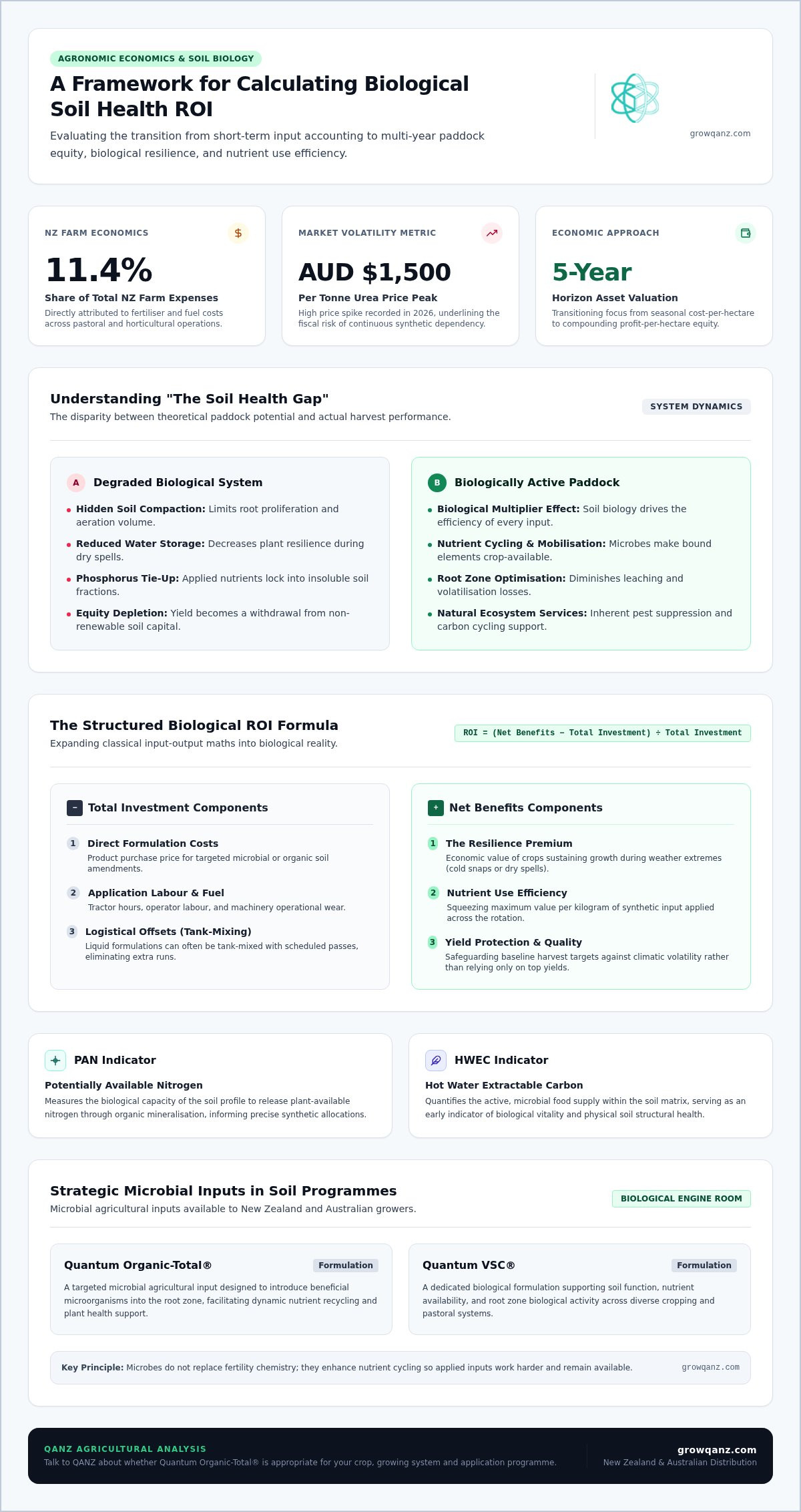
Focusing only on the current harvest can mask the steady erosion of paddock resilience. A single-season input-output calculation might show a positive return on a heavy nitrogen application, but it ignores the hidden costs that often follow. These include soil compaction, reduced water-holding capacity, and the gradual tie-up of phosphorus in the soil profile. These factors quietly increase the cost of production over time. By shifting the focus from cost per hectare to profit per hectare over a five-year horizon, growers can better account for these variables. This long-term view reveals how biological investments buffer against the volatility of global fertiliser markets, which saw urea prices spike to AUD $1,500 per tonne earlier in 2026.
Soil Biology as a Productivity Multiplier
Soil microbiology functions as a biological engine that drives the efficiency of every other input on the farm. Introducing beneficial soil microorganisms for plants isn’t about replacing chemistry; it’s about making it work harder. These microbes facilitate nutrient cycling and improve root zone dynamics, ensuring that applied fertilisers are actually available to the crop rather than leaching or volatilising. When calculating ROI on soil health investments, this multiplier effect is vital. It means the value of biological inputs is found in the improved performance of the entire system. Understanding soil health and biological function allows growers to move from a defensive strategy of high-input dependency to a proactive model of evidence-based productivity.
The ROI Formula for Biological Soil Health Investments
To move beyond simple cost-per-hectare accounting, growers need a formula that reflects the biological reality of the land. When calculating ROI on soil health investments, the standard equation—(Net Benefits minus Total Investment) divided by Total Investment—requires a more nuanced data set than a standard fertiliser bill. Total investment must include direct product costs, application labour, and fuel. However, it should also account for the simplified logistics of modern inputs. For instance, liquid microbial soil treatments can often be tank-mixed with existing passes, reducing the additional diesel and man-hours required for application.
Net benefits are where the calculation often becomes oversimplified. It’s not just about the yield increase at harvest; it’s about yield protection and input efficiency. By aligning management with USDA NRCS soil health principles, growers can improve the cycle of nutrients and water within the profile. This creates what we call the “Resilience Premium.” This is the tangible financial value of a crop that maintains productivity during a dry spell or a cold snap while a conventionally managed paddock might stall. It’s an insurance policy written into the soil biology.
Calculating Direct and Indirect Costs
Direct costs are easy to track, but indirect costs often slip through the cracks. If poor soil structure leads to waterlogging, the opportunity cost of having a paddock out of production for weeks can be devastating. Investing in biological function helps maintain soil porosity and drainage, keeping your land working longer. To reduce the risk of trial and error, leveraging Quantum product and application support ensures that inputs are applied at the right time and rate for your specific conditions, protecting your initial capital outlay.
Measuring the Financial Gains
Financial gains in horticulture and viticulture are often found in quality premiums rather than just raw volume. Better pack-out rates, more consistent fruit size, and improved shelf life all contribute to the bottom line. In broadacre systems, the gain is frequently seen in nutrient use efficiency. If your soil biology can unlock legacy phosphorus or improve nitrogen uptake, you get more value from every dollar spent on base fertilisers. It’s important to acknowledge that soil health is a cumulative asset. While some benefits appear quickly, the full return on investment often compounds over a three to five-year period as the microbial population stabilises.
If you’re ready to evaluate how these principles apply to your specific operation, talk to QANZ about a structured biological programme.
Evaluating the “Unmeasurables”: Resilience and Nutrient Efficiency
While yield is the headline figure on any harvest report, the true margin is often dictated by factors that don’t appear in a standard soil chemistry test. Improved soil structure is frequently viewed as a secondary benefit, yet it’s a fundamental driver of cost reduction. When biological activity improves soil aggregation, water infiltration rates increase. This reduces the energy costs of irrigation and ensures that limited rainfall reaches the root zone rather than running off. The economics of soil health investments suggest that these physical improvements provide a critical buffer against rising operational costs; allowing the land to remain productive under a wider range of environmental conditions.
Assigning a dollar value to these “soft” metrics requires a shift in perspective. Instead of looking only at what the soil produces, growers must look at what the soil preserves. This involves quantifying the financial value of nutrient recycling within the paddock. Microbes work to unlock the existing bank of legacy nutrients, such as phosphorus, that are often chemically bound in the soil profile. Calculating ROI on soil health investments involves evaluating how these biological processes reduce the need for corrective applications by making the “unavailable” available again.
The Resilience Premium in NZ and Australian Climates
In the context of the Australian and New Zealand climates, the Resilience Premium is the financial buffer created by biological soil vitality. This premium becomes evident during El Niño cycles or extreme weather events where soil moisture retention can be the difference between a viable harvest and a total loss. Beyond drought, healthy soil biology helps mitigate “transplant shock” in horticultural settings. By supporting rapid seedling establishment and root development, biological programmes improve the ROI of your planting capital. When the soil is alive, the crop spends less energy surviving and more energy growing.
Quantifying Nutrient Use Efficiency (NUE)
Nutrient Use Efficiency (NUE) is perhaps the most significant “unmeasurable” that can actually be measured through careful leaf and soil monitoring. Microbial activity doesn’t just move nutrients; it transforms them. For example, photosynthetic bacteria for soil support plant energy levels by assisting in the conversion of sunlight and nutrients into biomass. This biological support helps plants maintain higher Brix levels and better overall vigour. While we don’t promise specific fertiliser reductions, the savings potential is found in the increased efficiency of every kilogram of input applied. Calculating ROI on soil health investments requires tracking these efficiency gains over multiple seasons to see how the system stabilises and thrives.
A Step-by-Step Framework for Tracking Soil Health Progress
Successfully calculating ROI on soil health investments requires a disciplined approach to data collection across several seasons. Because soil biology is a dynamic asset, a single snapshot is rarely enough to capture the full trajectory of improvement. Growers should begin by establishing a clear baseline through comprehensive soil and leaf testing. While QANZ does not sell testing services, we recommend using accredited laboratories that provide biological indicators such as Hot Water Extractable Carbon (HWEC) and Potentially Available Nitrogen (PAN). These metrics offer a more detailed view of your soil’s “engine room” than standard fertility tests alone. Once a baseline is set, you can implement a structured Quantum biological growing programme tailored to your specific crop and soil type.
The framework for verification follows five essential stages:
- Step 1: Establish a baseline with independent soil and leaf analysis.
- Step 2: Deploy a targeted biological programme using verified microbial inputs.
- Step 3: Designate “Check Paddocks” or test strips to provide a direct control for comparison.
- Step 4: Monitor multi-year trends in soil organic matter and microbial respiration.
- Step 5: Conduct an end-of-season financial audit that includes yield, quality, and input efficiency.
The Importance of the “Check Paddock”
Side-by-side comparisons remain the gold standard for verifying the performance of any new input. When setting up a trial area, it’s vital to ensure that the soil type, aspect, and previous management history are identical between the treated area and the check paddock. Growers must avoid “Variable Creep,” which occurs when multiple changes are made to a programme simultaneously. To isolate the impact of biological inputs, keep your base fertiliser and irrigation rates consistent across both areas. This clarity is essential for calculating ROI on soil health investments without the data being clouded by other management shifts.
Beyond the Harvest: Long-Term Data Collection
The value of your soil health investment often extends beyond the farm gate. For those in organic production, maintaining rigorous BioGro documentation ensures the premium value of the harvest is protected. Utilising BioGro certified soil inoculants like Quantum Organic-Total® allows you to support soil function while remaining compliant with certification standards. Over a three to five-year period, this data allows you to build a “Soil Health Balance Sheet.” This document tracks the appreciation of your land’s biological capital, providing a powerful piece of evidence for farm succession planning or bank valuations.
To begin building your own evidence-based soil strategy, contact the QANZ technical team for a programme consultation.
Strategic Inputs: Integrating Quantum Organic-Total® and Quantum VSC®
Integrating microbial technology into a farm system is a strategic decision that requires high-quality, verified inputs. When calculating ROI on soil health investments, the focus should be on how these inputs support the natural biological processes that drive paddock productivity. Quantum Organic-Total® and Quantum VSC® are designed to function as part of a structured biological programme; providing the microbial diversity needed to support the soil engine room we’ve explored in previous sections. These products are not intended as standalone replacements for conventional inputs but as tools to improve the efficiency and resilience of the entire growing environment.
The Role of Quantum Organic-Total® in Soil Programmes
Quantum Organic-Total® is a microbial agricultural input offered by QANZ for use in soil and plant application programmes. It’s a BioGro certified product, making it a suitable option for growers operating under strict organic standards or those simply looking to reduce their reliance on synthetic interventions. It’s important for growers to confirm that any input is suitable for their own certification programme and intended use by checking current QANZ technical and BioGro documentation. This product is frequently integrated into vegetable, fruit, nut, and field crop programmes to support plant vigour and soil biological function. By introducing a consortium of beneficial microbes, growers can support the natural cycling of nutrients that is essential for long-term paddock health.
Evidence and Observations
While local data collection is the cornerstone of calculating ROI on soil health investments, historical overseas evidence provides a useful point of reference for the potential of microbial technology. A historical overseas trial conducted at Nolt Farm in Pennsylvania reported a 39% yield increase in the treated block. It’s important to note that this specific trial utilised Quantum-Light® and Quantum-VSC® formulations, rather than Quantum Organic-Total®. These results from overseas environments demonstrate the capacity of biological inputs to influence harvest outcomes under specific management conditions. However, every paddock is unique, and results can vary significantly based on local climate, soil type, and existing management practices.
Results from individual trials or commercial observations are specific to the formulation, crop, location, treatment and conditions tested and should not be interpreted as a guarantee of equivalent performance elsewhere.
Talk to QANZ about whether Quantum Organic-Total® or Quantum VSC® is appropriate for your crop, growing system, and application programme. Our technical team can assist you in developing a structured approach to soil health that prioritises evidence-based decision-making and long-term paddock productivity.
Building a Resilient Paddock for Long-Term Profit
Transitioning to a biological framework isn’t just an environmental choice; it’s a strategic financial shift. By closing the Soil Health Gap, you turn your land from a disposable medium into a high-performing capital asset. Success relies on moving beyond simple cost-per-hectare metrics to a system that quantifies resilience and nutrient use efficiency. Calculating ROI on soil health investments becomes a practical reality when you use a structured framework of baselining and check paddocks to verify your progress.
Quantum products are used globally in professional agriculture, and Quantum Organic-Total® is BioGro New Zealand Certified, giving local growers confidence in its integrity and suitability. QANZ provides technical support and application programmes specifically tailored for Australian and New Zealand conditions to help you achieve consistent results. The path to a more stable and productive future starts with understanding the biology beneath your feet. Talk to QANZ about whether Quantum Organic-Total® is appropriate for your crop, growing system and application programme.
Frequently Asked Questions
How long does it take to see a return on soil health investments?
Biological systems operate on a multi-year horizon. While some physical improvements in water infiltration might be observed within a single season, the full return on investment typically compounds over three to five years. This period allows microbial populations to stabilise and build the soil’s natural capital. Assessing progress requires consistent monitoring of yield stability and input efficiency rather than focusing solely on immediate, single-season output gains.
Can biological inputs replace my entire synthetic fertiliser budget?
Biological inputs are not intended to replace your entire synthetic fertiliser budget. Instead, they function as a productivity multiplier by improving nutrient use efficiency. By supporting the soil’s biological engine, these inputs help plants access legacy nutrients already present in the soil profile. This process makes your existing fertiliser applications more effective, potentially allowing for more precise input allocation over time as the soil’s natural cycling improves.
Is Quantum Organic-Total® suitable for certified organic farms in NZ?
Quantum Organic-Total® is BioGro New Zealand certified as a microbial agricultural input. This makes it suitable for use in organic growing systems that adhere to BioGro standards. However, it’s vital for growers to verify suitability against their specific certification programme and intended use. Always check the current BioGro certificate and QANZ technical documentation to ensure compliance with your farm’s unique regulatory requirements and application protocols.
What is the best way to measure microbial activity in my paddock?
The most reliable method involves using accredited laboratories to test for biological indicators. Metrics such as Hot Water Extractable Carbon (HWEC) and Potentially Available Nitrogen (PAN) provide a technical baseline for microbial activity. These tests should be paired with practical field observations, such as Visual Soil Assessments (VSA). Monitoring these trends over several seasons is essential for accurately calculating ROI on soil health investments and tracking paddock progress.
Does soil health ROI differ between horticulture and broadacre cropping?
The financial drivers of ROI vary significantly between these systems. In horticulture, ROI is often found in quality premiums, such as improved fruit size, consistency, and pack-out rates. In broadacre cropping, the return is more frequently tied to yield stability across variable seasons and improved nutrient use efficiency. Both sectors benefit from reduced long-term degradation, but the specific metrics used to justify the investment will reflect the unique market requirements of the crop.
How do liquid microbial treatments compare to granular amendments in terms of ROI?
Liquid microbial treatments like Quantum Organic-Total® often offer a more efficient ROI due to their ease of application. Because they can frequently be tank-mixed with existing passes, they reduce the additional costs of labour and diesel. Granular amendments may require dedicated machinery passes, which can increase the ‘Total Investment’ part of the equation. Liquid formulations allow for precise targeting of the root zone, which supports the overall efficiency of the biological programme.
What records should I keep to satisfy a soil health ROI audit?
Maintaining detailed records is crucial for an evidence-based audit. You should document baseline soil and leaf tests, exact application rates, and the timing of all biological inputs. It’s also important to track ‘Total Investment’ costs, including product purchase prices, fuel usage, and labour hours. Keeping data from ‘Check Paddocks’ or untreated test strips provides the necessary comparison to verify the financial impact of your soil health programme over multiple seasons.
Can I use Quantum products alongside my existing crop protection programme?
Quantum products are designed to be integrated into comprehensive crop programmes. While they are often compatible with many standard inputs, it’s essential to verify tank-mix stability and timing to protect the living microbes. calculating ROI on soil health investments involves ensuring that every input works in harmony. Talk to QANZ about your current programme to determine the most effective way to incorporate Quantum Organic-Total® or Quantum VSC® into your existing management schedule.
Disclaimer
Important: This article provides general agricultural information only. Product performance can vary according to crop, soil, climate, management practices and application conditions. Trial or research results discussed may have been obtained under specific conditions and should not be interpreted as a guarantee of equivalent results. Always follow current product directions and confirm suitability for your crop, growing system and organic certification requirements. Contact QANZ for current product and application information.
