
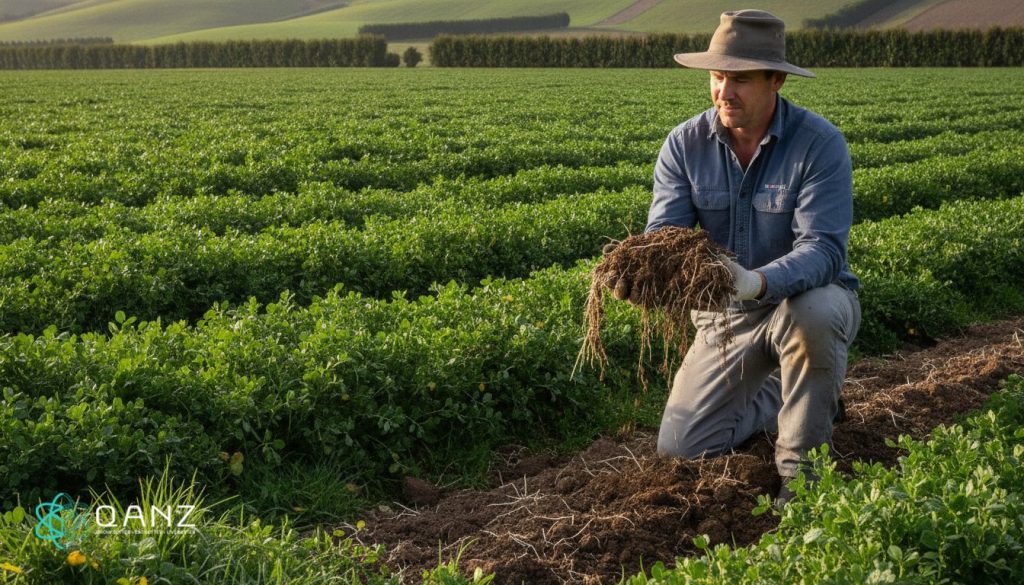
Improving soil carbon on farms in New Zealand requires supporting the soil microbes that convert plant residues into stable carbon. By fostering a diverse microbial environment, growers can increase microbial necromass, which accounts for up to 80% of stable soil organic matter. This approach enhances water-holding capacity and nutrient cycling, providing a practical pathway to long-term farm resilience and improved soil structure.
Did you know that the vast majority of stable soil organic matter is actually composed of dead microbial cells rather than just decomposed plant material? Most New Zealand growers recognise the mounting pressure to manage emissions while maintaining productivity on increasingly compacted or depleted soils. It’s a difficult balance to strike when traditional fertility programmes don’t always deliver the structural improvements your land needs. This article explores how focusing on the microbial engine can transform your approach to improving soil carbon on farms in New Zealand, moving beyond temporary gains to achieve genuine, long-term stability. We’ll examine the science of microbial necromass, the impact of biology on water retention, and how to integrate biological inputs like Quantum Organic-Total® into your management plan with confidence.
Key Takeaways
- Recognise that soil carbon is the primary driver of farm resilience, directly influencing moisture retention and nutrient cycling in New Zealand soils.
- Understand the “Microbial Carbon Pump”, the biological process where soil life transforms plant residues into stable, long-lasting organic matter.
- Discover evidence-based methods for improving soil carbon on farms in New Zealand by reducing physical disturbance and supporting the microbial engine.
- Learn how to establish a baseline for soil health and implement management changes that protect delicate microbial habitats.
- Explore the role of BioGro certified microbial inputs, such as Quantum Organic-Total®, in establishing stable carbon pools for long-term productivity.
Why Improving Soil Carbon is a Priority for New Zealand Growers
Improving soil carbon on farms in New Zealand involves increasing organic matter inputs and, crucially, supporting the microbial activity that converts these inputs into stable humus. This biological approach ensures that carbon is not just added to the soil but is effectively sequestered in a stable form. By fostering a healthy microbial population, growers can enhance soil organic matter (SOM), leading to better water holding capacity, improved nutrient retention, and greater overall farm resilience.
For New Zealand growers, soil carbon serves as the primary foundation for long-term productivity. It is the central component of soil organic matter, influencing everything from the soil’s physical structure to its chemical fertility. As climate patterns become more unpredictable, the ability of a paddock to hold moisture and recycle nutrients becomes a critical factor in maintaining commercial yields. A high-carbon soil acts like a sponge, soaking up water during heavy rain events and holding it for use during dry spells.
The Agronomic Value of Stable Soil Carbon
Stable soil carbon provides the structural integrity necessary to resist compaction, particularly in heavy New Zealand clays. While labile carbon provides a temporary food source for soil life, it’s the stable, mineral-associated organic matter that offers lasting benefits. This stable fraction is largely a product of microbial necromass, the remains of bacteria and fungi that have lived and died within the soil matrix. A deeper understanding of soil carbon dynamics reveals that these stable carbon pools significantly increase a soil’s Cation Exchange Capacity. This means the soil can better retain and exchange vital nutrients, making nutrient recycling far more efficient and reducing the need for excessive synthetic inputs. You can learn more about how biology drives these processes on our technology page.
Regulatory and Market Drivers in Aotearoa
The transition toward low-emissions farming systems is no longer a distant prospect but a current reality in Aotearoa. While policy has shifted toward market-led approaches in the Second Emissions Reduction Plan (2026–2030), the commercial pressure from international buyers remains high. Consumers are increasingly seeking New Zealand produce that is grown with a focus on ecological health and carbon stewardship. Beyond market access, building soil carbon provides a practical buffer against environmental volatility. Soils with robust carbon stocks are more resilient to erosion and nutrient leaching, protecting the farm’s natural capital while meeting the rising expectations of both regulators and global consumers.
The Microbial Engine: How Life Below Ground Builds Carbon
The true power behind improving soil carbon on farms in New Zealand lies in a biological mechanism known as the Microbial Carbon Pump. This process describes how soil life ingests plant-derived carbon and converts it into stable forms that can remain in the soil for decades. Unlike “passive” carbon management, which focuses solely on adding bulk organic matter, this active approach prioritises the microorganisms that anchor carbon into the soil matrix. When microbes consume organic residues, they don’t just release CO2; they also build their own biomass and produce exudates that eventually become part of the soil’s permanent carbon stock.
Contemporary research has shifted our focus from plant-based lignin to the role of microbial necromass. It’s now understood that the dead cell walls of bacteria and fungi are the primary building blocks of stable soil carbon. This means that improving soil carbon on farms in New Zealand is less about how much straw or compost you apply and more about how many microbes are present to process those inputs. Without a functional microbial population, organic matter remains “labile” and vulnerable to loss. For a deeper look at the national context, Manaaki Whenua’s soil carbon sequestration research provides essential data on how land management affects these vital carbon sinks.
The Process of Carbon Stabilisation
Microbes turn simple plant sugars into stable humus through a complex metabolic pathway. During this process, they produce “soil glue,” such as glomalin and other sticky exudates. These substances act as a protective coating, binding tiny soil particles into larger aggregates that shield carbon from rapid decomposition and oxidation. A diverse microbial population is crucial here; a varied community ensures that different carbon compounds are processed and protected, preventing the loss of carbon stocks during environmental fluctuations. This biological structure also reduces the risk of erosion, keeping your hard-earned carbon where it belongs.
Photosynthetic Bacteria and Soil Energy
Photosynthetic bacteria play a unique role in this engine by capturing light energy and supporting soil vitality. These organisms contribute to the overall energy balance of the soil, providing the fuel that other microorganisms need to function effectively. They act as a foundational energy source, ensuring the soil remains an active, living system rather than a sterile medium. Understanding how beneficial soil microorganisms boost plant health is particularly relevant for growers who are looking to rebuild this energy balance after periods of intensive cultivation or chemical use. If you are looking to support this biological engine, exploring microbial inoculants is a practical first step toward restoring natural carbon stabilisation.
Strategies for Carbon Retention: Management vs. Biology
Traditional management often views soil as a chemical bank account, focusing on NPK inputs to drive seasonal yield. While this produces results, it often overlooks the biological cost. Improving soil carbon on farms in New Zealand requires a shift from viewing carbon as an additive to seeing it as a biological outcome. Simply adding compost or mulch isn’t enough if the soil’s microbial community is degraded; without the right “workers” to process these inputs, much of that organic matter is lost to the atmosphere as CO2 rather than being stabilised.
High-intensity cultivation and heavy synthetic nitrogen use can inadvertently deplete existing carbon stocks. Tillage introduces oxygen into the soil profile, which over-stimulates aerobic microbes, causing them to rapidly consume organic matter. Similarly, excessive nitrogen can lead microbes to “mine” soil carbon to maintain their internal carbon-to-nitrogen balance. This is why understanding the role of microbial necromass in soil carbon accumulation is so critical. The goal isn’t just to add carbon but to ensure it’s converted into stable microbial remains that stay in the soil profile.
The Impact of Synthetic Inputs on Soil Biology
Synthetic fertilisers, particularly high-rate nitrogen, can create a “burn off” effect where soil carbon is consumed faster than it’s replaced. While nitrogen is essential for plant growth, an imbalance can signal microbes to break down stable humus to find the carbon they need for energy. Maintaining a balance between commercial productivity and biological preservation is key. Many growers are now exploring a transition toward microbial solutions for field crops to help maintain soil vitality while managing input costs. This approach allows for productivity without sacrificing the long-term health of the soil engine.
Regenerative Agriculture and Microbial Support
Regenerative practices like cover cropping and diverse pastures serve as a constant food source for the soil engine. By keeping living roots in the ground, growers provide the exudates that feed beneficial fungi and bacteria. Minimum till practices further protect these microbial habitats, helping to restore a healthy fungal-to-bacterial ratio which is often skewed in conventional systems. Biological inputs act as a catalyst in this transition, providing the specific microbial strains needed to kickstart the carbon stabilisation process. This synergy between management and biology is the most effective path for improving soil carbon on farms in New Zealand, ensuring that every management decision supports the life below the surface.

Practical Steps to Improve Carbon on New Zealand Farms
Implementing a biological carbon strategy requires a shift from reactive inputs to proactive system management. Improving soil carbon on farms in New Zealand is a multi-season commitment that begins with understanding your current soil state and protecting the delicate life within it. By following a structured roadmap, growers can move beyond theory into measurable on-farm results.
- Step 1: Establish a baseline. Conduct comprehensive testing for soil organic matter and microbial activity. You cannot manage what you do not measure; establishing these levels allows you to track the efficacy of your biological programme over time.
- Step 2: Minimise soil disturbance. Physical cultivation introduces sudden bursts of oxygen that cause carbon to oxidise and escape as CO2. Reducing tillage protects the microbial habitats where carbon stabilisation occurs.
- Step 3: Maintain living roots. Living plants provide a constant source of liquid carbon through root exudates. Use cover crops or diverse pasture mixes to ensure the “microbial pump” is fed year-round, even during fallow periods.
- Step 4: Integrate microbial inoculants. Use BioGro certified inputs like Quantum Organic-Total® to kickstart the carbon pump. These specific microbial strains assist in processing organic residues into stable humus.
- Step 5: Monitor progress. Combine laboratory analysis with physical observations. Regular checks of soil structure and root health provide immediate feedback on how your management is affecting the underground engine.
Optimising Input Timing for Soil Health
Microbial establishment depends heavily on environmental conditions. To ensure maximum integration, apply biological treatments when soil moisture is adequate and temperatures are rising, typically in spring or autumn. Microbes are living organisms; they require a hospitable environment to thrive and begin the work of carbon stabilisation. Integrating these inputs into structured Quantum crop application programmes ensures that biology is delivered at the precise growth stages where the plant and soil benefit most. This methodical approach maximises the return on your biological investment.
Monitoring and Measuring Success
Measurable increases in stable soil carbon often involve a lag time as biological processes take hold. While lab results may take a few seasons to show significant shifts, you can use Visual Soil Assessments (VSA) to track immediate structural changes. Look for improved crumb structure, deeper root penetration, and increased earthworm activity. Consistent record-keeping is essential for improving soil carbon on farms in New Zealand, as it helps identify which paddocks are responding best to biological management. Talk to QANZ about designing a monitoring schedule that fits your specific cropping or pastoral system.
Integrating QANZ Biologicals into Your Carbon Strategy
Adopting a biological approach to improving soil carbon on farms in New Zealand requires more than just changing management practices; it involves introducing a specific microbial workforce capable of stabilising organic matter. While regenerative techniques provide the environment, high-quality microbial inputs act as the catalyst to ensure the “carbon pump” functions at peak efficiency. QANZ provides professional-grade tools designed to integrate seamlessly into existing farm programmes, helping growers move from theory to verifiable soil health gains.
A successful carbon strategy isn’t built on a single application but on a methodical programme that supports the soil engine through every season. By using targeted biologicals, you aren’t just adding organic material; you’re supporting the metabolic processes that turn that material into stable microbial necromass. This shift in focus ensures that your efforts in improving soil carbon on farms in New Zealand lead to long-term resilience rather than temporary spikes in labile carbon.
The Role of Quantum Organic-Total®
Quantum Organic-Total® is a microbial agricultural input offered by QANZ for use in crop and soil programmes. For growers in Aotearoa, the BioGro certification of this product provides essential peace of mind, particularly for those operating under organic standards or transitioning away from high-synthetic systems. It offers a verified biological solution that supports the “Microbial Carbon Pump” without the risk of synthetic interference. It’s essential to check product suitability and certification requirements against current technical documentation to ensure alignment with your specific farm management plan. For professional growers evaluating the integration of these tools, exploring the technical specifications of Quantum Organic-Total® is an excellent starting point for commercial planning.
Evidence-Based Approach and Trial Data
While Quantum Organic-Total® focuses on the soil foundation, Quantum VSC® can be utilised in broader crop programmes to support plant health and overall vitality. This dual-action approach ensures that the entire system remains biologically active. We rely on an evidence-based framework that respects both historical overseas evidence and the unique environmental context of New Zealand. For example, historical responses observed at sites like Nolt Farm provide valuable insights into how these microbes interact with plant systems, though we always prioritise site-specific application and local conditions.
To maintain scientific integrity and transparency, all observations are shared with a necessary understanding of variability: “Results from individual trials or commercial observations are specific to the formulation, crop, location, treatment and conditions tested and should not be interpreted as a guarantee of equivalent performance elsewhere.” QANZ provides professional technical support to help you tailor these microbial solutions to your specific soil types and cropping cycles. Talk to QANZ about whether Quantum Organic-Total® is appropriate for your crop, growing system, and application programme.
Securing Long-Term Productivity Through Biological Resilience
Building stable soil organic matter is no longer just a secondary goal; it’s a fundamental requirement for farm resilience in an increasingly volatile climate. By prioritising the microbial engine, growers can transition from temporary organic matter gains to the creation of stable, mineral-associated carbon. This biological approach, centred on the “Microbial Carbon Pump”, ensures that carbon is effectively anchored within the soil matrix, improving water-holding capacity and nutrient efficiency across the paddock.
Successful strategies for improving soil carbon on farms in New Zealand must balance commercial productivity with ecological stewardship. Integrating BioGro certified technology like Quantum Organic-Total® provides a verified pathway to support this vital underground workforce. QANZ offers professional technical support to help you tailor these microbial solutions to your specific soil types and cropping cycles, ensuring your land remains productive for generations to come. Talk to QANZ about whether Quantum Organic-Total® is appropriate for your crop and carbon strategy. Investing in your soil’s biological health is the most practical and evidence-based step toward a sustainable and profitable farming future.
Frequently Asked Questions
How long does it take to see an increase in soil carbon?
Measurable increases in stable soil carbon typically occur over a three to five-year period rather than a single growing season. While you might notice improved soil structure or increased earthworm activity within months, the biological conversion of organic matter into stable humus is a gradual process. Consistent management and baseline testing are vital to accurately track these long-term shifts in your soil’s carbon profile.
Can I use microbial inputs like Quantum Organic-Total® alongside traditional fertilisers?
Microbial inputs can be integrated into conventional systems, although high rates of synthetic nitrogen may impact microbial efficiency. Quantum Organic-Total® is designed for use in various crop and soil programmes. Many growers use biologicals to enhance nutrient cycling efficiency, which can support a more balanced approach to fertility. It’s important to coordinate these applications to ensure the biology has the best chance to establish in the paddock.
Is Quantum Organic-Total® suitable for certified organic farms in New Zealand?
Quantum Organic-Total® is BioGro New Zealand certified as an approved microbial agricultural input. This certification confirms it meets the standards required for use on certified organic farms. Growers should always verify the product’s current certification status and suitability for their specific farm management plan against the latest BioGro documentation. It’s essential to ensure any input fits within your specific certification requirements and intended land use before application.
What is the difference between soil organic matter and soil organic carbon?
Soil organic matter refers to the entire organic component of the soil, including plant residues and living microbes. Soil organic carbon is the specific carbon element within that matter, usually making up about 58% of the total. Improving soil carbon on farms in New Zealand focuses on the carbon fraction because it is a stable indicator of sequestration and is vital for maintaining healthy soil structure and moisture.
Do I need to change my cultivation practices to improve soil carbon?
Reducing soil disturbance is highly recommended for those prioritising carbon retention. Heavy cultivation introduces oxygen that stimulates microbes to consume organic matter rapidly, which releases carbon as CO2. Moving toward minimum-till or no-till systems protects the microbial habitats necessary for the Microbial Carbon Pump to function effectively. This protection allows the soil to stabilise carbon within the mineral matrix rather than losing it to the atmosphere.
How do microbes actually stabilise carbon in the soil?
Microbes stabilise carbon by converting plant residues into their own biomass and sticky exudates. When these microbes die, their remains, known as necromass, bind to silt and clay particles to form stable aggregates. This biological process, often called the Microbial Carbon Pump, protects carbon from rapid decomposition. By anchoring carbon to soil minerals, microbes ensure it remains in the soil profile for much longer than raw organic matter would alone.
What role does soil pH play in carbon sequestration?
Soil pH significantly influences the diversity and activity of the microbial community responsible for carbon cycling. Most beneficial bacteria and fungi involved in carbon stabilisation thrive in a neutral range, typically between pH 6.0 and 7.0. If the soil is too acidic or alkaline, microbial turnover slows down. This reduction in biological activity can hinder the natural processes required for improving soil carbon on farms in New Zealand.
Can biological inputs help with soil restoration after chemical use?
Biological inputs are often used as a tool for soil restoration following intensive chemical use or soil fumigation. These treatments can deplete beneficial microbial populations, leaving the soil less capable of processing organic matter. Introducing specific microbial strains helps re-establish the biological engine. This restoration assists the soil’s natural ability to recycle nutrients and build stable carbon stocks, helping the land recover its productive capacity and structural integrity.
Disclaimer
Important: This article provides general agricultural information only. Product performance can vary according to crop, soil, climate, management practices and application conditions. Trial or research results discussed may have been obtained under specific conditions and should not be interpreted as a guarantee of equivalent results. Always follow current product directions and confirm suitability for your crop, growing system and organic certification requirements. Contact QANZ for current product and application information.
