
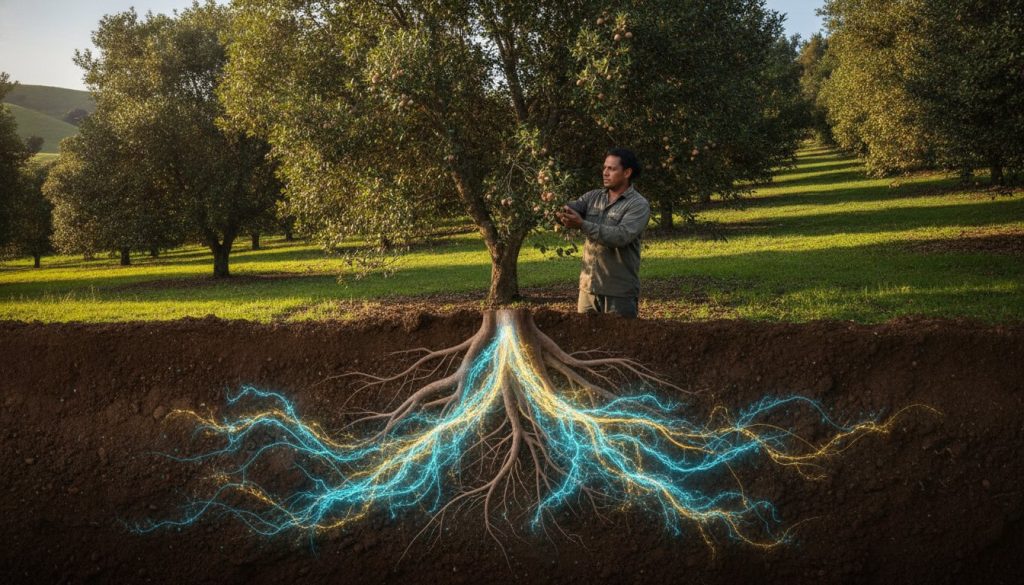
What if the key to your orchard’s 2026 harvest isn’t sitting in a bag of synthetic fertiliser, but is already locked beneath your boots? Many New Zealand nut growers are facing the frustration of rising input costs while battling stubborn soil compaction and nutrient lock-out in their established blocks. You’ve likely noticed that simply adding more NPK doesn’t always translate to better kernel fill or tree vigour, especially as regional paddocks face increasing drought pressure. Implementing BioGro certified microbial soil amendments for nut orchards can bridge this gap by restoring the natural biological processes that traditional chemistry often overlooks.
It’s understandable to feel the weight of strict organic compliance and the need for consistent yields in a changing climate. This guide shows you exactly how biological treatments for fruit trees can transform your orchard productivity and long-term soil health. We’ll explore the methodical application of liquid microbial technologies like Quantum Organic-Total® and Quantum-VSC®, providing a clear roadmap to increased nut meat quality and improved tree resilience without the heavy reliance on synthetic inputs.
Key Takeaways
- Understand why 2026 is a pivotal year for New Zealand nut production as biologicals move from niche treatments to essential orchard management tools.
- Learn how microbial soil amendments for nut orchards establish a ‘biological bridge’ to unlock trapped soil minerals and enhance tree vascular health.
- Discover why liquid-based microbial solutions are superior to granular alternatives for achieving faster efficacy and seamless integration into existing irrigation systems.
- Identify the critical timing for your biological applications, starting with the spring root flush to optimise tree resilience against seasonal stress.
- Gain insights into using BioGro certified products like Quantum Organic-Total® to improve nut meat quality while maintaining strict organic compliance.
The Evolution of Microbial Soil Amendments for Nut Orchards
Biological treatments for fruit and nut trees are no longer viewed as experimental additives. They represent a fundamental shift in how we manage the rhizosphere, the critical zone of soil surrounding the root system. These treatments introduce beneficial microbial consortia that work in symbiosis with the tree to improve nutrient uptake and soil structure. As we move into 2026, the adoption of microbial soil amendments for nut orchards has reached a turning point in New Zealand. Growers are moving away from a narrow, NPK-only mindset in favour of a holistic soil microbiome approach that prioritises long-term ecological health over short-term chemical spikes.
This evolution is driven by a growing understanding that soil is a living engine. While traditional fertilisers provide raw elements, they often bypass the natural biological processes required for sustainable growth. True microbial inoculants differ significantly from simple bio-stimulants. While a bio-stimulant might provide a temporary “sugar hit” to existing soil life, a complex microbial inoculant introduces a functional community of organisms designed to establish a permanent presence. This distinction is vital for orchardists who need reliable, season-after-season performance rather than a fleeting boost in vigour. The same principles that underpin organic viticulture soil health in New Zealand’s vineyards apply equally to perennial nut crops, where long-term microbial community stability is the foundation of consistent production.
Why Nut Trees Require Specific Microbial Consortia
Perennial crops like macadamias, walnuts, and hazelnuts have unique biological requirements compared to annual field crops. Their long-term root systems develop deep relationships with soil fungi and bacteria over decades. In older New Zealand orchards, soil fatigue often sets in as the same ground is worked for generations, leading to a decline in natural microbial diversity. Microbial soil amendments for nut orchards address this by reintroducing the specific consortia needed to cycle phosphorus. Nut production is notoriously phosphorus-heavy, and microbes play a decisive role in solubilising this mineral, making it available to the tree’s vascular system even in compacted or high-pH soils.
The Role of BioGro Certification in NZ Agriculture
Purity and verification are the cornerstones of the New Zealand agricultural export brand. In a market where “natural” is often used as a vague marketing term, BioGro certification provides the independent verification that professional growers require. This certification ensures that the microbial technologies you apply are free from synthetic interference and harmful pathogens. For orchards targeting organic standards or high-value export markets, using verified solutions is a matter of compliance and risk management. GrowQanz maintains this gold standard by ensuring that products like Quantum Organic-Total® meet the rigorous requirements of BioGro New Zealand, giving growers the confidence that their soil health strategy aligns with the country’s strictest environmental benchmarks.
How Biological Treatments for Fruit Trees Transform Soil Physiology
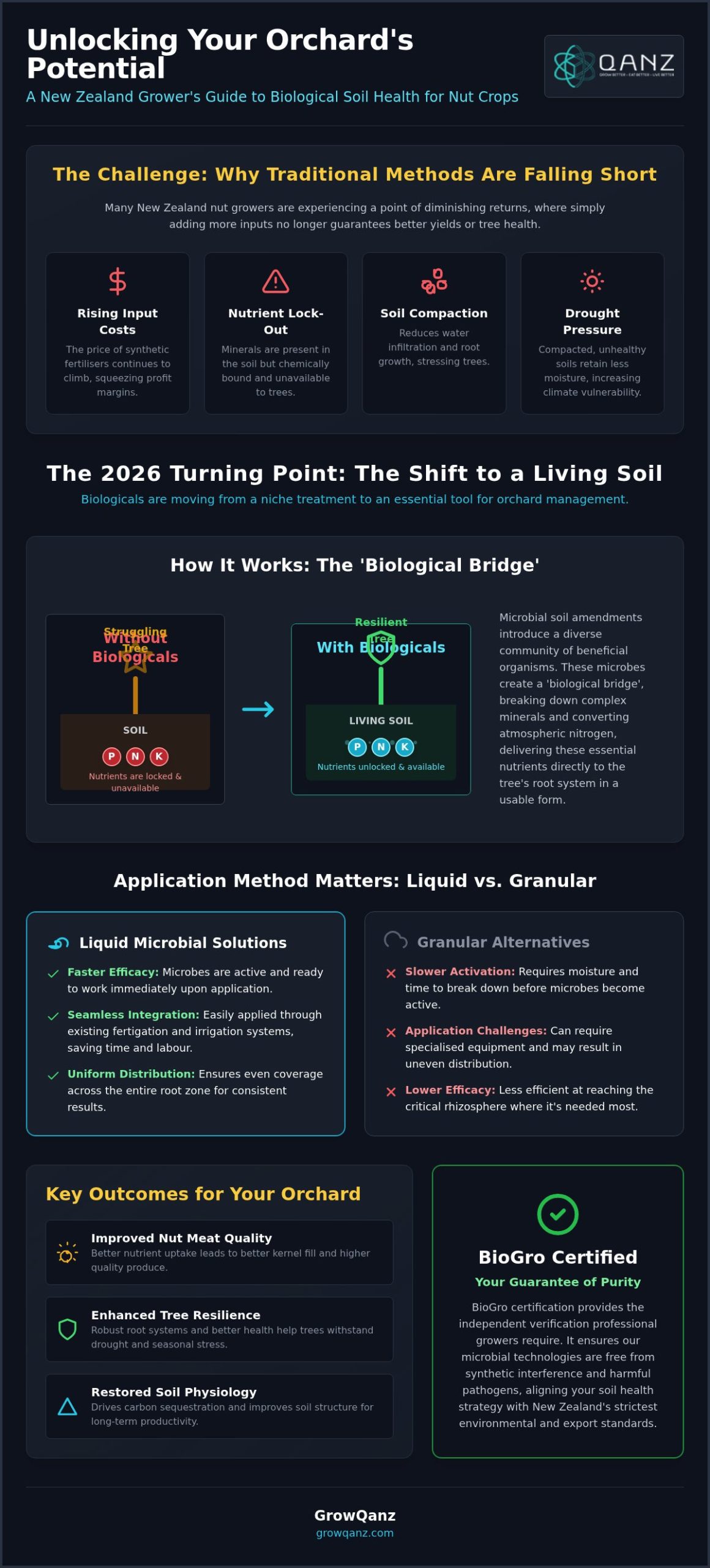
The transition from a chemically dependent orchard to a biologically active one relies on what scientists call the ‘Biological Bridge’. In many New Zealand nut orchards, essential minerals are present in the soil but remain chemically bound and inaccessible to the tree. Biological treatments for fruit trees act as this bridge, using specialised microbes to facilitate the movement of nutrients from the soil matrix into the tree’s vascular system. This process doesn’t just feed the tree; it fundamentally alters the rhizosphere’s physical and chemical properties to support long-term productivity.
While most soil programmes focus on underground activity, the inclusion of photosynthetic bacteria provides a hidden engine for orchard vitality. These unique organisms operate at the soil surface and within the upper layers, driving carbon sequestration by converting light energy and carbon dioxide into organic carbon. Photosynthetic bacteria serve as highly efficient, non-symbiotic nitrogen fixers that capture atmospheric nitrogen and deliver it to the root zone, reducing the need for heavy external inputs in nut orchards. This activity supports a more robust root architecture, encouraging deep taproot penetration and a dense network of lateral feeder roots that can better explore the soil profile for moisture and minerals.
Unlocking Nutrient Availability with Quantum Organic-Total®
New Zealand’s volcanic soils are notorious for their ability to “fix” phosphorus, making it unavailable to plants despite high soil test results. Quantum Organic-Total® contains specific microbial strains that actively solubilise these locked-up phosphorus reserves. By breaking these chemical bonds, the consortia ensure a steady supply of energy for the tree’s metabolic functions. This biological activity also enhances the uptake of critical trace elements like Zinc, Boron, and Magnesium, which are essential for pollination and kernel development. In high-rainfall regions like the Bay of Plenty or Tasman, this improved soil structure creates better aggregate stability, significantly reducing nutrient leaching and keeping your investment in the root zone where it belongs. To see how these consortia function in different environments, you can explore our range of microbial soil amendments for nut orchards.
Managing Stress and Resilience with Quantum-VSC®
Resilience is the hallmark of a biologically balanced orchard. Quantum-VSC® is engineered to help trees develop systemic resistance against common pathogens and environmental extremes. During the increasingly dry summers on the East Coast, the extracellular polysaccharides produced by these microbes act as a biological glue, improving soil moisture retention and preventing root desiccation. This support is most critical during the nut-fill stage, when the tree’s energy demands are at their peak. By reducing the physiological stress associated with heat and drought, these microbial consortia allow the tree to direct its resources toward nut meat quality and yield rather than mere survival.
Comparing Liquid vs. Granular Microbial Amendments
Choosing the right delivery system is often the difference between a successful biological programme and a wasted investment. While granular products have served broadacre farming for decades, liquid microbial soil amendments for nut orchards are rapidly becoming the preferred standard for commercial operations across New Zealand. This preference isn’t merely about convenience; it’s rooted in the physics of how biology moves through the soil profile to reach the active root zone. In established orchards, where thick layers of mulch or leaf litter are common, granular applications often struggle to penetrate the surface, leaving the beneficial microbes stranded away from the roots they are meant to support.
Liquid consortia offer superior efficacy rates because they utilise water as a transport vehicle. This allows the microbes to bypass surface barriers and move directly into the rhizosphere, where colonisation can begin almost immediately. For large-scale operations in regions like Waikato or Canterbury, the cost-benefit analysis heavily favours liquid formats. The ability to integrate these treatments into existing fertigation hardware eliminates the need for additional machinery passes, significantly reducing diesel consumption and soil compaction. This streamlined approach ensures that biological management remains a practical part of the daily orchard routine rather than an arduous seasonal task.
The Efficiency of Liquid Fertigation
Precision placement is the primary advantage of liquid application. By delivering biology through your irrigation lines, you can target the drip line where feeder roots are most active. This method provides several operational benefits:
- Labour Reduction: Automated fertigation requires far fewer man-hours than the manual or mechanical spreading of dry amendments across hundreds of hectares.
- Environmental Stability: Liquid applications eliminate the “dust and drift” issues often seen with fine granular powders, ensuring the entire dose reaches the soil.
- Uniformity: Every tree receives an identical concentration of microbial consortia, leading to more consistent orchard-wide results in nut meat quality and yield.
Bio-availability and Colonisation Speed
Liquid inoculants generally establish microbial colonies more reliably than their dry counterparts. Many granular products rely on dormant spores that must “wake up” once they encounter soil moisture, a process that can be hindered by dry spells or poor soil contact. In contrast, liquid technologies like Quantum Organic-Total® contain metabolically active consortia that are ready to function the moment they hit the ground. The specialised carrier liquid is designed to maintain a stable shelf-life while protecting the microbes from UV exposure during application. This high level of bio-availability makes them easy to integrate into comprehensive orchard soil health management programmes, allowing growers to see measurable improvements in tree resilience within a single growing season.
Implementation Guide: Integrating Microbials into Your Orchard
Successful integration of microbial soil amendments for nut orchards requires a shift from reactive problem-solving to a proactive seasonal calendar. While chemical interventions often address symptoms, biological management focuses on the underlying engine of tree health. Establishing a high-functioning microbial community is a methodical process that aligns with the natural phenology of the tree, ensuring that beneficial consortia are present when the demand for nutrient cycling and stress resilience is highest.
Step 1: Baseline Testing. Before your first application, conduct comprehensive soil and leaf tissue testing to identify existing microbial gaps and nutrient lock-outs. This provides a scientific benchmark to measure the efficacy of your biological programme over time.
Step 2: Spring Root Flush. The primary application should coincide with the spring root flush, typically occurring in late September or October across most New Zealand regions. Introducing consortia like Quantum Organic-Total® during this window ensures that new roots are immediately colonised by beneficial bacteria.
Step 3: Maintenance through Nut-Fill. As the tree enters the energy-intensive nut-fill stage, maintaining microbial populations is essential. Regular, lower-dose applications through fertigation help sustain the biological activity required to solubilise phosphorus and move trace elements into the developing kernels.
Step 4: Post-Harvest Recharge. An autumn application acts as a “recharge” for the soil. This helps break down organic matter from the harvest and prepares the rhizosphere for dormancy, ensuring a healthy microbial base for the following spring.
Maximising ROI with Strategic Timing
Adopting a “little and often” approach to application generally yields a higher return on investment than a single, heavy dose. This strategy keeps microbial populations stable and prevents the “boom and bust” cycles that can occur with inconsistent management. When you focus on maximising nut yields through biology, timing is everything. It’s best to apply liquid consortia during overcast conditions or late in the afternoon to protect the microbes from UV degradation. Additionally, avoid application immediately before heavy regional rain events to prevent the biology from being washed out of the active root zone.
Monitoring Success in the Field
Evidence of a successful biological transition often appears first in the physical structure of the soil. You’ll likely notice improved tilth and a visible increase in fine feeder root mass within the drip line. Nut meat quality, specifically kernel weight and oil content, serves as the ultimate indicator of improved nutrient uptake. Modern growers are increasingly using sap analysis alongside traditional leaf testing to get a real-time view of how microbes are facilitating mineral movement. Over a three to five-year period, a well-managed biological programme typically leads to a measurable reduction in the volume of synthetic NPK required to maintain peak production. If you’re ready to establish this foundation on your property, you can explore our Fruit & Nut Crop Microbial Solutions to find the right consortia for your orchard’s specific needs.
The GrowQanz Solution: Quantum Technologies for Nut Growers
GrowQanz provides the scientific framework and high-performance technologies required to navigate the complexities of modern orchard management. As New Zealand’s nut industry looks toward 2026, the transition to biological-first systems is being led by those who value verified, evidence-based inputs. Our range of microbial soil amendments for nut orchards is designed to integrate seamlessly into existing operations, providing a reliable path to soil health without compromising commercial productivity. We position ourselves as a serious professional partner, offering the technical support needed to ensure your biological transition is both smooth and profitable.
Quantum Organic-Total® serves as our flagship consortia, engineered to provide total orchard vitality. It’s not a single-strain additive but a complex community of beneficial microbes that work in harmony to restore the soil’s natural energy cycle. This 100% natural, BioGro certified technology provides the purity required for premium export markets while delivering the results expected by professional orchardists. By establishing this foundational microbiome, growers can ensure their trees have constant access to the minerals required for healthy wood growth and high-quality kernel development.
For targeted support during periods of high stress, Quantum-VSC® provides the additional resilience needed to protect your investment. This formulation focuses on enhancing tree vigour and developing systemic resistance against the pathogens that often take hold in compromised or compacted soils. Whether you’re managing young transplants or established blocks facing the pressure of a dry summer in the Hawke’s Bay or Canterbury, these specialised microbes help maintain the physiological momentum required for a successful harvest. Growers in adjacent industries have found similar success applying these principles, as demonstrated by the measurable gains in organic viticulture soil health management across New Zealand’s premium wine regions.
Why NZ Growers Trust GrowQanz
Our commitment to scientific rigour means every product in our range is backed by proven field results. We understand that Aotearoa’s soils, from the volcanic loams of the north to the alluvial plains of the south, present unique challenges that generic imports often fail to address. When you partner with us, you gain access to a dedicated team that understands the local landscape. We provide:
- Proven Field Results: Technologies tested and refined for the unique conditions of New Zealand orchards.
- Scientific Innovation: Advanced microbial consortia that go beyond simple bio-stimulants.
- Technical Expertise: Direct guidance on application timing and integration with existing fertigation systems.
Getting Started with a Biological Programme
Transitioning from a conventional, chemical-heavy approach to a biological-first system is a journey of soil restoration. It begins with a consultation to understand your orchard’s specific needs and the varieties you cultivate, whether macadamias, walnuts, or hazelnuts. Our team will help you tailor a solution using BioGro certified microbial soil amendments for nut orchards that fits your irrigation setup and seasonal schedule, guiding you through the initial baseline testing and subsequent application phases. To take the first step toward a more resilient and productive future, Enquire about Quantum Organic-Total® for your orchard today.
Securing the Future of New Zealand Nut Production
The transition toward biological management represents a fundamental change in how we maintain orchard productivity. By moving beyond a reliance on synthetic inputs and focusing on the health of the rhizosphere, you’re building a resilient foundation that can withstand the environmental pressures of the coming seasons. Adopting liquid microbial soil amendments for nut orchards allows for precise, automated nutrient delivery that directly supports kernel fill, tree vigour, and overall soil structure.
Integrating these BioGro certified technologies ensures your property remains compliant with the highest organic standards while fostering long-term ecological health. As a 100% NZ owned and operated partner, GrowQanz provides the scientific field trial results and technical expertise needed to support your commercial success. Request a Technical Data Sheet for Quantum Organic-Total® to see how these consortia can transform your next harvest. Investing in your soil’s biology today ensures a more sustainable and profitable orchard for years to come.
Frequently Asked Questions
Are microbial soil amendments safe for use in organic nut orchards?
Yes, microbial soil amendments are safe and highly beneficial for organic nut orchards, provided they carry independent verification. GrowQanz technologies are BioGro New Zealand certified, ensuring they meet the strict criteria for organic production without synthetic additives. This certification gives growers confidence that their soil health strategy aligns with both local and international organic standards while protecting the integrity of their land.
Can I mix liquid microbial treatments with my standard fertilisers?
You can integrate liquid microbial treatments with many standard fertilisers, but it’s essential to avoid high concentrations of certain synthetic salts or biocides that might harm living organisms. We recommend a “jar test” for physical compatibility and checking with our technical team regarding specific chemical interactions. Applying microbes alongside compatible nutrients can actually improve fertiliser efficiency by preventing mineral lock-out in the root zone.
How quickly will I see results after applying biological treatments to my nut trees?
Visible changes in soil tilth and fine feeder root mass often appear within the first growing season. However, improvements in nut meat quality and overall yield typically become more pronounced over a one to three-year period as the microbial community stabilises. Biological management is a long-term investment in orchard physiology rather than a temporary chemical fix, leading to sustained productivity gains over multiple harvests.
Do microbial amendments work in heavy clay or sandy NZ soils?
Yes, microbial soil amendments for nut orchards function effectively across New Zealand’s diverse soil profiles, from heavy North Island clays to the sandy loams of the south. In clay soils, microbes help create better aggregate stability and drainage, reducing compaction. In sandy soils, the biological glues produced by the consortia improve moisture retention and nutrient holding capacity, preventing leaching during heavy rain events.
Will these products help my nut trees survive a drought?
Microbial treatments significantly improve drought resilience by encouraging deeper root architecture and enhancing the soil’s ability to hold water. Specialised consortia like Quantum-VSC® help trees manage physiological stress during dry East Coast summers. By maintaining a healthy rhizosphere, the tree can continue to access moisture and nutrients even when surface soil layers are dry, reducing the risk of nut drop or poor kernel fill.
What is the difference between Quantum Organic-Total® and Quantum-VSC®?
Quantum Organic-Total® is our flagship foundation consortia designed to boost overall soil vitality and nutrient cycling. It provides the essential biological community required for a healthy orchard engine. Quantum-VSC® is a more targeted formulation that focuses on stress recovery, disease resistance, and vigour. While Organic-Total® builds the baseline, VSC is often used to provide extra support during transplanting or periods of environmental pressure.
How often should I apply microbial treatments to an established orchard?
We generally recommend a programme of three to four applications per year for established orchards. This typically includes a primary application during the spring root flush, a maintenance dose during the nut-fill stage, and a post-harvest recharge in autumn. This “little and often” approach ensures that beneficial microbial populations remain active and dominant in the rhizosphere throughout the entire production cycle.
Is BioGro certification necessary for non-organic orchards?
BioGro certification isn’t strictly required for conventional orchards, but it serves as a powerful guarantee of product purity and safety. Even for non-organic growers, using certified microbial soil amendments for nut orchards ensures that you aren’t introducing unwanted pathogens or synthetic contaminants into your soil. It provides a level of independent verification that gives professional growers peace of mind regarding the integrity of their inputs.
