
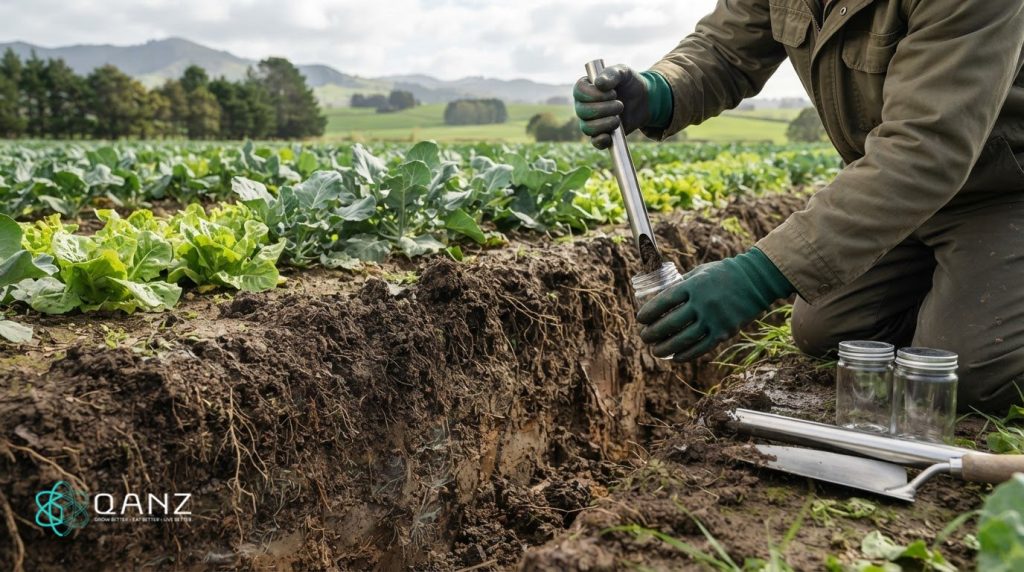
What if the best first step in soil restoration after fumigation isn’t adding a biological input, but checking what the paddock needs? Fumigation can affect beneficial soil organisms as well as target pests, but the impact and recovery depend on the fumigant, soil conditions and management. Soil isn’t permanently sterilised, and one treatment won’t suit every growing area.
It’s understandable to want to act quickly, especially with the next crop in mind. But choosing an intervention before assessing the soil can mean relying on general advice that doesn’t fit your conditions, or on product claims that aren’t supported by relevant evidence.
This guide explains what can influence recovery and how to assess your paddock before planning next steps. You’ll learn how to compare practical soil-management options, evaluate biological inputs against current technical information, and check guidance for your crop and location. New Zealand growers should confirm that product information and fumigant instructions apply locally, as recommendations and requirements can differ between New Zealand and Australia.
Key Takeaways
- Soil restoration after fumigation starts with assessing the paddock and treatment history, not assuming a particular input is needed.
- Fumigant, soil type, moisture, temperature, organic matter and management can all influence biological recovery.
- Compare options such as organic matter, living plant cover, cultivation choices, monitoring and biological inputs against your crop’s needs and the evidence available.
- Use the fumigant label and qualified local advice to guide product-specific handling and crop decisions in New Zealand.
- Before considering Quantum Organic-Total®, check current technical information and whether it suits your crop, growing system and programme.
What does soil restoration after fumigation involve?
Soil restoration after fumigation is context-dependent. Start by assessing the treatment, soil and next crop, rather than assuming a particular amendment is needed. Restoration means managing conditions and monitoring how the soil responds; it doesn’t guarantee that the biological community will return to a specific earlier state. The right plan depends on what was applied and what the growing area needs next.
What can fumigation change in soil?
Fumigation is intended to manage the pests, pathogens or other target organisms specified for the particular product and use. Check the current product label for its stated purpose and directions. Don’t infer the target, suitable crop timing or treatment effect from the word “fumigation” alone.
Depending on the fumigant and conditions, treatment may also affect non-target soil organisms. Soil communities can recolonise, but recovery doesn’t necessarily mean the same organisms or functions return in the same balance. Findings from one fumigant, soil type or study setting shouldn’t be assumed to apply to another. Without the product name, application details and site conditions, growers can’t reliably predict the scale of change or the recovery period.
The US Environmental Protection Agency’s soil fumigant management guidance provides a reference for treatment planning in the United States. It isn’t New Zealand guidance or evidence that a particular treatment restores soil biology. Use the applicable local label and relevant research when making site-specific decisions.
What should growers establish before planning recovery?
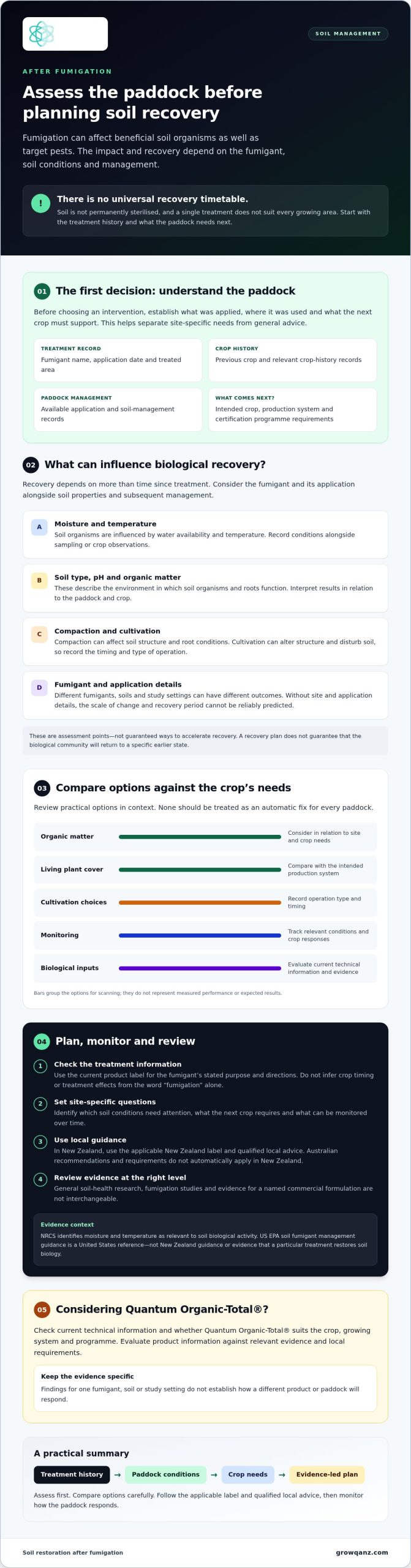
Start with a clear record of what happened and what the paddock must support next. Gather:
- the fumigant name, application date and treated area
- the previous crop and relevant crop-history records
- available application and soil-management records
- the intended next crop, production system and any certification programme requirements
These details help frame practical questions: what does the label say about the treatment and subsequent crop, which soil conditions need attention, and what can be monitored over time? They also help separate general soil-health advice from guidance that applies to a particular fumigant or site.
New Zealand growers should use the applicable New Zealand label and local guidance. Australian growers should check the current Australian label and guidance separately. Recommendations or requirements in one country shouldn’t be treated as automatically applicable in the other. The label and qualified local advice should guide product-specific handling and crop decisions.
How do soil conditions influence biological recovery after fumigation?
Biological recovery depends on more than time since treatment. The fumigant and its application matter, as do soil properties and subsequent management. Assess soil restoration after fumigation by tracking relevant conditions and crop responses over time, rather than relying on a universal recovery timetable.
Evidence also needs to be read at the right level. General soil-health research explains how organisms respond to their environment; fumigation studies examine the effects of particular treatments. Neither automatically demonstrates how a named commercial formulation performs. Findings for one fumigant or study site can’t establish the outcome for a different product, soil or paddock.
Which soil and management factors are worth assessing?
Use these as assessment points, not guaranteed ways to accelerate recovery:
- Moisture and temperature: soil organisms are influenced by water availability and temperature, so record conditions alongside sampling or crop observations. The USDA Natural Resources Conservation Service (NRCS) identifies these as relevant to soil biological activity in its soil health guidance.
- Soil type, pH and organic matter: these help describe the environment in which soil organisms and roots function. NRCS includes soil structure and organic matter among soil-health considerations. Interpret any result in relation to the paddock and crop, rather than as a stand-alone recovery score.
- Compaction and management: compaction can affect soil structure and root conditions. Cultivation may alter structure and disturb soil, so record the timing and type of operations rather than assuming more cultivation will help.
- Roots and plant diversity: living roots and different plant species contribute to changing soil conditions over time. Consider crop sequence, cover and root presence when interpreting observations, not as a guaranteed remedy.
Fumigation research is treatment-specific, so results from overseas studies shouldn’t be applied unchanged to New Zealand soils or production systems. The US Environmental Protection Agency’s Fumigant Management Plan (FMP) guidance illustrates the value of recording site and treatment details, but it is US guidance, not a New Zealand requirement.
How can growers monitor soil conditions over time?
Establish a baseline using available soil-test results, crop observations and management records. Choose indicators that fit the question: a soil test may help assess selected chemical or physical properties, while crop establishment and visible root condition provide field observations. Neither alone describes the full microbial community, and results can vary with sampling location, depth, timing and method.
For useful comparisons, keep sampling areas, methods and timing as consistent as practical. Note treatment and management differences, and interpret changes alongside weather and crop history. Growers can discuss Quantum products and application programmes with GrowQanz, while checking current technical information for suitability to their crop and system.
Which soil restoration options should growers compare after fumigation?
There’s no single restoration treatment for every paddock. Compare options against soil conditions, the crop plan and available evidence, then consider how each fits the broader production programme. General soil-health principles can inform that discussion, but they don’t prove that a particular practice or commercial input will restore fumigated soil.
The USDA Natural Resources Conservation Service discusses organic matter, living roots and soil disturbance as soil-health considerations. These principles provide useful context, not a prescription for post-fumigation treatment in New Zealand. The practical article on restoring soil biology after fumigation also discusses amendments and cover crops; treat this as practitioner guidance, not proof of a specific product’s performance.
| Option | Purpose to consider | Evidence and practical checks | Limitations |
|---|---|---|---|
| Organic matter | Forms part of broader soil structure and fertility management. | Check the material’s suitability, quality and fit with the crop programme. | It isn’t a guaranteed microbial remedy; effects depend on the material and site conditions. |
| Living plant cover | Maintains living roots between or alongside crops where the system allows. | Assess crop sequence, establishment conditions and compatibility with the next crop. | Species and timing need local, crop-specific consideration. |
| Cultivation choices | Address soil structure and fit field operations to the production plan. | Review compaction concerns, soil conditions and planned operations. | Extra cultivation isn’t automatically beneficial and can disturb soil. |
| Monitoring | Shows how measured indicators and crop observations change over time. | Use consistent methods and compare like areas and sampling conditions. | Individual indicators don’t describe the whole soil biological community. |
| Biological inputs | Consider as one possible component of a crop and soil programme. | Check the exact formulation, intended use, current technical information and relevant crop evidence. | A biological input isn’t automatically a fumigant replacement or a proven post-treatment remedy. |
How should growers evaluate biological inputs?
Separate general research on microbial inputs from trials of the exact formulation being considered. Check the crop, location, study conditions and whether evidence comes from independent research, manufacturer work or grower observations. For example, review Quantum Organic-Total® information alongside current technical guidance. The information supplied here does not establish a product-specific post-fumigation outcome. For organic production, confirm with your certification programme that the input and intended use are acceptable.
How can growers plan and review post-fumigation soil management?
A useful recovery plan turns treatment records and field observations into decisions that can be reviewed. Keep the process practical: confirm what was applied, check guidance for your location, assess the soil, set priorities, then monitor and adjust. Soil restoration after fumigation isn’t a fixed timetable; crop decisions and product-specific handling must follow the current label and qualified local advice.
A practical planning framework
- Confirm treatment details. Record the fumigant, application date, treated area, target, available application information, previous crop and planned next crop. Keep relevant management records together.
- Check current guidance. Consult the current fumigant label and qualified local advice before making handling or crop decisions. New Zealand growers should use applicable New Zealand information; Australian growers should check the relevant Australian label and guidance separately. Don’t transfer directions between countries.
- Assess the soil. Gather available soil-test results and establish field observations, such as crop establishment, visible root condition and areas that differ in moisture or structure. Note when and where each observation was made.
- Set priorities. Identify the practical issue to address in the crop programme, then compare management options and any proposed input against its intended use, supporting evidence and current technical information. Record uncertainties that need advice from an agronomist or relevant authority.
- Monitor and review. Set review points around crop-management activities, not an assumed biological recovery date. Record actions and observations at each point, then decide whether the plan still fits the crop and site.
What belongs in the plan, and how should results be read?
Include treatment and crop details, baseline observations, management actions, monitoring dates and the person or adviser responsible for decisions. Make the review schedule clear, but avoid promising a particular recovery period. If label interpretation, crop suitability or another technical decision is uncertain, seek guidance from a qualified local agronomist or the appropriate authority before acting.
Compare each new observation with the baseline and note weather, crop stage and management changes that could also explain differences. A change after an input is used doesn’t, by itself, prove that the input caused it. When considering trial evidence, identify the exact formulation, crop, location, treatment and conditions, and distinguish independent research from manufacturer trials or grower observations. Results from one setting don’t guarantee the same outcome elsewhere.
For help assessing whether a Quantum product or application programme fits your crop and management plan, talk to QANZ about product and application support.
When might Quantum Organic-Total® be considered after fumigation?
Consider a biological input only after reviewing the treatment details, assessing the soil and clarifying the next crop’s needs. No single input suits every paddock, and the information available for this article does not establish that Quantum Organic-Total® restores soil after fumigation. Assess its possible fit against current product guidance and the wider crop programme.
What can be said about Quantum Organic-Total®?
Quantum Organic-Total® is a microbial agricultural input offered by QANZ for use in crop and soil programmes. That description doesn’t establish a post-fumigation effect, a specific mechanism or suitability for every crop or growing system. General research about soil microbes, or evidence involving a different product, can’t be treated as proof of performance for this formulation in a fumigated paddock.
Growers can review the Quantum Organic-Total® product information, then check whether current technical documentation addresses their intended crop and use. Confirm any application guidance with QANZ before making a programme decision. Don’t infer an application rate or timing from general soil-restoration advice.
What should growers verify before considering an input?
Use the paddock assessment and crop plan to frame the questions. Before deciding, confirm:
- Product information: the exact formulation, current intended use and applicable technical guidance.
- Fit with the treatment: whether guidance addresses the fumigant used, the treated area and the planned crop. If it doesn’t, seek advice from a qualified local agronomist or relevant authority.
- Certification requirements: check current QANZ and BioGro documentation, then confirm with your own certification programme that the input and intended use are acceptable.
- Evidence: distinguish general microbial research from trials of Quantum Organic-Total® itself. Check the crop, location, treatment and study conditions; don’t assume results for another formulation apply.
These checks help growers evaluate whether an input belongs in their soil restoration after fumigation plan without treating it as a guaranteed remedy or fumigant replacement. If you’re weighing up its suitability, talk to QANZ about Quantum Organic-Total® for your crop and programme.
Make your next soil decision with confidence
Effective soil restoration after fumigation starts with understanding the treatment and the paddock, then choosing actions that fit the next crop and production system. Soil conditions and management influence biological recovery, so don’t assume one amendment or a fixed timeline will suit every site.
Compare practical options, including organic matter, plant cover, cultivation choices, monitoring and biological inputs. Look for evidence relevant to the specific treatment and crop, and check current label guidance before making fumigant-related decisions. A biological input may be one option to evaluate, but it isn’t automatically a proven post-treatment remedy.
QANZ supplies Quantum agricultural biological products to growers in New Zealand and Australia, and provides product and application support. If you’re considering an input as part of your crop and soil programme, discuss its suitability and current technical information before deciding.
Talk to QANZ about your crop and soil programme. A measured assessment gives you a sound starting point for practical, informed decisions about the paddock’s next steps.
Frequently Asked Questions
How long does soil take to recover after fumigation?
There’s no single recovery period that applies to every treated paddock. The timeframe depends on the fumigant, application, soil conditions and management after treatment. Without a study that matches those details, a published recovery period shouldn’t be used as a forecast for your site. Monitor relevant soil and crop indicators over time, and use the current label and qualified local advice to inform decisions.
Does fumigation kill all soil microorganisms?
No. Fumigation can affect non-target soil organisms as well as its intended targets, but it doesn’t necessarily eliminate every microorganism or permanently sterilise soil. The impact varies with the fumigant and site conditions, and surviving organisms may recolonise. That doesn’t guarantee the community returns to its previous structure or functions. Check the specific treatment details before drawing conclusions about biological effects in a particular growing area.
Can I apply microbial products straight after soil fumigation?
Don’t assume a microbial product can be applied straight after fumigation. First check the fumigant label for relevant directions and confirm product suitability, timing and application guidance using current information for the exact input. These decisions depend on the treatment, crop and local guidance. No product-specific post-fumigation outcome is established here for Quantum Organic-Total®, so general microbial research isn’t proof of its effectiveness in this use.
What should I do first after fumigating soil?
Start by recording the fumigant, application date, treated area, previous crop and intended next crop. Then check the current label and applicable local guidance before making handling or crop decisions. Establish a baseline from available soil information, field observations and management records. This measured first step helps identify what needs attention and prevents assumptions about a standard treatment or recovery schedule from driving the next decision.
Can organic matter help restore soil after fumigation?
Organic matter can be considered as part of broader soil management, but it isn’t a guaranteed post-fumigation remedy. Its suitability depends on the material, soil, crop and production system. Before applying it, consider the paddock’s needs and current crop guidance, then monitor consistently. General research on organic matter and soil health doesn’t, by itself, establish that a particular material will restore soil biology after a specific fumigant treatment.
Is Quantum Organic-Total® proven to restore soil after fumigation?
No product-specific evidence supplied for this article establishes that Quantum Organic-Total® restores soil after fumigation. Quantum Organic-Total® is a microbial agricultural input offered by QANZ for use in crop and soil programmes. Growers considering it should check current QANZ technical information for intended use and suitability, and verify any relevant certification requirements against current documentation and with their own certification programme.
Do New Zealand and Australian growers follow the same post-fumigation guidance?
Not necessarily. New Zealand and Australian growers should check the current label and relevant local guidance for their own country rather than assuming directions or recommendations transfer across the Tasman. Fumigant handling and crop decisions must follow applicable local information and qualified advice. This matters when checking permitted uses, application directions or crop-specific guidance, as details can differ between countries and products.
Disclaimer
Important: This article provides general agricultural information only. Product performance can vary according to crop, soil, climate, management practices and application conditions. Trial or research results discussed may have been obtained under specific conditions and should not be interpreted as a guarantee of equivalent results. Always follow current product directions and confirm suitability for your crop, growing system and organic certification requirements. Contact QANZ for current product and application information.
