
What if your soil isn’t actually short on fertiliser, but starved of the living biology needed to deliver it? Biological soil degradation manifests in the paddock long before standard chemical assays detect it, leaving many growers wondering why performance has stalled despite rigorous fertility programmes. Recognising the visual and physical signs of poor soil microbiology is the first step toward correcting this hidden bottleneck and restoring functional soil health.
You already know the frustration of watching yields plateau while input costs climb, water ponds on crusted ground, and old crop stubble sits undecomposed across successive seasons. When synthetic inputs fail to shift the dial, the issue is rarely a lack of applied nutrients; it is biological lockup stemming from an impaired soil ecosystem. Understanding this distinction saves valuable time, preserves capital, and protects long-term paddock productivity.
This diagnostic guide shows you how to identify living soil decline through practical field indicators, straightforward spade tests, and reliable laboratory metrics, providing an actionable biological remediation framework suited to Australian and New Zealand systems.
Key Takeaways
- Identify the five primary signs of poor soil microbiology, from lingering crop residue and surface crusting to restricted root systems.
- Distinguish between genuine chemical nutrient deficiencies and biological lockup to avoid unnecessary fertiliser expenditure.
- Conduct simple, reliable on-farm diagnostics, including spade tests, aggregate slake assessments, and root sheath evaluations.
- Implement cultural management strategies that rebuild microbial habitat by reducing disturbance and protecting fragile soil pore networks.
- Integrate targeted microbial inputs into a structured restoration plan suited to Australian and New Zealand growing conditions.
Understanding Soil Microbiology: Why Biological Health Declines Under Intensive Management
Paddock productivity relies on an unseen living engine. At its core, soil microbiology comprises complex communities of bacteria, fungi, actinomycetes, and protozoa that drive organic turnover. These organisms convert insoluble soil minerals into plant-available ionic forms naturally, fuelling crop metabolism without compounding chemical salt loads. When biological vitality wanes, nutrient cycling stalls. In commercial production, biological depletion typically occurs well before severe physical compaction or stubborn yield plateaus emerge, making an understanding of the early signs of poor soil microbiology essential for timely intervention.
The Functional Roles of Beneficial Rhizosphere Microbes
Healthy topsoil functions as a living digestive system where diverse microbial groups carry out distinct ecological functions:
- Structural aggregation: Beneficial bacteria secrete extracellular polysaccharides and slimes. These biological glues bind fine silt and clay particles into micro-aggregates, creating stable crumb structures that resist slaking and erosion.
- Nutrient foraging: Mycorrhizal fungi thread vast hyphal networks through the root zone, effectively extending root surface area to scavenge immobile phosphorus, zinc, and moisture from micropores.
- Residue digestion: Saprophytic fungi and actinomycetes produce specialised enzymes that break down tough crop residues, transforming stubborn lignin and cellulose into stable soil humus.
Primary Drivers of Biological Degradation in Commercial Soils
Intensive farming systems often disrupt these biological partnerships through routine operational pressures. Continuous inversion tillage physically shatters fragile fungal hyphae and accelerates carbon oxidation, venting stored soil energy into the atmosphere as carbon dioxide. High-salt synthetic nitrogen fertilisers compound this damage; when flooded with surplus free nitrates, plants restrict the liquid carbon exudates normally fed to the rhizosphere, effectively starving beneficial communities.
Extended fallows create a similar biological drought. Without active root systems pumping carbon into the profile, underground populations decline rapidly. Recognising these cultural triggers as precursors to the signs of poor soil microbiology gives growers the chance to modify paddock management before functional soil structure collapses entirely.
Five Key Field Signs of Poor Soil Microbiology
Growers do not need to wait for laboratory assays to identify biological exhaustion. The soil profile continually reflects its biological condition through physical architecture, crop growth patterns, and residue breakdown rates. By aligning field observations with established frameworks like the USDA-NRCS soil health assessment guidelines, managers can spot early warnings directly in the paddock. Spotting these signs of poor soil microbiology allows for timely remediation before compaction and yield loss become permanent.
The five primary field indicators include:
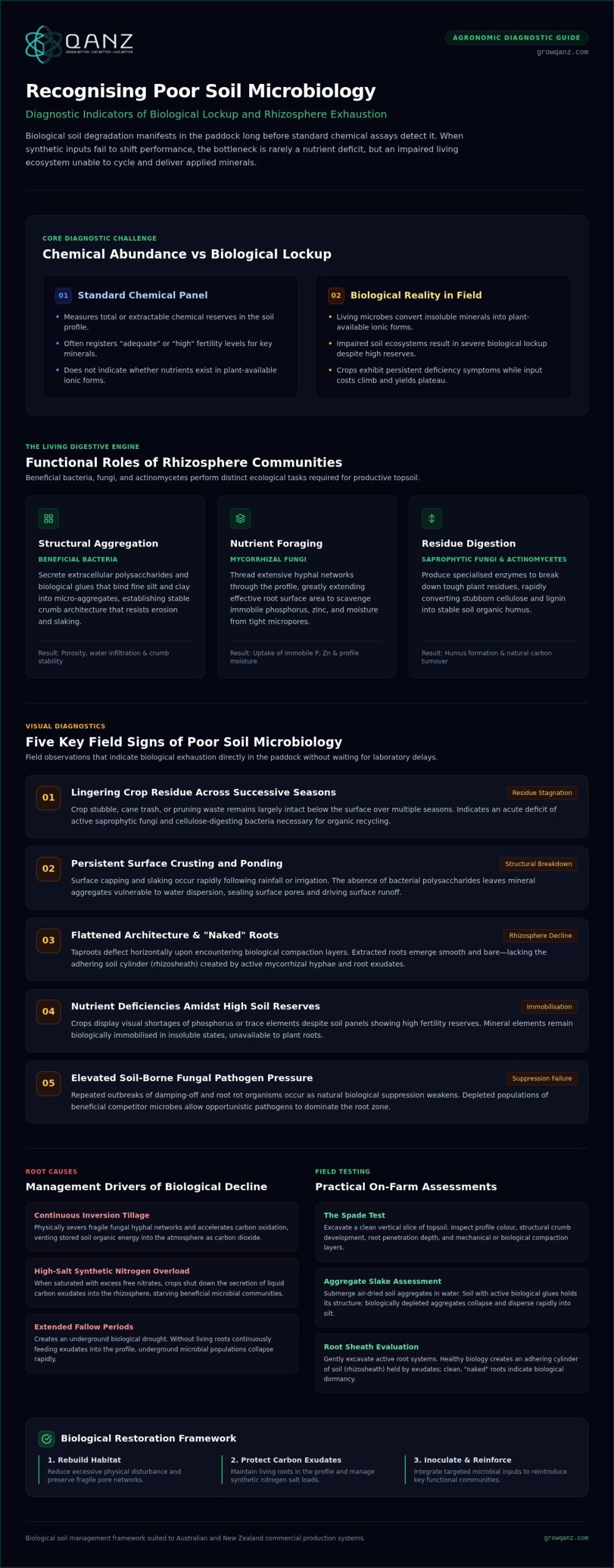
- Lingering crop residue: Stubble, cane trash, or pruning waste from preceding seasons that remains largely intact below the surface points to a deficit of active saprophytic fungi and cellulose-digesting bacteria.
- Persistent surface crusting: Slaking and rapid capping following moderate irrigation or rainfall demonstrate an absence of biological glues, leaving aggregates vulnerable to dispersion.
- Flattened root systems: Taproots that hit shallow boundaries and deflect horizontally, accompanied by “naked” roots lacking soil adhesion, reflect biological compaction and sparse mycorrhizal presence.
- Nutrient deficiency amidst high soil reserves: Crops showing classical trace element or phosphorus shortages while standard soil panels show adequate fertility indicates biological immobilisation.
- Elevated fungal pathogen pressure: Recurring outbreaks of soil-borne damping-off or root rot diseases signify that beneficial competitor microbes are no longer suppressing opportunistic strains.
Surface Indicators and Soil Physical Integrity
Physical surface capping happens when individual soil particles dissociate due to depleted glomalin and microbial gums. Without these organic stabilisers, topsoils collapse into dense crusts that restrict gas exchange. Additionally, a healthy soil produces geosmin, the organic compound responsible for a fresh, earthy aroma. Soils that smell sour, metallic, or completely inert often suffer from poor aeration and an absence of aerobic decomposers, allowing subsoil hardpans to consolidate rapidly in the absence of biological tunnelling organisms.
Crop and Root Growth Manifestations
Plant architecture provides immediate feedback on root-zone ecology. In biologically active paddocks, fine feeder roots emerge encased in a thick, soil-coated sheath known as a rhizosheath, glued together by root exudates and fungal threads. If roots pull up completely clean and white, root-microbe symbiosis is compromised.
This ecological absence leads to uneven germination, stunted early vigor, and heightened vulnerability to pathogens like Pythium, Rhizoctonia, and Fusarium. When natural biological antagonists disappear, these pathogens easily colonise vulnerable root tissue. Growers seeking to support root-zone ecology across broadacre or intensive plantings can explore how targeted field crops programmes help re-establish microbial presence.
Biological Depletion vs Chemical Deficiencies: How to Diagnose the Root Cause
A common misstep in paddock fertility management is assuming that low plant tissue nutrient levels require immediate synthetic fertiliser additions. Traditional soil testing relies on strong acid or chemical extractions to measure total or exchangeable nutrient reserves, but these figures reveal nothing about biological cycling rates. When a laboratory report shows luxury levels of phosphorus yet leaf tests reveal deficiency, applying additional synthetic fertiliser simply adds unnecessary input costs. In many instances, the problem is not a lack of soil nutrition, but one of the clearest signs of poor soil microbiology: biological immobilisation.
Distinguishing between chemical shortages and biological collapse requires an integrated approach. Frameworks such as the Comprehensive Assessment of Soil Health framework highlight how physical and biological indicators must be interpreted alongside standard chemistry to expose functional constraints across commercial soils.
The Mechanism of Biological Nutrient Lockup
In biologically depleted soils, applied nutrients rapidly bind to mineral surfaces. Inorganic phosphorus, for instance, precipitates with aluminium and iron in acidic ground or binds with calcium in alkaline profiles. In functional ecosystems, native microbes release organic acids and phosphatase enzymes that free these bonded elements into plant-available orthophosphates naturally. When these biological pathways shut down, adding more high-salt fertiliser increases root-zone electrical conductivity, which suppresses sensitive rhizosphere communities even further and deepens nutrient lockup.
Key Diagnostic Differences in Crop Symptoms
Growers can diagnose whether poor crop performance stems from chemical scarcity or biological exhaustion by assessing symptom distribution across the canopy and root zone:
- Targeted vs diffuse stress: True chemical deficiencies usually present with distinct, repeatable chlorosis patterns on specific leaves, such as interveinal yellowing on older foliage for magnesium or purpling on juvenile leaves for phosphorus. Biological failure tends to manifest as uniform stunting, poor seedling vigor, and non-responsiveness across the paddock.
- Fertiliser responsiveness: When a paddock receives recommended fertiliser applications based on standard soil tests but yields continue to plateau, biological cycling is compromised.
- Root architecture evaluation: Inspecting the fine roots of struggling crops often settles the diagnosis. Plants suffering from genuine mineral deficiencies maintain typical root branching and intact rhizosheaths. In biologically exhausted ground, roots appear bare, brittle, and restricted, confirming that the signs of poor soil microbiology are driving the issue rather than a chemical shortage in the soil profile.
Practical On-Farm Methods to Assess Soil Biological Activity
Growers do not need expensive genomic sequencing to assess paddock ecology. Straightforward, repeatable diagnostic steps allow managers to track biological trends and identify the signs of poor soil microbiology directly in the field. Establishing these baseline observations takes minimal equipment and integrates readily into regular crop monitoring.
A practical diagnostic routine involves four sequential steps:
- Step 1: Conduct a visual soil assessment across distinct zones. Compare high-yielding areas against underperforming ground to identify structural variations.
- Step 2: Inspect the active root zone. Dig up healthy plants to evaluate root branching and soil-to-root adhesion.
- Step 3: Measure cellulose breakdown rates. Use standard in-field burial assays to gauge saprophytic activity over a fixed period.
- Step 4: Check surface infiltration rates. Monitor how rapidly water enters the soil profile following irrigation or heavy rain to spot surface capping.
Conducting a Thorough Visual Spade Examination
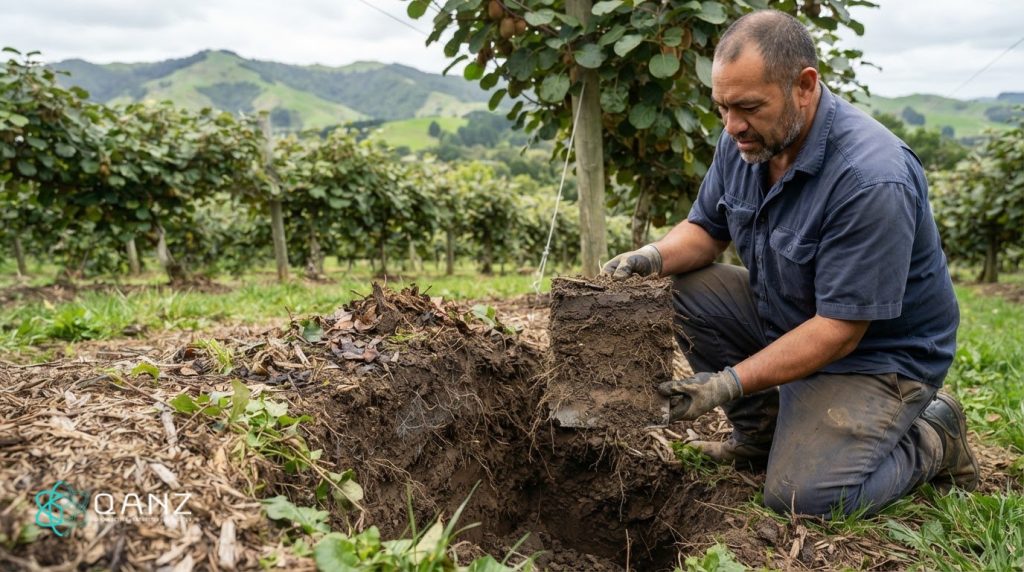
The spade test remains the benchmark for field-level biological diagnostics. Using a flat spade, extract an intact soil cube roughly 200 mm to 300 mm deep. Break the cube open gently by hand along its natural fracture lines to inspect its physical makeup.
Under the New Zealand Visual Soil Assessment (VSA) framework, counting macro-organisms provides an immediate surrogate for deeper food web health. A standard 200 mm spade spit containing fewer than 15 earthworms indicates a depleted population, whereas 30 to 45 worms reflects strong biological activity. Examine the exposed profile for plough pans or compacted plates. Subsoils exhibiting blue-grey mottling or emitting sour, stagnant aromas reveal severe oxygen starvation, where anaerobic conditions have overtaken aerobic biological life.
Simple Biological Activity Indicators for Commercial Blocks
To quantify biological decomposition rates without specialised equipment, commercial growers often use the cotton strip assay or bury standard white cotton fabric for six to eight weeks. Active saprophytes quickly break down the cellulose; retrieved fabric showing minimal fraying confirms inactive decomposition pathways.
Conducting a water slake test also provides rapid feedback. Place dry soil aggregates into mesh baskets submerged in clean water. Biologically aggregated soils stay intact due to microbial glues, while depleted aggregates collapse into loose sediment within minutes. For detailed commercial baselines, laboratory tests measuring anaerobically mineralisable nitrogen (AMN) or microbial biomass carbon offer valuable supporting metrics.
Once diagnostics confirm active biological decline, growers can explore biological soil technology to learn how beneficial microbial inoculants assist in restoring functional root-zone ecology.
Restoring Biological Function: Cultural Strategies and Microbial Inputs
Reversing biological decline requires an active, two-pronged approach. Once field assessments confirm the signs of poor soil microbiology, passive resting alone is rarely enough to restore high-value paddock productivity. Successful remediation pairs cultural adjustments that rebuild subterranean habitat with targeted microbial inputs that reintroduce beneficial populations directly to the root zone.
Agronomic Practices that Protect and Feed Soil Biology
Remediation begins by fostering an environment where living organisms can survive and cycle nutrients effectively. Key cultural modifications include:
- Minimising mechanical disturbance: Strategic reductions in tillage protect delicate fungal hyphae from fragmentation and preserve continuous biopores built by burrowing worms.
- Maintaining living roots year-round: Integrating diverse cover crop blends ensures a continuous flow of liquid carbon exudates into the profile, preventing biological starvation during traditional fallow periods.
- Managing fertiliser salt indices: Moderating single large applications of high-salt chemical inputs lowers osmotic stress on rhizosphere bacteria, helping protect natural mineralisation pathways.
- Returning stable carbon: Applying quality composts, cover crop residue, or humic amendments provides the raw materials needed by saprophytic species to build durable organic matter.
The Role of Dedicated Microbial Agricultural Inoculants
While sound cultural practices protect soil habitat, heavily cropped paddocks don’t always retain the microbial diversity required to restart nutrient cycling quickly. Inoculating the profile with purpose-formulated biological inputs helps bridge this gap, delivering viable organisms directly to the rhizosphere.
QANZ distributes specialised liquid biological products across Australia and New Zealand, including Quantum Organic-Total® and Quantum VSC®. Holding BioGro certification in New Zealand as an approved input for organic production, Quantum Organic-Total® is formulated for seamless compatibility with standard commercial boom sprayers and fertigation rigs, allowing straightforward integration into commercial management regimes. These microbial amendments deliver functional bacterial communities designed to support root colonisation, assist residue digestion, and enhance natural biological activity in the soil profile.
Whether you manage intensive vegetable rotations, perennial orchards, or broadacre ground, biological remediation is most effective when matched to specific soil and climatic constraints. Talk to QANZ about whether Quantum Organic-Total® is appropriate for your crop, growing system, and application programme.
Restoring Living Biology to Secure Paddock Productivity
Diagnosing functional soil health requires looking past standard nutrient panels to evaluate the living ecosystem within your topsoil. Unexplained yield stalls, persistent surface crusting, and lingering stubble aren’t random operational headaches. They are direct signs of poor soil microbiology that indicate natural mineralisation pathways have stalled. Addressing these biological constraints early protects your input investment and safeguards long-term paddock resilience.
Remediation succeeds when practical cultural adjustments pair with targeted biological inoculants. By minimising unnecessary soil inversion, maintaining continuous living cover, and moderating chemical salt applications, you create the conditions required for beneficial organisms to thrive. Adding purpose-formulated microbial amendments helps reintroduce vital functional diversity directly into the rhizosphere, accelerating the return of active nutrient cycling across commercial blocks.
Supported by documented overseas historical trials and backed by BioGro certification in New Zealand, QANZ provides dedicated liquid biological formulations designed for seamless integration with commercial boom equipment. To assess your paddock ecology and explore tailored application strategies, talk to QANZ about integrating Quantum Organic-Total® into your soil programme.
Frequently Asked Questions
What is the fastest visual indicator of depleted soil microbiology in the paddock?
The quickest field sign is persistent surface capping combined with water ponding following moderate rainfall or irrigation. When soil organisms are depleted, topsoils lose the biological glues needed to stabilise aggregates, causing individual particles to collapse into a dense crust. Digging beneath the surface often reveals bare roots devoid of clinging rhizosheaths, representing immediate signs of poor soil microbiology that confirm biological inactivity long before laboratory assays arrive.
Can soil with high synthetic fertiliser reserves still suffer from biological starvation?
Yes, chemically saturated ground frequently suffers from functional biological starvation. Standard laboratory tests quantify total or exchangeable chemical reserves, but crops depend on living microorganisms to cycle and solubilise those elements into bioavailable ionic forms. When biological communities collapse, applied nutrients precipitate or bind tightly to mineral surfaces, leaving plants exhibiting visible deficiency symptoms despite luxury fertility figures showing on your standard soil panel.
How does excessive tillage impact beneficial soil bacteria and fungal networks?
Intensive tillage physically shatters mycorrhizal hyphal networks and rapidly burns through soil organic matter reserves. Inverting or aggressively churning the profile injects surplus oxygen into deeper layers, triggering brief bacterial spikes that rapidly oxidise stable carbon. Once that carbon vents off into the atmosphere as carbon dioxide, underground communities starve. Delicate fungal architectures break down, aggregate stability dissolves, and functional soil structure collapses.
Are laboratory biological soil tests essential before implementing a biological programme?
No, laboratory biological panels are not mandatory before starting a biological programme, though they offer useful baseline data. Straightforward in-field diagnostic tests, including visual spade assessments, earthworm counts, and water slake evaluations, usually give growers enough immediate information to confirm biological decline. If quantitative benchmarks are required, targeted laboratory tests measuring anaerobically mineralisable nitrogen (AMN) or active carbon can help track progress over time.
What causes crop residues to remain intact on the soil surface for months?
Lingering surface trash indicates a severe deficit of active saprophytic fungi and cellulose-digesting bacteria. Complete crop residue breakdown requires specialised biological enzymes to process tough lignin and cellulose fibres into stable humus. When intensive cultivation, excessive salt loads, or bare fallows depress these decomposer populations, crop stubble stays unchewed between seasons, highlighting one of the classic signs of poor soil microbiology across commercial paddocks.
How do certified organic microbial inoculants support conventional cropping programmes?
Certified organic microbial inputs provide conventional systems with living biological diversity without introducing unwanted synthetic residues or chemical salts. Formulations like BioGro certified Quantum Organic-Total® deliver viable bacterial populations that integrate smoothly into standard commercial boom sprayers. In conventional ground, these targeted microbial inputs help re-establish rhizosphere colonisation, support natural biological activity, and complement standard fertiliser strategies without requiring changes to existing machinery.
Can chemical fungicides or fumigants permanently sterilise agricultural soil biology?
Chemical fumigants and non-selective fungicides rarely sterilise soil permanently, but they severely depress population diversity and disrupt biological balance. Fast-growing pioneer bacteria often rebound rapidly following chemical applications, but beneficial mycorrhizal fungi and slow-growing actinomycetes take much longer to re-establish. This prolonged biological void leaves crops vulnerable to opportunistic soil pathogens unless growers actively rebuild beneficial populations and maintain living root exudates.
How long does it typically take to rebuild biological activity in compacted soils?
Measurable biological improvements typically begin within a single growing season when management pairs cultural adjustments with targeted microbial inputs. Surface water infiltration and root sheath formation often show noticeable recovery within months. Rebuilding durable subsoil pore architecture, resilient biological aggregation, and robust residue digestion across severely compacted ground generally requires two to three seasons of reduced disturbance, continuous root cover, and consistent biological support.
Disclaimer
Important: This article provides general agricultural information only. Product performance can vary according to crop, soil, climate, management practices and application conditions. Trial or research results discussed may have been obtained under specific conditions and should not be interpreted as a guarantee of equivalent results. Always follow current product directions and confirm suitability for your crop, growing system and organic certification requirements. Contact QANZ for current product and application information.
