
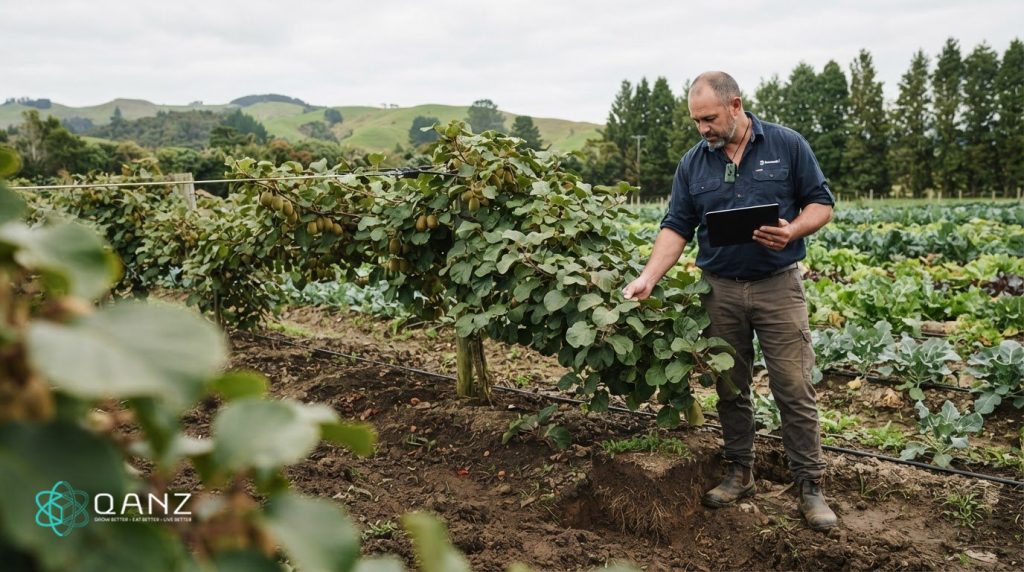
One input can’t make an unpredictable season predictable. Reducing stress from unpredictable crop yields starts with understanding what is driving variation on your property, then separating risks you can influence from those you can only plan around. Weather, soil conditions and management decisions can overlap, so it can be difficult to know which change is worth making.
If uncertain production is complicating seasonal plans and cash-flow decisions, that concern is understandable. Rather than chasing a single promised fix, build a clearer picture of risk and make measured decisions using evidence relevant to your crop and conditions.
This article sets out a practical approach for growers in New Zealand: compare paddock or block performance, investigate possible causes such as moisture, soil constraints and management timing, and prioritise actions within your control. It also explains how to track changes and assess biological inputs against relevant evidence and current technical guidance. The aim is a more informed plan, not a guaranteed yield.
Key Takeaways
- Understand yield variability by comparing harvested output across seasons, paddocks, blocks or crop areas.
- Use consistent records to establish a baseline, spot differences and investigate possible causes.
- Compare monitoring, crop and soil management, diversification and financial planning to identify practical ways to manage risk.
- Build a crop-yield risk plan by ranking risks, assigning actions and setting review points suited to your crop calendar and local conditions.
- For reducing stress from unpredictable crop yields, assess biological inputs as one possible part of a broader programme, using relevant evidence and current technical guidance.
Why unpredictable crop yields create stress, and what growers can control
Yield variability can be managed, but it can’t be eliminated or guaranteed away. Identify what differs across seasons or areas of a property, act on risks within your influence, and prepare for those you can’t control. Reducing stress from unpredictable crop yields is therefore about making better-informed decisions and plans, not promising a fixed harvest.
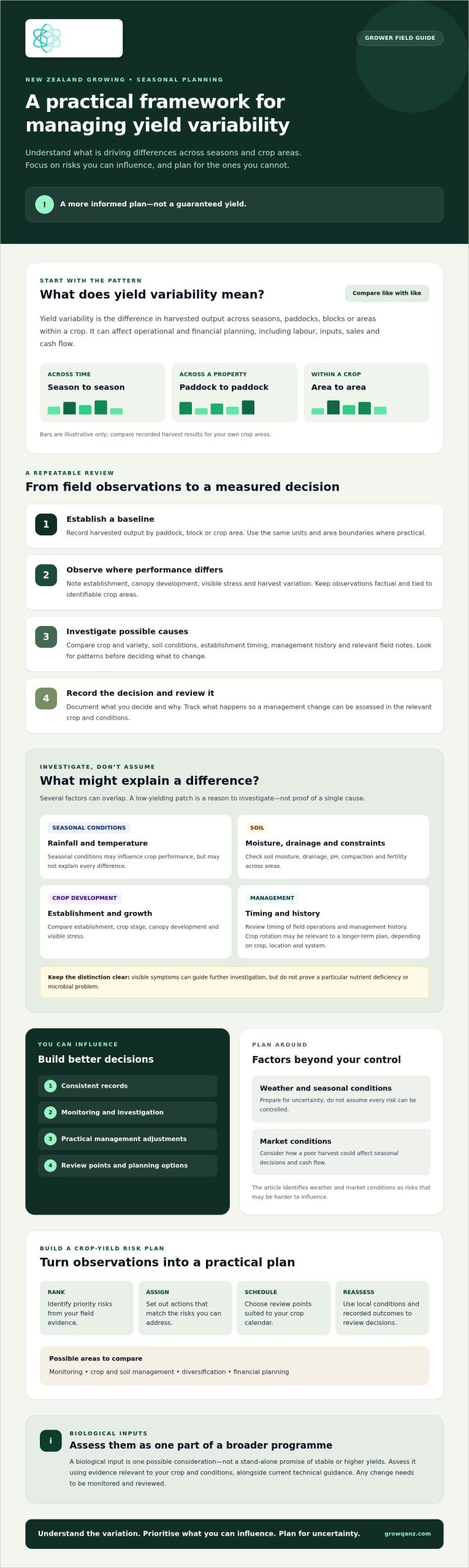
Yield variability is the difference in harvested output across seasons, paddocks, blocks or areas within a crop. The variation is agronomic, but its effects can also be operational and financial. Uncertain production makes it harder to plan labour, inputs, sales and cash flow. Separating these concerns helps clarify what can be reviewed, such as records and management choices, and what may be harder to influence, such as weather and market conditions.
Which factors can make crop yields unpredictable?
Rainfall, temperature and seasonal conditions may influence crop performance, but they won’t necessarily explain every difference. Investigate the conditions in areas where output varied. Soil moisture, pH, compaction and fertility may differ between areas. Crop establishment, timing and management history may also help explain a pattern.
These factors can interact. A crop may respond differently to a dry spell depending on soil conditions, its stage of development and how it was established. A low-yielding patch is a reason to investigate, not proof of a single cause. Compare similar crops and blocks, then look for consistent patterns before deciding what to change.
Crop rotation may be relevant to a longer-term production plan, but its suitability depends on the crop, location and wider system. Consider it alongside other field evidence and locally relevant agronomic guidance, rather than treating it as a universal solution to yield variation.
What does reducing yield stress realistically mean?
The aim is to be better prepared, not to control every outcome. Growers can improve operational resilience by keeping useful records, identifying priority risks, making practical adjustments and reviewing what happens. They can also consider how a poor harvest could affect seasonal decisions and prepare options where possible.
This is different from promising to increase or stabilise yield. A management change may be worth testing, but its effect needs to be assessed in the relevant crop and conditions. For growers in New Zealand and Australia, local seasonal patterns and crop calendars matter too. Reducing stress from unpredictable crop yields means making uncertainty easier to understand and respond to, while recognising that some agronomic and market risks remain outside a grower’s control.
How to identify yield variability early through field observations and records
A repeatable review helps distinguish a recurring pattern from a one-off result. Establish a baseline, note where performance differs, investigate possible causes, then record what you decide and why. This makes reducing stress from unpredictable crop yields a practical process: gather comparable information before choosing an intervention.
Which field observations help explain uneven crop performance?
Start with areas you can identify consistently, such as a paddock, orchard block or mapped crop zone. Note establishment, canopy development, visible stress and harvest variation by area. Add observations about soil moisture, drainage and signs of compaction, as well as recent weather and the timing of field operations.
Keep observations factual. “Uneven canopy in the lower block after heavy rain” is more useful than recording a presumed cause. Visual symptoms can guide further investigation, but they don’t prove a particular nutrient deficiency or microbial problem. Look for patterns across locations and time, then check whether other differences in crop, soil or management might explain them.
How can farm records turn seasonal uncertainty into useful comparisons?
Use records you already have and trust to build a comparison. A simple sequence is:
- Establish a baseline: record harvested output by paddock, block or crop area, using the same units and area boundaries where practical.
- Observe differences: note where establishment, crop development, visible stress or harvest results diverge.
- Investigate: compare like with like, including crop and variety, soil conditions, planting or establishment timing, management history and relevant field notes.
- Record decisions: document what you changed, where and when, then review your observations and harvest information at the next relevant point in the crop cycle.
Maps can help locate recurring patches, while harvest records and field notes add context. Use data only when it is consistent enough to compare. Flag unusual seasonal conditions or changes in variety, planting date, measurement method or management, as these can limit direct year-to-year comparisons. Don’t treat a difference as proof that one decision caused the result.
If the records point to a soil question that needs testing, arrange this through an appropriate independent provider. GrowQanz doesn’t offer soil testing services. Use New Zealand crop and soil guidance that reflects your production system and local conditions when considering possible responses.
Keep the evidence and your decision together once you’ve identified a question to investigate. If you’re considering a biological input as part of a wider programme, review GrowQanz product and application information alongside current technical guidance.
Which strategies can reduce exposure to unpredictable crop yields?
Reducing exposure means using several practical controls around risks a grower can influence, rather than relying on one intervention. Monitoring can flag developing issues. Soil and crop management can address diagnosed constraints. Diversification may spread some production or market exposure, while financial planning can help prepare for different outcomes. No strategy or input guarantees a particular yield or removes seasonal uncertainty.
These approaches serve different purposes. Choose among them according to the crop system, available resources, risk tolerance and local conditions.
| Approach | Purpose | Relevant decision | Limitations | Information needed |
|---|---|---|---|---|
| Monitoring | Detect changes and identify where investigation may be needed. | What should be checked, where and at what crop stage? | Observations indicate patterns but may not explain their cause. | Consistent field observations, crop stages and reliable harvest records. |
| Soil and crop management | Respond to a diagnosed constraint or improve management fit. | Which action is relevant to the crop and observed condition? | Suitability depends on soil, season, crop and management history. | Field evidence, relevant testing where needed, and current local technical guidance. |
| Diversification | Consider whether varying crops, varieties or markets could spread exposure. | Would a different mix fit the land, skills, rotation and market options? | It can add complexity and may not suit every operation or market. | Production capacity, crop calendar, market access and advice from relevant specialists. |
| Financial planning | Prepare for production, sales and cash-flow uncertainty. | How would different harvest or sales scenarios affect commitments and timing? | Plans depend on assumptions and can’t remove uncertainty. | Farm records, planned commitments, sales exposure and appropriate professional advice. |
How do agronomic actions compare with business risk controls?
Agronomic actions focus on field conditions and crop management. Business controls address how production variation may affect cash flow, commitments and sales. Both matter, but they answer different questions: what can be changed in the crop system, and how can the operation prepare if outcomes differ from the plan? In New Zealand and Australia, adapt choices to the specific crop, local conditions and production calendar. A qualified agronomic or financial adviser can help assess options, but no single option is a universal prescription.
When should a grower test one change rather than alter several at once?
If practical and agronomically appropriate, changing fewer variables at a time can make comparisons easier to interpret. Document the treatment, comparison area, timing and relevant conditions. Don’t compromise established good practice just to create a test. A management trial can inform a decision on that farm; it doesn’t prove general effectiveness across crops, seasons or locations.
How to build a crop-yield risk plan for New Zealand and Australia
A useful crop-yield risk plan turns observations into assigned actions and review points. Rank risks by their potential impact and how well they can be monitored or influenced. Choose responses suited to the crop and available resources, then note who is responsible and when the plan will be reviewed. Set the timing around your crop calendar and current local conditions.
How should growers prioritise risks and actions?
Keep the plan workable. For each priority risk, note the evidence behind it, the action you’ll take and what would prompt a review. A simple sequence is:
- Rank: identify risks with potentially serious farm impacts, then consider whether you can monitor or influence them.
- Choose: select practical actions that suit the crop, resources and existing management programme.
- Assign: name the person responsible for carrying out or checking each action.
- Review: set a date or crop-stage checkpoint, then record what changed, what you observed and what remains uncertain.
Prioritisation helps avoid spreading effort across too many issues at once. A risk that is difficult to influence may still need a contingency plan, while a manageable field issue may call for closer monitoring or an agronomic response. Consider the underlying risk before selecting a product or practice.
How can seasonal and crop-specific context improve the plan?
Use current local observations alongside reliable weather information. In New Zealand, NIWA and MetService provide sources growers can consult. In Australia, check relevant local weather information. Forecasts and seasonal outlooks can inform planning, but they can’t determine what will happen in a specific paddock or block. Revisit assumptions as conditions develop.
Check local suitability before applying a recommendation from another country, crop or production system. Seasonal timing, crop calendars, certification requirements and technical advice may differ between New Zealand and Australia. Where certification applies, confirm input suitability with the relevant programme rather than assuming an approach is acceptable across schemes.
For broadacre growers, QANZ’s field crop biological programmes may provide relevant crop context. Consider any biological input within the wider risk plan and assess it against current technical information. It can’t guarantee a particular yield or remove seasonal uncertainty.
A written plan is most useful when it leads to clear, reviewable decisions. To discuss whether a Quantum product or application programme is relevant to your crop and growing system, contact QANZ.
When biological inputs may fit a yield-risk plan, and how to assess them
Biological inputs may be considered as one part of a wider crop and soil programme, but they aren’t a guaranteed solution to yield risk. First identify the issue you’re trying to address. Then check whether evidence and current technical guidance apply to your crop, location and management system. This keeps decisions tied to a specific need rather than an expectation of a particular harvest outcome.
What evidence should growers check before considering a biological input?
Check the details behind any evidence, not just its conclusion. Confirm the exact product formulation, crop, location, treatment, study type and growing conditions. A laboratory study or general research on soil biology can help explain broader concepts, but it doesn’t establish that a particular product will produce the same effect in a field crop. Results from one formulation, crop or country shouldn’t be assumed to apply to another.
For a local decision, ask whether the available evidence resembles your production conditions. Is it from New Zealand or Australia, or overseas? Was it an independent trial, manufacturer research, a laboratory study or a grower observation? What was compared, and were relevant conditions described? These distinctions help show what the evidence can support and where uncertainty remains.
Before using an input, check its suitability and directions against current QANZ technical information. If certification matters to your operation, check current documentation with the relevant certification programme. Don’t assume an input is suitable for every certified system, or that using an input makes a crop or farm organic.
How can growers assess whether Quantum Organic-Total® is relevant?
Quantum Organic-Total® is a microbial agricultural input offered by QANZ for use in crop and soil programmes. Consider it only after identifying a relevant programme need, and assess its suitability using current technical guidance. The product description alone isn’t evidence that it will improve stress tolerance, stabilise yield or address a particular cause of variability.
Review the Quantum Organic-Total® product information and microbial technology information alongside evidence for the exact formulation. If you decide to evaluate an input, record the context and observations. Avoid attributing a result to it if other management or seasonal factors changed at the same time.
Reducing stress from unpredictable crop yields depends on a clear risk plan, careful observation and realistic expectations. Check Quantum Organic-Total® suitability, rates and certification requirements against current QANZ technical and BioGro documentation.
Turn yield uncertainty into a practical plan
Yield variability can’t be eliminated, but a clear process can make it easier to understand and respond to. Compare like with like using field observations and reliable records. Investigate potential causes before changing practice, then rank risks according to their likely impact and how much you can influence them.
Choose actions that fit your crop, resources and local conditions. Assign responsibility, set a review point and record what changed, what you observed and what remains uncertain. This is the practical basis for reducing stress from unpredictable crop yields: better preparation and learning, rather than a promise of a fixed harvest.
Biological inputs may be considered within a wider crop and soil programme, but shouldn’t be treated as a guaranteed yield-risk solution. QANZ supplies Quantum agricultural biological products to growers in New Zealand and Australia. Check current technical information for product suitability and use in your particular system.
For a measured discussion about whether Quantum Organic-Total® may suit your crop, growing system and application programme, talk to QANZ.
Frequently Asked Questions
Can growers prevent unpredictable crop yields?
No single management action can prevent all yield variability, because weather, crop conditions and farm decisions interact. Growers can compare records and field observations, investigate factors they can influence, and prepare for risks outside their control. Review results over time and use locally relevant agronomic advice to decide what suits the crop and growing system. This supports reducing stress from unpredictable crop yields, but it can’t guarantee a stable harvest.
How can I find the cause of inconsistent crop yields?
Start by comparing records for the same crop, area and season, including management history and harvest measurements. Then check field observations such as establishment, soil moisture, drainage and compaction. Consider unusual weather or changes in practice that may affect the comparison. Visible symptoms can guide investigation, but rarely prove a specific cause. If the cause remains unclear, an independent soil test or advice from a suitably qualified agronomist may help.
Does improving soil health guarantee more consistent yields?
No. Soil condition is one part of a crop system, and addressing a measured limitation can’t guarantee a particular harvest or remove weather-related uncertainty. First identify the issue, then choose management actions suited to the crop and monitor what follows. General soil-health principles aren’t evidence that a particular product will deliver an outcome. Assess evidence for the exact product and formulation separately, and don’t assume findings transfer across crops, locations or growing conditions.
Can microbial inputs reduce stress from unpredictable crop yields?
A microbial input shouldn’t be treated as a guaranteed way to reduce crop stress or stabilise yields. Check its intended use, exact formulation, crop suitability, application guidance and the evidence available for those conditions. Results from another product, location or crop may not apply. Quantum Organic-Total® is a microbial agricultural input offered by QANZ for use in crop and soil programmes. Review current QANZ technical information and discuss programme fit with QANZ or a qualified agronomic adviser.
What records should I keep to understand crop-yield variability?
Record the crop and variety, establishment timing, management actions, field observations and harvest measurements by area. Note unusual seasonal conditions and changes that could make comparisons less direct. Keep units, area boundaries and measurement methods consistent where practical. These records help you spot patterns and ask more focused questions, but they don’t prove what caused a yield difference. Interpret them alongside field observations and, where needed, appropriate independent agronomic or soil assessment.
Should New Zealand and Australian growers use the same crop-risk plan?
The planning steps can be similar, but actions should reflect each grower’s crop, local conditions, season and applicable certification or programme requirements. Don’t assume advice from one country transfers unchanged to the other. Check current local information and seek advice relevant to your operation before changing practices or selecting inputs. QANZ supplies Quantum agricultural biological products to growers in New Zealand and Australia; confirm product suitability and use against current technical information.
Disclaimer
Important: This article provides general agricultural information only. Product performance can vary according to crop, soil, climate, management practices and application conditions. Trial or research results discussed may have been obtained under specific conditions and should not be interpreted as a guarantee of equivalent results. Always follow current product directions and confirm suitability for your crop, growing system and organic certification requirements. Contact QANZ for current product and application information.
