

Reducing nitrogen fertiliser use starts with understanding what the crop needs and what the soil can supply. Rather than cutting a set amount, review crop demand, soil information and application decisions together. This helps identify where an application could be adjusted without assuming that less nitrogen is always better or making changes that put crop growth at risk.
It’s understandable to be cautious. Nitrogen supports crop development, but the appropriate rate varies with crop, soil, previous inputs and seasonal conditions. General recommendations can help frame a decision, but they don’t automatically translate into the right plan for every New Zealand farm.
This guide sets out a practical way to review nitrogen decisions before changing rates. It covers nutrient budgeting, application timing and placement, and what to monitor to assess whether a programme remains appropriate. The aim is a farm-specific plan based on available information, so you can identify avoidable applications without assuming a particular change will deliver a specific result.
Key Takeaways
- Improve nitrogen-use efficiency by matching applications more closely to crop demand, not by assuming every farm should lower its rates.
- Distinguish between nitrous oxide emissions and nitrate moving through soil and water when assessing potential nitrogen losses.
- Compare current practice with changes to timing, placement and demand-based planning, considering the information and monitoring each option requires.
- Use a consistent review process that brings together soil information, crop history, nutrient budgets and seasonal conditions before changing a programme.
- Consider biological inputs as one part of a broader crop and soil programme, not as a fertiliser replacement. Quantum Organic-Total® is a microbial agricultural input.
Why reduce nitrogen fertiliser use carefully?
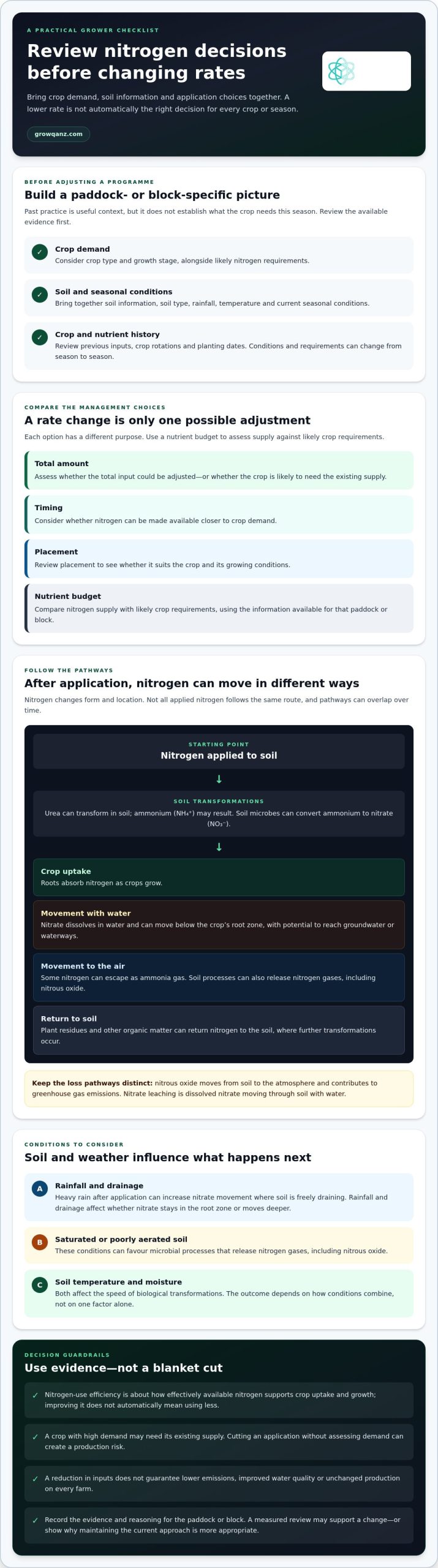
Before changing a nitrogen programme, review what the crop is likely to need and where applied nitrogen may be lost. Consider crop type and growth stage alongside soil information, previous inputs, seasonal conditions and the production system. This helps distinguish between opportunities to adjust the total amount, improve application decisions or maintain the current rate to support crop growth.
Nitrogen-use efficiency describes how effectively a crop uses available nitrogen to support growth and production. Improving efficiency doesn’t automatically mean using less. A crop with high demand may need its existing supply, while another situation may offer scope to avoid unnecessary applications or align them more closely with demand.
Nitrogen moves between soil, plants, air and water through the nitrogen cycle. Some soil transformations can produce nitrous oxide, a greenhouse gas. Nitrate leaching is different: nitrate dissolves in water and can move below the crop’s root zone, with potential to reach groundwater or waterways. The likelihood of either pathway depends on factors such as nitrogen availability, soil and weather. A reduction in inputs does not guarantee a particular environmental result.
Better nitrogen management may help reduce avoidable losses, but it can’t guarantee lower emissions, improved water quality or unchanged production on every farm.
What does reducing nitrogen fertiliser use mean in practice?
Reducing nitrogen fertiliser use can mean lowering total inputs, but that’s only one possible change. A grower might improve timing so nitrogen is available closer to crop demand, adjust placement to suit the crop, or use a nutrient budget to assess supply against likely requirements. Each option has a different purpose and relies on different information.
The right approach varies across New Zealand and Australian growing systems. A vegetable crop, orchard, vineyard and pasture-based system won’t necessarily have the same nitrogen demand, rooting pattern, soil conditions or growing calendar. Soil type, rainfall and temperature also affect how nitrogen behaves. There’s no universal percentage reduction or application rate that can safely be applied across crops and farms.
Why can blanket nitrogen cuts create risk?
Nitrogen is an essential plant nutrient. If the available supply is inadequate for the crop and its growth stage, development may be constrained. Cutting an application without assessing demand can therefore create a production risk, particularly when crop requirements, soil supply or seasonal conditions differ from expectations.
Past practice is useful context, but it doesn’t establish what a crop needs this season. Crop rotations, previous nutrient inputs, soil conditions, planting dates and weather can all change the picture. Before altering a programme, review the evidence available for that paddock or block and record the reasoning. A measured decision may support a change, or show why maintaining the current approach is more appropriate.
How nitrogen moves through soil, crops and the environment
After nitrogen is applied, it doesn’t remain in one form or place. Plants can take it up, soil processes can transform it, and some may be lost to the air or move with water. Understanding these pathways helps growers interpret what an application can do, while recognising that the balance depends on soil, weather, crop and management.
Nitrogen-use efficiency describes how effectively available nitrogen supports crop uptake and growth, rather than being left unused or lost from the crop-soil system. It’s a useful way to think about management, not a single measure that dictates a particular rate. Soil organisms contribute to nitrogen transformations as part of natural cycling. That general role is not evidence that a particular biological product changes nitrogen supply or crop response.
What happens to nitrogen after application?
Nitrogen moves through several forms. For example, urea is transformed in soil, with ammonium (NH4+) among the forms that can result. Soil particles can hold some ammonium, making it less mobile than nitrate. Soil microbes can convert ammonium to nitrate (NO3−), a form plant roots readily take up that can also move with water through the soil profile.
Roots absorb nitrogen as crops grow. Plant residues and other organic matter can return nitrogen to the soil, where further biological and chemical transformations occur. Some nitrogen can also escape as ammonia gas, depending on the fertiliser form and conditions after application. These pathways overlap: an individual nitrogen atom may move through several forms over time, and not all applied nitrogen follows the same route.
How do soil and weather affect nitrogen losses?
Rainfall and drainage influence whether nitrate remains in the root zone or is carried deeper through the soil. Heavy rain after application can increase movement where soil is freely draining, while saturated or poorly aerated soil can favour microbial processes that release nitrogen gases, including nitrous oxide. Soil temperature and moisture also affect the speed of biological transformations. The outcome depends on how these factors combine, not on rainfall or soil type alone.
Nitrous oxide emissions and nitrate leaching are different pathways. Nitrous oxide moves from soil to the atmosphere and contributes to greenhouse gas emissions. Nitrate leaching is the movement of dissolved nitrate through soil with water, with potential to reach groundwater or waterways. The IPCC’s 2019 Refinement to the 2006 IPCC Guidelines describes nitrous oxide emissions from managed soils. This is general emissions guidance, not a prediction for an individual paddock.
For growers in New Zealand and Australia, local rainfall patterns, soil drainage, crop rooting depth and seasonal conditions all matter. A result or recommendation from another climate or production system may not transfer directly. Keep the distinction clear when assessing options: soil biology is one part of the nitrogen cycle, not proof of a product-specific effect. Any biological input considered within a wider programme needs separate evidence for its intended use. QANZ’s crop and soil programme information provides context on biological inputs without presenting them as a substitute for fertiliser.
Which nitrogen-management options should growers compare?
There isn’t one nitrogen strategy that suits every crop or paddock. Compare the current programme with practical alternatives, then consider what each change is intended to address, what information it depends on and how you’ll assess the result. The table is a decision aid, not a recommendation to reduce rates or a promise of lower emissions, less leaching, better yields or lower costs.
| Option | Purpose | Information needed | Likely constraints | What to monitor |
|---|---|---|---|---|
| Baseline practice | Establish what is currently applied and why. | Application records, crop history, soil information and expected production. | Past practice may not reflect this season’s crop demand or conditions. | Record applications and compare crop growth with the intended outcome. |
| Better timing | Align supply more closely with crop growth stage and expected demand. | Crop development, application windows, weather and soil moisture. | Weather, access to the block and operational timing can limit options. | Note application dates, conditions and crop response. |
| Placement changes | Position nitrogen in a way that suits the crop and application method. | Rooting pattern, crop layout, soil conditions and equipment capability. | Crop establishment, soil variability and machinery access may affect feasibility. | Check application uniformity and observe crop development across the treated area. |
| Demand-based planning | Estimate crop need against soil supply and other nutrient inputs. | Soil test information, crop history, nutrient budget and seasonal outlook. | Estimates involve uncertainty, especially when weather or growth differs from expectations. | Compare the plan with crop observations and update records through the season. |
| Urease inhibitor | Slow urea breakdown at the soil surface to help limit ammonia loss in suitable circumstances. | Fertiliser form, placement, weather and product guidance. | It addresses a particular loss pathway, not every nitrogen loss or crop need. | Record use and conditions; assess the relevant loss risk rather than assuming a crop or financial benefit. |
How do rate, timing and placement shape decisions?
These choices work together. The amount applied sets the nitrogen supply; timing affects whether it is available during crop demand; placement influences where it sits relative to roots and soil processes. Consider crop growth stage, expected nutrient demand and likely weather as one plan. A timing change can’t make an unsuitable total rate appropriate, and placement alone doesn’t establish how much nitrogen the crop requires.
When should growers consider nitrogen inhibitors or other inputs?
Urease inhibitors are distinct from nitrification inhibitors, which target a different soil transformation. Neither category should be treated as a universal solution: suitability depends on the fertiliser, conditions and intended purpose. Assess each input against its label, current local guidance and the farm programme. Biological inputs are another category, not evidence of reduced nitrogen requirements or a fertiliser replacement. QANZ’s biological growing programmes can be considered within a broader crop and soil programme, separately from decisions about nitrogen rates.
When reducing nitrogen fertiliser use, compare options against a clear baseline and monitor the crop and relevant loss risks. A change that suits one block or season may not suit another.
How can growers review and monitor nitrogen use?
A useful nitrogen review starts with a specific crop question, then brings together available farm information before any programme changes. Review soil and crop history, nutrient inputs and seasonal conditions, and distinguish measured data from estimates. After making a decision, record what was applied and observe the crop over time. This creates a practical basis for assessing whether the approach remains suitable, without assuming that a particular change will produce a specific result.
What information should be reviewed before changing a programme?
Gather information for the crop and block in question. Note crop type and growth stage, previous nitrogen applications, relevant soil test results and other nutrient inputs. Add local weather, irrigation and farm-system details where available. A measured result from the block is different from a general recommendation or an estimate. Label each clearly so assumptions don’t become mistaken for evidence.
Use the information in a consistent sequence:
- Define the question. Identify what you want to assess, such as whether an application matches crop demand or whether its timing could be improved.
- Describe the crop and block. Record crop type, variety where relevant, growth stage, area and any differences in establishment or management that may affect comparison.
- Gather the baseline. Bring together soil information, crop history, previous applications and other nutrient sources. Note when measurements were taken and which details are estimates.
- Account for the season. Record conditions that can influence crop growth and nitrogen availability, including rainfall, soil moisture, temperature and irrigation where relevant.
- Set out the decision and measure. Document the planned change, why it is being considered, and what crop observations or measurements will help review it.
For broadacre crops, the field-crop growing information can provide relevant crop-system context. Apply general guidance carefully: crop type, soil and seasonal conditions still shape what is appropriate for an individual block.
How should growers assess the result over time?
Keep records that connect the decision with what happened afterwards. Note the application date, product or nutrient input, placement, weather and any relevant irrigation. Add crop observations at suitable growth stages, such as establishment, canopy development or other crop-specific indicators. Where available, include measurements that help assess crop condition or production.
Comparisons need care. A treated area and a reference area are most informative when they are similar in crop, soil, management and seasonal exposure. Otherwise, differences may have more than one explanation. Comparisons across seasons also need context because weather and crop conditions can change. Record limitations rather than treating one observation as proof of cause.
Use the record to inform the next review, not to promise an outcome. If results are unclear, retain the existing evidence and make future adjustments cautiously. QANZ’s crop and soil programme information provides further context on biological inputs within a broader growing programme.
Where do biological inputs fit when reducing nitrogen fertiliser use?
Biological inputs may be considered as one part of a wider crop and soil programme, but they shouldn’t be treated as fertiliser replacements or as evidence that nitrogen rates can be lowered. Evaluate each input for its stated purpose and fit with the crop system, keeping that assessment separate from decisions about nitrogen supply. For New Zealand growers, current technical information and relevant certification requirements should guide how an input is used.
How should growers evaluate a biological input?
Start with the exact formulation and its intended use. Review current technical documentation for suitability, application rates and directions, rather than relying on general claims about microbial products. If certification requirements are relevant to your growing programme, refer to current GrowQanz and BioGro documentation and confirm that the input suits your intended use.
Evidence needs the same care. General research on soil biology can explain processes in soils, but it doesn’t establish how a named product will perform. Interpret any trial result in context by identifying the formulation, crop, location, conditions and type of evidence. Findings from one formulation or growing environment don’t automatically apply to another, and trial outcomes aren’t guaranteed results for a future crop.
GrowQanz’s information about biological inputs provides context for evaluating them. Product-specific decisions should rely on the relevant formulation’s current technical information.
What is a measured next step with GrowQanz?
Quantum Organic-Total® is a microbial agricultural input offered by GrowQanz for use in crop and soil programmes. It should be assessed within the wider programme, not as a substitute for nitrogen fertiliser or proof that a rate can be reduced. When considering Quantum Organic-Total®, review its stated intended use and current guidance alongside the crop’s needs and the records used to make nutrient decisions.
For a considered assessment, separate three questions: what the crop requires, what the input is intended for, and what evidence applies to that exact formulation and growing context. This keeps nitrogen management grounded in crop and soil information while allowing a biological input to be evaluated on its own terms.
For product and application information, visit GrowQanz’s website.
Make your next nitrogen decision a measured one
Think beyond a single application. A considered crop programme takes account of successive seasons, the crop’s longer-term objectives and the realities of each growing system. Reducing nitrogen fertiliser use is not a target in itself; the aim is to make decisions that remain appropriate for crop demand and local conditions.
Biological inputs can be considered as one part of that wider programme. Quantum Organic-Total® is a microbial agricultural input offered for crop and soil programmes, with suitability guided by current technical information.
Start with a clear review of crop demand, soil information and application records. To discuss Quantum Organic-Total® within your crop and application programme, talk to QANZ.
Frequently Asked Questions
Can I reduce nitrogen fertiliser without reducing crop yield?
It’s possible in some situations, but no change can guarantee the same yield. Before altering a programme, decide which production outcome matters for the crop, such as marketable yield or quality, then assess it against an unchanged comparison where practical. Consider the season’s conditions when interpreting results. A change that appears workable for one crop or block still needs to be judged in its own production context.
How do I know whether my crop is receiving too much nitrogen?
There isn’t one visual sign that confirms excess nitrogen. If growth appears unusually vigorous or crop maturity seems delayed, investigate rather than assuming nitrogen is the cause. Check the crop’s nitrogen history, other nutrient inputs and, where appropriate, tissue results against crop-specific guidance. Compare observations across the block, too. Disease, water stress and other nutrient imbalances can affect crop appearance, so avoid making a rate change on symptoms alone.
What happens if I apply nitrogen fertiliser at the wrong time?
An application that misses the crop’s uptake period may be less well aligned with its needs. For practical planning, work backwards from key crop stages and the likely application window, then consider access to the paddock and weather forecasts. If wet conditions delay work or planting changes, revisit the plan rather than automatically applying on the original date. Keep the crop’s development stage central to that decision.
Does reducing nitrogen fertiliser lower nitrous oxide emissions?
It may, but a change in application alone doesn’t establish the emissions outcome for a particular block. If emissions are part of your farm’s assessment, use the applicable reporting or inventory method and retain the input records it requires. Don’t infer a measured emissions reduction from a lower fertiliser purchase or application record alone. Conditions and the accounting method matter when interpreting a farm-level estimate.
How can soil testing help guide nitrogen fertiliser use?
Soil testing can support nutrient planning when sampling is consistent and results are interpreted for the crop. Follow the laboratory’s sampling instructions, avoid combining unlike areas in one sample, and record the sampled block and date. If comparing results over time, use a consistent sampling approach so changes are more meaningful. A test result is one piece of information; crop history and seasonal conditions still matter.
Can biological inputs replace nitrogen fertiliser?
No. A biological input shouldn’t be used as a reason to remove nitrogen from a crop programme. If considering an input alongside nitrogen management, look for evidence that identifies the exact formulation and makes clear how nitrogen was managed in the comparison. That helps distinguish an input’s evaluation from a separate decision to change fertiliser. Follow current technical information for the product’s intended use.
Do nitrogen management recommendations differ between New Zealand and Australia?
Yes. Local guidance can differ because crops, soils, seasonal patterns and applicable requirements aren’t identical across the two countries. Before applying a recommendation from across the Tasman, check which crop and production system it addresses and whether its assumptions match your own. Also use guidance current for the relevant country and location. A familiar crop name alone doesn’t mean its nitrogen programme transfers directly.
Disclaimer
Important: This article provides general agricultural information only. Product performance can vary according to crop, soil, climate, management practices and application conditions. Trial or research results discussed may have been obtained under specific conditions and should not be interpreted as a guarantee of equivalent results. Always follow current product directions and confirm suitability for your crop, growing system and organic certification requirements. Contact QANZ for current product and application information.
