
The strongest case for organic inputs isn’t that they always cost less; it’s a clear comparison of their costs, potential benefits, market risks and effects on soil fertility. For New Zealand public-sector organisations, The Treasury’s Better Business Cases framework brings that assessment together through five cases: strategic, economic, commercial, financial and management. This gives decision-makers a structured way to consider why an input is needed, how options compare and what it will take to put the preferred option into practice.
It’s reasonable to expect a proposal to show more than the purchase cost. A sound case also considers application and whole-of-life costs, the value sought, market uncertainties and how success will be assessed. This article explains how to bring those factors together when presenting a business case for organic inputs, including how to discuss fertility impacts without overstating them. It also outlines how the five-case framework can shape a proposal for management and financial approval, from the strategic rationale to delivery and risk planning.
Key Takeaways
- Compare organic inputs with the alternatives by weighing purchase, application and whole-of-life costs alongside expected value.
- Assess market conditions and identify the risks, mitigation measures and contingencies that could affect the proposal.
- Show how fertility goals connect with broader soil management, including practices that build fertility without synthetic inputs.
- Use the five-case framework to organise the rationale, options, financial implications and delivery plan for decision-makers.
- Define the need, stakeholder input and measures of success so management can assess the proposal and its case for funding.
Evaluating market conditions, costs, benefits and risks
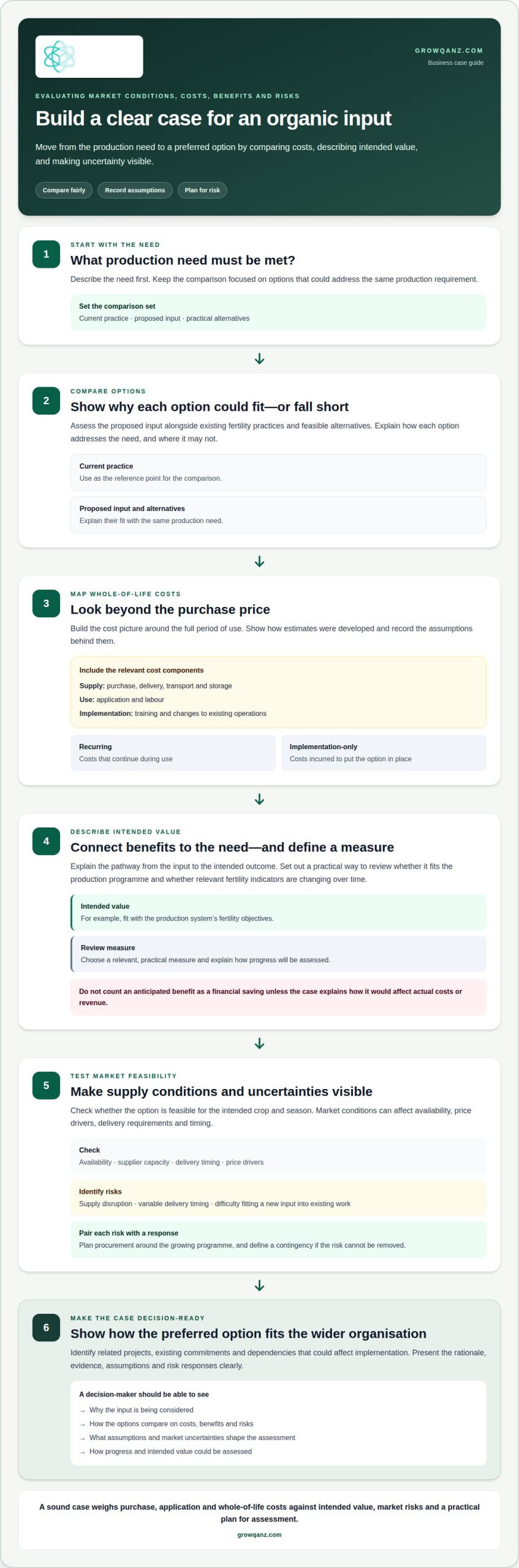
A useful assessment compares organic inputs with other options for the same production need. Set out current practice, the proposed input and any practical alternatives. Then explain why each option could meet the need, or where it falls short. A procurement business case evaluates the benefits, costs and risks of alternatives, giving decision-makers a rationale for the preferred option. For a grower, that comparison might assess an organic input alongside existing fertility practices, rather than treating the purchase in isolation.
Build the cost picture around the whole period of use, not just the purchase. Include application, labour, storage, transport, training and any changes to existing operations. Identify recurring costs and those incurred only during implementation. Explain how estimates were developed, using relevant market research and supplier discussions where appropriate. Prices and cost drivers can change with product type, supply conditions, delivery requirements and the proposed scope. Record your assumptions so readers can see how each estimate was calculated.
- Compare the proposed input with current practice and feasible alternatives.
- Separate purchase, delivery, application and ongoing operating costs.
- Describe the expected benefits and how each could be assessed.
- Record market assumptions, supply risks and planned responses.
Benefits should connect to the need identified in the proposal. They might include a better fit with a production system’s fertility objectives or a planned change in inputs. Explain the pathway from the input to the intended outcome, then identify a practical measure for reviewing progress. For example, a grower could assess whether the input fits the crop programme and monitor relevant fertility indicators over time. Don’t count an anticipated benefit as a financial saving unless the case explains how it would affect actual costs or revenue.
Market assessment also considers availability, supplier capacity, delivery timing and price drivers. These factors influence whether an option is feasible for the intended crop and season. A proposal should identify risks such as supply disruption, variable delivery timing or difficulty integrating a new input into existing work. Pair each risk with a mitigation, such as planning procurement around the growing programme, and set out a contingency if the risk cannot be removed. This makes uncertainty visible rather than burying it in a single estimate.
Finally, place the proposal within the organisation’s portfolio. Identify related projects, existing commitments and dependencies that could affect implementation. A project sponsor owns the business case, while public-sector spending decisions may face scrutiny through OIA requests, ministers, MPs and the media. Clear assumptions, evidence and risk responses help explain why the preferred option makes sense in that wider setting.
Obtaining management and financial approval
Approval requires a clear decision, not simply a request to purchase an input. New Zealand agencies are expected to prepare business cases for higher-value and higher-risk procurement. Each agency should have a policy explaining when a case is required and what it must contain. That policy, alongside the organisation’s project approval process, determines the route a proposal follows.
Start by identifying the approvals sought. A business case should request management approval for the project to proceed and financial approval for its estimated costs. State the decision-makers, funding source, proposed timing and what approval would allow the project team to do. If procurement is part of a larger project, an approved business case may already exist. Explain whether the organic input proposal sits within its scope or requires a separate decision.
Massey University’s thresholds illustrate why local approval rules matter, but they are institution-specific rather than universal New Zealand requirements. At Massey, a business case is required for a funding request exceeding a total project cost of NZ$300,000. It is also required for recurrent funding of NZ$100,000 per annum or above. Massey’s Council approves business cases with whole-of-life costs of more than NZ$5m, while SLT or the Vice-Chancellor may approve cases up to NZ$5m.
Massey currently has two SLT meetings per year for presenting business cases and strategic assessments, in April and October. That schedule shows why decision timing belongs in the proposal. Connect the approval pathway to procurement and implementation milestones, including when a decision is needed to align with the growing programme.
- Map the internal approval steps and the people responsible for each decision.
- Show estimated costs, funding requirements and the period they cover.
- Explain how the proposal fits any existing approved project.
- Set out the procurement approach and the timing needed for delivery.
For procurement approval, define supplier selection criteria, the scope of supplier involvement, and who will negotiate and secure contracts. Explain what the organisation expects suppliers to contribute and how their proposals will be assessed against the stated need. This helps distinguish approval to proceed from later procurement decisions.
Also describe the capacity and skills of the business-as-usual team. If the proposal depends on contractors or suppliers, identify which work existing staff can manage and where external input is needed. A procurement plan should build on the approved business case, not repeat it. It translates the decision into a delivery method, process and project management structure, linking approval to implementation.
Building fertility without synthetic inputs
Suitable inputs for New Zealand farms can include compost, animal manures, green manures, retained crop residues and microbial inputs. Their suitability depends on crop nutrient demand, soil condition, composition, local supply and the grower’s production system, including any certification programme requirements.
To trial and scale an organic input, establish a baseline, then compare a treated area with an appropriate reference under the same crop conditions. Record the input, management and agreed soil or crop indicators. Expand use only when the results and delivery plan support it.
Fertility involves more than the nutrients applied in one season. A management plan should consider nutrient supply, soil organic matter, biological activity and the timing of crop demand. For example, a vegetable grower might assess how a cover crop fits between cash crops, rather than judging fertility by a single input purchase. Connect each practice to a defined soil or production objective.
Rotation and plant diversity can form part of that plan. Different crops leave different root systems and residues, while a planned legume phase can contribute nitrogen to the system. Its value depends on the crop sequence, residue handling and what follows. Describe those decisions in the proposal, including how the rotation fits market commitments and the farm’s planting calendar.
Organic matter also needs practical management. Retained residues and compost can return material to the soil, while cover crops protect the ground between cash crops. Their use must fit cultivation, moisture conditions and the next crop’s establishment needs. A vineyard, for instance, may assess a living ground cover differently from a vegetable operation with frequent bed preparation. Explain the practice by crop and site, rather than presenting it as a universal recipe.
- Match each input to a defined fertility need and crop stage.
- Record nutrient content and source information for each material.
- Plan storage, handling, application and timing alongside other farm work.
- Track soil and crop indicators that relate directly to the proposal’s objectives.
For a useful comparison, assess an input’s nutrient contribution alongside its handling demands and availability. Manure and compost vary in composition, so a proposal should not treat them as interchangeable. Consider whether the material can be sourced when needed, moved to the intended block and applied within the crop programme. These operational details can affect feasibility as much as the input’s role in the fertility plan.
Keep pest, weed and disease management within the same whole-system view. Crop rotation, habitat design and natural treatments are prevention-first approaches used in organic systems. They address more than fertility alone. A business case can show how an input fits alongside these practices while keeping its stated purpose distinct. This clarifies what the input is intended to contribute and how the wider system will be managed.
Five-case business case framework
New Zealand government agencies use the Treasury’s Better Business Cases™ Model to organise investment proposals. Its five cases are strategic, economic, commercial, financial and management. Together, they help decision-makers assess why an initiative is needed, whether it offers value, how it can be procured, what it will cost and how delivery will work. For an organic input proposal, each case answers a different question, keeping the rationale, evidence and delivery plan connected.
- Strategic case: Explain the production or organisational need. For example, a farm may be seeking a fertility approach that supports its planned transition away from synthetic inputs. Show how that need fits wider objectives, what existing projects already address it, and where a genuine gap remains. In a public-sector proposal, describe how the initiative meets strategic needs not already met elsewhere in the organisational portfolio. Explain its value to New Zealand and its contribution to the public good.
- Economic case: Compare feasible options and explain why the preferred option creates the strongest value. An organic input might be assessed alongside current practice and other fertility approaches. Set out the expected benefits, costs, risks and trade-offs for each option. Make clear which assumptions affect the comparison, such as application requirements or supply timing. The recommendation should follow from the options analysis, not from a preference stated before alternatives are assessed.
- Commercial case: Show how procurement could work in practice. Define the input required, the market approach, supplier selection criteria and the scope of supplier involvement. Explain who would negotiate and secure any contract. For example, specify how a supplier’s proposed delivery arrangements will be considered against the growing programme. Keep the commercial proposal aligned with the need and preferred option already established in the strategic and economic cases.
- Financial case: Present the estimated costs, funding source and financial implications over the initiative’s life. Separate purchase costs from application and ongoing operating costs. State how estimates were developed and identify assumptions that could change the total. Decision-makers need to understand the funding sought and its relationship to the organisation’s budget, rather than relying on a purchase figure alone.
- Management case: Explain how the approved proposal will move into delivery. Set out responsibilities, procurement planning, milestones, measures of success and risk management. For instance, identify who will coordinate supply and application, and how progress will be reviewed. Describe the team’s capacity and any external support required, so the plan reflects the skills and resources available.
The five cases should read as one connected argument. The strategic case defines the need; the economic case tests options; the commercial and financial cases establish feasibility; and the management case explains delivery. If the preferred input changes after comparison, update the procurement and implementation rationale to match. This consistency helps decision-makers trace the proposal from its purpose to the work required.
Making a case for organic inputs to decision-makers
A compelling proposal starts with a defined need, not a preferred product. Describe the production challenge, the affected crop or business unit, and why existing practices leave a gap. For example, a grower may need to align fertility management with a planned transition away from synthetic inputs. Explain who experiences the issue, what happens if it remains unresolved, and how the proposed option addresses that specific need.
Consult the people who will fund, use and manage the proposal. A grower, finance lead, operations manager and procurement team may each weigh different outcomes. Record their concerns and show how they shaped the options analysis. An operations manager may focus on application timing, while a finance lead needs whole-of-life cost assumptions. This consultation helps define a workable scope and prevents delivery requirements from emerging only after approval.
Define success before comparing options. Select measures connected to the stated need that can be reviewed during implementation. For an input trial, these might include application records, agreed soil indicators, crop observations and fit with the production programme. Explain who will collect each measure, when it will be reviewed, and how findings will inform a decision to continue, adjust or expand. Do not treat a projected benefit as an achieved result.
Then explain why the preferred option is stronger than the alternatives. Compare it with current practice and other feasible approaches using consistent criteria. A table can show how each option performs against fertility objectives, operational fit, market supply, risks and estimated costs. State why an option was rejected, such as poor timing or a mismatch with the crop programme. This makes the recommendation traceable rather than presenting it as an unsupported preference.
- State the need, affected stakeholders and consequences of inaction.
- Summarise consultation and identify changes made to the proposal.
- Set measurable outcomes, review responsibilities and decision points.
- Compare feasible alternatives and explain the preferred option.
- Connect approval to procurement, implementation and risk planning.
Use evidence carefully. Separate independent research, product information, overseas trials, New Zealand trials and commercial observations. Identify the crop, location, input formulation and conditions for any result cited. Evidence from one formulation or overseas production system should not be presented as proof of performance in another New Zealand setting. This distinction helps management understand both the relevance and limits of each source.
Close with a decision-ready request: specify the approval sought, the estimated funding, the accountable lead and the next procurement step. For growers assessing a microbial input, discuss whether Quantum Organic-Total® fits your crop and growing programme as part of that evaluation when presenting a business case for organic inputs.
GrowQanz: Quantum Organic-Total®
QANZ offers Quantum Organic-Total®, a microbial agricultural input for crop and soil programmes. It may be relevant when evaluating a biological input for a particular growing system. Consider its intended use alongside the crop, production objectives and certification programme requirements.
In a proposal, identify how the input would be assessed and which outcomes matter to the decision. QANZ also offers crop application programmes and product support to help growers consider the product within their growing programme.
Talk to QANZ about whether Quantum Organic-Total® suits your crop, growing system and application programme.
Turn the proposal into a practical next step
A business case becomes useful when its decision leads to a clear, manageable next step. Carry the proposal’s success measures into implementation, assign responsibility for reviewing them, and use the findings to inform future input decisions. This keeps the original rationale connected to what happens on the farm, rather than leaving the case as an approval document.
For growers considering biological inputs, presenting a business case for organic inputs can provide a disciplined way to assess how an option fits a wider growing programme. QANZ offers Quantum Organic-Total®, Quantum VSC® and Quantum. Consider the relevant option in the context of its intended use and your production system.
If you’re ready to discuss a biological input for your operation, discuss organic inputs with QANZ. An evidence-led next step can help move your proposal towards practical evaluation.
Frequently Asked Questions
What are the business benefits of using organic inputs in New Zealand?
Presenting a business case for organic inputs is strongest when the proposal links them to a clear business objective. An input may suit a fertility strategy focused on biological approaches, a planned change in production practices, or customer expectations. Assess what matters to the operation rather than assuming a financial gain. For example, consider whether the input aligns with the business’s production principles and can be evaluated against its intended purpose.
What is the cost of organic inputs compared with synthetic fertilisers and pesticides in New Zealand?
There’s no single cost comparison that applies across organic inputs, fertilisers and pesticides, because they may serve different purposes. Compare products only when their intended functions are meaningfully equivalent. For nutrient sources, assess cost relative to the nutrients supplied; for biological inputs, assess cost against the specific role being considered. A purchase price alone can’t establish which option offers better value for a particular New Zealand production system.
What yield and revenue impacts can businesses expect from switching to organic inputs?
Yield and revenue impacts depend on the crop, growing conditions, input and management practices, so a business shouldn’t treat a forecast as a guaranteed outcome. Use evidence that matches the formulation and production context, and distinguish measured trial results from projections. For example, estimate revenue using the operation’s own saleable-grade and market assumptions, then compare those estimates with recorded results after implementation.
How can a New Zealand business calculate the return on investment for organic inputs?
When presenting a business case for organic inputs, calculate ROI from the change in net financial return, not yield alone. Compare the proposed system with a credible baseline, then identify which revenue or expense changes can reasonably be attributed to the input. Model conservative, expected and stronger performance scenarios to see how sensitive the decision is to market conditions. Keep non-financial soil objectives visible, but don’t count them as cash returns unless they affect the accounts.
Disclaimer
Important: This article provides general agricultural information only. Product performance can vary according to crop, soil, climate, management practices and application conditions. Trial or research results discussed may have been obtained under specific conditions and should not be interpreted as a guarantee of equivalent results. Always follow current product directions and confirm suitability for your crop, growing system and organic certification requirements. Contact QANZ for current product and application information.
