
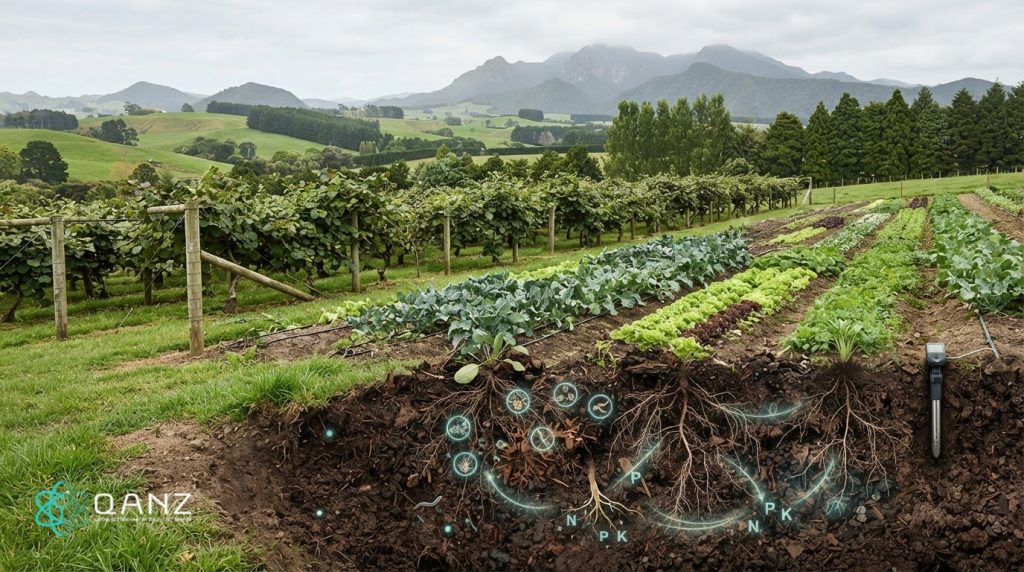
Moving away from NPK-dependent farming doesn’t have to start with cutting fertiliser. A safer first step is to review what each crop and block needs, what nutrients are already available, and why current inputs are being used. Reducing fertiliser without understanding its role can add risk, so assess the programme before making changes.
Established practices often reflect years of experience, and any transition needs to account for the farm’s crops and conditions. This article explains how to assess NPK reliance, strengthen nutrient stewardship and plan staged trials with clear measures of progress. It also considers where biological inputs may fit within a crop and soil programme, without treating them as fertiliser replacements. The aim is to help New Zealand growers make informed adjustments while keeping crop nutrition central to each decision.
Key Takeaways
- Moving away from NPK-dependent farming starts with identifying crop nutrient needs and the factors affecting nutrient availability, not cutting inputs by assumption.
- Use soil condition, crop residues and management history to identify where nutrient planning may need closer attention.
- Compare nutrient budgeting, rotations, cover crops, residue management and biological inputs, while recognising that each has practical limits.
- Make change measurable: establish a baseline, trial one crop or block, and record inputs, crop observations and relevant management changes.
- Consider Quantum Organic-Total® as a microbial agricultural input for crop and soil programmes, not as a fertiliser replacement.
Why move away from NPK-dependent farming gradually?
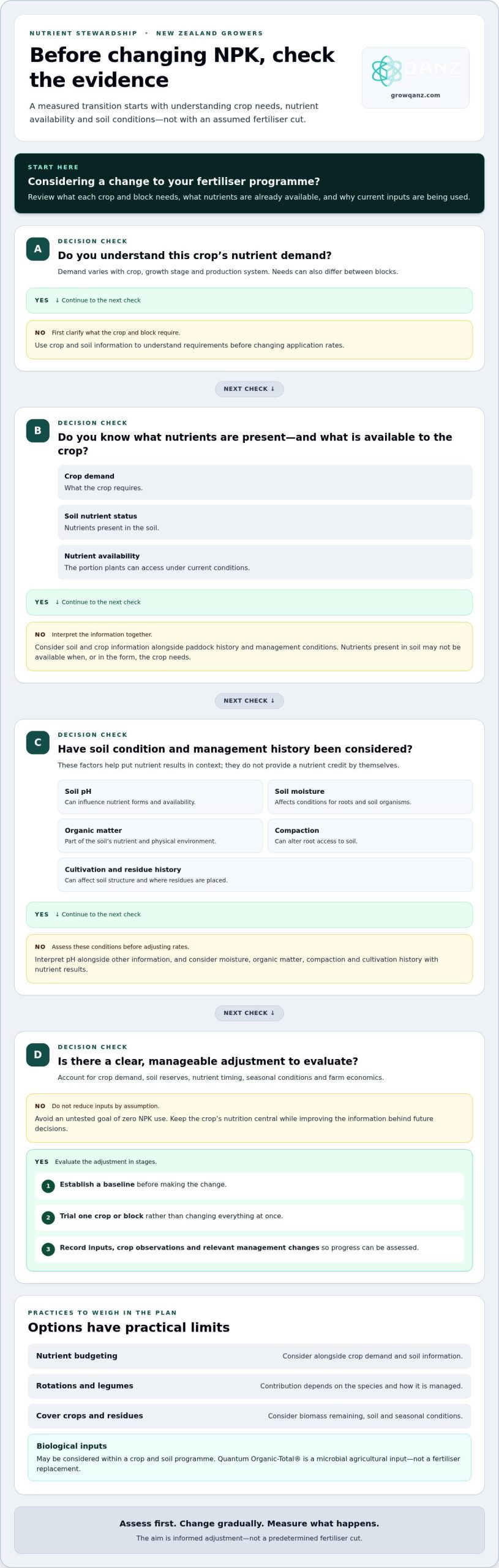
Move away from NPK dependence by first assessing crop nutrient needs, improving nutrient stewardship and changing practices incrementally. Review what each crop and block requires, how existing nutrients are managed, and whether soil or crop information points to a gap. Then test adjustments in a controlled way, rather than abruptly stopping fertiliser or setting an untested goal of zero NPK use.
Nutrient planning should come before any change to application rates, so decisions reflect crop demand, soil conditions and nutrients already available. This measured approach helps growers judge whether current inputs suit each crop, rather than assuming that using less is automatically better.
What does NPK dependence mean on a working farm?
NPK refers to nitrogen, phosphorus and potassium, three nutrients commonly supplied through fertilisers. NPK dependence describes a farm-specific pattern of relying on fertiliser inputs to meet crop nutrient demand. It isn’t a judgement about a grower’s choices. Those choices are shaped by crop requirements, production goals, paddock history and the information available when decisions are made.
Nor does the term mean every crop needs the same nutrient balance. A crop’s demand varies with its growth stage and production system, while fertiliser is only one part of crop nutrition. Nutrient cycling, soil condition, residues, cultivation and application timing also shape how nutrients move through and are managed in the growing system. The USDA Natural Resources Conservation Service outlines nutrient cycling as one of its soil-health principles, providing useful context for considering these farm processes.
Why consider a measured transition?
Reviewing NPK use can help growers strengthen nutrient stewardship and understand how well decisions are supported by current crop and soil information. Farm records and responsive management can also inform planning when input conditions change. These are reasons to investigate, not guaranteed outcomes.
There are real constraints. Crop demand can vary between seasons and blocks; soil nutrient reserves and availability differ; and application timing can affect whether nutrients are present when crops need them. Farm economics matter, too. A rate change that appears reasonable on paper may carry production risks if it doesn’t account for the crop, soil and seasonal conditions.
For growers in New Zealand and Australia, the practical objective is informed adjustment: examine the evidence, identify where there may be scope to improve decisions, and retain the flexibility to respond to crop or soil observations. The aim isn’t to promise lower costs or higher yields, or to presume that every farm can reduce NPK use. It’s to replace assumption with assessment.
- Consider resilience: review whether nutrient decisions are supported by current crop and soil information.
- Strengthen stewardship: consider how nutrient inputs fit alongside broader soil and crop management.
- Manage uncertainty: account for crop demand, soil reserves, timing and farm economics before adjusting rates.
In practice, moving away from NPK-dependent farming means learning what the farm relies on and why. That diagnosis gives growers a sounder basis for deciding what, if anything, to change next.
How do nutrient cycling and soil condition shape NPK decisions?
Nutrient demand, soil nutrient status and nutrient availability are connected, but they describe different things. Demand is what a crop requires; soil status describes the nutrients present; availability concerns the portion plants can access under current conditions. Keeping these concepts separate helps growers interpret nutrient information more carefully than simply adding up fertiliser inputs.
Nutrient cycling is the movement and transformation of nutrients between soil, organisms, plants and the wider environment. Biological activity contributes to this process and to soil function, but it doesn’t show that a crop can meet all its nutrient demand without inputs. A nutrient may be present in soil but unavailable at the time, or in the form, the crop can use.
That distinction matters when moving away from NPK-dependent farming. Improved nutrient stewardship means understanding what is available and what the crop needs, not simply removing fertiliser. Consider soil observations and nutrient results together, alongside the crop, paddock history and management conditions.
Which farm factors can affect nutrient availability?
Soil pH can influence the chemical forms of nutrients and how available they are to plants. Its effects depend on the nutrient and soil context, so interpret a pH result alongside other information rather than treating it as a stand-alone instruction. Soil moisture also affects the conditions in which roots and soil organisms function.
Assess organic matter, compaction and cultivation history alongside nutrient results. Organic matter is part of the soil’s nutrient and physical environment; compaction can alter root access to soil, while cultivation changes soil structure and residue placement. These factors don’t provide a nutrient credit by themselves, but they can help explain why a soil result may not tell the whole story.
How do crop rotations and residues fit into nutrient planning?
Rotations, legumes, cover crops and residue management can influence nutrient supply and timing within a farm system. Their contribution depends on the species grown, how it is managed, the biomass remaining, and local soil and seasonal conditions. For example, don’t assign a fixed nitrogen credit to a legume in the rotation without applicable evidence and a plan to assess its contribution.
For each paddock, record the crop sequence, cover crop or legume history, residue handling and cultivation. Use that context when interpreting nutrient information and planning the next crop. These practices may complement fertiliser inputs, but their presence alone doesn’t establish that rates can be reduced safely.
Global evidence can offer context, not a direct prescription for a New Zealand crop or paddock. Our World in Data discusses reducing fertilizer use without sacrificing yields in a global overview; local decisions still need to account for crop demand, soil conditions and management.
Once these factors are considered together, growers can build a more complete picture of their crop programme. QANZ’s crop and soil programme support can help connect farm observations with programme decisions.
Which practices can reduce NPK reliance, and what are their limits?
Several practices can improve how nutrients are planned and managed, but they work in different ways. Nutrient budgeting helps organise decisions; rotations, cover crops and residue management shape the farm system; biological inputs can be considered within crop and soil programmes. Their value depends on crop needs, soil conditions and management. None is an automatic reason to reduce fertiliser rates.
No single practice is a universal NPK substitute; sound nutrient stewardship combines suitable practices with crop-specific assessment. Use the comparison below to identify what each approach can contribute, what affects its suitability and what it cannot establish on its own.
| Practice | Purpose | Decision factors | Limits |
|---|---|---|---|
| Nutrient budgeting | Bring crop demand, nutrient information and planned inputs into one decision process. | Crop and paddock history, available soil information, expected production and timing. | A budget depends on the quality and relevance of its inputs; it doesn’t guarantee that nutrients will be available to the crop as expected. |
| Crop rotation | Vary crop sequences and assess how one crop’s management affects the next. | Crop choice, rotation length, seasonal conditions and farm objectives. | Effects differ between systems and seasons. Rotation alone doesn’t show how much fertiliser a following crop may need. |
| Cover crops | Include additional plant cover as part of a broader soil and nutrient plan. | Species, establishment, termination timing, water conditions and the following crop. | Establishment and management take planning; nutrient contributions aren’t fixed or assured. |
| Residue management | Consider how crop residues are retained, moved or incorporated in the programme. | Residue quantity and quality, placement, cultivation and the next crop’s timing. | Residues don’t necessarily release nutrients when the crop needs them, and their contribution varies. |
| Biological inputs | Consider an input as part of a crop and soil programme. | Crop and programme suitability, application guidance and the evidence for the specific product. | They shouldn’t be assumed to replace NPK fertiliser or to deliver a guaranteed reduction in inputs. |
How can rotations, cover crops and residues contribute?
These practices are options to evaluate within the whole rotation, not nutrient credits to assume in advance. A cover crop that establishes or terminates differently from plan may change the timing and amount of material returned to the field. Similarly, a legume’s place in a rotation doesn’t establish a fixed nutrient contribution. Record crop choice, establishment and termination, residue handling and seasonal conditions, then use that history when planning the next crop.
Where might a biological input fit?
A biological input is considered alongside nutrient planning and crop management, not as a presumed substitute for NPK. Quantum Organic-Total® is a microbial agricultural input offered by QANZ for use in crop and soil programmes. Assess its role within the specific programme using current product and application guidance. Read the Quantum Organic-Total® product information as part of that evaluation.
For growers moving away from NPK-dependent farming, the practical question isn’t which single practice can replace fertiliser, but which combination can be assessed and monitored on the farm. Keep decisions tied to crop needs and observed results.
How can growers trial a transition without changing everything at once?
A small, well-documented trial can help show whether a change is suitable for a particular crop and block before it becomes part of a wider programme. Treat moving away from NPK-dependent farming as a learning process: set a baseline, change a defined part of the programme, and compare relevant observations while keeping other management as consistent as practical.
What should a grower establish before making changes?
Gather available soil and crop records, current nutrient inputs and the reasons behind each application. Interpret soil test results in a crop-relevant context, using suitably qualified advice where needed. Then choose a manageable comparison area and note differences in soil, crop history or management that could affect the comparison. A trial is useful only when its starting conditions are understood.
How should a transition trial be monitored?
Choose measures that match the crop and the question being tested, such as crop condition, production records or nutrient-management observations. Compare like with like and log weather, soil context, input timing and management changes. If several factors change together, it becomes difficult to attribute an observed difference to one input or practice.
- Establish a baseline. Record the existing programme, including nutrient inputs, application timing, crop observations, available soil information and recent management. Note why each input is used, rather than recording quantities alone.
- Choose a crop or block. Select an area that can be monitored consistently and is reasonably representative of the system being considered. Identify a comparable area under the current programme if practical, and document any differences between them.
- Define the measures. Decide in advance what observations will inform the decision. These might include crop condition at relevant growth stages, production records, nutrient applications and soil information. Use measures that are meaningful for that crop, not a generic checklist.
- Trial carefully. Make a clearly recorded, staged change rather than altering several inputs or practices at once. Trial size and duration should suit the crop, farm operations and question being tested. There is no universal rate or timetable for every crop and condition.
- Review the evidence. Compare the trial area with its baseline and, where available, the comparison area. Consider whether weather, soil conditions, timing or other management changes could explain what you observed. Use the findings to decide whether to continue, adjust or stop the approach.
Keep local context in view. New Zealand and Australian growing seasons differ, and timing that suits one crop calendar may not suit another. Agronomic recommendations and certification requirements can also vary by jurisdiction and programme, so use advice relevant to the farm and its market rather than transferring a protocol across the Tasman. For broadacre context, QANZ’s guide to microbial solutions for field crops is relevant when considering biological inputs within crop programmes.
A disciplined record turns a trial into useful farm knowledge, even when the result is inconclusive. For support considering a biological input within a crop programme, talk to QANZ about your application programme.
How can QANZ biological products fit into a considered crop programme?
Once you understand the crop’s nutrient requirements, the paddock context and how you’ll monitor a staged trial, you can assess whether a biological input belongs in the programme. Consider it alongside nutrient management, not as a shortcut around it. Quantum Organic-Total® is a microbial agricultural input offered by GrowQanz for use in crop and soil programmes. Its inclusion does not, by itself, justify reducing NPK fertiliser or predict a particular crop outcome.
What should growers assess before considering Quantum Organic-Total®?
Start with the intended crop and the role you want the input to have within the existing crop and soil programme. Compare that purpose with current GrowQanz technical information, and use the product’s current guidance when considering application rates and suitability. Keep nutrient requirements and the existing fertiliser plan grounded in crop-relevant information; don’t assume that adding a biological input changes what the crop needs from other sources.
If your farm operates under a certification programme, assess input suitability and requirements against current GrowQanz and BioGro documentation and your programme’s rules. Product use doesn’t make a crop, farm or produce organic. Keep these considerations distinct: product suitability concerns the intended programme, while certification decisions concern the requirements that apply to your operation.
What evidence should guide the next decision?
Evidence is most useful when its type and scope are clear. General peer-reviewed research can explain broader scientific questions about biological inputs, but it doesn’t establish the performance of a particular product. Independent trials, manufacturer trials, overseas trials and commercial grower observations are different forms of evidence. None should be treated as interchangeable, and results from one formulation should not be assumed to apply to another.
For any product-specific result, identify the exact formulation and the crop, location, treatment and conditions tested. An overseas finding is not a New Zealand trial, and an observation from one farm isn’t a guarantee of the same result elsewhere. Review the methods and comparison used, what was measured, and whether the conditions resemble your growing system. Where results are available, consider them alongside your baseline and the measures chosen for your own staged trial.
Biological inputs are an active area of research, but broad scientific understanding and evidence for a specific product answer different questions. GrowQanz’s Quantum technology information can provide context about its technology; it should not be treated as proof of an unreported crop outcome.
For growers moving away from NPK-dependent farming, assess the product, application guidance and certification considerations against current documentation, then decide whether a measured trial fits the crop programme. Talk to GrowQanz about your crop programme.
Make the next change a measured one
Progress doesn’t depend on setting a target of zero NPK. It comes from making decisions that fit the crop, the paddock and the available evidence, then learning from each carefully managed change. That approach makes moving away from NPK-dependent farming a practical, stepwise process rather than a leap of faith.
QANZ supplies Quantum agricultural biological products to growers in New Zealand and Australia. Quantum Organic-Total® is a microbial agricultural input for crop and soil programmes. Consider it within a broader plan, not as a fertiliser replacement or a promise of lower inputs.
Your next step can be a conversation grounded in your crop, growing system and aims. Bring the questions you’re working through and discuss whether a product or application programme fits your approach. Careful assessment keeps the focus on sound decisions and steady progress.
Talk to QANZ about your crop programme and make your next decision with your crop, system and application plan in view.
Frequently Asked Questions
Does moving away from NPK-dependent farming mean stopping NPK fertilisers?
No. Moving away from NPK-dependent farming can mean reviewing reliance on nitrogen, phosphorus and potassium fertilisers, not eliminating every NPK input. For example, a grower might first check whether an application still fits the crop’s current requirements and paddock records. Keep decisions crop-specific: a change that suits one block or season may not suit another, and continued fertiliser use may remain appropriate.
How much should I reduce NPK fertiliser when starting a transition?
There’s no single reduction amount that applies across crops, soils and farms. Don’t use a general article or a biological-input claim to set a new rate. Base any planned adjustment on crop requirements, available soil information and production records, interpreted with relevant agronomic advice. For farms operating in New Zealand and Australia, use guidance for the country and crop concerned rather than assuming recommendations transfer across borders.
Can cover crops replace NPK fertiliser?
Not automatically. A cover crop may be one part of a nutrient-management plan, but its contribution depends on the species, establishment, management, soil and following crop. For instance, a cover crop that establishes poorly may not contribute as expected. Avoid assigning a fixed nutrient credit without applicable evidence. Record the cover crop and its management, then assess its place in the programme alongside the next crop’s requirements.
How long does it take to move away from NPK-dependent farming?
There’s no fixed timeline. The pace depends on the farming system, rotation, soil condition, nutrient reserves and the changes being assessed. Set a review period that makes sense for the crop and the measure being tracked, rather than expecting a result by a predetermined date. If seasons or management conditions vary, note those differences; they can affect how confidently you interpret observations and plan subsequent steps.
Can biological inputs replace NPK fertilisers?
Don’t assume a biological input replaces NPK fertiliser. Crop nutrient requirements still need to be managed, and product purpose and suitability relate to the specific formulation and programme. Consider it within the wider crop plan, and use current QANZ technical information for product suitability and rates. Don’t infer that its use will reduce fertiliser requirements.
Should I change several farm practices at the same time?
Changing several practices together can make it harder to tell what influenced an observed difference. Where farm operations allow, keep other management as consistent as practical while assessing one defined change. If changes need to happen together, document each one, including its timing and the area affected. That record gives you a clearer basis for interpreting crop observations, even when weather or operational constraints complicate the comparison.
Disclaimer
Important: This article provides general agricultural information only. Product performance can vary according to crop, soil, climate, management practices and application conditions. Trial or research results discussed may have been obtained under specific conditions and should not be interpreted as a guarantee of equivalent results. Always follow current product directions and confirm suitability for your crop, growing system and organic certification requirements. Contact QANZ for current product and application information.
