
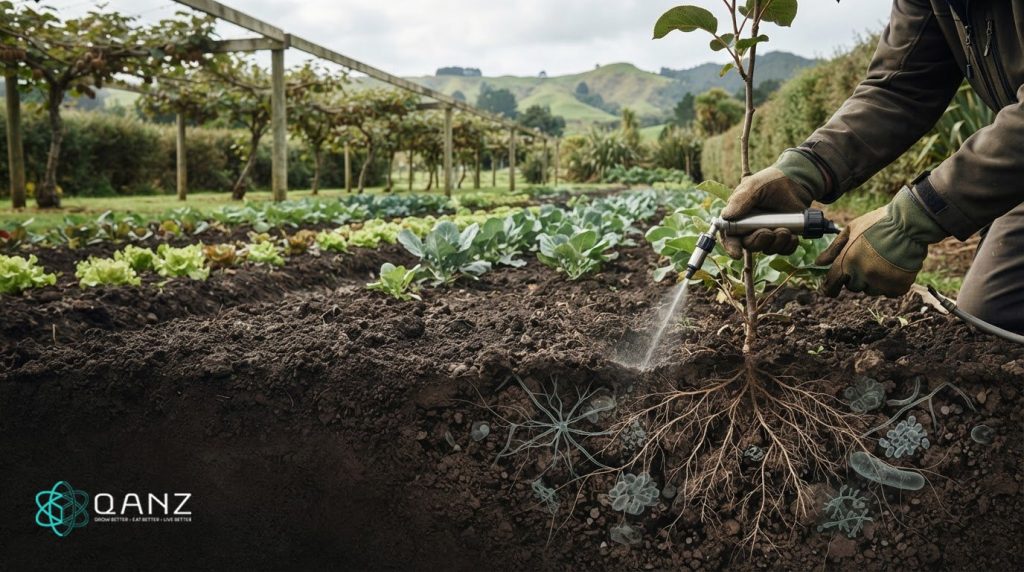
A microbial inoculant is most useful when it suits the crop, soil conditions and application method. For growers looking to buy microbial soil inoculants in NZ, the practical priorities are choosing an appropriate product and applying it as directed. This guide covers New Zealand-wide delivery, mixing and application, and how microbial inputs relate to soil life and structure.
Before introducing a biological input into a growing programme, it helps to understand how you’ll use it. Microbial products are not interchangeable: preparation and placement should match the specific product and its intended use.
This guide explains what to consider when choosing microbial inoculants in New Zealand, how to approach application and what to consider about soil conditions. Use these points to make an informed product choice and decide whether a biological input fits your soil and crop management plan.
Key Takeaways
- Compare inoculants by their intended use and suitability for the crop, rather than assuming all microbial products work the same way.
- Plan mixing and application around the product instructions, application method and conditions in the growing area.
- Understand how soil structure, air spaces and microbial activity relate to the conditions plants grow in.
- Match the inoculant type to the growing system, whether you’re working with vegetables, turf, orchards or native plants.
- Explore New Zealand delivery and application support as part of deciding how a biological input could fit your growing programme.
New Zealand-wide delivery
When comparing microbial soil inoculants, focus on the specific product and its intended use rather than a broad category label. Check whether you’re considering a packaged formulation or a compost-based preparation, then match your choice to the material and application you plan to use.
Are microbial soil inoculants approved or regulated for sale in New Zealand? There isn’t one approval status that applies to every inoculant based on its category name. Assess the specific product and intended use, and follow the requirements that apply to your growing programme.
Before ordering, prepare the receiving details for your site. Include the full delivery address, any rural route details, farm entrance instructions and a suitable receiving point. For a commercial property, specify who can accept the parcel and where it should be placed. Clear directions help distinguish between separate access points, such as a farm office, packhouse or growing block.
Before ordering, identify the application method and the area you intend to treat. A small garden plot and a commercial horticultural block have different handling needs. Read the product’s instructions for storage, mixing and application, then keep them with the delivery. This gives the person preparing the inoculant a direct reference for the particular product.
- Confirm the destination: provide the full urban or rural address and access directions.
- Plan receipt: nominate a responsible person and parcel drop-off point.
- Prepare for use: read product instructions before mixing or applying.
- Keep records: retain order details and the product label for reference.
Compost-based preparations require their own materials and method. For a compost extract, prepare mature compost, clean water and suitable mixing equipment. Plan the batch around the intended application so you don’t prepare more than the growing area requires.
Compost readings can describe a sample’s microbial population. A low microBIOMETER reading is 500 µg C/g, a medium reading is approximately 1200 µg C/g, and a high reading is 1700 µg C/g. These figures describe compost readings, not delivery standards or product specifications. Interpret them in relation to the sample and the purpose of the measurement.
For faulty, damaged or incorrect goods, New Zealand’s Consumer Guarantees Act provides remedies such as repair, replacement or refund, with return costs covered by the seller. Keep packaging and order records if a problem arises. Keeping purchase details and product information together also makes it easier to plan receipt and use.
Mixing and applying the inoculant
Follow the preparation and application directions for the specific product. Microbial formulations differ, so don’t transfer a recipe or rate from one product to another. Identify the intended method first, then prepare only what your treatment plan requires.
Can microbial soil inoculants be imported into New Zealand, and what biosecurity rules apply? A generic product label can’t establish whether a particular product may be imported. Before arranging shipment, consult New Zealand’s official import guidance for the named product and its ingredients.
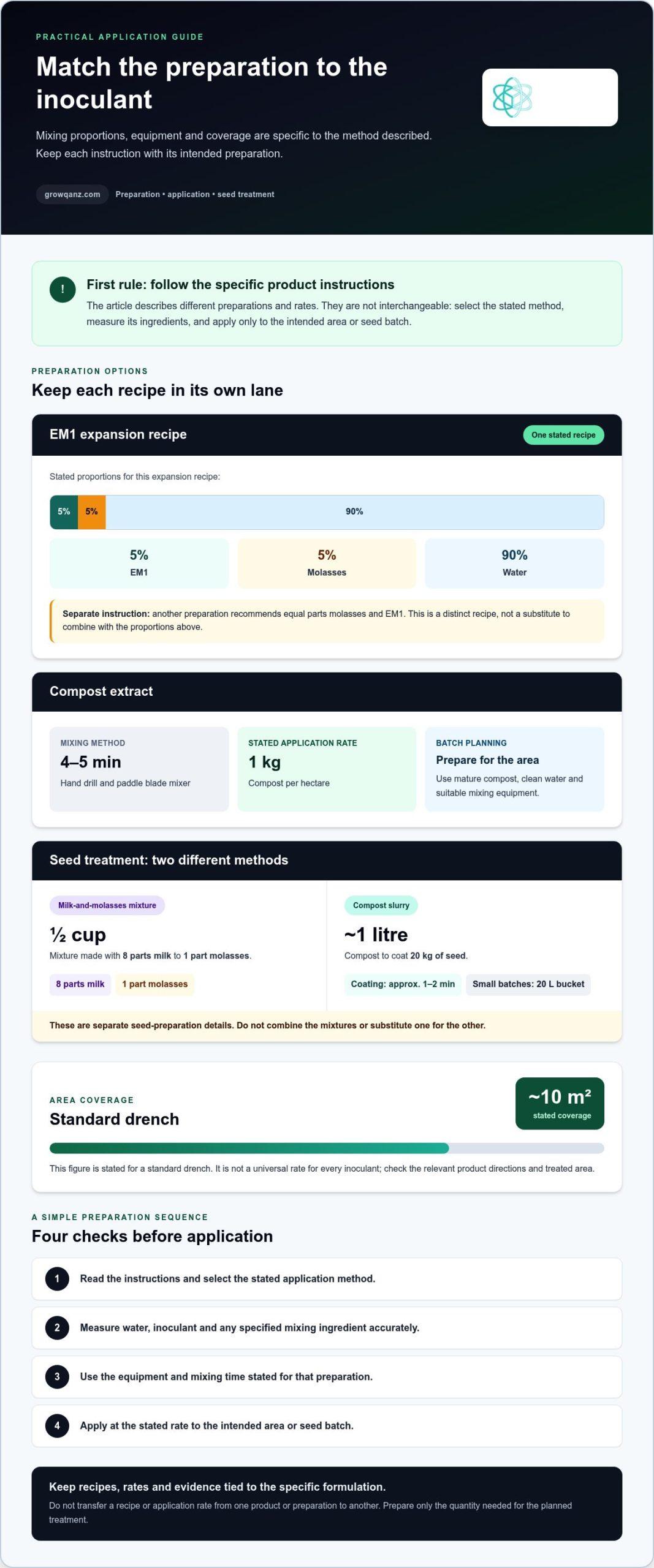
For an EM1 expansion recipe, the stated proportions are 5% EM1, 5% molasses and 90% water. Another preparation instruction recommends equal parts molasses and EM1 to provide food for microbes. These are distinct recipes, not interchangeable directions. Follow the instructions for the particular product and avoid combining guidance from different formulations.
Application also depends on the method and treated area. A standard drench is said to cover roughly 10 m2. Treat this as a stated coverage figure for that drench, not a universal rate for every inoculant. For compost extract, one described mixing method uses a hand drill and paddle blade mixer for 4-5 minutes. The stated successful application rate is 1 kg of compost per hectare. Keep those directions tied to compost extract, rather than applying them to a packaged product.
Seed coating needs a separate process. One recipe uses ½ cup of a milk-and-molasses mixture, made with 8 parts milk to 1 part molasses. Compost slurry instructions use about a litre of compost to coat 20 kg of seed. The coating process takes approximately 1-2 minutes. Smaller batches of inoculated seed can be prepared by hand in a 20L bucket.
- Read the product instructions and select the stated application method.
- Measure water, inoculant and any specified mixing ingredient accurately.
- Use the specified equipment and mixing time for that preparation.
- Apply to the intended area or seed batch using its stated rate.
What risks, limitations, or evidence issues should I consider before buying soil inoculants? Preparation and application rates are formulation-specific, and one recipe can’t establish results for another product. Separate general scientific findings from product-specific trials, and distinguish overseas evidence from New Zealand results. Compare a product’s intended use with your crop and application plan; microbial technology information can help explain the broader context.
For seed treatment, keep each preparation tied to the method it describes. The seed-coating recipe uses ½ cup of a milk-and-molasses mixture made with 8 parts milk to 1 part molasses. The seed-inoculation recipe uses about a liter of compost to make the slurry. These details describe different mixtures, so don’t combine them or substitute one for the other when preparing seed.
Before mixing, check that the preparation method matches the product and treatment. Keep the stated ingredients and proportions together, and prepare only the quantity required for the intended application. Don’t treat a recipe as a general formula for every inoculant: directions vary by product. If the product directions specify another method, follow them rather than adding ingredients from a separate preparation.
Soil life and soil structure
Soil structure can be assessed through practical observations across a growing site. Kōanga’s soil-building guidance says soil must be 50% air. Treat this as guidance about the importance of air space, rather than assuming every paddock or garden bed has that proportion. Compare areas with different management histories, such as a cultivated bed and an undisturbed margin.
After rainfall, observe the soil surface. Note where water ponds, where a crust forms and where the surface remains open. Compare locations, such as a wheel track and an adjacent bed, or bare ground and an area covered with plant residues. These observations describe field conditions; they don’t measure microbial activity or prove an input’s effect.
Dig a small inspection hole in representative parts of the site. Compare how easily a spade enters, whether the soil breaks into clods and whether roots encounter a visibly compacted layer. Check more than one location, as a headland, orchard row and sheltered bed may have different histories. Record the crop, recent cultivation and soil moisture alongside each observation.
Consider organic matter, moisture, pH and compaction when assessing soil conditions. A biological input doesn’t remove the need to address physical constraints. If a wet traffic lane is compacted, consider traffic patterns and soil condition as part of the management response. If a vegetable bed dries quickly, review surface cover and watering practices as part of the wider soil plan.
How should microbial soil inoculants be stored, and what is their shelf life? Storage directions and expiry information vary by product, so follow the specific label. Keep it with the container, and record when the product was opened if the instructions call for it.
- Compare locations: inspect a wheel track, crop row and less-disturbed area.
- Record surface conditions: note ponding, crusting or visible differences after rain.
- Inspect below the surface: use a spade to compare compaction and root-zone conditions.
- Keep context: record crop, management and moisture alongside each observation.
Compost measurements provide a separate kind of information. A medium microBIOMETER microbial-population reading for compost is approximately 1200 µg C/g. It describes a compost reading, not a universal soil-health threshold, soil-structure score or product-performance result. Keep the sample type clear when recording or discussing the measurement.
Repeat observations at the same locations over time to make comparisons more useful. For example, revisit a crop row and headland after similar rainfall, noting surface condition and spade resistance. These records can help describe changes at the site, but one observation does not prove a microbial cause.
What types of microbial soil inoculants are available in New Zealand?
New Zealand growers can encounter different types of microbial inputs, including mycorrhizal fungi products and compost-based preparations. These vary in formulation and intended use. Compare those details before choosing an input for a vegetable bed, orchard row, lawn or field crop.
Mycorrhizal fungi form associations with plant roots. Products may describe the amount of fungal propagules, a measure used to indicate viable fungal starting material. One product listing gives a concentration of 30 propagules per mL. Treat that number as a specification for that product, not a standard shared by every mycorrhizal inoculant.
Bacterial inoculants contain bacteria selected for agricultural applications. Their intended role depends on the strains and formulation, so check the specific product label. For example, a bacterial input labelled for seed treatment shouldn’t automatically be used as a soil drench. Match the stated application to the crop and growing stage.
Mixed microbial products may combine different organism groups in one formulation, and the organisms and proportions vary between products. Look for a clear description of the formulation and directions for storage, preparation and application. A broad claim about “soil biology” doesn’t tell you what a product contains or how it should be used.
Compost-based inputs include extracts and slurries made from mature compost. Unlike packaged inoculants, they are prepared by the grower from compost and water. An extract is applied as a liquid, while a slurry can be used to coat seed. Follow preparation guidance for the specific method.
EM1-style products are another category encountered in microbial growing discussions. One expansion recipe uses 5% EM1, 5% molasses and 90% water. That recipe describes an EM1 expansion approach, not a universal mixing instruction for other inoculants. Product identity and label directions remain essential.
- Check the organism group: distinguish mycorrhizal fungi from bacterial or mixed formulations.
- Read the intended-use directions: compare soil application, seed treatment and other stated methods.
- Interpret specifications narrowly: a concentration such as 30 propagules per mL applies to the named product.
- Separate preparation types: compost extracts, slurries and packaged products aren’t interchangeable.
Choosing by category alone can hide important differences. Mycorrhizal products and compost extracts have different preparation and application considerations. For New Zealand systems such as kiwifruit, grapes, potatoes or turf, first identify the crop and purpose. Then compare the product description, handling directions and evidence relevant to that formulation. This is more useful than relying on broad labels such as “microbial” or “soil enhancer”.
Which inoculants suit vegetables, lawns, orchards, or native plants?
Choose an inoculant for the plant, growing environment and application purpose. A product intended for seed treatment, for example, isn’t automatically suitable for an established lawn. Identify the crop and growth stage, then compare them with the product’s stated use and application directions.
Vegetables: Tomatoes, potatoes and leafy crops differ in their root systems and growing practices. Check whether a product is intended for seed, transplant roots or soil application. Match the method to the planting stage, and don’t apply a rate from another crop or formulation. Crop-specific instructions are more useful than broad claims about vegetables.
Lawns and turf: Turf is a dense plant cover that is cut regularly. Decide whether you’re treating seed, establishing new turf or applying an input to an existing lawn, as these situations involve different placement and timing considerations. Follow directions for the actual application method rather than adapting guidance for orchards or vegetables.
Orchards: Kiwifruit, blueberries and other fruit crops grow in perennial systems. Consider where active roots sit, how the orchard floor is managed and whether the product is intended for established plants. A treatment designed for seed coating isn’t suited by default to an established orchard. Match the crop, plant stage and method.
Native plants: Species and growing conditions matter. A restoration planting with locally sourced natives differs from nursery-grown plants in containers. Identify the plant species and establishment setting before selecting a microbial product. Don’t assume an inoculant designed for crop plants suits every native species or local soil.
Mycorrhizal fungi require careful selection. Pennsylvania State University reports that plant responses can range from growth promotion to growth depression, depending partly on the host crop, soil nutrients and fungal inoculum. The fungal type and intended host matter; the category name alone doesn’t predict a plant’s response.
- Name the plant: distinguish tomatoes, turfgrass, kiwifruit and native species.
- Set the purpose: identify establishment, seed treatment or established-plant application.
- Match the method: follow directions for the crop and application stage.
- Assess the setting: consider soil nutrients and management around the root zone.
For a New Zealand vegetable system, compare the product’s stated crop use with the planting method and growing conditions. Explore vegetable crop guidance when assessing biological inputs for vegetables. Keep the decision evidence-led: findings for one host plant or formulation don’t automatically apply to another crop, lawn or native planting.
Match an inoculant to the crop, plant stage and application method rather than relying on a broad label. For mycorrhizal fungi, Pennsylvania State University reports that responses may range from growth promotion to growth depression, with the host crop, soil nutrients and fungal inoculum partly influencing the response. Consider these factors when choosing a product for vegetables, lawns, orchards or native plants. The choice should reflect the intended host and growing conditions, as the fungal category alone doesn’t establish whether the response will be beneficial.
GrowQanz: Quantum Organic-Total®
Quantum Organic-Total® is a microbial agricultural input offered by GrowQanz for use in crop and soil programmes. Product suitability, rates and certification requirements should be checked against current GrowQanz technical and BioGro documentation. Consider it in the context of your crop, growing system and intended application.
GrowQanz offers crop application programmes to help growers consider how a biological input may fit their production system. If you’re comparing options for vegetables, turf, orchards or other horticultural crops, discuss your crop and application plans with the team. This is a practical next step after reviewing product types, soil conditions and application methods.
Visit GrowQanz to learn more about Quantum Organic-Total® and its application support.
Choose a biological input that fits your next step
To decide whether an inoculant fits your growing programme, start with a clear purpose. Identify the crop, growing stage and intended application method. Then consider how a biological input fits alongside the soil-management practices already in place. This keeps the decision grounded in your operation rather than broad claims about microbial products.
For growers ready to buy microbial soil inoculants in NZ, GrowQanz offers Quantum Organic-Total®, Quantum-VSC® and Quantum. The appropriate option depends on the crop and application programme, so product choice should follow your intended use and the relevant directions. A conversation about your growing system can help connect those practical details with a considered next step.
Contact GrowQanz about soil inoculants and explore how a biological input could fit your programme. Each informed decision helps you build a more deliberate approach to soil health.
Frequently Asked Questions
How do I apply microbial soil inoculants, and what dosage should I use?
Apply the product using the method and rate stated for that formulation. There isn’t one rate for every product, crop or application area. Check the current label or technical directions, then calculate the amount needed for your treatment area before mixing. Quantum Organic-Total® is best applied as a soil drench, but can be applied as a foliar. Don’t transfer a rate from another product or recipe.
Which microbial inoculant brands are available in New Zealand, and how do they compare?
GrowQanz Quantum Organic-Total® is named, and Mycorrhizal Fungi is sold at a concentration of 30 propagules per mL. Compare products by intended use and crop suitability, as microbial formulations are not interchangeable.
Disclaimer
Important: This article provides general agricultural information only. Product performance can vary according to crop, soil, climate, management practices and application conditions. Trial or research results discussed may have been obtained under specific conditions and should not be interpreted as a guarantee of equivalent results. Always follow current product directions and confirm suitability for your crop, growing system and organic certification requirements. Contact QANZ for current product and application information.
