
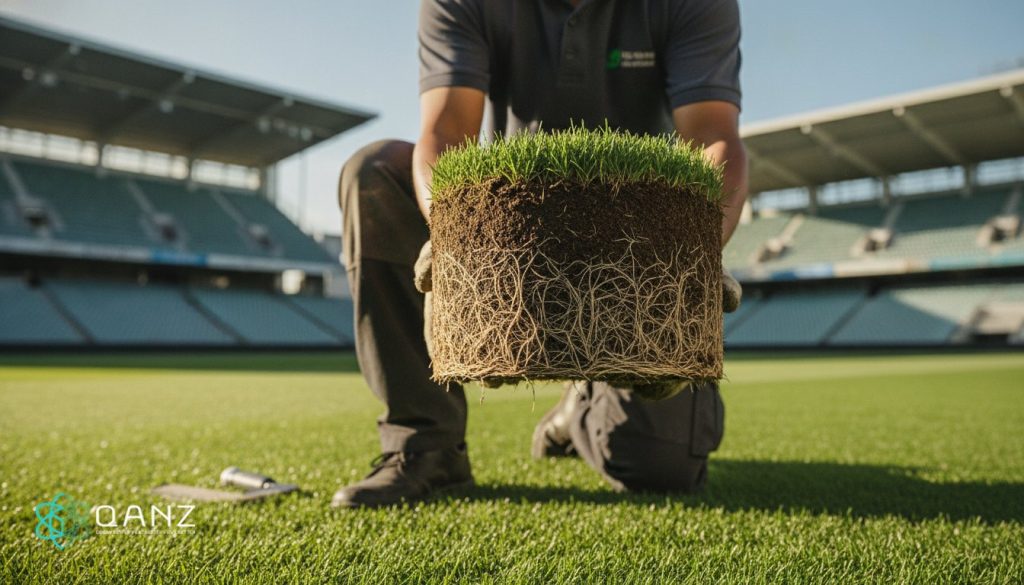
In 2026, professional sports turf management is no longer about just ‘feeding the grass’ but about managing the microbial engine of the soil profile to ensure long-term playability and resilience. Whether you’re overseeing a premier national stadium or a regional community oval, the pressure to maintain elite standards while navigating soil compaction and chemical fatigue is a daily reality. Curators across Australia and New Zealand are increasingly finding that traditional synthetic programmes alone struggle to keep pace with the demands of high-traffic environments and shifting regulatory landscapes.
We understand that your goal is to maintain a robust, self-sustaining turf profile that performs under pressure. This guide details how professional-grade microbial inoculants for sports turf may support soil vitality and enhance resilience against weather extremes and heavy wear. You’ll discover how integrating biological inputs like Quantum Organic-Total® and Quantum VSC® into your existing management plan can improve nutrient cycling and soil structure. We’ll also explore the practicalities of transitioning toward more sustainable practices that prioritise long-term ecological health without compromising the playability of your surface.
Key Takeaways
- Understand the 2026 industry shift toward Integrated Turf Management (ITM) and why professional curators are moving beyond purely synthetic regimes to support long-term soil health.
- Discover how professional-grade microbial inoculants for sports turf may enhance nutrient cycling and assist in maintaining essential soil pore space within high-traffic profiles.
- Evaluate the practical advantages of liquid-based formulations, which offer superior coverage and more efficient integration into existing professional spray programmes compared to granular alternatives.
- Learn how to align application schedules with Australian and New Zealand seasonal growth patterns, prioritising soil temperature and moisture for successful microbial establishment.
- Identify how biological inputs such as Quantum Organic-Total® and Quantum VSC® function as part of a holistic strategy to support turf resilience during peak playing seasons.
Why Sports Turf Management is Shifting Toward Biological Solutions
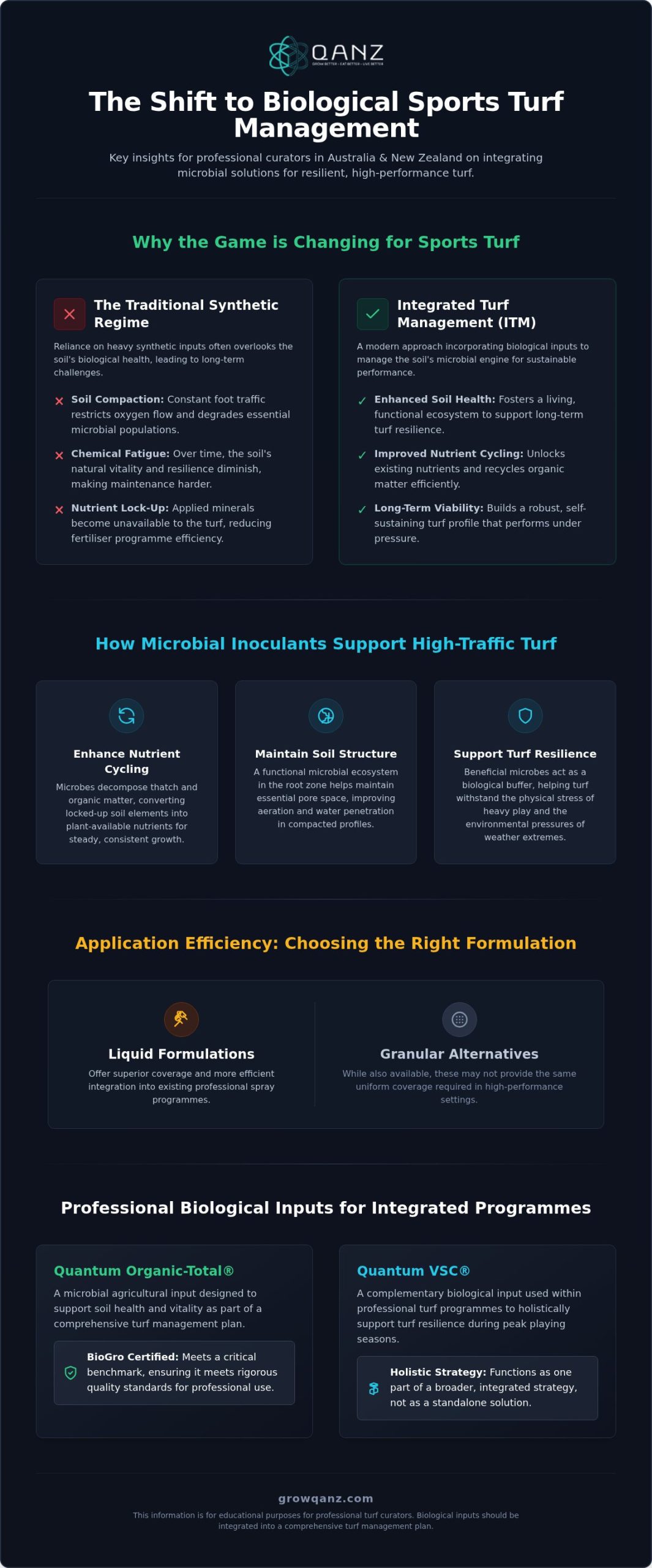
In 2026, the Australian turf industry, valued at approximately $302.8 million, is facing a pivotal transition. Curators are moving away from traditional reliance on heavy synthetic inputs toward Integrated Turf Management (ITM). This shift acknowledges that high-traffic sports profiles require more than just nitrogen, phosphorus, and potassium to remain resilient. A purely synthetic approach often overlooks the biological health of the soil, leading to issues like nutrient lock-up where applied minerals become unavailable to the plant. By focusing on the soil’s living component, managers can better support the long-term viability of their surfaces.
The Challenges of Modern Sports Turf in ANZ
Intensive play schedules on stadium pitches and local ovals place immense physical stress on the soil. Constant foot traffic causes severe compaction, which restricts oxygen flow and degrades the natural microbial populations necessary for healthy turf. Over time, chemical fatigue sets in, diminishing the soil’s natural vitality and making it harder to maintain playability during weather extremes. Additionally, regulatory shifts, such as New Zealand’s move toward mandatory organic standards by March 2028, are prompting turf managers to seek compliant, biological alternatives that reduce reliance on conventional chemical inputs.
Defining Microbial Inoculants for the Curators
To understand this transition, it’s essential to ask: What are microbial inoculants? These are biological inputs containing beneficial microorganisms intended to support soil health and plant vitality. Unlike conventional fertilisers, microbial inoculants for sports turf act as biological catalysts rather than direct nutrient sources. They introduce specific bacteria and fungi into the root zone to assist with natural processes like nutrient cycling. For professional curators in the ANZ region, BioGro certification has become a critical benchmark, ensuring that products like Quantum Organic-Total® meet rigorous environmental and quality standards for professional use.
These biological solutions may assist in addressing the core issues of compaction and nutrient efficiency. By reintroducing life into the profile, managers can support better soil structure and pore space maintenance. Integrating products such as Quantum VSC® into a professional turf programme allows for a more holistic approach. This strategy balances the high-performance requirements of elite sport with the need for long-term ecological stability and environmental compliance.
How Microbial Inoculants May Support Soil Health in High-Traffic Turf
High-traffic environments like Australian Rules football ovals or regional New Zealand rugby pitches experience extreme physical pressure. This constant foot traffic suffocates the rhizosphere, the narrow region of soil directly influenced by root secretions and inhabited by a dense population of microorganisms. Using microbial inoculants for sports turf helps re-establish a functional ecosystem in this zone. A diverse microbial community acts as a biological buffer, ensuring the turf remains resilient even when play schedules are at their most intensive.
Nutrient Cycling and Organic Matter Breakdown
Thatch accumulation is a frequent challenge for curators, often leading to spongy surfaces and restricted water penetration. Microbes play a vital role in decomposing this organic matter, effectively recycling it back into the soil profile as usable nutrients. In the context of professional turfgrass management, nutrient cycling is the biological process where microorganisms decompose organic matter and mineralise soil-bound elements, transforming them into plant-available forms. This natural recycling ensures that existing soil nutrients don’t remain locked away in the profile. Instead, they’re released steadily, supporting consistent leaf strength and root development without the volatile growth surges often seen with heavy synthetic applications.
Supporting Soil Structure and Water Infiltration
Soil structure in high-traffic areas often collapses, leading to a loss of the pore space required for gas exchange and drainage. Certain beneficial bacteria produce extracellular polysaccharides, which are sticky substances that help bind individual soil particles into stable aggregates. This biological aggregation is essential for maintaining macropores, the channels through which air and water move. For ovals and greens prone to surface ponding, improving these natural drainage pathways is critical for maintaining playability during wet winter months. Better soil structure leads to superior water infiltration and reduces the risk of anaerobic conditions that can damage root health. Curators looking for a deeper understanding of these biological processes can explore our resources on Turf Horticulture.
Maintaining a balanced soil profile requires a shift from purely chemical management to a more holistic, biologically led strategy. You can learn more about the microbial technology that supports these soil functions to see how it might complement your current maintenance schedule.
Liquid vs Granular: Evaluating Application Efficiency for Professional Turf
The choice between liquid and granular applications is a fundamental decision for any curator aiming to optimise the soil profile. While granular products have been a staple in traditional maintenance, liquid microbial inoculants for sports turf offer specific advantages in terms of uniformity and biological delivery. In high-performance environments like golf greens or stadium pitches, the ability to achieve total coverage across the leaf and into the root zone is paramount for consistent results.
Coverage and Penetration in the Turf Profile
Liquid formulations provide a level of penetration that granules simply cannot match. When applied via a calibrated sprayer, the microorganisms are distributed evenly across the entire treated area, ensuring that every square centimetre of the rhizosphere receives the intended biological load. This is particularly effective when followed by a light irrigation cycle, which helps ‘wash in’ the microbes through the thatch layer and into the soil matrix where they are most needed. This method ensures that the beneficial bacteria reach the root zone immediately, rather than waiting for a granule to break down over several days or weeks. For more technical details on these systems, curators can refer to our guide on Professional Turf Biological Products.
Operational Efficiency for Large-Scale Ovals
For large-scale management of regional ovals or expansive sports complexes, operational efficiency is just as important as biological efficacy. Liquid biologicals like Quantum VSC® are designed to integrate seamlessly into existing professional spray programmes. Integrating liquid microbial inoculants for sports turf into a regular schedule allows curators to address multiple turf needs in a single pass, saving significant labour hours and reducing machinery wear.
Precision is another key factor. Liquid applications allow for exacting control over dosage, often measured in millilitres per hundred square metres, ensuring a uniform response in turf colour and growth habit across the entire surface. This eliminates the ‘speckling’ effect sometimes associated with uneven granular spread. From a logistics perspective, liquid products are also easier to handle in a professional shed environment. They typically offer excellent shelf stability and take up less storage space than bulky bags of granular material, making them a practical choice for modern turf facilities.
Implementing Microbial Programmes in Professional Turf Maintenance
Successful integration of microbial inoculants for sports turf requires a shift in perspective. Rather than viewing biologicals as a reactive ‘quick fix’ for poor turf performance, curators should treat them as a foundational component of a long-term management strategy. Consistency is key. Establishing a robust microbial population in the soil profile takes time, but the resulting resilience during peak playing seasons is a significant reward for a methodical approach. A well-structured programme ensures that the soil’s biological engine is consistently supported throughout the year.
Timing and Frequency of Application
In Australia and New Zealand, the most effective application windows align with periods of active root growth, typically during spring and autumn. Soil temperature and moisture levels are the primary drivers of microbial establishment. Most beneficial microorganisms become active when soil temperatures consistently exceed 10 to 12 degrees Celsius. A ‘little and often’ strategy, involving regular monthly applications of Quantum Organic-Total®, often proves more effective than a single high-dose treatment. This maintains a steady population in the rhizosphere, allowing the microbes to adapt to local conditions and support the plant through varying growth stages.
Monitoring the response of your turf is essential for long-term success. Look beyond just surface colour. Evaluate root depth, soil structure, and thatch degradation over several months to gauge the efficacy of your biological inputs. During periods of environmental stress, such as summer droughts or winter waterlogging, you may need to adjust application frequencies to support the turf’s natural defences. Maintaining adequate soil moisture after application is critical to ensure the microbes can migrate effectively into the soil profile.
Compatibility and Tank Mixing
Operational success depends on the practicalities of the spray rig. When using microbial inoculants for sports turf, curators must be mindful of water quality. Chlorinated municipal water can be detrimental to live microbes. It is standard practice to allow water to off-gas in the tank for at least 30 minutes before adding biological inputs. While most Quantum products are compatible with common wetting agents and liquid fertilisers, avoid mixing them with copper-based fungicides which can be toxic to the microorganisms. A simple jar test is always recommended before full-scale mixing to ensure physical compatibility. Talk to QANZ about whether a customised biological programme is appropriate for your specific turf varieties and maintenance schedule.
Professional Biological Inputs: Quantum Organic-Total® and Quantum VSC®
Professional turf curators require verified inputs that align with the high standards of international sports environments. Quantum Organic-Total® and Quantum VSC® are professional-grade biological products designed for integration into modern turf management programmes across Australia and New Zealand. These inputs aren’t replacements for standard nutrition but function as biological catalysts to support soil vitality. A critical benchmark for many curators is the BioGro certification, which Quantum Organic-Total® maintains (BioGro number 4948), ensuring the product meets rigorous quality and environmental integrity standards for the region.
Quantum Organic-Total® for Turf Vitality
Quantum Organic-Total® can be considered for use in broad-spectrum turf programmes where the objective is to support the natural biological engine of the paddock or oval. Its liquid formulation is particularly suited to ANZ sports turf profiles, allowing for uniform distribution through standard spray equipment. By introducing a diverse range of beneficial microorganisms, this microbial agricultural input may assist in maintaining soil health under the high-pressure conditions of a premier stadium or regional sports complex. It fits naturally into existing schedules, providing a methodical way to support the soil profile without introducing synthetic interference.
Quantum VSC® and Programme Integration
For a more holistic approach, Quantum VSC® may be used alongside other inputs within a structured maintenance schedule. This biological product is intended for use in professional programmes where curators seek to enhance the long-term resilience of their turf profiles. It’s essential that any claims regarding its suitability for specific turf varieties or climates are tied to current QANZ technical information. Because every soil profile is unique, curators are encouraged to talk to QANZ about tailored application support that fits their specific environmental conditions and playability goals.
While microbial inoculants for sports turf offer a principled path toward sustainable management, results are always specific to local soil chemistry, climate, and management history. These biological inputs are tools for progress, not guaranteed solutions; their efficacy depends on consistent application within a well-managed programme. Professional curators should evaluate their specific needs and environmental goals when selecting the appropriate microbial inputs for their surfaces. By focusing on long-term ecological health, managers can work toward a more stable and efficient way of maintaining elite playing surfaces.
Advancing Professional Turf Standards with Biological Inputs
Professional turf management is evolving toward a more integrated, biologically led model. This shift prioritises the health of the soil profile as the foundation for turf resilience and long-term playability. By incorporating microbial inoculants for sports turf, curators can support natural nutrient cycling and maintain soil structure even under the most intensive play schedules. Using BioGro New Zealand certified inputs like Quantum Organic-Total® ensures that your programme meets the highest standards of environmental integrity while remaining practical for use in standard ANZ spray rigs.
Success with biological inputs comes from a consistent, long-term approach rather than reactive treatments. As you look toward the 2026 season and beyond, focusing on the microbial engine of your soil will help you navigate compaction and chemical fatigue with greater confidence. Our team is here to provide the professional technical support needed to integrate these liquid formulations into your existing maintenance schedule.
We look forward to partnering with you to achieve a more resilient and self-sustaining surface for your athletes and community.
Frequently Asked Questions
What are microbial inoculants for sports turf and how do they differ from fertilisers?
Microbial inoculants for sports turf are biological inputs containing beneficial microorganisms intended to support soil health and plant vitality. Unlike conventional fertilisers, which provide direct nutrients like nitrogen or phosphorus, these inoculants act as biological catalysts. They introduce specific bacteria into the root zone to assist natural processes such as nutrient cycling. This approach focuses on managing the soil’s living component to support long-term playability rather than providing a short-term growth surge.
Can I use microbial inoculants alongside my regular fungicide programme?
You can integrate biological inputs into most professional management plans, but compatibility requires careful management. It’s essential to avoid mixing microbial products with copper-based fungicides, as these can be toxic to the microorganisms. For standard fungicide programmes, we recommend a staggered application schedule to ensure the microbes have time to establish in the soil profile. Always check current QANZ technical documentation or perform a jar test before tank-mixing any biological inputs with chemical products.
How long does it take to see the effects of a microbial programme on a golf green?
Biological programmes are designed for long-term ecological health rather than immediate visual changes. While some curators report subtle shifts in soil structure or thatch breakdown over a few months, establishing a robust microbial population typically requires a consistent, season-long approach. Factors such as soil temperature, moisture levels, and existing chemical profiles influence the speed of establishment. We recommend monitoring root depth and soil aggregation over several months to evaluate the programme’s efficacy accurately.
Is BioGro certification relevant for professional sports turf in Australia?
BioGro certification is a recognised benchmark for quality and environmental integrity across both Australia and New Zealand. For Australian turf managers, using a BioGro certified product like Quantum Organic-Total® provides assurance that the input meets rigorous standards for natural purity and safety. As regulatory pressure on synthetic inputs increases across the region, choosing certified biological products helps curators demonstrate a commitment to sustainable management practices and high-performance environmental standards.
Are liquid microbial treatments more effective than granules for sports ovals?
Liquid microbial treatments often provide superior coverage and penetration compared to granular alternatives on large-scale ovals. The liquid formulation allows for even distribution across the leaf surface and more efficient movement into the root zone when followed by irrigation. This precision is critical for maintaining uniform turf colour and growth. Additionally, liquid products like Quantum VSC® integrate seamlessly into existing professional spray rigs, allowing curators to manage multiple turf needs in a single pass.
How do I store liquid microbial products in a typical maintenance shed?
Proper storage is essential for maintaining the viability of the beneficial microorganisms within the liquid formulation. You should store products like Quantum Organic-Total® in a cool, dry environment away from direct sunlight and extreme temperature fluctuations. A typical maintenance shed is suitable provided the containers remain sealed and are kept off concrete floors to prevent temperature transfer. Our liquid biologicals are designed for professional use and offer excellent shelf stability when handled according to technical guidelines.
Can microbial inoculants help turf recover from heavy foot traffic during the winter season?
Microbial inoculants for sports turf may support the natural recovery processes of high-traffic surfaces by improving soil structure and nutrient availability. While they aren’t a direct replacement for physical renovation, these biological inputs assist in maintaining the pore space necessary for root respiration and drainage. This can be particularly helpful for ovals prone to compaction during wet winter months. A consistent biological programme helps build a more resilient turf profile that is better equipped to handle intensive play.
Do I need to change my irrigation schedule when applying biological products?
You don’t necessarily need to overhaul your entire schedule, but a light irrigation cycle immediately following application is highly recommended. This helps ‘wash in’ the microorganisms through the thatch layer and into the soil matrix where they can begin establishing. It’s also important to manage chlorinated water by allowing it to off-gas in the spray tank before mixing. Maintaining adequate soil moisture in the days following treatment ensures the microbes have the environment they need to function effectively.
Disclaimer
Important: This article provides general agricultural information only. Product performance can vary according to crop, soil, climate, management practices and application conditions. Trial or research results discussed may have been obtained under specific conditions and should not be interpreted as a guarantee of equivalent results. Always follow current product directions and confirm suitability for your crop, growing system and organic certification requirements. Contact QANZ for current product and application information.
