
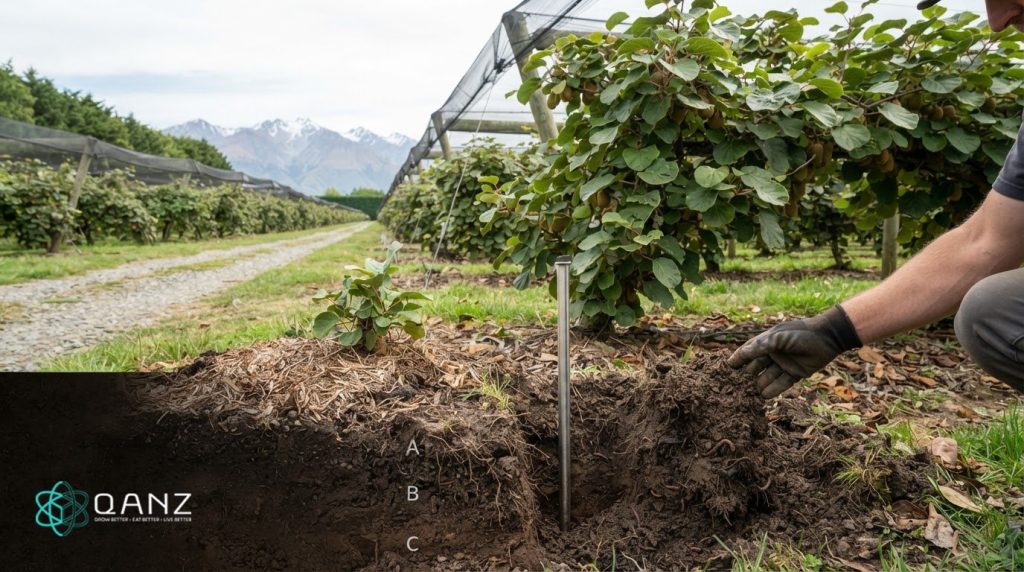
Nearly 33% of the world’s soils are moderately to highly degraded, showing how easily productive land can lose condition. In New Zealand plantations, long-term soil health management means addressing threats such as erosion, declining organic matter and nutrient imbalance while monitoring soil condition over time. Healthy soil depends on its physical, chemical and biological characteristics working together.
It’s easy to focus on what a crop needs now, but managing nutrients and organic inputs over time also affects the soil that supports future growth. This guide to long-term soil health management explains how production pressures can affect soil condition, why balanced nutrient replacement matters and how testing and field observations can inform decisions. It also covers practical ways to protect the soil surface and return organic material, connecting day-to-day choices with the longer-term condition of your land.
Key Takeaways
- Look beyond visible crop symptoms: erosion, nutrient imbalance and declining organic matter can all affect plantation soil.
- Plan nutrient replacement around crop needs and the most limiting nutrient, rather than relying on a single input.
- Use soil measurements such as pH, organic matter and nutrient levels to guide management and track changes over time.
- Explore how compost, green manure and returned crop residues can contribute organic carbon to the soil.
- Consider soil biology alongside physical and chemical condition when assessing how soil supports farm productivity.
Balanced crop nutrition and nutrient replacement
Harvest removes nutrients from a production system, while leaching, runoff and crop residues affect what remains available in the soil. A nutrient plan should account for both crop demand and nutrients leaving the field. When harvested produce is removed, for example, its nutrients are not returned through that harvest. Balancing nutrient replacement with crop needs helps maintain fertility across successive crops.
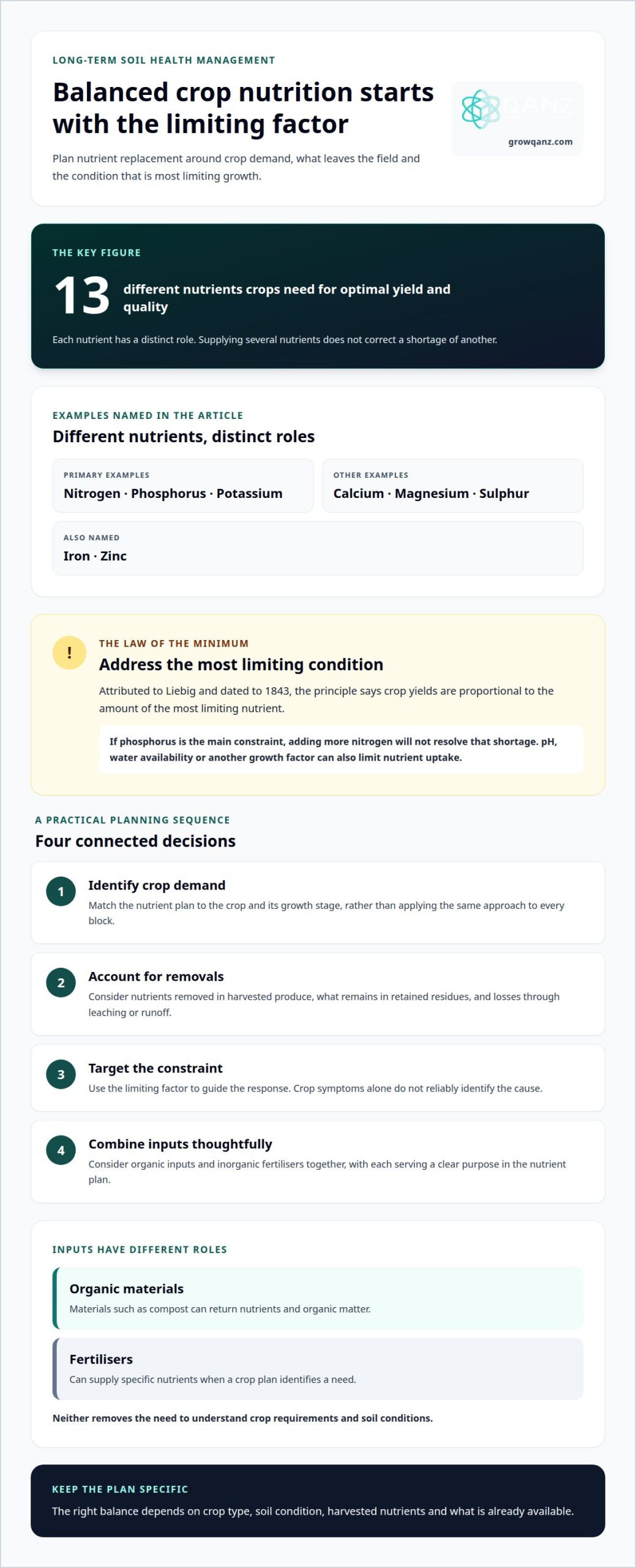
Crops need 13 different nutrients to obtain optimal yield and quality. These include nitrogen, phosphorus and potassium, alongside nutrients such as calcium, magnesium, sulphur, iron and zinc. Each has a distinct role in plant growth, so supplying several nutrients does not correct a shortage of another. A crop showing poor growth may have a nutrient constraint, but symptoms alone don’t identify the cause reliably.
The Law of the Minimum, attributed to Liebig, dates to 1843. It states that crop yields are proportional to the amount of the most limiting nutrient. In practical terms, adding more nitrogen won’t resolve a phosphorus shortage if phosphorus is the main constraint. The same principle applies when pH, water availability or another growth factor limits nutrient uptake. The crop’s limiting condition guides the response.
Integrated nutrient management combines organic inputs with balanced fertilisers to support long-term soil fertility. Organic materials such as compost can return nutrients and organic matter; fertilisers can supply specific nutrients when a crop plan identifies a need. Each has a different role. Neither replaces the need to understand crop requirements and soil conditions.
A sound nutrient replacement plan connects several decisions:
- Identify crop demand: Match the nutrient plan to the crop and its growth stage, rather than applying the same approach to every block.
- Account for removals: Consider what leaves in harvested fruit, vegetables or other produce, and what remains in retained residues.
- Target the constraint: If nitrogen is adequate but another nutrient is limiting, address that limiting factor instead of increasing nitrogen alone.
- Combine inputs thoughtfully: Consider organic inputs and inorganic fertilisers together, with each serving a clear purpose in the nutrient plan.
For a New Zealand orchard, vineyard or vegetable crop, the right balance depends on crop type, soil condition, harvested nutrients and what is already available. A planned approach helps distinguish nutrient replacement from routine application. The aim is to meet crop needs without overlooking the wider soil system, since a productive season depends on more than supplying one nutrient at a time.
Why Is the Importance of Soil Health So Crucial for Plantation Productivity?
Soil degradation can undermine the conditions that support productive farms and plantations. In New Zealand, the pressures and responses vary with land use, from grazing damage to erosion on sloping ground.
Soil Degradation and Plantation Productivity
Soil degradation is the decline of soil condition through physical, chemical or biological damage. Nearly 33% of global soils are moderately to highly degraded, and loss of fertility can constrain crop growth. Revitalising the fertility of degraded lands can increase farm production by up to 58%. For a plantation, declining soil condition can affect water retention, root development and nutrient availability, making productive management harder over successive seasons.
Common causes include erosion, nutrient depletion, compaction and loss of organic matter. On sloping land, exposed soil can wash away in heavy rain; repeated traffic on wet ground can compact soil and restrict root growth. Mulching, planting on slopes and terracing can help conserve water and limit erosion. Each practice addresses different pressures, so choose according to the landform and production system.
Farm-Specific Soil Health Practices
Soil management needs differ across dairy, arable, horticultural and lifestyle farms because each uses land differently. Dairy farmers can focus on limiting pugging and compaction around grazing areas and stock movements. Arable growers can consider how cultivation and rotations affect soil structure. Horticultural growers need to manage soil around perennial crops and production rows, while lifestyle block owners often need to manage livestock pressure over smaller areas.
A dairy paddock with wet gateways, for instance, faces different risks from a cultivated potato field or a kiwifruit orchard. Match the response to the pressure: manage stock access where trampling is the issue, and protect exposed slopes where runoff carries soil away.
Costs, Benefits and Payback Periods
The costs, benefits and payback periods of soil management practices depend on the intervention, land condition and production system. Mulching or terracing requires different resources from changing cultivation or grazing practices. Benefits may include better soil protection and fertility, while rehabilitating degraded land can require sustained, often more costly investment before any impact is evident, as the Food and Agriculture Organization of the United Nations notes.
That timing matters in farm planning. Addressing active erosion may help protect productive soil, while rebuilding degraded ground can take sustained effort. Compare the work required with the problem being addressed, such as compaction in a dairy paddock or runoff from an arable slope.
Soil Policy and Land Degradation Neutrality
Land Degradation Neutrality is a global commitment to balance degradation with measures that maintain or restore land condition. The United Nations Convention to Combat Desertification’s 2018-2030 Strategic Framework sets global commitments to achieve Land Degradation Neutrality. The UNCCD is described as the sole legally binding international agreement linking environment and development with the promotion of healthy soils.
For New Zealand growers, this broader framework puts practical soil protection in context. Maintaining ground cover, managing water movement and restoring fertility connect farm decisions with the wider goal of reducing land degradation.
Soil health measurement and monitoring
Soil tests can measure pH, organic matter and nutrient levels to help New Zealand growers guide soil management. Combining results with field observations gives a fuller picture of changing soil conditions.
Soil Testing and Monitoring
Testing measures selected soil properties; monitoring compares results and observations over time. Together, they can help distinguish a persistent change from local or seasonal variation. A nutrient result from one sampling area, for example, may not represent the whole farm when soil types or management differ between blocks.
Consistent sampling makes comparisons more useful. Record each sample’s location, depth, crop and recent management. Repeat tests using the same approach, then compare results for the same area rather than treating isolated readings as a trend.
Soil Health Indicators and Monitoring Frequency
New Zealand growers can monitor pH, organic matter and nutrient levels alongside physical and biological signs of soil condition. Repeat measurements at consistent points in the crop or farm management cycle, and after a change that could affect the soil. The appropriate interval depends on soil variability, crop needs and the decisions the results are intended to inform.
Each indicator tells you something different. A pH result describes acidity or alkalinity; organic matter indicates the amount of carbon-rich material in the soil; and nutrient results help identify levels relevant to crop nutrition. Together, these measurements inform soil management, but they do not describe every physical or biological characteristic.
Field observations add context to test results. Check whether roots can penetrate the soil, whether water infiltrates or ponds, and whether the surface shows crusting or erosion. Compare areas with different histories, such as a regularly trafficked headland and a less disturbed crop row. Differences may show where further investigation is worthwhile.
- Map sampling areas: Separate blocks when soil type, crop or management history differs.
- Record conditions: Note the crop, sampling location and recent soil management alongside each result.
- Compare like with like: Repeat sampling using the same locations and method to make changes easier to interpret.
- Pair tests with observation: Consider field signs such as ponding, surface damage or restricted root growth alongside laboratory measurements.
If a test shows a change in nutrient levels, compare it with crop performance and management records for that block. Erosion or waterlogging at the soil surface may also help explain the result. Monitoring is most useful as a record that informs decisions, not as a single score for the whole farm.
Which Real-Life Instances Illustrate Soil Health Management?
Soil organic carbon is the carbon contained in soil organic matter, including decomposed plant material. It is one useful indicator for tracking changes associated with organic inputs and soil management. Compost, green manure and buried crop residues are practical ways to add organic material to farm soil.
Consider a vegetable block where harvested crops leave little residue. Returning suitable crop residues or incorporating green manure adds plant material to the soil, while compost can also supply organic matter. The options differ in source and handling, so choose according to available materials, the crop rotation and field management.
Cover crops offer another option. A grower can establish one between cash crops or in an area that would otherwise remain bare, then manage its growth and residues as part of the rotation. Living cover protects the soil surface, and plant material returned after termination adds organic inputs. Choose the species and timing to suit the production system.
Soil organic carbon is one indicator, not a complete measure of soil health. Physical, chemical and biological characteristics all matter. For a more practical assessment, pair an organic matter test with field observations: does water infiltrate or run off, is the surface covered, and are crop residues breaking down? These observations give context to test results.
- Compost: Apply suitable compost as an organic input and record the block where it was used.
- Green manure: Grow a crop for incorporation, then note its place in the rotation.
- Crop residues: Bury or retain suitable residues where they fit the crop system.
- Cover crops: Use living cover between production crops, and observe soil cover and residue condition.
In a vineyard, for example, a grower could compare a covered inter-row with a less-covered area. Record the cover crop or residue treatment, observe runoff after rain and compare organic matter results from consistently sampled locations. This cannot establish that one practice caused a change, but it helps relate observations to management history.
Keep records specific: note the crop, input type, location and timing, then compare similar areas in later assessments. If compost, green manure and residues are all used in one block, record each separately where possible. Clear records help show which practices were in place when soil organic carbon or other indicators changed, supporting more informed decisions for the next rotation.
Soil health and agricultural productivity
Farm productivity depends on soil’s physical, chemical and biological characteristics working together. For a New Zealand grower, that means looking beyond a single yield figure: crop establishment, root access, water movement and the soil’s capacity to support future production all matter. A block may produce a saleable crop while underlying soil constraints gradually limit management options.
The connection is practical. Soil structure affects whether roots can explore the profile; chemical conditions affect nutrient availability; and biological activity contributes to processes that support soil function. If one part is constrained, the others may not compensate. In a horticultural block, uneven establishment across rows could prompt investigation of soil variation, drainage and previous management, rather than the assumption that every plant had the same conditions.
Productivity also depends on reliable farm operations. Well-managed soil can support more consistent access for planting, cultivation and harvest, while wet or compacted areas may restrict timing and traffic. On a vineyard slope, ground cover and appropriate water management help protect the soil surface. In an arable rotation, cultivation and crop residue decisions shape how the soil is managed between cash crops.
That’s why soil health should be considered alongside crop performance and farm records. Compare areas with different histories, such as a repeatedly trafficked headland and an adjacent crop area. Note differences in establishment, visible runoff, surface condition and harvest performance. These observations can help identify constraints that may be limiting productive capacity and management changes worth considering.
Rehabilitation takes a longer view, not a quick seasonal adjustment. The Food and Agriculture Organization of the United Nations notes that rehabilitating degraded land requires longer-term, often more costly investment before any impact is evident. Growers need to weigh immediate production needs against the condition of the land that supports future crops. A practical priority is to address the limiting soil problem while maintaining a workable production system.
- Assess productivity across the block: Compare crop establishment and operations in areas with contrasting soil or management histories.
- Connect observations: Relate crop performance to soil structure, chemical condition and biological function.
- Set a management priority: Identify the constraint affecting productive capacity before changing several practices at once.
- Review progress over time: Use farm records and consistent observations to judge whether management is addressing the issue.
For growers considering a biological input as part of their soil programme, Quantum Organic-Total® is a microbial agricultural input available to New Zealand growers. Talk to GrowQanz about whether it is appropriate for your crop, growing system and application programme.
GrowQanz: Quantum Organic-Total®
Quantum Organic-Total® is a microbial agricultural input offered by QANZ for use in crop and soil programmes. Growers considering biological inputs may assess its place alongside practices such as protecting soil cover, returning organic material and monitoring soil condition. It is not a substitute for diagnosing nutrient imbalance, compaction or poor drainage; those constraints need to be understood within the crop and growing system.
QANZ provides product and application support to help growers consider how Quantum Organic-Total® fits their crop, soil management priorities and application programme. Keep any biological input’s role clear within the wider plan, and assess it alongside appropriate soil measurements and field observations. Contact QANZ for guidance on Quantum Organic-Total® and its potential fit for your growing system.
Set a clear direction for the next growing cycle
Make long-term soil health management part of each production cycle. Choose a priority that fits your farm, define what progress would look like, and give your team a clear way to keep it in view. A manageable objective can make soil care an ongoing part of farm decision-making.
For growers considering biological inputs, GrowQanz offers Quantum Organic-Total®, Quantum VSC® and Quantum, with crop application programmes and product support. The useful next step is to discuss how an input could fit your crop, growing system and wider management plan, while keeping its role clear alongside your other farm practices.
Contact GrowQanz about soil health to discuss your growing system and next steps. Steady, considered decisions can help you build a more purposeful approach to caring for productive land.
Frequently Asked Questions
What are the threats facing soil health in plantations nowadays?
Plantation soil can be affected by repeated disturbance, prolonged saturation and limited plant diversity. In a kiwifruit orchard, for example, compare the soil beneath the vine row with the inter-row. Different vegetation and traffic patterns can create distinct conditions. Mapping these differences helps pinpoint where a management change may be most relevant, rather than treating every part of the orchard as if it faces the same pressure.
What does long-term soil health management involve?
Align soil decisions with the production cycle instead of treating soil care as a separate task. Before changing a practice, identify the production objective, the area affected and the likely trade-offs. A vineyard manager considering an inter-row change, for instance, can assess how it fits with machinery access and seasonal work. Reviewing the decision after the operation helps refine the approach for the next cycle.
How can farmers test soil health in New Zealand, and what are typical testing costs?
Farmers can arrange soil analysis through a commercial laboratory, selecting tests to answer a specific management question. Costs depend on the analyses requested, sample numbers and collection or handling requirements. For a useful budget, decide which blocks need separate results and which analyses will inform a decision. A targeted request avoids paying for measurements that will not guide the choice at hand.
What practices improve soil organic matter, structure and biological activity over time?
Keep roots active for as much of the production cycle as the crop system allows, and avoid disturbing soil more than necessary. A grower establishing a new orchard, for example, can plan row access before planting to reduce the need to move machinery through vulnerable areas later. Consider soil moisture, pH and compaction together: a change aimed at one condition may have limited value if another continues to constrain the site.
How should lime, fertiliser and nutrients be managed for long-term soil health in New Zealand?
Plan lime and nutrient applications around crop demand and farm operations. Consider how an application fits with planting, cultivation or expected rainfall, rather than relying on the calendar alone. Make nutrient plans specific to each crop block and account for its production history. This supports deliberate input decisions and helps avoid applying the same treatment to areas with different needs.
How do cover crops, crop rotations and pasture management affect soil health?
Choose cover and rotation crops to suit the next crop, available growing window and farm operations. A fast-growing cover crop may need timely termination before a young cash crop is established. In pasture, adjust grazing plans to avoid repeatedly exposing the same areas to heavy stock pressure. The timing and sequence of crops and grazing shape how land is used between production periods.
What are the best ways to prevent soil compaction, erosion and nutrient loss?
Plan machinery routes and work sequences to reduce repeated passes over the same ground. Before field operations, consider soil trafficability and equipment loads; postponing a pass can prevent avoidable damage when conditions are unsuitable. Coordinate nutrient applications with crop uptake and the planned work programme. Review areas where machinery repeatedly turns or queues, as these may need a different traffic plan.
What are common risks or mistakes in soil health management, and how can they be avoided?
A common mistake is treating a visible symptom as proof of a single cause. Poor crop performance in one patch may reflect several interacting conditions, so compare it with nearby areas and the block’s management history before choosing a response. Another risk is changing a practice without recording where it changed. Mark treatment areas and note the reason for each change to make later evaluation more meaningful.
Disclaimer
Important: This article provides general agricultural information only. Product performance can vary according to crop, soil, climate, management practices and application conditions. Trial or research results discussed may have been obtained under specific conditions and should not be interpreted as a guarantee of equivalent results. Always follow current product directions and confirm suitability for your crop, growing system and organic certification requirements. Contact QANZ for current product and application information.
