
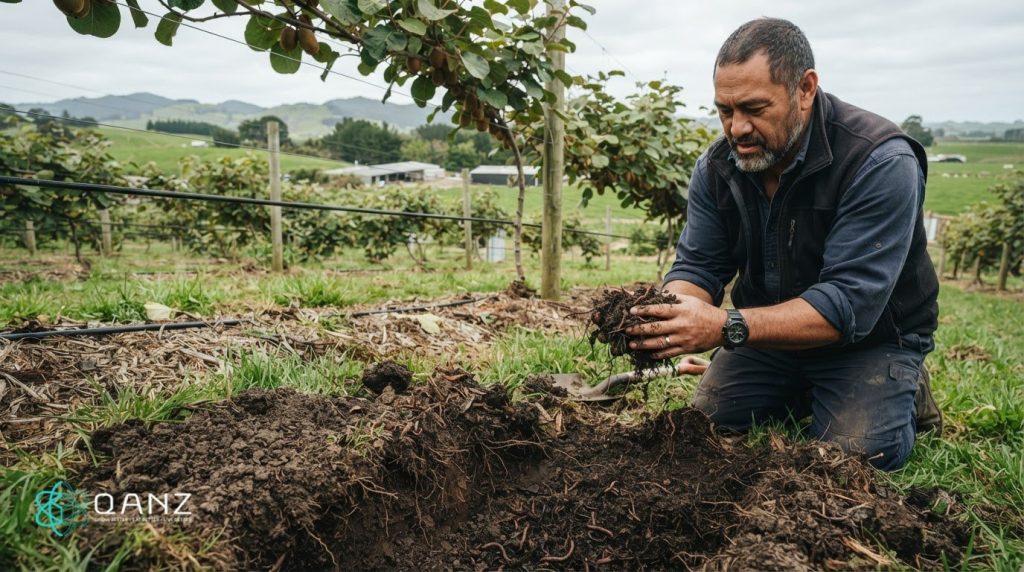
You can add organic inputs quickly, but building stable soil organic matter takes longer. If you need to increase soil organic matter quickly, start by comparing suitable sources, such as crop residues, cover crops or compost, and fit them around the crop already in the ground. The right choice depends on your soil, production system and timing.
Adding organic material is not the same as increasing stable soil organic matter. Much of an input decomposes, and the lasting change depends on what remains in the soil over time.
This guide compares practical ways to supply organic inputs, explains how complementary practices can support longer-term improvement, and outlines why moisture and temperature affect decomposition. It also covers realistic expectations and consistent soil monitoring, so you can assess progress using more than the amount of material applied.
Key Takeaways
- To increase soil organic matter quickly, choose an organic input that fits your crop timing, soil conditions and production system.
- Compare compost, crop residues, organic mulches and cover crops by availability, timing and practical constraints before changing your programme.
- Consider soil texture, drainage, pH, compaction and moisture when deciding which approach is suitable for a paddock.
- Establish a useful baseline and keep sampling depth, timing, locations and methods consistent to make comparisons more meaningful.
- Assess biological inputs separately from organic matter additions as part of a wider crop and soil programme. Quantum Organic-Total® is a microbial agricultural input offered by GrowQanz for use in crop and soil programmes.
Can you increase soil organic matter quickly? Set realistic expectations first
You can add organic inputs promptly, but durable changes in soil organic matter take time. Compost, crop residues, mulch and living roots supply organic material; they do not automatically create a lasting increase in what a consistent soil test measures. The pace and direction of change depend on starting soil condition, climate, crop system and management, so a fixed timeline will not suit every paddock in New Zealand.
What counts as soil organic matter, and what is only a recent addition?
Soil organic matter includes plant and animal material at different stages of decomposition, from recognisable fragments to more transformed material. Living roots and recent residues contribute organic inputs, but a surface layer of mulch or compost is not, by itself, proof of a durable change below. The overview of soil organic matter describes this broad mixture and its changing forms.
For growers working with GrowQanz, it helps to distinguish what has been applied from what is present in the sampled soil. A visible residue layer may protect the surface or decompose over time, while a soil test represents a sample taken from a particular depth and location using a particular method. Recent fragments can affect a result, depending on how the sample is collected and prepared. Record inputs and sampling details alongside each measurement.
An immediate organic input is a management action; a measured change in soil organic matter is a result to establish through consistent sampling over time.
Why does lasting change take longer than adding compost or mulch?
After application, organic material is broken down and transformed through biological processes. The rate varies with temperature, moisture, soil properties and the nature of the material. Some material decomposes relatively quickly, while some can remain longer in the soil. A thick surface application can be obvious straight away without creating a durable change in the sampled soil.
Conditions vary across farms in New Zealand, as do management systems. A moist site, a free-draining soil, a cultivated vegetable paddock and a perennial planting will not necessarily process or retain additions in the same way. Starting soil conditions matter too: the same input does not guarantee the same outcome across different soils. Assess each practice in the context of the paddock rather than assuming a set increase or timeframe.
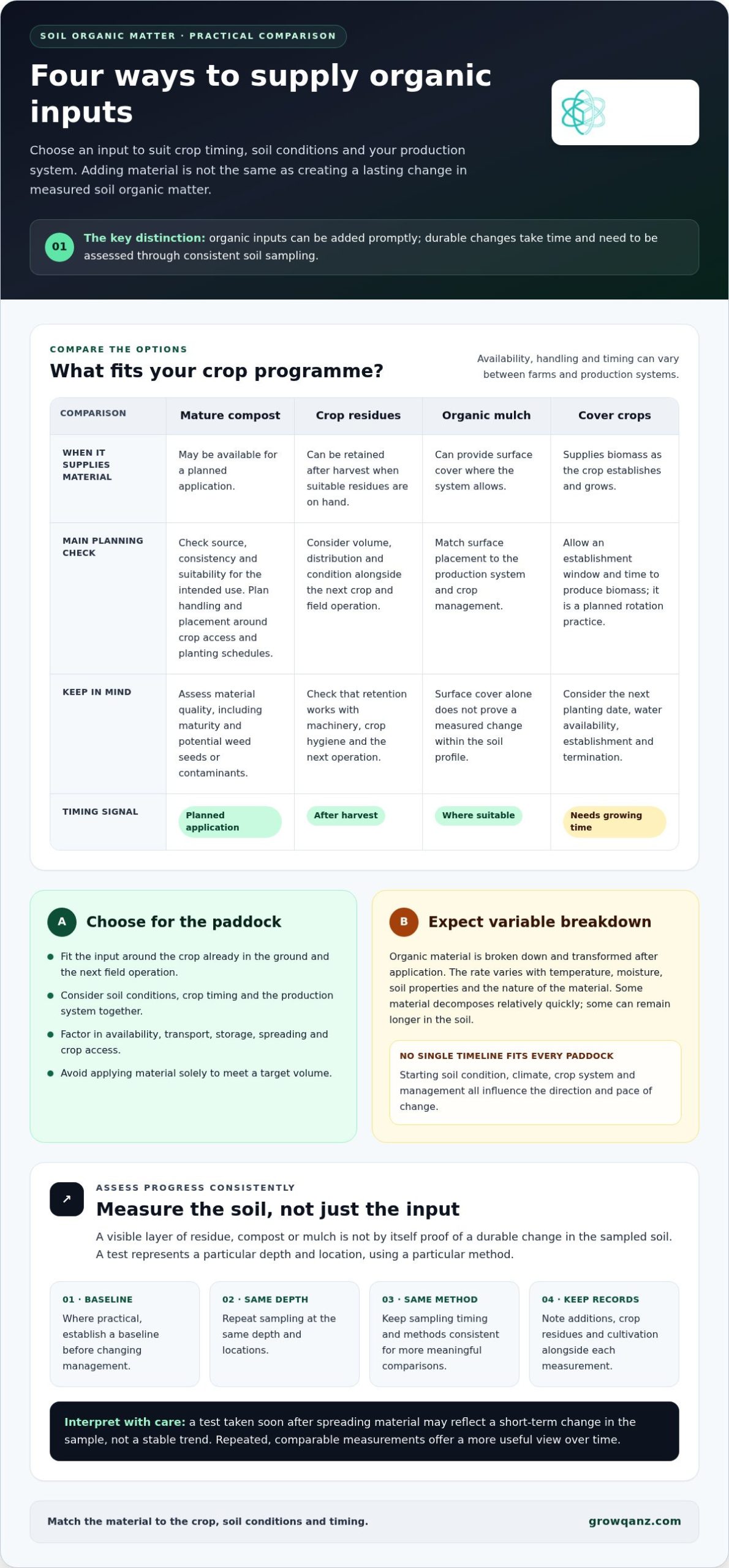
Where practical, establish a baseline before changing management, then repeat sampling at the same depth, timing and locations using the same method. Note the type and timing of additions, crop residues and cultivation so you can interpret results in context. A test taken soon after spreading material may reflect a short-term change in the sample, not a stable trend. Repeated, comparable measurements provide a more useful basis for judging whether your approach is changing soil organic matter over time.
Which practices add organic inputs quickly and support longer-term soil improvement?
Some inputs can be added during the current crop cycle; others need time to grow or become available. If you want to increase soil organic matter quickly, match the input to your crop programme and conditions rather than choosing by volume alone. Suitable compost, crop residues and organic mulches can be applied when available, while cover crops supply biomass as they establish and grow.
Which organic materials can be added within the current crop cycle?
Compost may be available for a planned application, residues may be on hand after harvest, and mulch can provide surface cover where the system allows. None is a universal recommendation. Assess maturity, material quality, potential weed seeds or contaminants, and compatibility with the crop and its management.
- Mature compost: Consider its source, consistency and suitability for the intended use. Plan handling and placement around crop access and planting schedules.
- Crop residues: Retaining suitable residues keeps plant material in the field. Consider how their volume, distribution and condition fit the next operation and crop.
- Organic mulches: These can be placed on the surface where appropriate, but surface cover should not be confused with a measured change within the soil profile.
- Cover crops: These need an establishment window and time to produce biomass, so they are a planned rotation practice rather than an instant input.
Availability and practical requirements vary between New Zealand and Australia, and between farms. Transport, storage, spreading, crop access and the timing of field operations all influence what is workable. Avoid applying material solely to meet a target volume; assess its condition and how it fits the production system.
How do cover crops and residue management contribute over time?
Living cover can provide organic inputs as plants grow, while retained residues contribute as they decompose. The amount and timing of biomass depend on establishment, growing conditions and the length of the available window. A cover crop adds material over a growing period, not as an instant measured increase in soil organic matter.
Before changing a rotation, consider the next crop’s planting date, water availability, establishment conditions and how the cover crop will be terminated. Residue retention also needs to work with machinery, crop hygiene and the next operation. An approach that suits one paddock or season may not transfer directly to another.
Reducing unnecessary soil disturbance is another practice to assess within the whole crop system. Cultivation affects how residues are incorporated and how soil is managed, but the appropriate approach depends on the crop, soil and operational constraints. Monitor how a change works in practice rather than assuming one method suits every field.
No single organic input guarantees a rapid, lasting change; progress depends on suitable materials and consistent management over time.
For growers considering biological products alongside these practices, QANZ product and application support can help place inputs within a wider crop and soil programme.
How should growers choose an approach for their crop, soil and country?
Choose an input by working through the paddock’s constraints, not by treating organic material as a one-size-fits-all fix. Before deciding how to increase soil organic matter quickly, consider crop timing and requirements alongside soil texture, drainage, pH, compaction, moisture and rotation. These factors help you identify what is practical and what to monitor after a change.
What should growers check before adding organic materials?
Start with observations across the paddock: where water sits or runs off, whether the soil is difficult to work, and how existing residues are distributed. These observations can guide further assessment, but they do not replace test results for pH or soil carbon. Consider the material’s maturity and quality, how it will be stored and applied, and whether its timing could interfere with planting, crop access or harvest operations.
Use this comparison as a planning aid. Timing refers to the production cycle, not a promised timeframe for changing measured soil organic matter.
| Practice | Likely timing | Suitable context | Constraints | What to monitor |
|---|---|---|---|---|
| Mature compost | When suitable material and an application window are available | Fields or beds where the material can be handled and applied within the programme | Quality, maturity, supply, transport and crop compatibility | Source and condition, application date, placement and soil-test results |
| Crop residues | After harvest or during routine crop operations | Rotations where residues can remain without obstructing the next crop | Residue distribution, machinery access, crop hygiene and establishment needs | Residue cover, field operations and subsequent crop establishment |
| Organic mulch | When surface application fits the crop cycle | Systems where a surface layer is manageable around crop access | Material quality, placement and interference with operations | Surface cover, moisture conditions and consistency of soil sampling |
| Cover crop | During a suitable gap in the rotation | Where there is time and moisture for establishment and growth | Rotation timing, water availability and termination plan | Establishment, biomass, termination and following-crop timing |
How can New Zealand and Australian growers keep recommendations relevant?
Localise guidance whenever climate, crop calendars, soil conditions, standards or certification affect a decision. Advice developed for an Australian growing region is not automatically suitable for a New Zealand paddock, or vice versa. Treat overseas research as context, not local validation. For example, a vegetable grower and a kiwifruit grower may both consider compost, but access, placement and crop timing differ. This example does not imply that a particular input has been tested in either crop.
If certification matters, confirm that each input is suitable for your programme and intended use. Keep the decision sequence practical: describe the soil and crop constraints, assess the material, fit it to the rotation, then record what you applied and what you will monitor. This makes the choice specific to the farm rather than a general recommendation mistaken for a local prescription.
How can you monitor soil organic matter without mistaking short-term change for progress?
Use a repeatable monitoring process to distinguish management activity from a longer-term soil trend. A single result, especially after a recent amendment, is not enough to show that a change is durable or that one input caused it. Establish a baseline, keep clear records, sample consistently and interpret results in light of the conditions at the time.
How do you create a useful baseline?
Before changing management, record the field or block, crop history, recent inputs and relevant soil-management changes. Note visible differences across the paddock, such as areas with different drainage or crop performance, so your sampling plan represents the area you want to assess. Use a consistent sampling method and record the depth and test method, rather than relying on informal observations to quantify soil organic matter.
A practical sequence is:
- Establish a baseline. Take a representative sample and record the date, field, depth and test method.
- Record management. Note the type and timing of organic inputs, residue handling, cultivation and crop changes.
- Sample consistently. Keep the sampling depth, locations, timing and method as comparable as practical between rounds.
- Compare results in context. Review results alongside management records and conditions at sampling, then look for a pattern rather than drawing conclusions from one reading.
How do you interpret results over time?
Consistency matters because soil results describe the sample collected, not every part of a paddock. Changing the depth or sampling locations can make comparisons less meaningful. Sampling at different points in the crop cycle or using a different method can also affect comparability. Follow the sampling method consistently and record any unavoidable differences, rather than treating all results as directly equivalent.
Record soil moisture, visible crop residues and recent amendments alongside each sample. For example, a sample taken soon after spreading compost may contain material that was not present in the earlier sample. That context helps explain a result, but it does not establish that a durable change has occurred. If several management practices changed together, results alone may not show which one contributed to an observed difference.
Keep soil measurement and product assessment as distinct parts of your plan. If you are considering biological inputs as part of the wider programme, QANZ provides crop and soil application support, while soil monitoring remains a separate way to track changes in the paddock.
Where can a biological input fit into a soil organic matter programme?
A biological input and an organic matter addition are different parts of a soil programme. Compost, crop residues, mulch and cover crops provide organic material. A microbial input is a separate type of agricultural input, so do not assume it supplies organic matter or will increase a soil test result. If your aim is to increase soil organic matter quickly, focus on suitable organic inputs and consistent management, and assess biological products on their own terms.
What should growers evaluate before considering a microbial input?
Start with the crop and soil programme already in place. Review the input’s intended use and application details in current technical information, then consider how it fits the crop, timing and other management practices. Suitability is not universal: a programme designed for one crop or system should not automatically be transferred to another.
Keep the evidence question specific. What does the product information say the product is intended for, and what evidence supports any proposed outcome? Do not attribute a measured change in soil organic matter to a biological input unless relevant evidence supports that conclusion. If you use a product alongside compost, residue retention or a cover crop, record each practice separately so later observations do not blur their possible effects.
For growers working within a certification programme, check current certification documentation and confirm that the input is suitable for the programme and intended use. A product’s name or description alone does not establish that it is acceptable for a particular certification system, and using an input does not make a crop or farm organic.
How does QANZ describe Quantum Organic-Total®?
Quantum Organic-Total® is a microbial agricultural input offered by QANZ for use in crop and soil programmes. This description does not claim that the product adds soil organic matter or produces a particular soil outcome. Check current QANZ technical information for product suitability, rates and application details. Where certification requirements are relevant to your operation, refer to current BioGro documentation.
Keep the role of each practice clear in your records. Note organic materials applied, crop and residue management, and any biological inputs as distinct programme decisions. Interpret soil measurements using consistent sampling and appropriate testing, rather than assuming that a visible change or a single result proves a lasting gain or identifies a product effect.
Biological inputs can be considered within a broader crop and soil programme, alongside management practices suited to the paddock. For product and application support, talk to QANZ about your crop, growing system and application programme.
Make your next soil-management decision count
Choose one practical change for your next planning window, then decide in advance how you will judge whether it fits the paddock and production system. You might review residue handling, plan an input around the crop calendar or set up a consistent monitoring approach. A measured plan is more useful than trying several changes at once and being left unsure what influenced the result.
The goal is not simply to increase soil organic matter quickly. Make decisions that suit your operation and support steady progress, with expectations tied to evidence. Adjust the programme as observations and comparable soil results build a clearer picture.
If you are weighing biological inputs as part of your next steps, discuss your crop and soil priorities with QANZ.
Frequently Asked Questions
Can you increase soil organic matter quickly?
You can add organic material promptly, but that does not guarantee a durable increase in measured soil organic matter. Treat “quickly” as choosing a practical input for the current programme, not setting an immediate soil-test target. For example, if a paddock is between crops, consider whether a suitable available material can be applied without delaying the next operation, then record the decision for later review.
What is the fastest way to add organic matter to soil?
Adding a suitable material that is already available, such as compost, crop residues or mulch, is generally the most immediate option. The practical choice depends on how it can be transported, stored and placed without disrupting crop access or the next field operation. Check its quality and suitability for the intended use, and record its source and application date so you can interpret later observations in context.
Does compost increase soil organic matter straight away?
Compost immediately adds organic material, but a visible layer does not prove that stable soil organic matter has increased. Results depend on decomposition, soil conditions and how the sample is collected and analysed. Record the compost source and application date. When comparing soil results later, use the same testing approach and note whether recent amendments were present when each sample was taken.
How long does it take to increase soil organic matter?
There is no single reliable timeframe for every farm, so avoid using a calendar deadline as proof of success or failure. Instead, set a baseline, record management changes and compare results from comparable samples. If results appear inconsistent, review the sampling records and test method before changing the programme; differences in how samples were taken can complicate comparisons.
Can cover crops increase soil organic matter?
Cover crops can contribute plant material as they grow and decompose, but their contribution depends on establishment and the time available in the rotation. Before choosing one, check whether the gap between cash crops allows adequate growth, and plan how and when the cover will be terminated. Consider water availability and the following crop’s establishment needs as well. No particular mix or species is suitable for every farm.
Do microbial products increase soil organic matter?
A microbial input is distinct from compost, mulch or crop residues, which add organic material. Do not assume that a biological product will increase measured soil organic matter; that claim requires evidence for the specific product and conditions. Quantum Organic-Total® is a microbial agricultural input offered by QANZ for crop and soil programmes. Use current QANZ technical and BioGro documentation to assess suitability, rates and certification requirements.
Disclaimer
Important: This article provides general agricultural information only. Product performance can vary according to crop, soil, climate, management practices and application conditions. Trial or research results discussed may have been obtained under specific conditions and should not be interpreted as a guarantee of equivalent results. Always follow current product directions and confirm suitability for your crop, growing system and organic certification requirements. Contact QANZ for current product and application information.
