
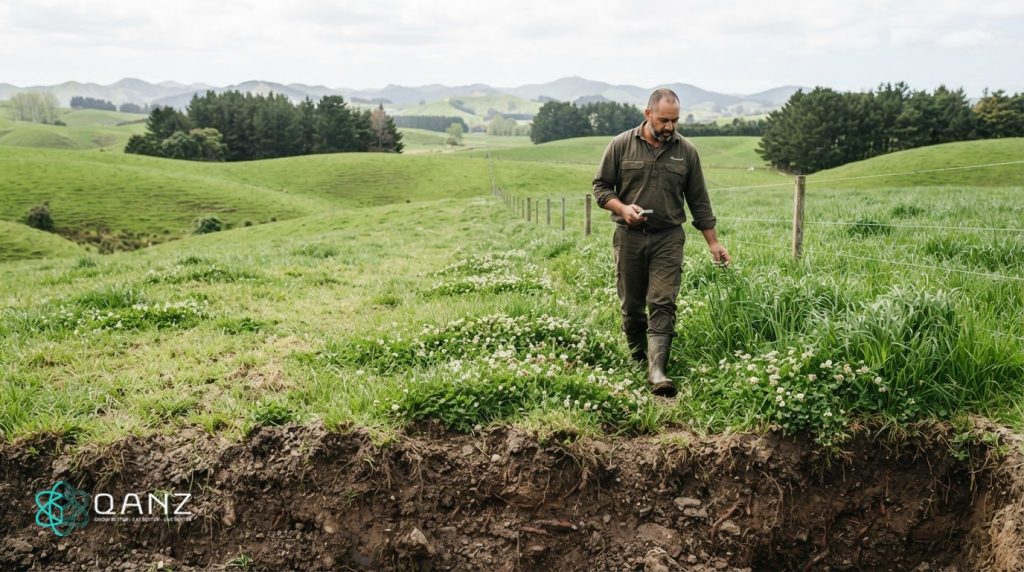
Improving dairy pasture quality naturally starts with finding out why feed quality is changing. Patchy growth may reflect grazing timing, soil condition, seasonal stress or several factors at once. Walk the paddock, compare its growth and grazing history with better-performing areas, then address the likely causes rather than reaching first for an input.
Pasture quality can vary between paddocks and through the season, and it is not always easy to separate feed changes from soil or grazing issues. Local conditions matter too: seasonal patterns and farm systems differ between New Zealand and Australia, so recommendations need to fit the relevant country and production system.
This guide explains what to look for in pasture, and how grazing management, soil structure, fertility, moisture and plant recovery can affect your assessment. It also covers practical actions to prioritise, ways to investigate possible causes and how to assess biological inputs carefully within a farm programme. The aim is a locally relevant approach grounded in pasture and soil management, not a promise of a quick fix.
Key Takeaways
- Assess pasture by considering feed value, plant composition and grazing timing, not pasture cover alone.
- When investigating uneven growth, consider soil moisture, pH, compaction and organic matter.
- For improving dairy pasture quality naturally, observe paddocks, record cover and residuals, then adapt grazing decisions to the season and farm system.
- Use a feed wedge or another suitable farm tool to compare paddocks and plan grazing priorities.
- Consider biological inputs within a wider management plan, and assess them against evidence relevant to the specific product and use.
What Does Good Dairy Pasture Quality Look Like?
Good dairy pasture quality depends on the feed value and composition of the plants, as well as grazing at a stage that allows cows to harvest leafy growth while leaving pasture able to recover. Quality is not the same as pasture cover or total feed supply. A paddock may have plenty of standing feed but also more mature stem, weeds or less desirable species. Assess these factors together and interpret them in the context of your farm system.
Which signs help assess dairy pasture quality?
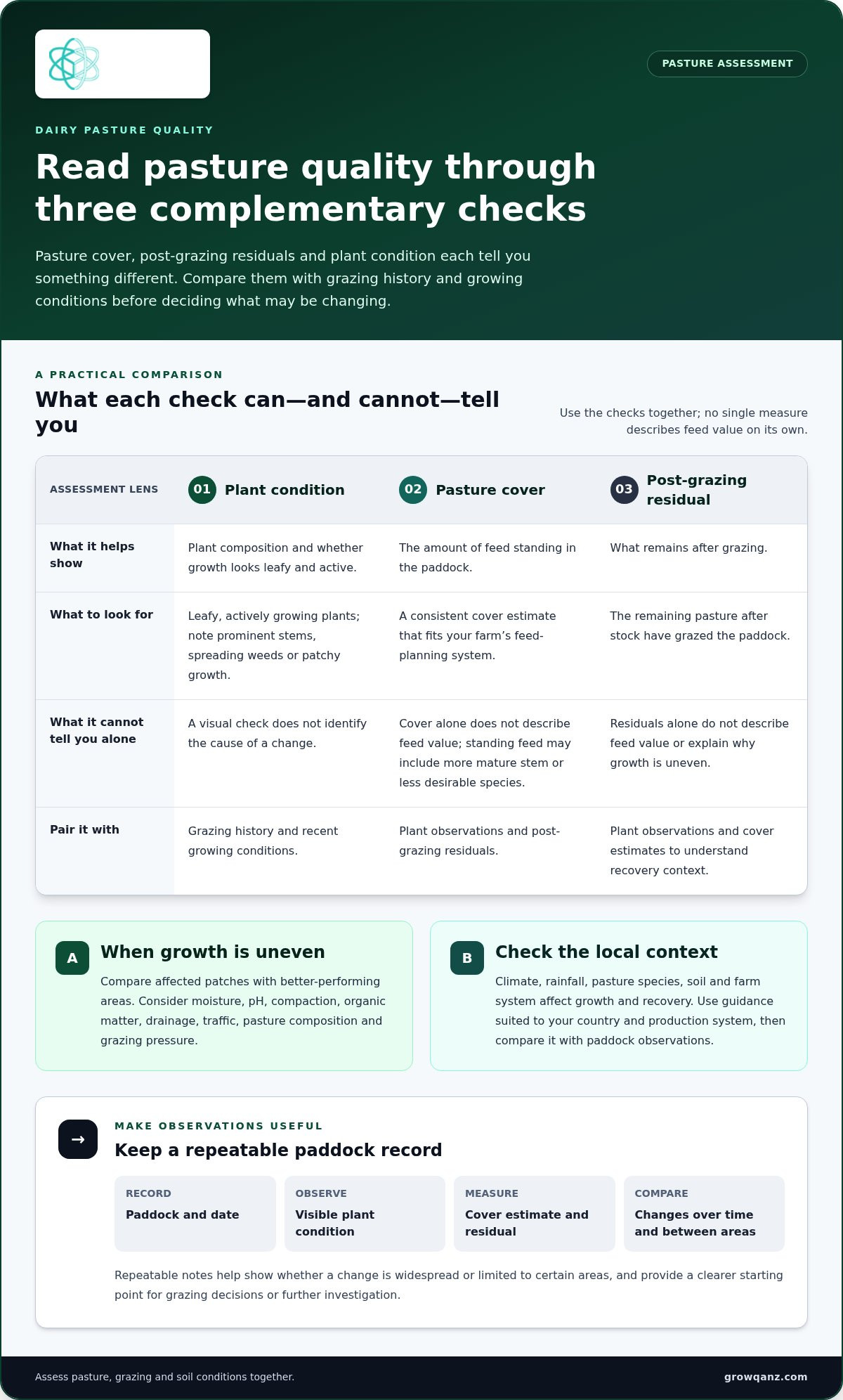
Walk the paddock in a consistent way. Look for leafy, actively growing plants, and note whether stems are becoming prominent, weeds are spreading or growth is patchy. These signs can point to a change in feed quality or pasture composition, but a visual check alone will not identify the cause. Compare your observations with grazing history and recent growing conditions.
Then consider grazing context. Pasture cover estimates the amount of feed standing in the paddock, while residuals show what remains after grazing. Neither measure describes feed value on its own. Used alongside observations of leaf and stem, they can help you distinguish adequate cover with mature growth from a paddock that has been grazed down and needs time to recover. Use a measurement approach that fits your farm’s existing feed-planning system.
Keep brief, repeatable records instead of relying on memory or a single paddock. Note the paddock, date, visible plant condition, cover estimate and post-grazing residual. Comparing these observations over time can show whether a change is widespread or limited to certain areas. It also gives you a clearer starting point before adjusting grazing decisions or investigating soil constraints.
Why do pasture seasons differ between New Zealand and Australia?
There is no single seasonal calendar that suits every dairy farm. Climate, rainfall, pasture species, soil and farm system all affect when growth accelerates or slows, and how quickly pasture recovers after grazing. Conditions can also vary between paddocks on the same farm. For New Zealand examples, use current DairyNZ guidance relevant to your farm system. In Australia, use recommendations that reflect the applicable state and production system.
That distinction matters when improving dairy pasture quality naturally. A grazing interval or target that suits one region, species mix or season may not suit another. Treat published guidance as a framework, then compare it with local paddock observations and your farm’s feed plan. Watch how quickly plants regain leafy growth and whether the paddock reaches the intended grazing stage, rather than relying on the month alone.
Leafy, actively growing pasture can be a useful part of a dairy feed plan because plant maturity affects the characteristics of the available feed. But pasture quality is only one part of the picture: the quantity available and timing of feed demand matter too. Read visual checks, cover and residual records together to build a more informed picture of pasture and soil conditions.
How Do Soil Conditions and Pasture Biology Affect Feed Quality?
Pasture growth depends on more than what is visible above ground. Soil moisture, pH, compaction and organic matter can influence plant establishment, access to water and nutrients, and recovery after grazing. These factors interact with weather, pasture species and management. Investigate a possible soil constraint rather than assuming it explains an uneven sward. Soil biology is one part of this wider system, not a stand-alone answer to every feed-quality issue.
What soil conditions should a grower investigate?
Start with the pattern and timing of poor growth. Waterlogged soil can restrict grazing access and be damaged by livestock pressure, while dry conditions can slow plant growth and recovery. A bare or uneven patch may reflect moisture stress, drainage, traffic, pasture composition or another constraint. Compare affected areas with better-performing parts of the farm and record when the difference appears.
Assess suspected compaction carefully, particularly in areas where stock or machinery regularly travel. A firm-looking surface does not prove there is a compacted layer. Consider the paddock’s history and soil condition, and use suitable field assessment or professional advice to investigate further. Avoid disruptive work when soil is wet, as traffic can increase damage.
Treat soil pH and nutrient status as questions for appropriate soil analysis, not something to diagnose from plant appearance alone. Results can help show whether soil conditions may be limiting growth and inform a suitable management response. DairyNZ’s pasture and farm-management guidance provides New Zealand context; recommendations should still reflect the farm’s soils, species and production system.
Where do organic matter and soil microbes fit?
Organic matter is associated with soil structure and water retention, while soil organisms contribute to processes such as decomposition and nutrient cycling. These are general soil-science principles, not evidence that a particular biological input will change pasture performance. The Food and Agriculture Organization’s report State of knowledge of soil biodiversity reviews the roles of soil organisms and factors that influence them.
When improving dairy pasture quality naturally, connect biological considerations to the conditions plants actually face: moisture, soil structure, pH, nutrient supply and grazing pressure. If a constraint is physical or chemical, adding a biological input alone may not address it. Information about field crops should not be treated as proof of pasture performance, because crops, soils and management differ. General information about biological inputs can explain the product category, but it does not establish a pasture outcome.
Build decisions from diagnosis, then assess any input against a defined purpose and observable measures within the farm programme. QANZ’s agricultural biological information can help you understand this wider context. Use it alongside practical assessment of pasture and soil conditions.
Do Natural Inputs Improve Dairy Pasture on Their Own?
A biological or other natural input should not be expected to correct poor grazing timing, waterlogging, compaction, unsuitable pH or seasonal feed pressure by itself. These constraints have different causes and need different responses. To improve dairy pasture quality naturally, first identify the limiting factor, then consider whether an input has a defined role in the wider farm management plan.
Management actions and biological inputs have different roles. Grazing decisions influence which plant material is eaten and how much remains for recovery. Soil investigation can help identify physical or chemical constraints. A biological input is a separate intervention, and its value needs to be assessed against evidence for the specific formulation, use and conditions. Do not treat any one of these as an automatic substitute for the others.
How can growers assess claims about pasture inputs?
Match the evidence to the claim. Check whether it concerns dairy pasture, the same formulation and growing conditions comparable to your farm. Peer-reviewed soil research can explain general soil processes, but it does not establish the performance of a particular commercial input. Product-specific evidence should identify the formulation and the crop or pasture studied.
Also establish who produced the evidence and where it applies. Independent trials, manufacturer trials and commercial grower observations are different evidence types, each with strengths and limits. Overseas findings remain overseas findings; they are not New Zealand or Australian results. If a claim leaves out the treatment, location, conditions or formulation, it is difficult to judge whether it applies to your paddock.
When might a biological input be considered?
Consider an input only after defining its intended role within a broader soil or crop programme. Set out what you want to assess and which relevant soil or pasture measures you will observe over a suitable period. Keep other management decisions in view, so a change in grazing, weather or soil conditions is not mistakenly attributed to the input.
For example, evidence relating to vegetables, turf or another crop does not by itself demonstrate suitability or performance in dairy pasture. General research on soil organisms does not verify a named product’s effects either. Quantum Organic-Total® is a microbial agricultural input offered by QANZ for use in crop and soil programmes. That description alone does not establish dairy-pasture results. Do not assume it replaces grazing management, soil analysis or other farm decisions.
A careful evaluation starts with a specific question, relevant evidence and realistic expectations. If these foundations are not in place, address known management or soil constraints first. Growers exploring biological inputs can use QANZ agricultural information as part of a broader assessment, while keeping product claims separate from general soil-science findings.
Which Pasture Management Steps Can You Take Through the Seasons?
A practical pasture-management sequence is to observe paddocks, record cover and grazing residuals, identify the likely constraint, then adjust the plan. Repeat as conditions change. Regular checks help distinguish a short-term seasonal shift from a recurring issue, and give grazing decisions a firmer basis than memory or applying the same approach across every paddock.
- Observe: Check pasture for leafiness, stem development, uneven growth and signs of surplus. Note how conditions differ between paddocks.
- Record: Track pasture cover and post-grazing residuals using a method your farm applies consistently.
- Investigate: Consider whether growth patterns relate to grazing pressure, moisture, soil condition, pasture composition or another constraint.
- Adjust: Use your observations alongside feed demand and the farm plan to decide whether to change allocation, grazing order or another management action.
How should grazing decisions respond to pasture observations?
Regular checks can flag a paddock shifting from leafy growth towards more stem, or show where surplus is accumulating. A feed wedge, which compares pasture cover across paddocks, can help show how available feed is distributed and support decisions about grazing order or surplus management when it suits the farm system. It informs the plan, but does not replace paddock checks or consideration of feed demand.
Record residuals alongside pasture allocation and what cows are being offered. A change in residual may help explain why a paddock is recovering differently or why feed quality is shifting. DairyNZ’s spring feed-planning guidance uses average pasture cover, feed supply and demand, and grazing residuals to support decisions. Its recommendations relate to New Zealand systems and conditions. Do not assume a spring target or rotation from that guidance suits every season or an Australian farm.
Surplus pasture can become stemmier as plants mature, so timely observation matters. However, there is no universal grazing target for every species, soil, season and dairy system. For Australian farms, use guidance relevant to the state, pasture species and production system, and adapt the plan to local conditions rather than transferring New Zealand advice unchanged.
How can soil constraints be addressed responsibly?
If observations suggest a soil constraint, investigate before choosing an intervention. Soil analysis can help assess pH and nutrient status, while suspected compaction needs appropriate assessment rather than assumptions based only on surface appearance. Use results and local agronomic guidance to inform decisions. Avoid applying a general rate or timing that has not been matched to the paddock and farm plan.
Seasonal management is a cycle, not a fixed calendar. Keep observations consistent, note what has changed and review whether the response fits the conditions. For information about biological inputs in broader crop and soil programmes, explore QANZ’s agricultural information.
How Can QANZ Biological Inputs Fit an Evidence-Led Pasture Plan?
Consider biological inputs after identifying the farm’s pasture-management objective and assessing relevant soil or growing conditions. They are one possible component of a wider programme, not a shortcut around grazing decisions or local agronomic guidance. GrowQanz supplies Quantum agricultural biological products to growers in New Zealand.
Quantum Organic-Total® is a microbial agricultural input offered by GrowQanz for use in crop and soil programmes. This description does not establish its suitability or performance in dairy pasture. When assessing a potential use, refer to current technical information and evidence relevant to the exact formulation, intended use and farm context. Product information can explain the stated use of Quantum Organic-Total®, but should not be read as proof of pasture results.
What should growers establish before considering an input?
Start with a clear question: what farm objective would the input support, and which soil or crop programme would it fit within? Identify the issue you are trying to address and how you will assess it. Then compare the proposed use with current product information and the certification requirements relevant to your operation. Keep general evidence about soil biology distinct from evidence about a specific product.
This distinction matters. Peer-reviewed research may explain general soil processes, while product-specific trials and commercial observations relate to particular formulations, settings and conditions. One type of evidence does not automatically verify another. Evidence from a different crop does not demonstrate dairy-pasture suitability. When evaluating a claim, note the formulation, study setting, management context and measured outcome, then consider whether those details match your purpose.
What is a measured next step for New Zealand growers?
Use local agronomic guidance for decisions about pasture and soils. New Zealand farms face specific climate patterns, pasture species and production systems, so recommendations should fit this local context. Set out how any proposed input would sit alongside the existing grazing plan, soil assessment and other farm decisions, without assuming it replaces them.
A measured approach is to discuss whether an input fits the specific crop, growing system and application programme, and to identify what relevant evidence would inform that decision. For dairy-pasture use, keep the standard high: do not infer a pasture outcome without product-specific supporting evidence.
For a considered discussion about your crop and application programme, talk to GrowQanz about your growing system.
Make Your Next Pasture Decision Evidence-Led
Improving dairy pasture quality naturally is an ongoing process of learning from each paddock and adapting decisions to local conditions. Use your observations to set a clear priority for the next part of the farm plan, whether that means refining grazing decisions or investigating a suspected soil constraint. Then assess any proposed input against a specific purpose and evidence that fits your system.
Consider biological inputs carefully, rather than treating them as a promise of pasture improvement. Quantum Organic-Total® is a microbial agricultural input for crop and soil programmes; its product description alone does not establish suitability or results in dairy pasture. Keep that distinction in view when deciding what belongs in your programme.
For a practical discussion about Quantum Organic-Total® and your crop, growing system and application programme, talk to QANZ.
Frequently Asked Questions
How can I improve dairy pasture quality naturally?
Start with one clear, observable goal, such as reducing stemmy feed in a particular paddock. To improve dairy pasture quality naturally, record a baseline and compare the same paddock at a similar point in its growth cycle after making a management change. Where practical, avoid changing several things at once. This makes it easier to see which adjustment may have contributed to a difference.
Does soil pH affect dairy pasture quality?
Yes, but the useful pH range depends on soil type, pasture species and the wider farm system. For a practical comparison, record sampling locations and dates, and use a consistent sampling approach when reviewing changes over time. Do not interpret a single result in isolation or apply a blanket correction across the farm. Use the analysis and local agronomic advice to decide whether a response is appropriate.
Can clover improve the quality of dairy pasture?
White clover can contribute to pasture composition, but a quick visual estimate may not show how well it persists or how evenly it is distributed through the sward. Check several areas within a paddock and revisit them at different points in the season. Note whether clover is present as established plants or scattered seedlings, and consider how grazing and competition may affect persistence before deciding on a change.
How often should dairy pasture be assessed?
Set an assessment routine around farm decisions, rather than relying on a calendar alone. Check the paddocks most likely to affect an upcoming grazing or feed-allocation choice, then reassess when growth conditions shift or the plan changes. During New Zealand spring, DairyNZ guidance emphasises regular pasture assessment. In other seasons or Australian systems, use a locally appropriate routine that matches growth and farm decisions.
Does overseeding naturally improve dairy pasture quality?
Not by itself. Overseeding introduces seed into an existing sward, so success depends on whether new plants can establish alongside the pasture already there. Before choosing this approach, consider the reason for decline, the existing species and whether conditions are suitable for establishment. Compare overseeding with other renovation options using local advice, then plan follow-up grazing to support the chosen approach.
Are biological soil inputs proven to improve dairy pasture?
Assess a claim by looking for a clearly described comparison, not just a reported change after treatment. Useful details include what the untreated or standard-management paddock received, which outcome was measured and whether the comparison was repeated under the stated conditions. This helps distinguish an observed association from a result that can reasonably be linked to the input. Even relevant findings do not guarantee the same response on another farm.
Disclaimer
Important: This article provides general agricultural information only. Product performance can vary according to crop, soil, climate, management practices and application conditions. Trial or research results discussed may have been obtained under specific conditions and should not be interpreted as a guarantee of equivalent results. Always follow current product directions and confirm suitability for your crop, growing system and organic certification requirements. Contact QANZ for current product and application information.
