
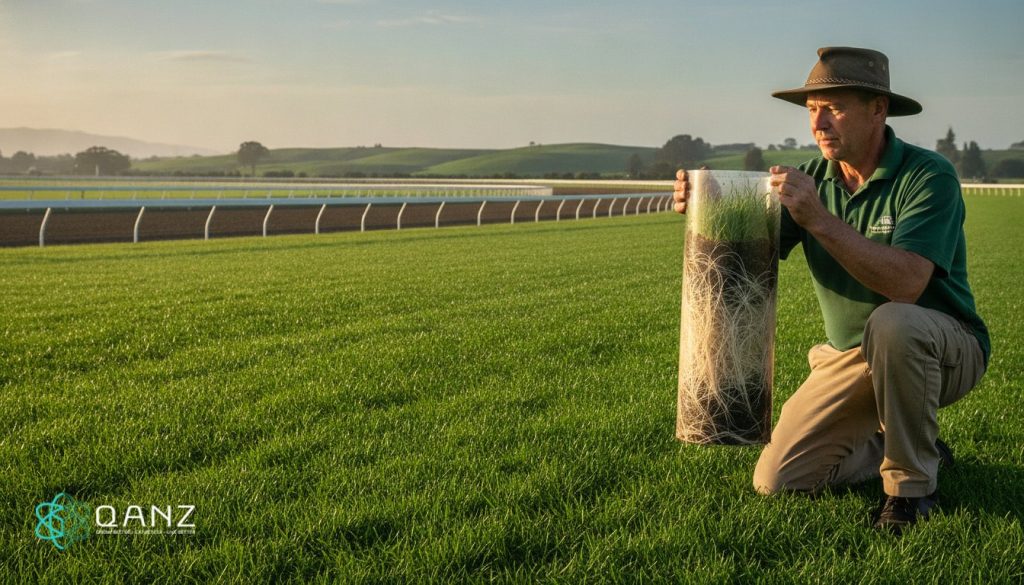
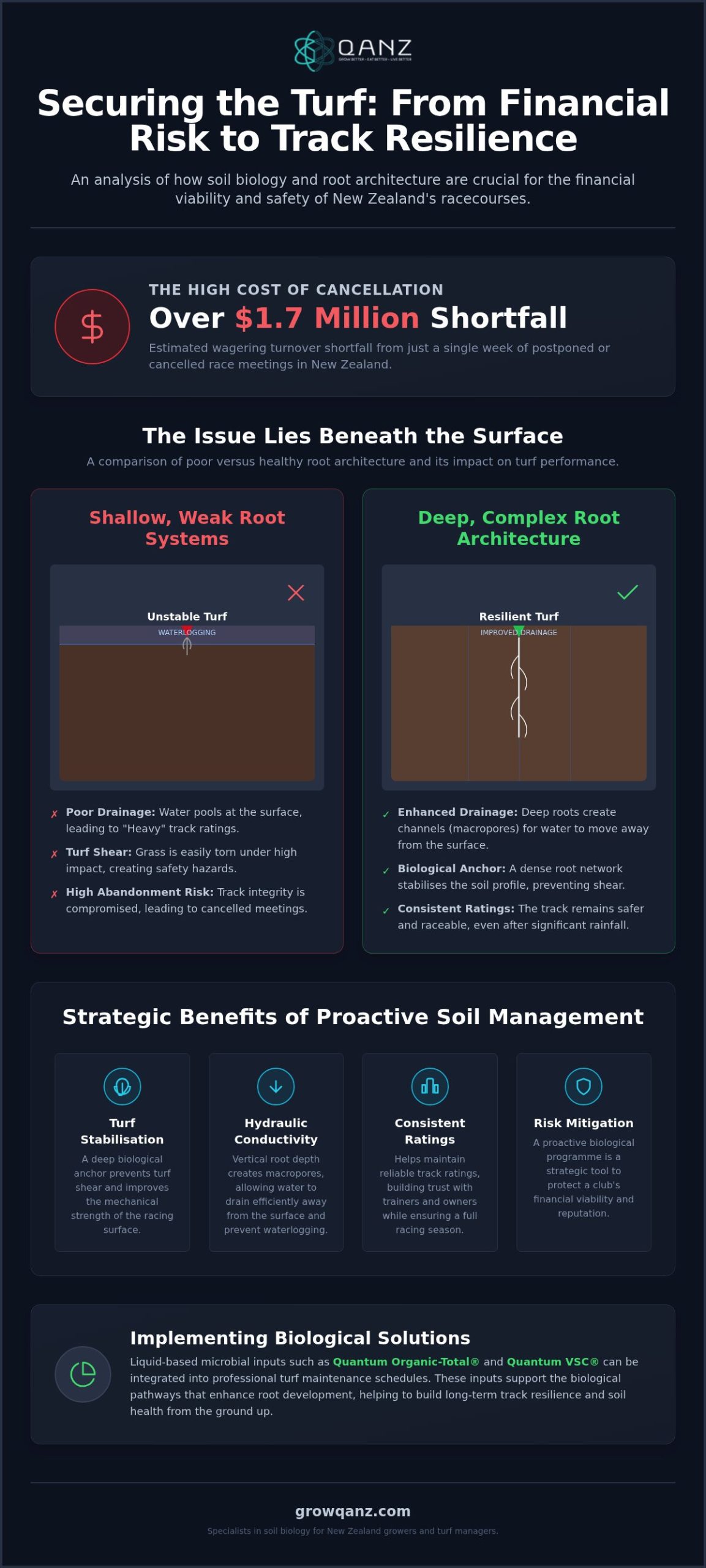
In June 2026, a single week of cancelled and postponed race meetings resulted in an estimated shortfall of more than $1.7 million in wagering turnover for the New Zealand thoroughbred industry. With abandonment rates in New Zealand reaching 6 per cent, which is more than double the rate of major Australian states, the pressure on track managers to deliver a safe and stable surface is immense. You know that while you cannot control the weather, the resilience of your turf during heavy rain depends almost entirely on the biological health of the soil profile.
Understanding how better root structure can help racecourse tracks.limiting the risk of cancellations of races by securing better turf is the key to moving beyond reactive maintenance. By prioritising microbial soil health, curators can build a deep biological anchor that prevents turf shear and improves natural drainage. This article examines how enhancing root architecture through inputs like Quantum Organic-Total® helps create a high-traffic surface capable of maintaining consistent ratings across all seasons. We will explore the technical link between soil microbiology and track stability, providing a practical pathway to reduce waterlogging and protect your club’s financial viability.
Key Takeaways
- Understand the significant financial impact of race abandonments and how improving soil health serves as a strategic risk mitigation tool for racing clubs.
- Learn why vertical root depth and complex root architecture are essential for maintaining hydraulic conductivity and preventing waterlogging during high-intensity rainfall.
- Discover how better root structure can help racecourse tracks.limiting the risk of cancellations of races by securing better turf through the biological stabilisation of the soil profile.
- Recognise the value of implementing proactive biological programmes before peak seasons to manage soil compaction and maintain consistent track ratings across different climates.
- Explore how liquid-based microbial inputs like Quantum Organic-Total® and Quantum VSC® can be integrated into professional turf maintenance schedules to support long-term track resilience.
The Impact of Racecourse Cancellations on the Australian and NZ Industry
Racing isn’t just a sport; it’s a high-stakes industry where stability is the primary currency. In June 2026, New Zealand experienced a difficult week of weather that led to an estimated loss of more than $1.7 million in wagering turnover. This isn’t an isolated incident. When a meeting is abandoned, the financial damage spreads through the entire supply chain. Trainers lose prize money opportunities; owners continue to pay training fees without returns; and the club loses everything from gate takings to broadcast fees. Traditional management often focuses on the top-down appearance of the grass, but the real issue lies beneath the surface. Understanding how better root structure can help racecourse tracks.limiting the risk of cancellations of races by securing better turf is essential for long-term viability.
The Economic Ripple Effect of Abandoned Meets
A cancelled race day represents more than just a quiet afternoon at the track. It triggers a cascade of lost revenue. Clubs lose significant income from hospitality bookings, corporate sponsorships, and on-course wagering. Beyond the immediate loss, there’s the ongoing cost of maintaining a track that isn’t generating revenue. If a surface cannot sustain a full racing season due to poor drainage or instability, the club’s reputation suffers. Consistent track performance is what builds trust with trainers and owners. If they can’t rely on a “Good” rating or at least a safe “Soft” surface, they’ll nominate their horses elsewhere. This reduces field sizes and further dampens wagering turnover, creating a cycle of decline that’s hard to break without addressing soil health.
Safety and Surface Integrity
The physical integrity of the racing surface is non-negotiable. Turf shear occurs when the grass plant is uprooted or torn during the high-impact stride of a thoroughbred. This usually happens because the root system architecture is too shallow to anchor the plant against lateral force. When the soil becomes saturated, the risk of “slipping” increases, posing a direct threat to both jockeys and horses. Track curators are under mounting pressure from racing bodies to deliver consistent “Good” ratings, yet many struggle with tracks that move into “Heavy” territory too quickly. By focusing on how better root structure can help racecourse tracks.limiting the risk of cancellations of races by securing better turf, curators can improve the mechanical strength of the surface. A biologically active soil profile encourages deeper roots, which act as a living reinforcement for the turf, ensuring the track remains safe and raceable even after significant rainfall. For those managing professional surfaces, integrating solutions like those found in QANZ turf programmes can provide the biological foundation needed to support these deeper root systems.
Understanding Root Architecture: The Biological Foundation of Turf
Root architecture refers to the complex spatial configuration of a root system within the soil profile. It isn’t merely a measure of total root mass; it’s a map of how roots occupy space and interact with the surrounding environment. For a racecourse, this architecture serves as the primary engineering component of the track. While the grass provides the aesthetic and initial contact point, the roots provide the structural integrity required to support high-speed equine movement. Implementing a strategy focused on how better root structure can help racecourse tracks.limiting the risk of cancellations of races by securing better turf allows curators to build a biological framework that manages water and resists mechanical stress simultaneously.
Vertical vs. Lateral Root Systems
Vertical root depth is the engine room of hydraulic conductivity. Deep, penetrating roots create natural macropores in the soil, allowing water to move away from the surface and into the lower profile. Without this vertical reach, tracks become waterlogged quickly, leading to “Heavy” or “Inconsistent” ratings that often trigger abandonments. Conversely, lateral root branching acts as the “locking” mechanism for the soil surface. These horizontal networks increase the surface area for nutrient recycling and moisture uptake, creating a dense, resilient mat. Following turfgrass management best practices involves balancing this underground development with top-growth to ensure the plant isn’t over-stressed during the peak racing season. A shallow root system simply cannot support the nutrient demands of high-traffic turf.
The Biological Anchor Effect
A robust root system provides essential tensile strength to the soil. In racing terms, this is the difference between a clean gallop and a track that “blows out.” When a horse’s hoof strikes the ground at speed, it exerts massive lateral force. If the root-soil bond is weak, the turf shears, creating dangerous divots and slippery patches that compromise safety. A dense, interconnected root mat acts as a natural shock absorber, distributing the energy of the hoof strike across a wider area. This cohesive bond is critical for maintaining surface integrity during wet weather when the soil is most vulnerable to displacement. Curators looking to strengthen this anchor often look toward microbial soil technology to encourage the natural biological processes that drive root branching. By securing this biological foundation, clubs can maintain safer surfaces and more consistent track ratings, even when the weather turns.
Microbial Pathways to Enhanced Root Development
The rhizosphere is the thin layer of soil directly surrounding plant roots where a complex exchange of energy and nutrients occurs. Within this zone, beneficial soil microorganisms for plants act as a biological engine, driving the physical development of the root system. These microbes secrete substances, such as polysaccharides, that bind soil particles together into stable aggregates. This process improves soil porosity, creating the pathways necessary for roots to penetrate deeper into the profile. When we discuss how better root structure can help racecourse tracks.limiting the risk of cancellations of races by securing better turf, we are essentially discussing the optimisation of this microbial environment.
Stable soil aggregates do more than just facilitate root growth; they ensure the soil can breathe and drain effectively. In professional turf management, maintaining this porosity is critical for preventing the surface saturation that leads to meeting abandonments. By fostering a healthy microbial population, curators can ensure that the soil remains an active, living filter rather than a compacted, anaerobic layer.
The Rhizosphere Relationship
Microbes serve as a primary support system for root extension. By colonising the root surface, certain bacteria and fungi protect the plant while simultaneously unlocking bound nutrients like phosphorus. This symbiotic relationship encourages the plant to invest more energy into complex root architecture rather than just succulent top-growth. A well-supported rhizosphere results in a more resilient turf surface that can better withstand the mechanical stresses of high-speed racing. This biological-driven soil aggregation is a natural way to maintain track integrity and support long-term turf vitality without relying solely on intensive mechanical aeration.
Biologicals in Professional Turf Management
For track curators, the practical application of biology must be seamless. Liquid microbial soil treatments, such as Quantum Organic-Total®, are often preferred because they can be easily integrated into existing spray programmes. These inputs provide a concentrated source of beneficial microbes designed to support soil health and nutrient recycling. By breaking down organic matter and thatch, these microorganisms prevent the “spongy” surface conditions that often lead to “Heavy” track ratings and increased divoting.
Using BioGro New Zealand certified soil inoculants allows clubs to move toward more sustainable management practices while prioritising track performance. Integrating these biologicals into a comprehensive maintenance schedule helps ensure that the turf remains vibrant and the soil structure remains open. This proactive approach to soil biology is a vital component for any club looking to reduce the risk of race cancellations through enhanced turf stability. Talk to QANZ about whether Quantum Organic-Total® is appropriate for your track, growing system, and application programme.
Practical Strategies to Minimise Track Failure and Cancellations
Transitioning from reactive maintenance to a proactive biological framework is the most effective way to secure track longevity. While mechanical interventions like verti-draining provide immediate relief, they don’t address the underlying biological causes of soil collapse. Understanding how better root structure can help racecourse tracks.limiting the risk of cancellations of races by securing better turf involves integrating microbial inputs into the annual maintenance calendar well before the first heavy rains arrive. By establishing a robust microbial population early, curators can ensure the soil remains open and the turf remains anchored during the high-pressure racing seasons.
Managing soil compaction requires a dual approach. Mechanical aeration opens physical channels, but beneficial microbes, such as those found in Quantum VSC®, help maintain those channels by colonising the soil and preventing the rapid “re-sealing” that often occurs in high-traffic areas. Regular soil health monitoring is essential to identify microbial imbalances before they manifest as surface ponding or turf shear. This data-driven approach allows for precise adjustments to application rates, ensuring the “biological engine” of the track is always performing at its peak.
Improving Hydraulic Conductivity
Hydraulic conductivity is the measure of how easily water moves through the soil profile. When root architecture is shallow or restricted, water sits on the surface, leading to the “Heavy” or “Soft” ratings that frequently result in meeting abandonments. Deep, vertical roots act as living conduits, pulling moisture down and away from the surface. Microbial activity also plays a critical role in reduced thatch build-up. By accelerating the decomposition of organic matter, specialised microbes prevent the formation of a spongy, anaerobic layer that traps water and encourages shallow rooting. This natural breakdown ensures the surface stays firm and the drainage remains efficient.
Seasonal Maintenance Frameworks
Preparing the track for the extremes of the Australian and New Zealand climates requires a focus on root strengthening. In winter, the goal is to maximise drainage to prevent waterlogging; in summer, the focus shifts to moisture retention and heat resilience. Balancing traditional fertiliser inputs with biological soil enhancers ensures the plant has the nutrients it needs without compromising the soil’s natural structure. Curators should use a simple checklist to assess biological turf health:
- Measure vertical root depth at multiple points across the track.
- Assess the thickness and density of the thatch layer.
- Monitor for consistent soil moisture levels across the profile.
- Check for signs of microbial activity, such as rapid organic matter breakdown.
By following these strategies, clubs can significantly improve turf recovery times between meetings and maintain a more resilient racing surface. Talk to QANZ about whether Quantum Organic-Total® is appropriate for your track, growing system and application programme.
Implementing QANZ Biological Solutions in Racecourse Programmes
Integrating biological inputs into a professional turf maintenance schedule requires a methodical approach that prioritises soil health as a long-term asset. While previous sections explored the mechanics of soil porosity and root architecture, the practical application of these principles involves selecting the right microbial tools. QANZ provides technical support to help curators understand how better root structure can help racecourse tracks.limiting the risk of cancellations of races by securing better turf through the strategic use of microbial soil treatments. These solutions are designed to work alongside existing mechanical and nutritional programmes to build a more stable racing surface.
Quantum Organic-Total® and Quantum VSC®
The core of the QANZ biological offering includes Quantum Organic-Total® and Quantum VSC®. These are liquid-based microbial agricultural inputs, making them ideal for large-scale application across many hectares of turf. Because they are liquids, they can be easily integrated into existing spray programmes using standard equipment. These products are intended to support overall soil microbial activity, which in turn facilitates the natural processes of nutrient recycling and soil aggregation. Curators often find that liquid applications provide a more uniform distribution of beneficial microbes across the track profile than granular alternatives.
Historical evidence from overseas applications has shown that microbial treatments can play a role in maintaining turf health under various environmental stresses. However, it’s vital to maintain a factual perspective on performance. Results from individual trials or commercial observations are specific to the formulation, crop, location, treatment and conditions tested and should not be interpreted as a guarantee of equivalent performance elsewhere. Track managers should always check product suitability against current QANZ technical documentation before starting a new programme.
The Path to a More Resilient Racecourse
A long-term biological approach is often preferred over quick-fix chemical solutions that may provide a temporary flush of green but fail to address the underlying soil structure. By focusing on the biological anchor of the turf, racing clubs can work toward a surface that recovers faster and drains more effectively. For clubs moving toward sustainable management, Quantum Organic-Total® carries BioGro New Zealand certification, providing assurance of its status as a natural input. This certification is particularly valuable for tracks located near sensitive waterways or those operating under strict environmental guidelines.
Building a resilient track is an ongoing process of monitoring and adjustment. Working with QANZ technical support allows curators to tailor a programme to their specific track conditions, soil types, and racing schedules. This collaborative approach ensures that the “biological engine” of the soil is properly supported throughout the year. Talk to QANZ about whether Quantum Organic-Total® is appropriate for your racecourse maintenance programme, growing system and application programme.
Securing the Future of Racing through Soil Biology
Building a resilient racecourse requires looking beyond the surface and addressing the complex biological systems that support turf stability. A robust root architecture serves as the primary engineering component of a high-performance track, providing the tensile strength needed to prevent turf shear and the hydraulic conductivity required for efficient drainage. By prioritising the soil microbiome, curators can move from reactive maintenance to a proactive strategy that manages waterlogging and compaction naturally.
Understanding how better root structure can help racecourse tracks.limiting the risk of cancellations of races by securing better turf is a critical step for any club seeking to protect its financial and operational integrity. QANZ offers technical support for professional turf curators across Australia and NZ, providing liquid-based formulations like Quantum Organic-Total® that are BioGro New Zealand certified for sustainable results. These inputs are designed for seamless integration into professional application equipment, supporting the long-term ecological health of your racing surface.
Talk to QANZ about whether Quantum Organic-Total® is appropriate for your racecourse management programme, growing system, and application schedule. Investing in your soil’s biological foundation today ensures a more stable, raceable track for many seasons to come.
Frequently Asked Questions
How can better root structure prevent race cancellations?
Better root structure helps water move through the soil profile more efficiently, which reduces surface ponding and waterlogging during heavy rain. By strengthening the biological anchor of the turf, curators can maintain safer surface ratings and reduce the risk of turf shear. This structural integrity is essential for how better root structure can help racecourse tracks.limiting the risk of cancellations of races by securing better turf.
What are the best beneficial soil microorganisms for racing turf?
Beneficial soil microorganisms for plants include various bacteria and fungi that interact within the rhizosphere to bind soil particles into stable aggregates. These microbes improve soil porosity, allowing for better oxygen and water movement. While specific strains vary by product, the most effective ones for turf focus on accelerating organic matter breakdown and supporting complex root architecture through natural symbiotic relationships that strengthen the plant.
Can microbial treatments be used alongside traditional fertilisers?
Yes, microbial treatments are designed to be integrated into comprehensive turf maintenance schedules alongside traditional nutritional inputs. These biological products support nutrient recycling, which can help the turf utilise applied fertilisers more effectively. It’s often recommended to maintain a balanced programme that addresses both the chemical and biological needs of the soil to ensure long-term track resilience and surface consistency across different racing seasons.
How long does it take to see improvements in turf root density?
The timeframe for observable changes in root density depends on several factors, including the existing soil health, weather conditions, and the specific maintenance programme in place. Biological processes are gradual and focus on long-term soil structural improvements rather than immediate top-growth flushes. Curators typically monitor root depth and soil porosity over a full growing season so they don’t miss the gradual progress of their biological soil management strategies.
What is the role of Quantum Organic-Total® in racecourse management?
Quantum Organic-Total® is a microbial agricultural input offered by QANZ for use in crop and soil programmes, including professional turf management. It’s intended to support overall soil microbial activity and help build a more resilient root system. By fostering a healthier soil environment, it assists curators in their efforts regarding how better root structure can help racecourse tracks.limiting the risk of cancellations of races by securing better turf.
Are these microbial products safe for horses and jockeys on the track?
Quantum Organic-Total® is BioGro New Zealand certified, ensuring it meets strict standards for natural agricultural inputs. These products are intended to enhance the biological health of the soil without the use of synthetic chemicals. While they are designed for professional turf environments, curators should always review the technical documentation and follow labelled application protocols to maintain a safe environment for both horses and jockeys during and after application.
How do liquid soil inoculants compare to granular fertilisers for turf?
Liquid microbial soil treatments are often preferred for large-scale racecourse applications because they provide more uniform coverage across the track profile. Unlike granular fertilisers that may sit on the surface, liquid formulations move into the rhizosphere more quickly where they can begin interacting with the root system. They are easily integrated into existing spray programmes using standard professional application equipment, allowing for precise management of the soil microbiome.
What should I check before applying a BioGro certified product to my track?
Before applying any BioGro certified product, it’s essential to check the product suitability, application rates, and current certification requirements against current QANZ technical and BioGro documentation. You should also consider your specific track conditions and existing maintenance schedule. QANZ provides technical support to help professional turf curators tailor a programme that meets the specific biological and structural needs of their racecourse effectively.
Disclaimer
Important: This article provides general agricultural information only. Product performance can vary according to crop, soil, climate, management practices and application conditions. Trial or research results discussed may have been obtained under specific conditions and should not be interpreted as a guarantee of equivalent results. Always follow current product directions and confirm suitability for your crop, growing system and organic certification requirements. Contact QANZ for current product and application information.
