
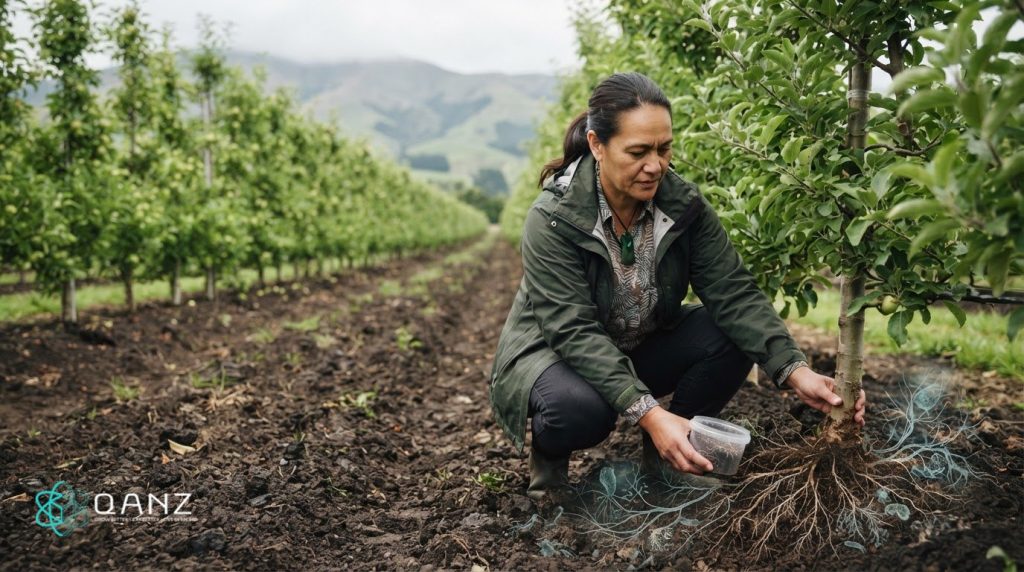
Could a biological treatment that suits one orchard be the wrong choice for yours? Biological treatments for fruit trees vary in purpose, and a product’s suitability depends on the crop, the issue you’re addressing and the evidence behind its claims. For growers in New Zealand, local conditions, seasonal timing and the requirements of the relevant certification programme matter too.
Biological inputs can be difficult to compare with conventional orchard treatments, especially when product claims don’t explain what was tested, where or on which crop. They aren’t interchangeable, and shouldn’t be treated as automatic replacements for other parts of an orchard programme. GrowQanz supplies quality agricultural biological products to support local growers.
This guide explains where biological treatments may fit in fruit-tree management and how to assess whether one is relevant to your orchard. You’ll learn what to check before considering a product, how to weigh crop-specific evidence, and what to verify about seasonal timing, local guidance and certification. The aim is a practical, evidence-led way to make an informed decision, not a promise of results.
Key Takeaways
- Biological treatments for fruit trees cover different types of inputs, so match a product’s stated purpose to the orchard issue you want to address.
- Review soil moisture, pH, organic matter, compaction and carbon availability as part of the wider orchard context before considering an input.
- Assess evidence by its source and setting, and check whether it relates to the same crop, formulation and growing conditions.
- Use a practical decision process: define the issue, review orchard records, check evidence and product guidance, then document your decision.
- For Quantum Organic-Total®, verify fruit-tree suitability, rates and certification requirements against current GrowQanz technical and BioGro documentation.
What are biological treatments for fruit trees, and what can they address?
Biological treatments for fruit trees are a broad category of agricultural inputs associated with living organisms or biological processes. Products may be intended for specific soil or plant uses, but they don’t all share the same ingredients, purpose or supporting evidence. Treat the product label and crop-specific guidance as essential. Suitability depends on the tree crop, orchard conditions, growing system and intended use.
What does biological treatment mean in an orchard?
The term can refer to different products, so it isn’t a precise description of one treatment. Some products are intended for soil application; others may be labelled for use on plants. Don’t assume that a product suited to one application is suitable for another. Check its label and technical information for the named crop, application site, purpose and directions.
Biological inputs are also distinct from soil-management practices such as maintaining ground cover or adding organic matter. Those practices influence orchard conditions, but they aren’t packaged products. Nor does the word “biological” mean an input is a conventional fertiliser or crop-protection product, or that it can replace one. The product’s intended use and evidence matter. For example, biological pest control describes approaches that use natural enemies such as predators or parasites. That’s one area of biological control, not a definition that applies to every biological input.
In brief: a biological input is a product associated with biological organisms or processes; its specific use must be verified from its own label and supporting documentation. For example, Quantum Organic-Total® is a microbial agricultural input offered by QANZ for crop and soil programmes. That description alone doesn’t establish its suitability for a particular fruit-tree crop or orchard use.
Which orchard questions should growers identify first?
Start with the observed issue, rather than selecting a product based on a broad claim. Describe what you’re seeing, where it occurs and when it appears. Then consider the factors that may affect whether an input is relevant:
- Crop and tree age: identify the fruit species or cultivar and whether trees are young or established.
- Soil and growing system: note known soil conditions, orchard layout and how trees are managed.
- Management history: record recent inputs and practices that may be relevant to the issue.
- Intended application: clarify whether you’re assessing a soil or plant application, and check that the label supports it.
- Country and certification programme: record whether the orchard is in New Zealand or Australia and check requirements with the relevant programme. Using a biological input doesn’t, by itself, make a crop, farm or produce organic.
A clear description of the orchard problem gives you a sound basis for comparing products and asking a supplier for crop-specific evidence.
How do soil biology and fruit-tree conditions shape treatment decisions?
Soil biology is part of a wider system. The rhizosphere is the soil region influenced by plant roots, where roots, soil organisms and their surroundings interact. The soil microbiome refers to communities of microorganisms living in soil. These are general concepts, not evidence that a particular input will produce a particular orchard outcome. Washington State University’s Orchard soil health guide discusses soil health through its biological, physical and chemical properties.
Orchard context influences how biological inputs should be assessed. Soil structure, water availability, pH, organic matter and available carbon help describe the conditions in which roots and soil organisms exist. They don’t, by themselves, show that a biological treatment is needed or will work. The same product claim may have different relevance where soil, management and growing conditions differ.
Which soil and management factors are worth checking?
Start with what you already know about the orchard. Review soil records and observations, including whether moisture varies across blocks, whether water drains or ponds, and whether traffic or cultivation may have compacted the soil. Note pH and organic matter information where available, along with ground cover, organic inputs and irrigation management.
Ground cover and plant diversity form part of the orchard context because they affect the range of plant roots and residues present. Cultivation can also change soil structure and the distribution of organic material. These factors help frame questions for a supplier or adviser; they aren’t proof that a treatment will have a specific effect. If you need soil measurements, use an appropriate independent testing service or adviser. QANZ does not provide laboratory soil testing.
Why do crop, season and country matter?
Fruit trees pass through changing growth stages, and orchard conditions shift with local weather and seasonal patterns. Assess product guidance against the crop’s current stage and the label’s directions rather than applying a universal calendar. A recommendation developed for another crop, season or country may not transfer directly to your orchard.
Country matters too. Growers in New Zealand and Australia should check the guidance and requirements that apply to their location and certification programme, as well as whether current product documentation names their specific crop and intended application. Don’t assume an overseas recommendation is suitable locally, or infer a fruit-tree use from general statements about soil biology.
For help checking product and application information against your orchard context, see QANZ product and application support.
How can growers compare biological treatments and assess the evidence?
Compare products against the orchard question you’ve defined, not broad claims about biological inputs as a category. Check the intended use, named fruit crop and supporting evidence. Note whether the information comes from independent research, manufacturer trials, New Zealand or overseas work, or commercial observations. These describe different aspects of evidence and shouldn’t be treated as interchangeable.
What makes a trial relevant to your orchard?
First match the evidence to the exact formulation, crop, location, treatment and growing conditions assessed. Then look for a transparent description of the trial design, comparison treatment, measurements and source. If those details aren’t available, record the gap rather than filling it with assumptions. Evidence for one biological product doesn’t establish that another product will perform similarly. For biological control specifically, UC IPM outlines the role of natural enemies in biological control with natural enemies.
| Evidence type | What to check |
|---|---|
| Independent research | Who conducted it, what formulation and crop were assessed, and whether the methods are described. |
| Manufacturer trial | Who sponsored or carried out the work, which formulation was used, and whether the trial details are available. |
| New Zealand or overseas trial | Where it took place and how closely its crop and conditions match your orchard. Overseas evidence is not New Zealand evidence. |
| Commercial observation | Who made the observation, what was applied and whether other changes could also explain what was seen. |
These labels can overlap. For example, a manufacturer trial may be conducted overseas. Assess both who produced the evidence and where and how the work was done. Results from individual trials or commercial observations are specific to the formulation, crop, location, treatment and conditions tested and should not be interpreted as a guarantee of equivalent performance elsewhere.
What should growers verify before considering a product?
Use this checklist to assess biological treatments for fruit trees before making a programme decision:
- Intended use and crop fit: check the current label and technical documentation for the specific crop and application site.
- Application guidance: confirm current directions with the supplier, including any crop-specific guidance relevant to your orchard.
- Evidence: check that the formulation named in the evidence matches the product being considered.
- Certification: confirm with your certification programme whether the input is suitable for your programme and intended use. Don’t assume a product description or past document confirms current status.
Product descriptions, older articles and evidence for another formulation aren’t proof of suitability or performance. For relevant crop information, see QANZ fruit and nut crop information.
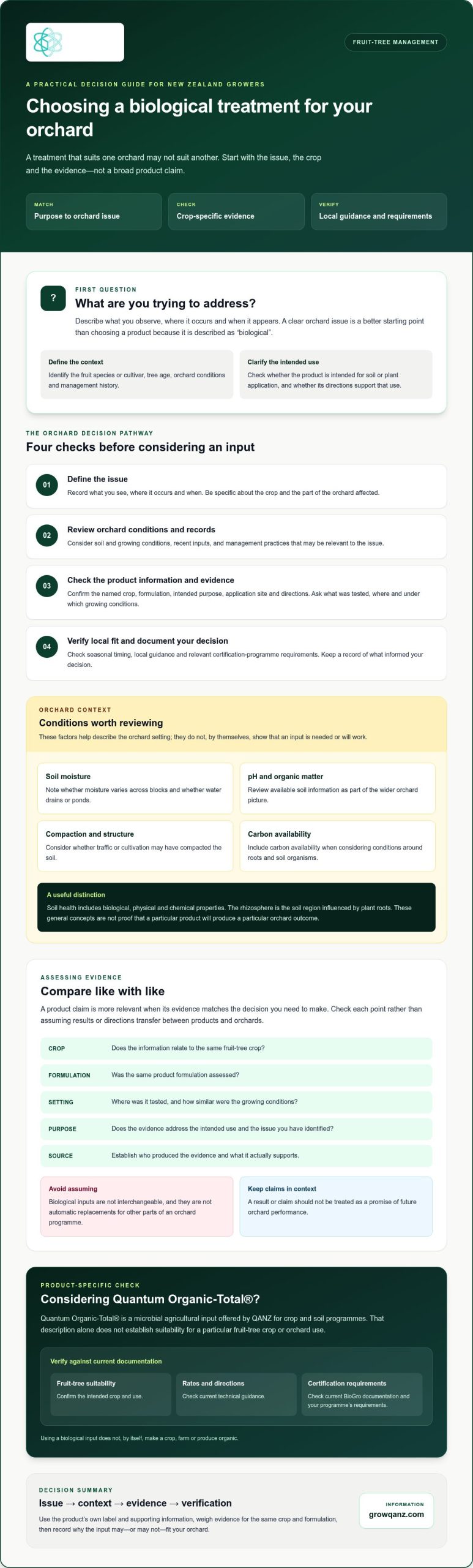
How should growers plan a biological treatment for fruit trees?
A clear plan helps you assess whether a biological input is relevant to an orchard and makes later observations easier to interpret. Start with the issue, establish a baseline from existing records, then check evidence and current product guidance before deciding whether to proceed. Keep New Zealand and Australian recommendations distinct, and seek appropriate agronomic advice if diagnosis or treatment selection needs specialist expertise.
A practical planning process
- Define the issue. Describe what you’ve observed, where it occurs and when. Be specific about the question you want a product to address.
- Review the orchard context. Record the crop, block, tree age, soil observations, management history and relevant conditions. Include existing records on irrigation, ground cover and previous inputs where they help explain the situation.
- Check the evidence. Look for information on the exact formulation, crop, location, treatment and conditions assessed. Don’t assume results or recommendations transfer from another crop, formulation or country.
- Verify product guidance. Check the current label and technical documentation for intended use, crop suitability, application directions and any certification requirements. Ask QANZ to clarify current product or application information where needed.
- Document the decision. Record why you considered the input, what guidance you relied on and how you’ll review the orchard afterwards. This creates a useful record even if the outcome is uncertain.
How can growers prepare an orchard assessment?
Use locally relevant crop timing and seasonal conditions rather than copying an overseas application calendar. New Zealand and Australian orchards may have different seasonal patterns, product availability, certification requirements or recommendations, so confirm which guidance applies to your location. If the cause of an orchard issue isn’t clear, consult an appropriately qualified independent adviser before selecting a treatment.
What should an application programme document?
Follow current product documentation for verified rates, handling and application instructions. Don’t fill gaps in directions with assumptions. If the product guidance and expert advice support an evaluation, agree on an appropriate approach before applying anything. A small comparison may be useful only where it can be carried out consistently and safely.
Keep a record of the exact product formulation, application date, block, method and relevant conditions. Note observations using the same approach over time, and record other management changes that could affect what you see. A change after application doesn’t, by itself, show that the product caused it.
For product and application support, discuss your orchard programme with QANZ.
Where does Quantum Organic-Total® fit in a fruit-tree programme?
Quantum Organic-Total® is a microbial agricultural input offered by QANZ for crop and soil programmes. That description establishes its general category and programme context, but it doesn’t confirm suitability for a particular fruit-tree crop, block or application. Before considering it, check current technical information and assess whether the documented intended use matches the orchard question you’ve identified.
What can be stated about Quantum Organic-Total®?
Quantum Organic-Total® should be assessed using its own current documentation. Don’t infer its composition, mechanism, fruit-tree suitability or performance from the word “microbial”, general research about soil biology, or information about a different product formulation. Evidence for another formulation, crop or location isn’t a substitute for evidence specific to Quantum Organic-Total® and the proposed use.
For the product description and current information, visit the Quantum Organic-Total® product page. Check that any technical material you rely on is current and clearly relates to this exact formulation. If the documentation doesn’t address your fruit crop or intended application, ask QANZ to clarify rather than assuming the use is supported.
What should growers ask QANZ before proceeding?
Bring a clear description of the crop, orchard conditions and issue you’re investigating. Then check the details that determine whether the product may fit your programme:
- Does current technical information support the intended fruit crop and soil or crop use?
- What application guidance and rates are specified in the current documentation for that use?
- What evidence is available for Quantum Organic-Total® specifically, and does it match the crop, location and conditions under consideration?
- What current certification documentation applies, and is the input permitted under your own certification programme and intended use?
Certification should be verified from current QANZ and BioGro documentation, then checked with the relevant certification programme. Don’t assume that using an input makes a crop, farm or produce organic, or that past documents confirm its current status.
Biological treatments for fruit trees should be selected through the same careful process: identify the orchard need, assess relevant evidence and verify product directions before deciding. QANZ can help growers check current product and application information, but suitability and outcomes must be evaluated for the specific programme. Talk to QANZ about product suitability for your crop and growing programme.
Make your next orchard decision evidence-led
Biological treatments for fruit trees are best considered as part of an orchard-specific management decision, not as a one-size-fits-all fix. Start with the issue you’ve observed, account for soil and management conditions, then assess evidence that matches the exact product, crop and intended use.
Before applying an input, verify current product directions and any certification requirements that apply to your programme. Keep clear records of decisions and observations so you can review what happened without assuming a change was caused by the treatment.
QANZ supplies Quantum agricultural biological products to growers in New Zealand and Australia, and offers product and application support. If you’re considering Quantum Organic-Total®, ask about current technical information for your crop and growing system. Talk to QANZ about whether Quantum Organic-Total® is appropriate for your crop, growing system and application programme. A careful assessment is a practical step towards making confident, well-informed orchard decisions.
Frequently Asked Questions
What are biological treatments for fruit trees?
Biological treatments for fruit trees are a broad category of agricultural inputs associated with biological organisms or processes. They’re different from orchard practices such as maintaining ground cover, and from conventional fertilisers or crop-protection products. Their intended uses vary: a product might be labelled for soil or plant application, but don’t assume one use applies to another. Check current product documentation, crop suitability and local guidance before considering an input.
Can biological treatments improve soil health around fruit trees?
Soil health reflects interacting biological, physical and management factors. Organic matter, moisture, pH and compaction help describe orchard soil conditions, alongside practices such as cultivation and irrigation management. General scientific understanding of soil biology doesn’t prove that a particular product will improve soil health. To assess a product-specific claim, look for relevant, verified evidence that matches the exact formulation and intended use, rather than assuming a measurable improvement will occur.
How do I choose a biological treatment for my orchard?
Define the issue first, then identify the crop, block conditions and management context. Review evidence for the exact formulation and check its current label and application documentation for your intended use. Recommendations, seasonal conditions and certification requirements may differ between New Zealand and Australia, so don’t rely on an overseas calendar or assume guidance transfers between countries. Seek locally relevant professional advice if you need help diagnosing the issue or selecting an approach.
Are biological treatments suitable for organic fruit production?
Suitability depends on the specific input, how it will be used and the requirements of your certification programme. Using a biological product doesn’t, by itself, make an orchard, crop or produce organic. Before use, check current product and certification documentation, then confirm with your relevant certification programme that the input and intended use are acceptable. Don’t rely on a general product description or assume that a product is suitable for every certified organic operation.
Is Quantum Organic-Total® suitable for fruit trees?
Quantum Organic-Total® is a microbial agricultural input offered by QANZ for crop and soil programmes. That description doesn’t confirm suitability for a particular fruit-tree crop or orchard application. Check current QANZ technical and BioGro documentation for crop suitability, applicable rates and certification requirements, and confirm requirements with your own certification programme. Don’t assume the product has been tested on your crop or that evidence for another formulation establishes its suitability.
Can results from an overseas biological-treatment trial be applied to New Zealand or Australian orchards?
Not automatically. Results apply to the formulation, crop, location, treatment and conditions assessed, so overseas findings aren’t local evidence and shouldn’t be transferred between formulations. Review the exact trial details, including where and how the work was done, before drawing conclusions. Results from individual trials or commercial observations are specific to the formulation, crop, location, treatment and conditions tested and should not be interpreted as a guarantee of equivalent performance elsewhere. Seek locally relevant guidance.
What information should I record when evaluating a biological treatment?
Record the exact product formulation, crop, block, application date and method, relevant conditions, and observations made over time. Include other management changes that could influence what you see. These notes help you review an evaluation, but they don’t establish that a treatment caused an observed change. Follow current product directions and seek appropriate agronomic advice when planning an evaluation or interpreting results, particularly if the issue or treatment choice needs specialist expertise.
Disclaimer
Important: This article provides general agricultural information only. Product performance can vary according to crop, soil, climate, management practices and application conditions. Trial or research results discussed may have been obtained under specific conditions and should not be interpreted as a guarantee of equivalent results. Always follow current product directions and confirm suitability for your crop, growing system and organic certification requirements. Contact QANZ for current product and application information.
