
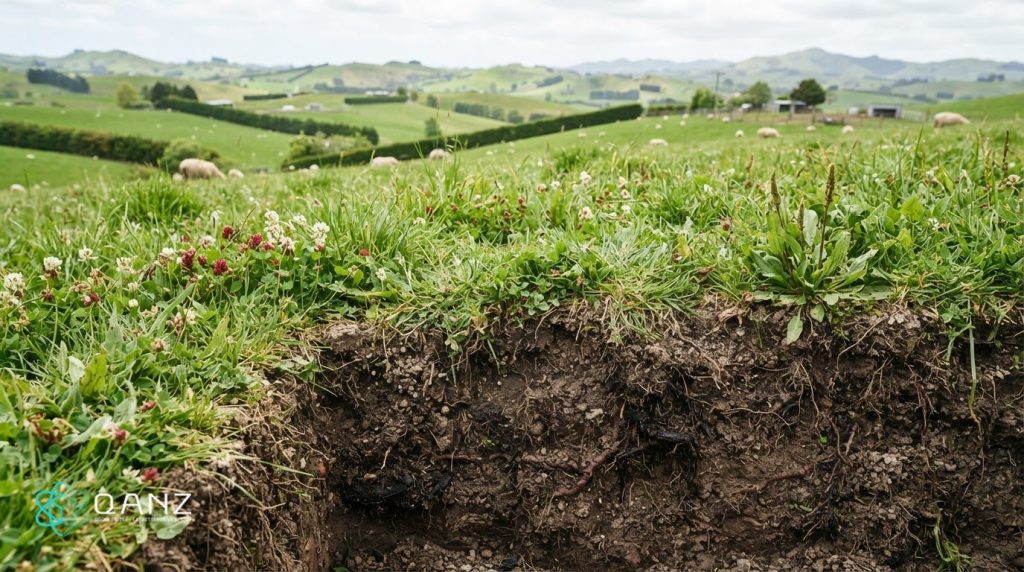
Soil health is more than a soil test result. Future-proofing your farm with soil health starts with understanding how its physical structure, chemical balance and biological activity work together. Healthy soil supports root growth, water movement and nutrient cycling, helping pasture and rangeland systems function through changing conditions.
When dry spells, heavy rain or uneven pasture growth put pressure on a farm, it makes sense to look at soil. Soil condition influences how water enters and is retained, while plants and soil organisms help cycle nutrients.
This article explains what soil health means in practical terms and how its physical, chemical and biological dimensions connect. It also explores practices that can support pasture and rangeland soils, including maintaining ground cover, encouraging plant diversity, reducing unnecessary disturbance and managing grazing with soil condition in mind. The aim is to give you a clearer basis for decisions that fit your land and farming system.
Key Takeaways
- Assess soil health through its physical structure, chemical balance and biological activity, rather than relying on a single measure.
- Keep soil covered with suitable pasture, forage or cover crops to protect the surface and support soil organisms.
- Recognise how soil structure affects water infiltration, moisture retention and the movement of nutrients through the soil.
- Support nutrient cycling by maintaining living roots, diverse plants and organic materials that feed soil biology.
- Adapt grazing and cultivation practices to your paddocks, aiming to maintain ground cover and minimise unnecessary soil disturbance.
What is soil health?
Soil health describes how well a soil’s physical structure, chemical conditions and living organisms work together. For New Zealand farmers, these functions affect how soil supports plants and responds to challenging weather.
For grants, advisers and resources, consult your regional council’s published land-management guidance and your farm adviser. Ask about current support that relates to your property and the soil issue you’re addressing. Eligibility depends on each programme’s criteria.
Cover crops and crop rotation
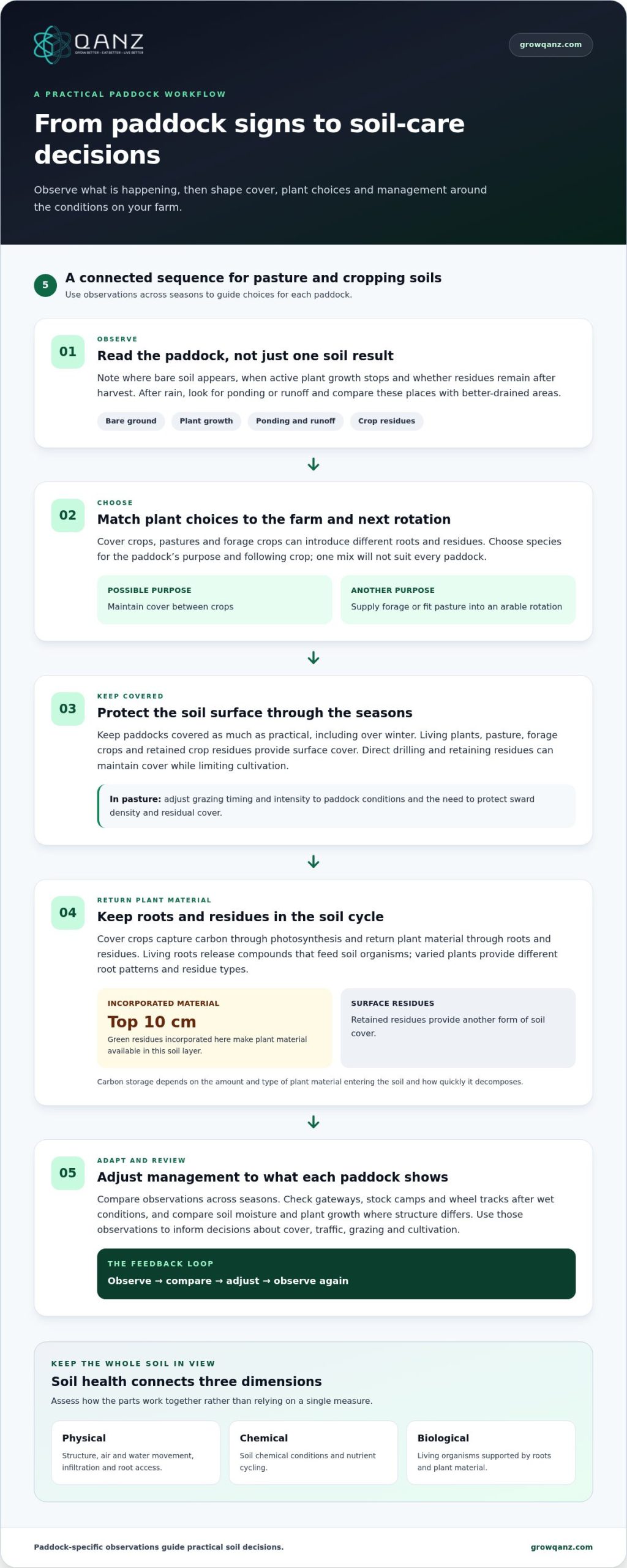
Cover crops are grown between or alongside main crops to keep soil active and covered. Diverse cover crops, pastures and forage crops introduce different roots and residues to a rotation, supporting a range of soil organisms. Choose plants suited to your farm and following crop rather than assuming one mix will suit every paddock.
Rotations change the timing and type of plant material returned to the soil. For example, a farmer might include a forage crop between cash crops or introduce pasture into an arable rotation. These choices can spread root activity across the year and avoid relying on a single crop type.
Keeping soil covered with plants
Living plants, pasture, forage crops and retained crop residues protect the soil surface. Keep paddocks covered as much as practical, including over winter, rather than leaving bare ground exposed. Direct drilling and retaining residues can maintain cover while limiting cultivation.
Ground cover shields soil from direct sunlight and temperature extremes, while providing habitat for soil microbes and insects. In pasture, strategic grazing can help maintain sward density and residual cover. Adjust timing and intensity to paddock conditions and the need to protect the soil surface.
Cover crops and carbon storage
Cover crops capture carbon through photosynthesis and return plant material to the soil through roots and residues. Keeping plants growing for longer can support soil carbon inputs, while living roots release compounds that feed soil organisms.
Green residues can feed soil bacteria. Incorporating them into the top 10 centimetres of soil can make that plant material available there, while retained surface residues provide another form of cover. These practices contribute to carbon cycling; storage depends on the amount and type of plant material entering the soil and how quickly it decomposes.
Plant diversity matters because species have different root systems and growth patterns. A pasture or forage mix can keep roots active for more of the season than a single crop, while varied residues provide different food sources. Select species for the farm’s purpose, such as maintaining cover between crops or supplying forage, and consider how each fits the next rotation.
To assess a paddock, note where bare soil appears, when active plant growth stops and whether crop residues remain after harvest. Compare observations across seasons to identify gaps in cover. This gives you a practical basis for adjusting crop or pasture choices to your land and production system.
Connections between soil health and water quality and quantity
Soil condition affects how water enters, moves through and remains in the root zone. On New Zealand farms, these processes influence plant access to water and the movement of sediment and nutrients across paddocks.
Healthy soil can support productivity and drought resilience by improving infiltration and moisture retention, helping plants access water between rainfall or irrigation events. These functions may contribute to steadier production, but profitability depends on how soil management fits farm operations and input decisions.
Soil structure and water movement
Soil structure is the arrangement of particles into aggregates, with gaps that allow air and water to move. These pathways help rainfall enter the soil profile rather than flow across the surface, carrying sediment and nutrients away. For example, stable aggregates can help a paddock absorb rain more effectively than compacted ground. Protecting soil structure supports root access to air and water.
After rain, note where water ponds or runs off and compare those areas with well-drained parts of the same paddock. These observations can help identify where compaction or poor structure may be affecting water movement. Cover crops protect exposed ground, while reduced disturbance helps preserve existing soil aggregates.
Water retention and crop resilience
Soil organic matter supports water retention, while better soil structure can increase infiltration. Together, these qualities affect how much water remains available to plants after rain. During a dry spell, water that infiltrates and remains in the soil profile can support root activity longer than water that runs off the surface.
For New Zealand growers, assess how individual paddocks respond to rainfall and irrigation rather than assuming the same management suits every soil. Compare plant growth and soil moisture in areas with contrasting structure. This can help identify where poor infiltration or limited water retention may constrain pasture or crop growth, and inform decisions about cover and traffic.
Compaction and waterlogging
Compaction reduces the gaps through which air and water move, while waterlogging fills those spaces with excess water. Both conditions can restrict roots and disrupt soil processes. Compacted ground may shed rainfall, while poorly drained areas can remain saturated. After wet conditions, check gateways, stock camps and wheel tracks, where damage is often easy to spot.
Compaction and waterlogging can contribute to nitrogen, phosphorus and carbon losses from soil. If a paddock stays wet, consider whether traffic, restricted drainage or soil structure is involved. Managing stock movement and machinery access to suit soil conditions can reduce pressure on vulnerable areas and help protect the surface.
Irrigation water quality matters because water can affect soil conditions and its microbiome. Testing irrigation water or soil can help assess this relationship. Carbon filters and compost weirs are options for filtering irrigation water. Filtration addresses water quality; soil structure governs water movement through the profile.
Record where irrigation ponds, runs off or leaves unevenly wetted areas, then compare those observations with soil condition and plant growth. This helps growers consider water quality, soil structure and crop performance together. If waterlogging recurs, its pattern across a paddock can help distinguish a local traffic issue from a broader drainage or structure concern.
Soil microbiome diversity and nutrient cycling
Soil microbes help transform nutrients into forms plants can access, while roots and residues provide food for soil organisms. To identify New Zealand requirements for soil protection, erosion and nutrient management, consult current official guidance for your location and proposed activity.
A diverse soil microbiome includes bacteria, fungi and other organisms involved in decomposing plant material and cycling nutrients. Their activity depends on food sources, moisture and soil conditions. Plants release root exudates, including sugars, while decaying roots and litter provide additional food. These relationships connect the plants in a paddock with the nutrients available through the season.
Soil testing and nutrient availability
Soil testing measures selected soil properties and nutrient levels in a sample, helping indicate whether particular nutrients may be available to plants. It does not directly describe every biological process or the condition of an entire paddock. Soil carbon stocks can vary significantly within a paddock, so representative sampling matters when measuring them.
Take samples from areas with similar soil and management, rather than combining contrasting zones such as a stock camp and a hill face. Compare results with crop or pasture performance and management history. This can help distinguish a paddock-wide pattern from a local issue before you decide which nutrients need attention.
Nutrient cycling and mineral deficiencies
Nutrient cycling is the movement and transformation of elements between soil, organisms and plants. Growth can be limited when a needed nutrient is unavailable, but poor soil conditions or restricted roots can also limit plant access.
Assess soil results alongside plant growth and paddock history. If a mineral imbalance is present, addressing that constraint may be more useful than applying a broad mix. Soil fungi can help mobilise phosphorus held in soil, while mycorrhizal fungi exchange soil-derived nutrients with plants for carbon sugars from roots.
Nutrient cycling and fertiliser use
Nutrient cycling can inform fertiliser decisions by showing how soil organisms and plants process existing nutrients. Healthy soil biology can help unlock nutrients within the soil profile, but it does not establish that every crop’s nutrient needs are met.
Match applications to identified needs and active plant growth. Excess nutrients can disrupt soil function, while a genuine deficiency can constrain production. Don’t assume greater microbial activity will automatically reduce fertiliser use. Use soil and plant observations to guide decisions throughout the season.
Livestock also influence nutrient movement. Grazing returns nutrients in dung and urine, but distribution can vary across a paddock. Compare soil and pasture conditions between camps, gateways and less-frequented areas. Combining these observations with plant growth and soil test results gives a fuller picture of nutrient cycling than relying on one indicator alone.
Soil health practices for pastureland and rangeland
Pasture soil health depends on living roots, ground cover, organic matter and grazing pressure. Regenerative management considers how these factors work together to support soil function as seasons change.
Pasture quality and root growth
Pasture quality and root growth are linked: actively growing plants develop roots that contribute organic matter below ground. Root activity also supports soil organisms and helps maintain structure. For example, vigorous pasture with good residual cover continues to provide root inputs, while repeated close grazing can reduce leaf area and slow regrowth.
Assess pasture condition alongside soil indicators. Look for bare patches, shallow rooting, runoff and signs of compaction after grazing. These observations help distinguish a feed-quality issue from a soil constraint. Match grazing pressure to plant recovery, leaving enough residual material to protect the soil and sustain new growth.
Pasture and crop diversity
Pasture and crop diversity means growing different species in a pasture or rotation, with varied roots and growth patterns. Diverse pasture species can provide soil organisms with different root-derived food sources and help keep living roots present for more of the season.
Management differs by farming system. Dairy farms balance pasture recovery with frequent feed demand; sheep and beef systems can use grazing rotations and deferred paddocks; cropping farms can include forage or perennial phases where they suit the rotation. In every case, choose species for the local soil, climate, livestock needs and the next crop or pasture phase.
In New Zealand, farmers are advised to defer 10-15% of pasture, choosing paddocks that are not overrun with weeds. Deferred paddocks can be closed from mid-spring, when pasture starts seeding, until early autumn after seeds drop. Treat them like new pasture and graze lightly again before winter.
Costs and returns of soil practices
The costs and returns of soil health practices depend on establishment, seed, labour, grazing flexibility and the value of resulting feed or ground cover. For example, changing a pasture mix involves an establishment decision, while deferred grazing may use existing pasture but change feed availability and utilisation.
Farmers should compare those inputs with practical outcomes, such as pasture persistence, soil cover and the need to restore damaged areas. Deferred pasture utilisation may be as low as 50% when the paddock returns to the rotation, so account for that feed trade-off. Returns depend on how the practice fits the farm’s production calendar and constraints.
Grazing management can help reduce compaction and erosion by limiting stock pressure on wet or vulnerable ground, maintaining pasture residuals and keeping soil covered. Use paddock observations to adjust access when soils are soft, and avoid concentrating animals on bare slopes or gateways. These steps protect soil structure while allowing pasture to recover.
For a deferred paddock, plan when to close and return it to grazing around pasture growth, seed drop and feed demand. This makes the practice part of the grazing rotation rather than a fixed calendar rule, helping you balance soil cover with available feed.
Physical, chemical, and biological dimensions of soil health
Soil health reflects how physical condition, chemical balance and biological activity function together. Considering all three helps New Zealand farmers understand why a paddock performs as it does, rather than treating one soil measurement as a complete diagnosis.
Physical condition: structure, air and roots
Physical condition includes aggregate stability, compaction, drainage and the space roots can explore. A spade inspection can show whether roots follow cracks, branch through the profile or stop at a dense layer. Compare several representative spots, as a gateway may differ sharply from the rest of a paddock.
Mechanical and chemical disturbance can affect soil microbes, especially fungi that help maintain soil health. Reduced or zero tillage can protect structure, while deep ploughing can bury nutrients. Before choosing a cultivation response, consider the depth and location of any restriction; disturbance alone may not address its underlying cause.
Chemical condition: balance and availability
Chemical condition covers nutrient availability and balance, as well as factors such as soil pH. A soil test provides information about selected chemical properties, but results need to be interpreted in relation to the crop or pasture being grown. Nutrient excess can sometimes constrain soil function as much as deficiency.
Compare test results with plant appearance, rooting and paddock history before deciding on an amendment. Uneven growth, for example, may have several contributing factors, so one low reading should not automatically prompt a broad nutrient application. Soil organic matter also varies with soil type and management, making context important when interpreting results.
Biological activity: organisms and living roots
Biological activity includes organisms involved in decomposing plant material and cycling nutrients. Their activity is shaped by habitat, food sources and the surrounding physical and chemical conditions. Earthworms provide one visible indicator, but their presence alone cannot represent the full soil community.
Earthworm numbers can triple within 18 months of sowing a grass or herbal ley. Treat that figure as an example, not a prediction for every New Zealand paddock. Assess earthworms alongside root distribution, residue breakdown and soil condition to build a broader picture of biological activity.
These dimensions interact in everyday farming. A compacted layer can restrict roots, which can limit a plant’s access to nutrients even when soil chemistry appears suitable. Grazing pressure, cultivation and inputs can each influence more than one dimension, so review management decisions in relation to the constraint you observe. This is a practical way to apply regenerative agriculture without assuming one practice suits every farm.
For an overview of biological growing approaches related to soil health, explore soil biology and growing technology.
GrowQanz: Quantum Organic-Total®
Quantum Organic-Total® is a microbial agricultural input offered by QANZ for use in crop and soil programmes. It may be considered alongside practical soil management, including attention to pasture cover, root growth, nutrient cycling and soil structure. It does not replace these practices, which remain central to managing soil health.
When choosing an input, consider its intended use within your crop, growing system and existing management programme. QANZ provides product and application support to help growers consider where Quantum Organic-Total® may fit. Focus on the soil constraints you’ve observed and the outcomes you’re working towards, rather than treating an input as a stand-alone solution.
For information about Quantum Organic-Total®, visit GrowQanz online.
Make your next soil decision deliberate
Future proofing your farm with soil health is an ongoing management commitment, built through informed decisions rather than a single intervention. Choose one paddock priority for your next planning cycle, such as maintaining cover or addressing a recurring soil constraint. Record what you observe and use it to guide your next decision.
Keep the process practical. Set a point in the season to review the paddock, note what has changed and decide whether your approach still fits the farm’s needs. This links day-to-day management with longer-term soil care without treating any one practice as a universal answer.
For growers considering biological inputs, GrowQanz offers Quantum-VSC® and Quantum. To discuss your soil health priorities and possible next steps, contact GrowQanz about soil health. A considered plan can help you keep building knowledge of your land and make purposeful choices for the seasons ahead.
Frequently Asked Questions
What are root exudates?
Root exudates are compounds, including sugars, released by living plant roots into the surrounding soil. They provide a carbon source for microbes near the root, linking plant growth with biological activity. For instance, a growing pasture root can feed organisms in its immediate soil zone, while different species vary in the timing and pattern of release. Exudates are one part of the soil food supply, alongside dead roots and plant litter.
What does soil health mean for New Zealand farms?
For New Zealand farms, soil health means the soil can support production while maintaining its physical, chemical and biological functions. A dairy pasture, sheep-and-beef paddock and arable field face different pressures, so useful indicators vary with land use. Consider whether roots establish, water infiltrates, nutrients remain available and living cover persists through vulnerable periods. These observations connect soil condition with management decisions.
Which soil health indicators should NZ farmers measure and how often?
Choose indicators that relate to a management question: pH and nutrient status for fertility decisions, organic matter or carbon for longer-term change, and structure, compaction and infiltration for physical condition. Biological observations, such as earthworm presence and root condition, add context. Sampling intervals vary by indicator. Repeat sampling at comparable locations and methods, at consistent points in the farm’s management cycle, then interpret results alongside paddock history.
How can NZ farmers improve soil organic matter and soil structure?
Build organic matter by maintaining plant inputs through roots, residues, pasture growth or suitable organic amendments. Protect structure by limiting unnecessary cultivation and avoiding heavy traffic when soil is wet. On a cropping block, retain residues where practical; in pasture, manage grazing to avoid scalping and bare patches. Match the practice to the constraint: adding organic material alone will not resolve compaction or poor drainage.
What cover crops and crop rotations work best for New Zealand farms?
No single cover crop or rotation suits every New Zealand farm. Select plants according to the sowing window, soil, moisture, livestock or machinery needs, and the following crop’s requirements. A vegetable grower may prioritise cover between cash crops, while a mixed farm may include a forage phase for livestock. Choose species suited to local conditions that can be managed without delaying the next crop.
What risks or trade-offs should farmers consider when changing soil management?
Soil health practices can involve short-term trade-offs: a cover crop may compete for moisture, deferred grazing changes feed availability, and reduced cultivation can require adjustments to weed or seedbed management. Planning, seed and labour also require resources. Start where the soil issue is clear, record baseline conditions and compare the changed paddock with a similar area under existing practice. Track production and soil observations together.
Disclaimer
Important: This article provides general agricultural information only. Product performance can vary according to crop, soil, climate, management practices and application conditions. Trial or research results discussed may have been obtained under specific conditions and should not be interpreted as a guarantee of equivalent results. Always follow current product directions and confirm suitability for your crop, growing system and organic certification requirements. Contact QANZ for current product and application information.
