
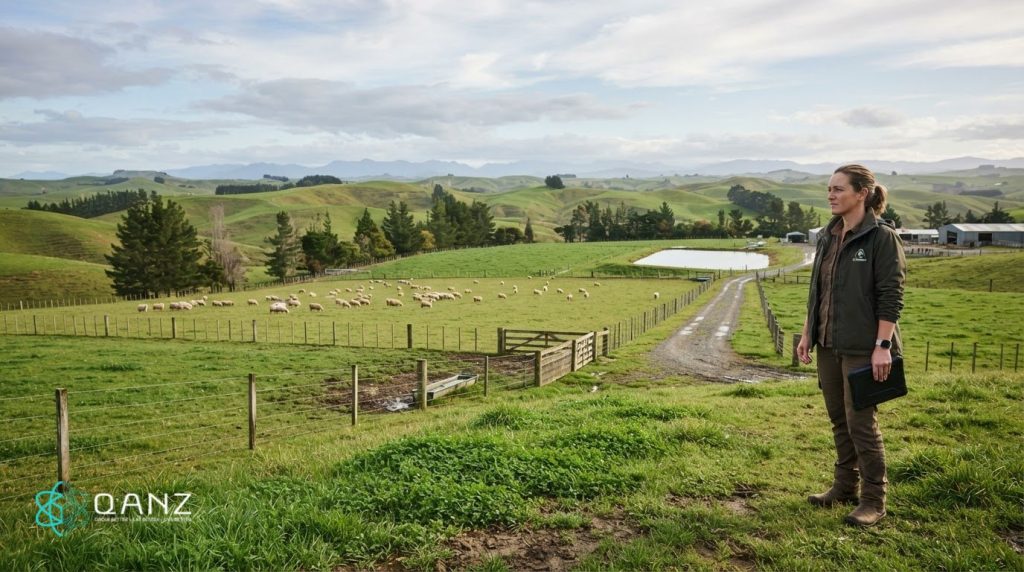
New Zealand farms should plan for longer dry spells, longer summers, shorter winters and continuing increases in storms, wind and rainfall by 2040. Improving farm resilience to climate change in NZ starts with understanding how these shifts could affect your local conditions, feed supply and farm system, then preparing practical responses that can adapt as circumstances change.
Weather has always varied, but the combination of dry periods and intense rainfall can put pressure on pasture, livestock, soils and freshwater. A flexible plan can help you prepare for extreme conditions, build feed buffers and identify ways to manage emissions and nitrogen leaching alongside day-to-day production.
This article explains projected climate changes in New Zealand, how drought risk varies across the country, and practical resources and farm-system actions that can support adaptation. It also covers feed management and environmental measures to help you identify useful next steps for your operation.
Key Takeaways
- Understand how longer dry spells, warmer conditions and more intense weather could affect your region and farm system.
- Use local climate projections to identify drought pressures and prepare for changes in rainfall, wind and water security.
- Build a flexible farm adaptation plan, including actions for adverse events and ways to protect soil, freshwater and biodiversity.
- Review feed supply and grazing decisions to strengthen feed buffers and manage livestock emissions.
- Explore practical approaches to reducing greenhouse gas emissions and nitrogen leaching as part of long-term farm planning.
Reducing greenhouse gas emissions and nitrogen leaching on dairy farms
New Zealand agriculture produces almost half of the country’s total greenhouse gas emissions. On dairy farms, methane from livestock digestion and nitrous oxide associated with nitrogen losses are distinct sources, so management needs to address both.
For farm water use, irrigation, wetlands and land management, site-specific requirements sit within relevant regional and district plans and resource consent conditions. The Resource Management Act 1991, section 7 requires local authorities to take account of climate-change effects when carrying out their functions.
New Zealand’s target is to reduce biogenic methane emissions to 10% below 2017 levels by 2030. Under the Climate Change Response (Zero Carbon) Amendment Act, New Zealand must reduce biogenic methane emissions by 24-47% by 2050. These targets make farm emissions planning relevant to long-term system decisions, not only annual reporting.
Methane from sheep and cattle is released primarily through burping as a by-product of digestion. Methane remains in the atmosphere for around 12 years before breaking down; over 100 years, one tonne produces the same amount of warming as 30 tonnes of carbon dioxide. Nitrogen-based fertilisers can contribute to nitrogen leaching and increased nitrous oxide emissions, linking nutrient management with freshwater and greenhouse-gas outcomes.
Start with a farm-level inventory of emissions sources and carbon storage. Record livestock numbers, feed-management practices, nitrogen inputs and areas of woody vegetation. Then identify practical changes, such as matching nitrogen applications to pasture and crop needs, avoiding applications when conditions increase the risk of loss, and protecting vegetation where it fits the farm system. These steps support informed decisions, but do not imply a fixed emissions reduction.
Sequestration is carbon captured and stored, including in growing trees. Beef + Lamb New Zealand’s woody vegetation factsheet explains why sequestration matters and how farmers can calculate on-farm carbon stocks and sequestration. The Ministry for Primary Industries’ default carbon tables help estimate sequestration for post-1989 forest land. Use each resource for its stated purpose, and keep the land area and vegetation records used in calculations.
- Beef + Lamb New Zealand woody vegetation factsheet: understand on-farm carbon stocks and estimate sequestration from woody vegetation.
- Ministry for Primary Industries default carbon tables: estimate sequestration for post-1989 forest land.
Make greenhouse-gas management a regular part of farm planning: identify major sources, choose relevant actions and review records as the system changes. On dairy farms, assess methane from livestock alongside nitrogen inputs, leaching pathways and vegetation. This joined-up view keeps emissions, freshwater and land-management decisions connected.
Drought severity, duration and frequency across New Zealand climate regions
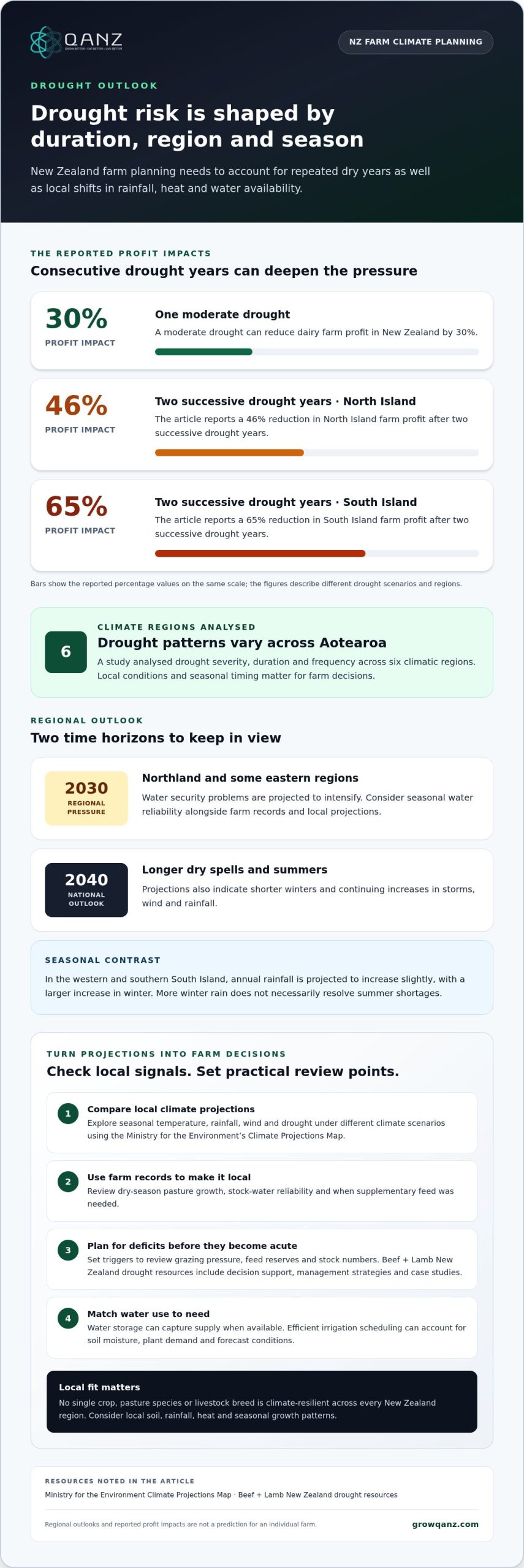
New Zealand’s drought risk varies by region and season. A study analysed drought severity, duration and frequency across six climatic regions, while projections indicate longer dry spells and summers by 2040. For farmers, the practical question is how those patterns affect pasture growth, water supply and stock feed on their own land.
Impacts can accumulate across consecutive seasons. A moderate drought can reduce dairy farm profit in New Zealand by 30%. Two successive drought years can reduce North Island farm profit by 46% and South Island farm profit by 65%. These figures show why plans need to account for drought duration, not only the severity of one dry spell.
Regional differences matter. Water security problems in Northland and some eastern regions are projected to intensify by 2030. In the western and southern South Island, annual rainfall is projected to increase slightly, with a larger increase in winter. More winter rain does not necessarily resolve summer shortages, so seasonal timing matters as much as annual totals.
The Ministry for the Environment’s Climate Projections Map lets farmers explore projected local and seasonal temperature, rainfall, wind and drought under different climate scenarios. Compare relevant scenarios with farm records, including dry-season pasture growth, stock-water reliability and periods when supplementary feed was needed. Beef + Lamb New Zealand’s drought resources offer decision support, management strategies and case studies for dry conditions, including advice for farmers and their teams.
Beef production is exposed to changes in pasture and water availability, as well as livestock heat stress. Longer dry spells can reduce pasture growth and tighten feed supply; heat can also challenge stock welfare and performance. A farm plan can set triggers to review grazing pressure, feed reserves and stock numbers before pasture deficits become acute.
No single crop, pasture species or livestock breed is climate-resilient across every New Zealand region. Match crop maturity, pasture persistence and seasonal growth patterns to local soil, rainfall and heat conditions. Select livestock genetics to suit the farm’s production goals and environmental pressures.
Farm water storage can capture supply when it is available, while efficient irrigation directs water to crop or pasture needs and reduces avoidable losses. Scheduling around soil moisture, plant demand and forecast conditions helps prioritise limited water during dry periods.
Biogenic methane targets add another consideration for beef systems, alongside drought adaptation. The targets discussed earlier make it important to consider how stocking, feed supply and production decisions interact with emissions planning, rather than treating climate resilience as only a water issue.
Assess drought using three separate measures: severity, duration and frequency. Compare pasture or soil-moisture impacts, how long recovery takes, and how often similar dry conditions recur in farm records. Keeping these measures distinct helps show whether the priority is a deeper feed buffer, faster recovery planning or preparation for repeated dry seasons.
Long-term farm-system adaptation planning
Long-term adaptation starts with understanding which weather pressures affect your farm and where the system is exposed. A qualitative study of seven dairy farms throughout New Zealand examined how farmers adapted, including through incremental changes and broader shifts. Applying those lessons to local conditions is a practical part of improving farm resilience to climate change in NZ.
Build an adverse-event plan around decisions, not just hazards. List conditions that could disrupt grazing, access, water supply, animal care or staff safety. For each, record actions, responsibilities and communication steps. After a flood or drought, review what happened and update the response for the next event.
In New Zealand dairy farm case studies, lower stocking rates were used to create larger feed buffers. Other examples included whole-season once-a-day milking and investment in housing infrastructure. Before changing the system, compare how each option fits feed supply, labour, animal management and the farm’s longer-term direction.
Adaptation choices involve trade-offs. Lower stocking rates can create more feed flexibility, while changing milking routines or adding housing alters daily operations and investment needs. Assess each option against the risk it addresses, the resources it requires and the farm’s priorities. Costs and benefits depend on the land, infrastructure, labour and management changes involved.
Biodiversity planning also belongs in a whole-farm assessment. Trees on marginal land can store carbon as they grow and may help improve soil and water quality, biodiversity and flood control. Planting uses land and requires establishment and management. A Tikokino farm example included establishing 10 QEII bush and scrub covenants, illustrating how protecting existing native areas can fit a long-term plan.
Combine science with local experience. Beef + Lamb New Zealand’s climate adaptation resource outlines projected impacts on farming systems and advice for building resilience. Use it to connect climate risks with management actions, then compare its guidance with farm records and local observations.
Assess adaptation options against consistent criteria before making changes:
- Exposure: identify the hazard, affected land and vulnerable farm activities.
- Practicality: consider feed, labour, infrastructure and management requirements.
- Natural capital: assess potential effects on soil health, biodiversity and freshwater.
- Flexibility: prioritise actions that can be adjusted as conditions and farm priorities change.
No single measure suits every farm. Use records, science and experience to review decisions over time. This flexible approach supports improving farm resilience to climate change in NZ as risks and operating needs evolve.
Climate change goals and action plans
New Zealand has a net-zero emissions target for 2050, so farm planning needs to connect emissions decisions with climate adaptation. Assess risks to production, natural resources and people, then set actions that can be reviewed as conditions and farm priorities change.
For practical adaptation advice, Beef + Lamb New Zealand’s climate-planning chapter covers greenhouse gas emissions and removals, climate resilience, risks, opportunities and planning actions. Its climate adaptation resource outlines projected impacts on New Zealand farming systems and advice for building resilience. These are advisory resources, not grant programmes. Use them to assess actions against your farm’s location, land use and operating needs.
Turn the broad goal into a working plan: record the farm’s main climate exposures and match each with a response. For example, link drought risk to feed planning, flood exposure to access and recovery actions, and emissions goals to sources identified in a farm greenhouse gas assessment. Assign responsibility and include a review after significant weather events.
Farm Environment Plans can help structure environmental actions. Perrin Ag describes these plans as action-focused, addressing water quality, biodiversity, greenhouse gases and soil conservation. Use a plan to connect related work rather than managing each issue in isolation. For example, assess whether a stream-margin action supports water quality, habitat and broader land-management objectives.
Before selecting an adaptation measure, compare its purpose, practical requirements and possible trade-offs. A farm might weigh feed security against stocking decisions, or consider how planting trees on marginal land affects available grazing while contributing to carbon storage, biodiversity and flood control. Record the reason for each choice, its intended outcome and the conditions that would prompt a review.
For planning support, use Beef + Lamb New Zealand’s climate-planning and adaptation resources to identify risks, opportunities and farm-system responses. They provide practical guidance for shaping an action plan, not financial assistance.
- Beef + Lamb New Zealand climate-planning chapter: organise actions across emissions, removals, resilience, risks and opportunities.
- Beef + Lamb New Zealand climate adaptation resource: relate projected farming-system impacts to resilience planning.
- Farm Environment Plan: structure practical actions for water quality, biodiversity, greenhouse gases and soil conservation.
Keep the plan usable: name each action, who will carry it out and the farm condition that triggers it. Review progress alongside farm records, then adjust priorities as climate risks and operational needs evolve.
Feed management to reduce emissions
Feed planning connects livestock nutrition with greenhouse gas management. Managing how much feed animals eat and what type they receive can help inform emissions planning. For New Zealand farms, the practical task is to match feed supply with animal needs while managing pasture, supplements and nutrient inputs as one system.
Start with a feed budget comparing expected pasture growth with stock demand. Use pasture-cover records, grazing rotations and seasonal growth patterns to identify likely shortages. A feed budget shows when supplementary feed may be needed and whether planned stocking levels fit the feed available across the season.
Then review the composition and amount of feed offered. Record pasture, conserved forage and supplements separately, noting changes in ration quality or availability. Livestock release methane as a by-product of digestion, so feed type and intake are relevant to emissions planning. Feed choices also influence how nutrients move through animals and return to paddocks.
Consider dietary nitrogen alongside methane. Compare the protein content of feed sources with animal requirements, and avoid adding nitrogen-rich feed without a clear nutritional purpose. Nutrients not used by livestock can return to the land in excreta. Combine feed records with fertiliser and grazing plans to manage nitrogen across the paddock.
Use a simple review process for each mob or herd:
- Estimate supply: use pasture-cover records and expected growth to map feed available through the season.
- Assess demand: group stock by production stage and nutritional needs, then compare demand with feed supply.
- Plan supplements: record the type, quantity and timing of supplementary feed in the ration plan.
- Review nutrient inputs: consider feed nitrogen alongside fertiliser applications and grazing management.
- Track changes: compare feed records with pasture condition, animal performance and emissions planning.
A feed budget helps identify seasonal gaps, while ration records let you compare what animals actually receive with the plan. A nutrient budget brings feed nitrogen, fertiliser inputs and farm outputs into one view. Together, these tools help assess trade-offs, such as securing feed during dry conditions while avoiding unnecessary nutrient inputs.
Climate pressures can change pasture growth and feed availability, so update feed plans as seasonal conditions shift. If a dry spell reduces pasture growth, for example, reassess grazing pressure, available supplements and stock demand together. This gives you a clear basis for adjusting the feed plan while keeping emissions connected to day-to-day management.
Ground the review in farm records. Compare planned and actual feed use, note which decisions supported the system, and carry those observations into the next feed budget. Linking feed, nutrient and emissions records helps New Zealand farmers make management choices that reflect their production system and seasonal conditions.
GrowQanz: Quantum Organic-Total®
Quantum Organic-Total® is a microbial agricultural input offered by GrowQanz for use in crop and soil programmes. It may be relevant if you are considering biological inputs as part of wider soil and crop management alongside the climate adaptation actions outlined above.
GrowQanz offers Quantum crop application programmes and product and application support to help you consider how an input fits your crop, growing system and application programme. Quantum Organic-Total® is BioGro New Zealand certified. Check its suitability for your certification programme and intended use against current GrowQanz technical and BioGro documentation.
A biological input does not replace planning for feed, water, emissions or extreme weather. Consider it as one component of a broader farm approach, and assess its role against your practical growing priorities.
For guidance on Quantum Organic-Total® and its use in your growing system, contact GrowQanz through growqanz.com.
Turn your next farm decision into a resilience step
A practical approach to improving farm resilience to climate change in NZ is to make a clear decision, record why it matters, then review its effect on your farm system. Choose a pressure that already affects day-to-day operations, such as feed availability, soil condition or nutrient management. A focused step gives you a useful starting point for future planning.
Biological inputs may be relevant where you’re considering soil and plant management as part of that wider approach. GrowQanz offers Quantum Organic-Total®, Quantum VSC® and Quantum. Each farm has its own crops, conditions and management priorities, so consider an input within the context of your existing programme.
Bring your crop, growing system and intended application programme into the discussion. Contact GrowQanz to discuss farm resilience and whether its products and application support suit your priorities.
Steady, informed decisions can help you keep adapting your farm plan as conditions change. Start with the next practical step.
Frequently Asked Questions
What is predicted to change?
New Zealand is expected to experience more hot days, shifts in rainfall, and changes in wind and sea levels. NIWA defines a hot day as temperatures above 25°C and projects increases in hot days across regions. NIWA projections indicate that by 2040, extreme wind speeds could increase by up to 10% in parts of New Zealand. NIWA projections indicate sea-level rise of 0.36-0.71 m by 2090, with local effects varying by place.
What climate risks are New Zealand farms facing, and how do they vary by region?
Farms face combinations of heat, drought, intense rainfall, flooding and stronger winds, with the dominant pressures differing by location. In the northern South Island, very wet days are projected to increase by 10% in the Marlborough Sounds region. Snowline changes also vary: in the western and southern South Island, the projected rise is from 1550 m to between 1700 m and 2000 m. Local conditions shape the consequences for each farm.
How can NZ farmers reduce flood, erosion, and soil-loss risks?
Keep protective ground cover, manage stock access on vulnerable slopes and maintain vegetated margins beside waterways. Before heavy rain, identify flow paths, exposed soil and areas where runoff could concentrate. After an event, inspect for rills, slips and sediment movement. Retaining vegetation on steep or erosion-prone land can help hold soil and slow runoff. Match actions to the landform, soil condition and water movement in each paddock.
How can farmers assess climate risks and create a farm adaptation plan in NZ?
Start with a farm map and records of past weather disruptions, then note which paddocks, assets, stock and activities were affected. Rank each risk by its likely effect on farm operations, and record a response, who is responsible and what conditions trigger action. Beef + Lamb New Zealand’s climate adaptation resource can inform the process. Review the plan after an event and update it using observations from the farm.
What crops, pasture species, and livestock breeds are most climate-resilient in New Zealand?
No single crop, pasture species or livestock breed is climate-resilient across every New Zealand region. Match crop maturity, pasture persistence and seasonal growth to local soil, rainfall and heat conditions, and select livestock genetics to suit the farm’s production goals and environmental pressures.
Disclaimer
Important: This article provides general agricultural information only. Product performance can vary according to crop, soil, climate, management practices and application conditions. Trial or research results discussed may have been obtained under specific conditions and should not be interpreted as a guarantee of equivalent results. Always follow current product directions and confirm suitability for your crop, growing system and organic certification requirements. Contact QANZ for current product and application information.
