
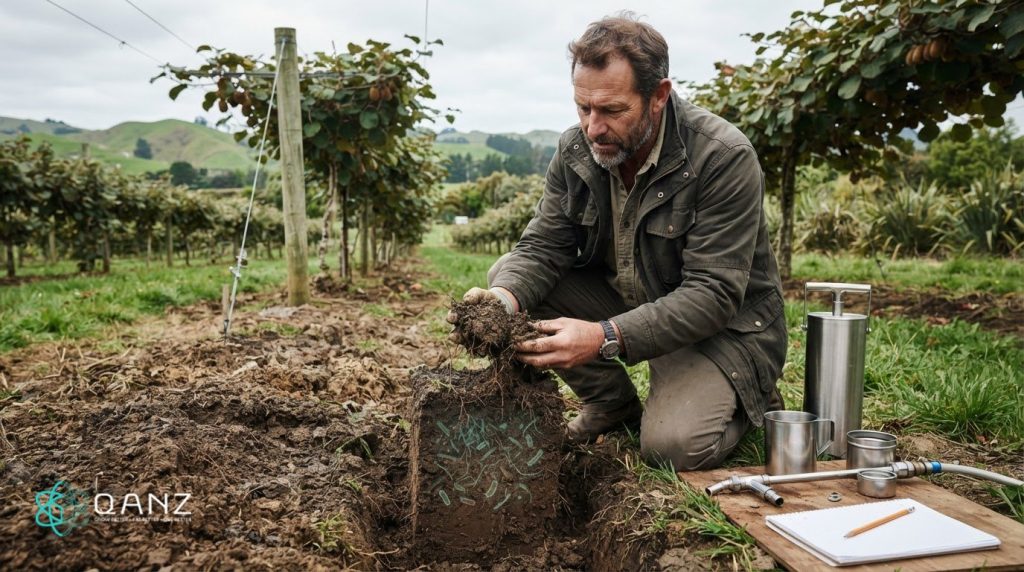
The common mistakes when applying soil microbes often come down to choosing an input before defining the crop need, overlooking product instructions or expecting a visible change straight away. Application conditions and the wider management programme also matter. A useful starting point is to identify what you want to assess, then check whether the exact formulation and its directions fit your crop and growing system.
This guide explains how to review soil conditions, product information and evidence before applying a microbial input. It also covers practical steps for keeping application records and assessing observations without attributing every change to one product. Quantum Organic-Total® is a microbial agricultural input for crop and soil programmes. It is best applied as a soil drench, but can be applied as a foliar. Always use the current product guidance for application details, and assess product-specific evidence separately from general information about soil biology.
Key Takeaways
- Define the crop or soil question first, then check that the exact formulation and its directions fit the intended use.
- A lack of immediate visible change doesn’t, by itself, show that an application has failed. Assess observations against a clear objective and suitable evidence.
- Consider biological inputs alongside soil management practices such as managing organic matter, moisture, pH, compaction and cultivation.
- Record application details and follow-up observations so you can review decisions in the context of the crop and growing conditions.
Why do soil microbe applications disappoint? Avoid these early mistakes
A sound application decision starts with a defined crop need, a product intended for that use and careful attention to its current instructions. Common mistakes when applying soil microbes include expecting a quick, obvious response or treating a biological input as a complete soil-management solution. If no change is immediately visible, that alone doesn’t establish whether the application succeeded. First consider what you expected to observe, when you expected to observe it and what else may have influenced the crop.
Mistaking an input for a complete soil management programme
A microbial product is one possible input within a broader crop and soil programme. It doesn’t remove the need to consider the conditions plants and soil organisms depend on, including organic matter, moisture, pH, soil structure, crop stage and cultivation practices. Don’t assume an input will address a limiting condition simply because it is biological.
If a crop is under stress, consider possible causes such as soil structure, water availability, nutrition or other parts of the management programme. An observation after application doesn’t, on its own, identify the cause or show that the product was applied incorrectly. Record the crop and soil conditions alongside what you notice, and avoid drawing a conclusion from a single factor.
Soil organisms interact with one another and with their environment. The Food and Agriculture Organization of the United Nations’ overview of soil biodiversity provides useful background on this broader picture. It is general information about soil biodiversity, not evidence that a specific commercial formulation will produce a particular crop outcome. Assess product claims against evidence for the exact formulation and intended use.
Expecting one result to apply everywhere
An observation from one crop or paddock doesn’t guarantee the same result elsewhere. Crop type and stage, soil properties, climate, application method and formulation can all affect how relevant a piece of evidence is. A commercial observation can help frame questions, but it isn’t the same as a controlled trial. Laboratory or overseas findings also shouldn’t be presented as proof of performance in a New Zealand field.
Growing conditions and programme requirements differ between New Zealand and Australia, and between farms within each country. Before relying on a result, identify the product and formulation, crop, location, application method and conditions. Also note the type of evidence: for example, whether it comes from a laboratory study, a trial or a commercial observation.
Keep expectations measured. A lack of immediate visual change may relate to the outcome being assessed, the assessment period or other crop and soil factors. A positive observation in one setting doesn’t establish that the same result will occur elsewhere. Compare the application plan with what actually happened, then review the wider programme before deciding what to change.
What soil conditions can affect microbial application?
Soil moisture, pH, organic matter and physical structure are relevant to soil biological activity, but none is a universal pass-or-fail test for every product or crop. Before applying an input, consider the paddock’s current condition and the crop’s needs alongside the formulation’s directions. Don’t assume that an overseas recommendation or a single soil target applies across New Zealand and Australia.
Assess soil moisture, pH and compaction
Soil organisms are part of a dynamic environment. Moisture affects the conditions in which biological processes occur, while pH influences the soil environment and nutrient availability. Compaction can restrict pore space and affect water movement and aeration. The USDA Natural Resources Conservation Service’s Soil Biology Primer provides background on interactions between soil organisms and their environment. These are general soil considerations, not proof of a specific product’s mechanism or performance.
Use available information rather than guesswork. Paddock observations, crop history and soil reports can help identify areas that are unusually dry, waterlogged, acidic or compacted for the crop. Interpret pH in the context of the crop and soil rather than against a universal target for microbial inputs. Where soil types, drainage or cultivation history vary across a field, assess those areas separately when planning the application.
New Zealand and Australian growers work across different soils, rainfall patterns and production systems. Conditions also vary within each country. Treat regional recommendations as a starting point, then check whether the crop, soil and formulation match the conditions behind that guidance. Follow the product’s current instructions for application details.
Consider organic matter and the wider cropping system
Organic matter is part of the habitat and resource context for soil organisms. Its amount, quality and distribution vary, so its presence alone doesn’t guarantee that an applied input will establish or deliver a particular result. Consider how residues, cover crops and other organic inputs fit the crop’s needs and the wider management plan.
Crop diversity and cultivation practices also shape the soil environment over time. Rotation, cover crops and reduced disturbance may influence soil structure and biological activity, but their effects depend on the production system. Don’t treat them as a guaranteed response to a microbial application. For field-crop context, GrowQanz’s field-crop programmes sit within crop-specific planning rather than replacing paddock assessment.
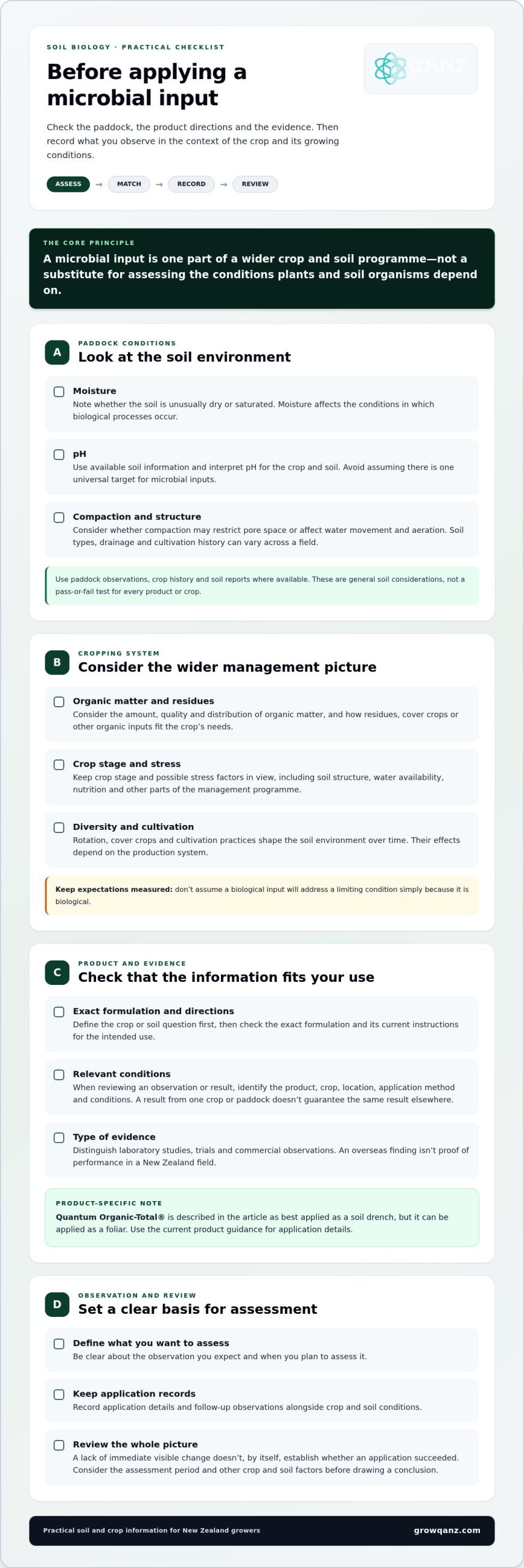
Before application, note:
- Moisture: Is the soil unusually dry or saturated, and what do the product instructions say about application?
- Soil condition: Are there signs of compaction, poor drainage or marked pH variation?
- System context: Which crop, residues, rotation and cultivation practices are relevant?
These checks help frame the decision; they don’t predict the outcome. GrowQanz’s biological growing programmes provide context for considering biological inputs within a wider crop plan.
Microbial inputs and soil management: what should growers compare?
When comparing a biological input with habitat-focused management or integrated programme planning, ask what each approach is intended to address, what evidence would support the decision and how it fits the crop. These choices are related but distinct. General knowledge about soil biology can guide questions, but it doesn’t establish that a particular formulation is suitable or effective in a specific situation.
| Approach | Purpose | Evidence to consider | Crop fit and practical considerations |
|---|---|---|---|
| Biological input | Apply a particular product as one component of a crop or soil programme. | Product-specific instructions and evidence for the exact formulation, use and relevant crop. | Check suitability, timing, handling and compatibility with the existing programme. |
| Habitat-focused management | Manage the wider soil environment through practices such as organic matter inputs, crop diversity and cultivation choices. | Evidence and agronomic guidance relevant to the practice, soil type and production system. | Consider crop rotation, residues, soil condition and the practical demands of the farm system. |
| Integrated programme planning | Coordinate inputs and management decisions around a defined crop or soil objective. | Evidence for each component, plus clear records of what was applied and observed. | Review interactions, operational timing and how outcomes will be assessed over the crop cycle. |
Compare a product application with habitat-focused practices
Organic matter, crop diversity and cultivation are management considerations, not guaranteed routes to a particular result. A product application raises the question of whether a specific input suits a defined use. Habitat-focused management considers how ongoing practices shape the soil environment. An integrated plan considers both without assuming one replaces the other. Begin by stating what you’re evaluating: a formulation, a soil-management priority or the overall crop programme.
Check whether evidence matches the formulation and crop
Independent research, manufacturer trials, overseas trials and commercial observations have different strengths and limits. Before interpreting a result, record the exact formulation, crop, location, conditions, application method and evidence type. A finding for one product doesn’t automatically apply to another. In particular, evidence for Quantum VSC® shouldn’t be attributed to Quantum Organic-Total®.
Check whether the evidence addresses the same crop and purpose, and whether the growing conditions are reasonably comparable. A commercial observation can help frame a question, but it doesn’t prove that the same outcome will follow elsewhere. This helps avoid a common mistake when applying soil microbes: treating general information about soil biology as proof for a specific product.
For New Zealand growers, overseas results may be informative, but they need to be interpreted in context rather than treated as direct recommendations. Match decisions to the relevant crop, soil and product instructions, and record the basis for them. QANZ’s biological growing programmes offer further context for considering inputs as part of a broader programme.
How can growers avoid mistakes when applying soil microbes?
A repeatable process makes application decisions easier to review. Define the crop question, check the instructions for the exact formulation, follow the stated application method and record what happens. This can reduce avoidable errors without assuming that a biological input will produce a particular result or that directions for one product apply to another.
Before application: confirm purpose, product and instructions
Define what you want to assess before choosing an input. Are you investigating a specific crop-management objective or responding to a broader soil condition? A clear purpose helps identify which evidence is relevant and what to monitor afterwards.
- Set the question. Record the crop, block or paddock, management objective and the observation that will help you review the decision.
- Identify the exact formulation. Read its current technical instructions. Check that its intended use fits the crop programme, and follow its stated directions for application rate, timing and handling.
- Review other planned inputs. Don’t assume that a microbial product is compatible with another product or suitable for a tank mix. Use only compatibility guidance supported by current product instructions or other appropriate technical information. Don’t change directions based on assumptions.
Instructions can differ between formulations, so don’t transfer rates or handling practices from another product, even if it appears to have a similar purpose. Resolve any uncertainty in the directions before application instead of improvising in the field.
During and after application: keep the process consistent
Once the plan is set, consistent application makes later observations more useful. Use the method stated for the specific product rather than switching to an unverified alternative. Record what was actually applied, including any departure from the plan and the reason. Brief, accurate field notes are more useful than relying on memory.
- Record the conditions. Note the application date, crop and growth stage, paddock or block, and relevant soil or weather observations.
- Log the programme. Record the formulation, method, rate stated in the product instructions and other inputs used as part of the programme.
- Review observations in context. Compare what you see with the original question, and note other changes in crop management or conditions. Avoid assigning a change to one input alone when several factors may have contributed.
Records won’t prove cause and effect by themselves, but they can show whether you followed the intended process and help guide future decisions. They also help distinguish an application issue, such as an unplanned change of method, from observations that may relate to crop, soil or programme factors. A consistent process addresses common mistakes when applying soil microbes without turning a single observation into a broad claim.
QANZ provides product and application support to help growers consider inputs within their crop programmes. Explore QANZ’s application programme information.
How should growers assess Quantum Organic-Total® for a crop programme?
Assess a microbial input against the crop question, soil conditions and current product instructions. Quantum Organic-Total® is a microbial agricultural input offered by QANZ for use in crop and soil programmes. Consider its intended use and product-specific information separately from general explanations of soil biology. This helps keep the decision grounded without assuming a particular crop response.
Match the product information to the intended use
Start with current technical information for the exact formulation. Review its stated suitability, application rates, handling and timing, then consider how those directions fit the crop programme. The application guidance for Quantum Organic-Total® is: Best applied as a soil drench, but can be applied as a foliar.
This describes the application method; it doesn’t establish suitability for every crop or growing condition. Assess the product against the intended use and relevant evidence, and don’t assume information about another formulation applies. Check product and BioGro documentation for current suitability, rates and certification requirements relevant to your intended use.
Make an evidence-aware next step
Evidence is most useful when it matches the formulation, crop, location, application method and conditions under consideration. General research on soil biology can inform the questions growers ask, but it isn’t automatically evidence of performance for Quantum Organic-Total®. Observations from one setting also shouldn’t be treated as a prediction for another. Keep any assessment grounded in the source and context of the information.
If organic certification requirements are relevant to your programme, confirm that the input is permitted for the intended use under the requirements that apply to your operation. An input’s certification status doesn’t make a crop, farm or produce certified organic; growers need to follow the requirements of their own certification programme.
Before deciding, bring together the crop objective, growing system, relevant soil information and existing programme inputs. This gives you a clear basis for assessing whether the formulation and application guidance fit, and for deciding what to record afterwards. It also helps avoid relying on broad biological claims instead of checking information for the exact formulation.
For product and application support, review QANZ’s crop programme information.
Make your next application a considered decision
Use each season to refine the questions behind your biological-input decisions. Before adopting an approach across a programme, decide what information is relevant to your crop and which observations would prompt a review. Assess the evidence, follow product-specific directions and keep decisions open to review. This turns uncertainty about common mistakes when applying soil microbes into a practical process.
Soil management involves many connected choices, not one application alone. A measured approach lets you consider biological inputs alongside the wider crop system without assuming outcomes in advance. It also gives you a clearer basis for assessing how a product’s intended use and application guidance fit your programme.
To discuss whether Quantum Organic-Total® fits your crop, growing system and application programme, contact QANZ for product and application support.
Frequently Asked Questions
Can soil microbes be applied with fertiliser or other crop inputs?
Only when current instructions for the exact microbial product support that combination. Compatibility can vary with the formulation and other input, so don’t assume products can be mixed in a tank or applied together because they are used in the same crop programme. Check the relevant directions before planning an application. If compatibility guidance isn’t clear, don’t improvise a mix; use product-specific technical guidance.
How long does it take for applied soil microbes to establish?
There isn’t one reliable timeframe for every microbial product, crop and soil. The outcome being assessed may not be immediately visible, and conditions vary. Check whether the product information describes an assessment period, and don’t use a general estimate as proof that an application has succeeded or failed. Record observations over a suitable period for the crop rather than relying on one early check.
Can fungicides affect beneficial soil microbes?
There isn’t a universal answer for every fungicide, soil organism or microbial input. A review by Zubrod et al. discusses fungicides as a pesticide class with potential non-target effects, but it doesn’t establish compatibility for a particular product combination. Check current instructions for the specific fungicide and microbial formulation. Don’t assume a tank mix or application sequence is suitable without product-specific guidance.
Should soil microbes be applied to wet or dry soil?
Neither wet nor dry is a universal target. Very dry or waterlogged conditions can affect the soil environment, but suitable conditions depend on the crop, site and product directions. Consider the soil where the product is intended to reach, not just the surface appearance. Follow the current instructions for the formulation rather than adding water or changing application timing based on a general rule.
Can the same microbial application guidance be used in New Zealand and Australia?
Not automatically. Crop systems, seasonal conditions, product documentation and certification requirements can differ between the countries and between farms. Use current local product information for the exact formulation and intended market. Overseas or neighbouring-country trial results may help frame questions, but they aren’t direct evidence for a different location or growing situation.
How should growers assess results after applying soil microbes?
Choose a relevant observation before application, such as a crop or soil measure already used in the programme, and record its starting point. If practical, compare similar areas managed consistently, noting differences in treatment and conditions. Record crop stage, date and other inputs, then review observations over an appropriate period. A change after application is useful information, but it doesn’t establish by itself that the input caused the change.
Is Quantum Organic-Total® applied to soil or foliage?
Quantum Organic-Total® is best applied as a soil drench, but can be applied as a foliar. The suitable method depends on the intended use and current product guidance. Check the latest QANZ technical information for rates and programme details before application. Assess the input alongside your existing management programme rather than assuming the same method or result applies across crops.
Disclaimer
Important: This article provides general agricultural information only. Product performance can vary according to crop, soil, climate, management practices and application conditions. Trial or research results discussed may have been obtained under specific conditions and should not be interpreted as a guarantee of equivalent results. Always follow current product directions and confirm suitability for your crop, growing system and organic certification requirements. Contact QANZ for current product and application information.
