
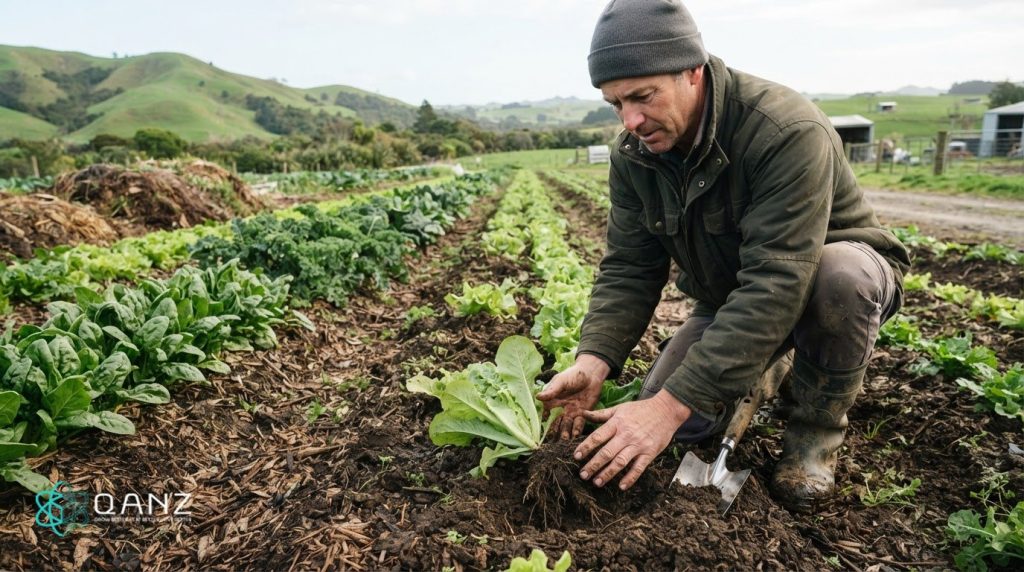
Five practical steps can help New Zealand growers reduce farm input costs sustainably: identify the biggest expense areas, target nutrients to crop needs, make suitable use of local inputs, use integrated pest management and assess new practices against a realistic budget. The key is to avoid cuts that undermine soil fertility or crop performance. This is how to reduce farm input costs sustainably while keeping long-term productivity in view.
It’s understandable to be cautious about investing in new practices when budgets are tight. Sustainable options can involve upfront costs, so compare their likely expense and practical benefits with your current system before making changes. This article explains how to assess major farm expenses, use compost, manure and crop residues where appropriate, avoid unnecessary pest-control applications and trial innovations in manageable steps. The aim is a grounded approach that connects input decisions with the needs of your land, crop and season.
Key Takeaways
- Review your farm’s major input expenses and target changes where they can reduce waste without undermining crop performance.
- Use monitoring and pest thresholds to guide integrated pest management decisions rather than relying on routine blanket treatments.
- Assess compost, manure and crop residues as locally available inputs, accounting for their fit with your soil and crop needs.
- Consider practices that support soil water retention and nutrient availability as part of a longer-term input plan.
- Introduce sustainable changes in stages, weighing upfront costs, practical barriers and likely value to your operation.
1. What is the biggest input cost on an Australian broadacre farm?
For Australian broadacre cropping, fertiliser is often a major variable expense, accounting for 25-35% of variable costs. Chemicals and herbicides account for 20-30%, while fuel and oil account for 10-15%. These figures help identify where to investigate savings, but New Zealand growers should assess their own accounts, crops and production systems rather than apply Australian cost patterns directly.
For New Zealand farms, practical ways to reduce input costs sustainably include targeting fertiliser and pest control, making use of suitable farm resources and improving application efficiency. Start by reviewing invoices and recording fertiliser, chemical, fuel, feed and finance costs separately. This breakdown shows which inputs have the greatest effect on your operation and where better timing or more accurate placement could help without cutting inputs indiscriminately.
New Zealand farm decisions should account for nutrient losses, water use and discharges alongside production needs. These environmental effects can shape fertiliser and irrigation choices, so consider the requirements relevant to your location and farming activity.
Soil testing and nutrient budgeting help match fertiliser applications to paddock needs. In New Zealand, use soil sampling results with a nutrient budget or worksheet to consider soil fertility, pH, crop demand and nutrients supplied by manure or legumes. Testing and budgeting costs depend on factors such as the number of samples, analyses selected and advisory work included. Compare the scope of each option with the decisions it will inform.
Lower fertiliser rates can reduce expenditure, but the yield response matters. One broadacre example reduces urea from 120kg/ha to 80kg/ha, cutting fertiliser cost by 33% while potentially reducing yield by 10-15%. Treat this as a trade-off to evaluate, not a universal recommendation: compare paddock history, nutrient status, crop value and the likely production response before changing rates.
On livestock farms, rotational grazing and pasture management can help control feed and fertiliser costs. Match grazing pressure to pasture growth, allow suitable recovery periods and use pasture and forage observations to guide feed decisions. Better use of existing pasture and farm-grown feed can reduce reliance on purchased supplements. Nutrient budgeting also helps account for manure and avoid fertiliser applications without a clear paddock need.
For irrigation, electricity and fuel, match each operation to actual need. Use soil-moisture observations to guide irrigation timing, maintain pumps and vehicles, keep tyre pressures correct and combine tractor operations where practical. These steps can reduce unnecessary water, electricity and fuel use without blanket cuts that could compromise crop or pasture performance.
2. Integrated pest management
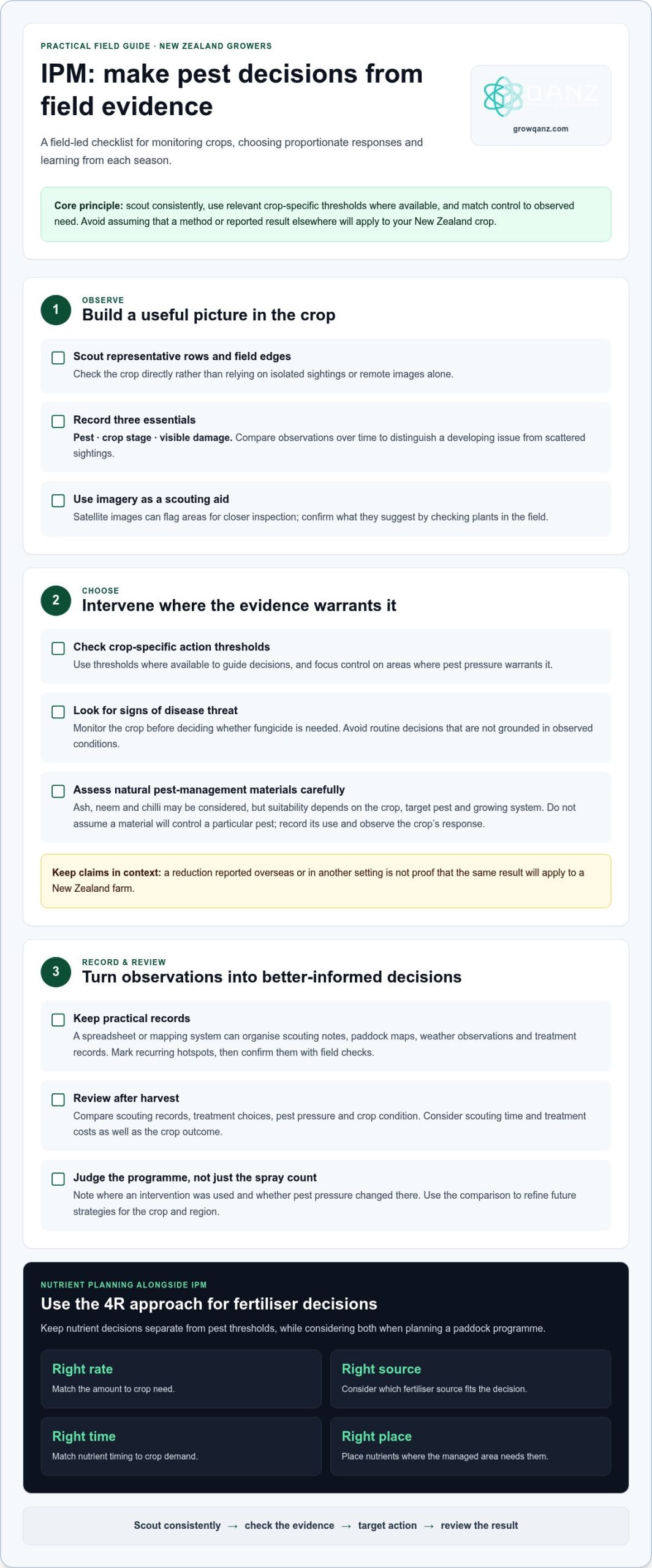
Integrated pest management (IPM) uses monitoring and a range of control methods to guide pest decisions. In a New Zealand crop block, scout representative rows and field edges, then record the pest, crop stage and visible damage. Compare observations over time before choosing an intervention. This helps distinguish an emerging problem from isolated sightings and gives each treatment decision a clear basis.
Use crop-specific action thresholds where available, and focus control on areas where pest pressure warrants it. For disease, monitor for signs of a threat before deciding whether fungicide is needed. Satellite imagery can identify areas for closer inspection, but it is a scouting aid, not a substitute for checking plants. Don’t assume a reduction reported overseas or in other settings will apply to New Zealand farms.
IPM also works alongside nutrient management. The 4R approach means the right fertiliser rate, source, time and place. For example, match nutrient timing to crop demand and application placement to the area being managed. Keep nutrient decisions separate from pest thresholds, but consider both when planning a paddock programme. This can help reduce avoidable applications while keeping crop requirements central.
Digital farm-management tools can organise scouting notes, paddock maps, weather observations and treatment records. Use a simple spreadsheet or mapping system to mark recurring hotspots, such as weeds along a boundary or pest damage in a particular crop zone. Satellite-based crop images can guide field checks, but confirm what they suggest by inspecting the crop. Records are most useful when they inform a decision, not when they simply accumulate data.
Natural pest-management materials also require careful judgement. Ash, neem and chilli are traditional pest-control materials, but their suitability depends on the crop, target pest and growing system. Don’t assume a natural material will control a particular pest. Record any use and observe the crop’s response. Seed saving is a separate input-management option: select healthy plants, retain seed with desired traits and store it cleanly and appropriately.
Review IPM decisions after harvest by comparing scouting records, treatment choices and crop outcomes. Note where an intervention was used and whether pest pressure changed in that area. This helps refine future strategies for each crop and region. Keep the comparison practical: consider scouting time, treatment costs and crop condition, rather than judging a programme solely by the number of applications.
Precision in IPM comes from matching action to observed need. Scout consistently, use relevant thresholds, confirm imagery in the field and maintain clear records. These steps support deliberate pest management without assuming one method or monitoring technology suits every New Zealand farm.
3. Using compost, manure and crop residues as local inputs
Compost, manure, slurry and crop residues can contribute nutrients and organic matter to farm soils. Their value depends on their source, condition and intended use, so assess each material as an input rather than treating it as a free substitute for purchased fertiliser. To reduce farm input costs sustainably, start by listing locally available materials, where they come from and which paddocks could use them.
Manure and slurry may supply nutrients, but their composition varies. Before including them in a paddock plan, consider available nutrient information, storage and handling, transport distance, spreading requirements and crop nutrient demand. Include manure and slurry alongside fertiliser in the nutrient budget, rather than adding them on top of the usual programme. This helps avoid overlooking nutrients already applied and makes cost comparisons more meaningful.
Compost also needs a practical assessment. Consider its source, maturity, handling needs and distance from the paddock, then weigh these factors against its potential role in soil management. A nearby supply may be easier to use than material requiring substantial transport. Crop residues involve a different choice: retaining them can return organic material and cover to the soil, while removing them may serve another farm purpose. Compare soil cover, feed demand and handling costs before deciding.
Rotation planning can connect local inputs with crop choice. Pulses and other legumes can contribute nitrogen within a rotation, while crop diversity can spread production and market exposure. For example, compare a pulse crop followed by a nutrient-demanding crop with a repeated single-crop sequence. Account for paddock history, local climate, suitable markets and machinery needs. A lower-input enterprise may suit a paddock where additional inputs are unlikely to produce a worthwhile economic response.
Use a crop budget to assess options before changing a rotation or investing in material handling. Record expected income and the costs of seed, fertiliser, labour, machinery, collection, storage and spreading. An ROI comparison should include those added tasks as well as potential input savings or additional revenue. A practical way to reduce farm input costs sustainably is to use farm-specific assumptions and revise them against actual paddock results.
Farm records can also guide crop and variety selection. Compare previous crop performance, planting dates, input use and seasonal conditions, then choose varieties and enterprises that match your operation’s resources and market requirements. Keep records by paddock so future budgets draw on local experience rather than broad averages that may not suit your soil or climate.
Risks include nutrient mismatch, added handling expenses and reduced production if inputs are cut without considering crop needs. Estimate payback by comparing input savings and any added income with the full cost of collecting, storing, transporting and applying local materials. Trial a suitable change in one paddock, track production and expenses, then use the results to guide any wider adoption.
4. How can producers balance innovation and sustainability without breaking the bank?
Start with soil practices that address water retention, nutrient availability and erosion together. Compost and other organic matter can help soils hold more water, improve nutrient availability, reduce erosion and recover faster after drought. Choose a suitable paddock, record its current management and compare soil and crop responses after changing practices. This staged approach limits upfront commitment while building farm-specific information.
Soil testing can identify where nutrients are already above the optimum range. Use the results with variable-rate spreading to direct fertiliser towards areas likely to respond, rather than applying one rate across an entire paddock. In pasture, a sub-maintenance rate may suit areas with nutrient status above optimum, provided pasture production isn’t reduced. Avoid short-term cuts that deplete soil fertility and constrain future production.
Match investment to a clear problem. If planting areas show uneven growth, for example, combine soil results with crop observations before investing in variable-rate equipment or services. Compare the cost of the new approach with the inputs it could help target, and begin in an area where results can be monitored. This makes innovation a measured operational choice, not an expense without a defined purpose.
Soil and crop monitoring make decisions more useful over time. Record soil moisture, crop condition, nutrient inputs and yield response by paddock. Use these observations to adjust planting plans, fertiliser timing and irrigation schedules. Soil-moisture monitoring can help avoid unnecessary irrigation, while cover crops and crop rotation can support soil health and biodiversity. Choose practices suited to local soils, climate and production demands.
Data-driven farming can reduce input costs by up to 30% while maintaining or increasing yields, according to studies in Kenya and South Africa. Those study results relate to those contexts, not a forecast for New Zealand farms. Use the principle, linking better information to more precise input decisions, and evaluate performance with your own records rather than assuming the same result.
For grants, rebates or support programmes, assess options against the investment type and region. Compare eligibility, co-funding, application timing and reporting requirements, then include only funding you can rely on in your budget. This keeps decisions grounded in the project’s full cost, including equipment, labour, maintenance and the time needed to measure soil or crop outcomes.
Treat soil health as a productive asset. Better water retention and nutrient availability can support resilience, while targeted applications can reduce avoidable input use. Review records after each crop or grazing cycle, then continue, adapt or pause the practice based on observed soil condition, crop performance and whole-farm costs.
5. Barriers to adopting sustainable practices
Upfront investment can slow adoption, even when a practice may suit the farm’s long-term direction. No-till systems, composting and agroforestry can involve equipment, materials, labour or planning costs before benefits become apparent. For New Zealand growers, these expenses compete with seasonal cash flow, repairs and other production needs. The challenge is not just deciding whether a practice has merit, but fitting the transition into the farm’s finances and workload.
Uncertainty about production outcomes is another barrier. Changes to cultivation, nutrient inputs or crop rotations can affect yield, quality and timing, making potential profit difficult to assess from forecasts alone. Before committing widely, define what success means for your operation, such as lower purchased-input costs, reduced labour or improved soil condition. Track these measures alongside production results so the decision reflects more than one outcome.
Time and technical capacity matter too. A new approach may require different skills, monitoring routines or machinery planning. Digital tools can add data-management work if records are difficult to maintain. Keep the system manageable: choose information that answers a real farm decision and use existing paddock, crop and application records where possible. Clear roles and consistent record keeping help make changes workable during busy periods.
Market conditions can create further obstacles. A diversified crop may spread production risk, but it can also require new buyers, harvest arrangements or handling processes. Before introducing an enterprise, assess demand, sales pathways, labour availability and cash-return timing. Climate adds variability to this analysis. Survey findings report weather-related disruptions among farmers, but those figures shouldn’t be treated as New Zealand-specific evidence. Local weather patterns and farm records are more useful for assessing a particular change.
There can also be a gap between interest and implementation. Survey findings suggest farmers recognise the importance of sustainable practices, but that general sentiment doesn’t remove practical barriers such as investment, skills and time. Break a transition into manageable decisions and identify what needs to change first. A staged plan makes it easier to coordinate labour, purchasing and production without changing several parts of the system at once.
For biological inputs, consider their intended role within the wider farm programme, rather than treating them as a stand-alone solution. Understanding microbial agricultural technology can help growers evaluate how a biological input relates to their soil and crop-management decisions. Keep the assessment tied to the farm’s objectives, available evidence and practical constraints.
The central challenge is balancing short-term production demands with long-term soil and business priorities. Make decision criteria explicit, include labour and transition costs, and review whether the change supports the farm’s goals. This gives growers a clearer basis for deciding which sustainable practices to adopt, adapt or defer.
QANZ: Quantum Organic-Total®
Quantum Organic-Total® is a microbial agricultural input offered by QANZ for use in crop and soil programmes. It may suit growers considering a biological input as part of their existing management plan. Assess its role alongside crop needs, soil management and your wider programme, rather than treating it as a substitute for other inputs or assuming it will deliver a particular saving.
QANZ offers product and application support to help growers consider Quantum Organic-Total® for their operation. Visit QANZ to discuss your crop and growing system.
Make your next input decision a measured one
Make cost control a regular part of farm planning. Set a clear baseline for the inputs and outcomes that matter to your operation, then review them at the end of each production cycle. This gives future decisions a sound footing and helps distinguish a worthwhile change from one that simply shifts expenses elsewhere.
There is no single answer to how to reduce farm input costs sustainably for every New Zealand farm. Soil, climate, crop demand, available labour and cash flow all shape which practices fit. Keep your approach adaptable: use what you learn each season to decide what to continue, refine or leave aside. This makes sustainability a practical part of business decision-making, rather than a separate goal competing with farm performance.
If you’re considering a biological input as part of your next plan, GrowQanz can help you explore the options for your operation. Discuss your farm’s next step with GrowQanz, and keep building a cost-conscious approach that supports productive land.
Frequently Asked Questions
How can producers balance innovation and sustainability without breaking the bank?
Start with a change that addresses a specific production constraint, then assess its whole-farm implications. For example, trial a cover crop in a suitable paddock and record establishment, labour, machinery use and the following crop’s performance. Compare the results with an untreated area or your usual practice. This helps you decide whether to expand, adapt or stop, while limiting the initial commitment and building farm-specific evidence.
How do I work out whether I can still make money at current input prices?
Estimate income using a realistic saleable yield and expected returns, then deduct variable costs such as seed, fertiliser, chemicals, fuel and contract work. The remainder is a gross margin, not net profit: overheads, finance and drawings still need to be accounted for. Stress-test the budget by changing expected yield or sale price, then identify the point at which the enterprise no longer covers its costs.
What is the biggest input cost on an Australian broadacre farm?
Fertiliser is often a leading variable expense in Australian broadacre cropping, but the largest cost on an individual farm depends on crop, season and input use. Compare annual paddock and enterprise accounts rather than assuming one national pattern fits your operation. Separate variable costs from overheads, and distinguish purchases from application costs. This analysis shows whether fertiliser, chemicals, fuel or another expense is the main target for review.
When is the best time to buy fertiliser and fuel?
For fertiliser, compare supplier quotes with your crop calendar, cash flow, storage capacity and delivery timing. Australian market information identifies October to December as an off-season period when fertiliser prices are generally lower, but don’t assume this pattern applies to New Zealand purchases. For fuel, plan purchases around expected operations and available storage, considering price terms and delivery logistics. Avoid buying ahead if storage or working capital is a constraint.
How can NZ farmers reduce fertiliser use without lowering yields?
Use paddock soil results, crop demand and previous nutrient applications to identify where rates may be adjusted. Prioritise areas already above optimum nutrient status, and avoid cuts where soil fertility could limit production. Apply the right nutrient at a suitable time and place, then compare crop or pasture performance with previous records. No rate change can guarantee unchanged yields; the decision depends on nutrient status, crop needs and likely response.
What are the costs and savings of precision agriculture and variable-rate fertiliser in New Zealand?
The investment depends on whether you need new equipment, paid data services, mapping, compatible spreading technology or operator training. Potential savings depend on how much paddock variability affects nutrient response and whether targeted rates reduce unnecessary applications. Start by mapping management zones using available farm records and soil results, then assess whether variable-rate application is practical. Compare total setup and operating expenses with measured changes in fertiliser use and crop performance.
What low-cost integrated pest and weed management options work for New Zealand farms?
Regular scouting, field records and crop rotations can help target pest and weed interventions before problems spread. Check representative crop areas, record pest or weed presence, and use relevant action thresholds to guide treatment decisions. For weeds, rotate crops where practical, manage crop residues and prevent surviving weeds from setting seed. These methods require consistent observation and must suit local crop and pest conditions, rather than applying one control approach to every paddock.
Disclaimer
Important: This article provides general agricultural information only. Product performance can vary according to crop, soil, climate, management practices and application conditions. Trial or research results discussed may have been obtained under specific conditions and should not be interpreted as a guarantee of equivalent results. Always follow current product directions and confirm suitability for your crop, growing system and organic certification requirements. Contact QANZ for current product and application information.
