
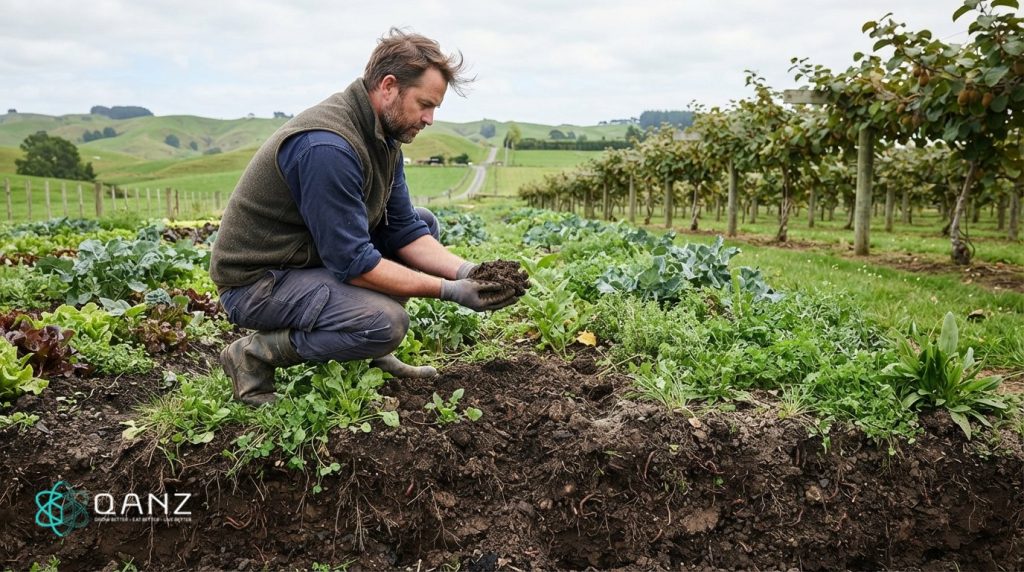
Healthier soil can be an economic asset as well as an environmental one. The financial benefits of regenerative agriculture may come from crop performance, lower reliance on purchased inputs and access to new markets. The effect on profit depends on how these changes influence a farm’s costs and returns over time.
It’s reasonable to ask what the transition means for the bottom line. Regenerative practices can require upfront investment and changes to established systems, while benefits may build gradually as soil structure, water retention and biodiversity improve. The balance varies with the crop, soil and growing conditions.
This article explains how regenerative agriculture may affect crop returns and input costs, what influences the financial outcome, and how training, practical resources and incentives may fit. It also considers why soil function can matter to farm resilience and long-term viability, helping you assess the economic case alongside the agronomy.
Key Takeaways
- Assess profitability by weighing crop returns against transition costs, input use and the time needed for soil improvements to influence farm performance.
- Understand how practices such as cover cropping, reduced tillage and crop diversity can support soil structure, water retention and biodiversity.
- Identify where lower reliance on purchased inputs could affect costs, while recognising that changes need to suit the crop and growing system.
- Separate proposed financial support from incentives that are currently available, and consider how training and practical resources could help with adoption.
- Explore how healthier soils and more resilient production may support a farm’s longer-term viability and market opportunities.
Potentially higher returns and crop profits
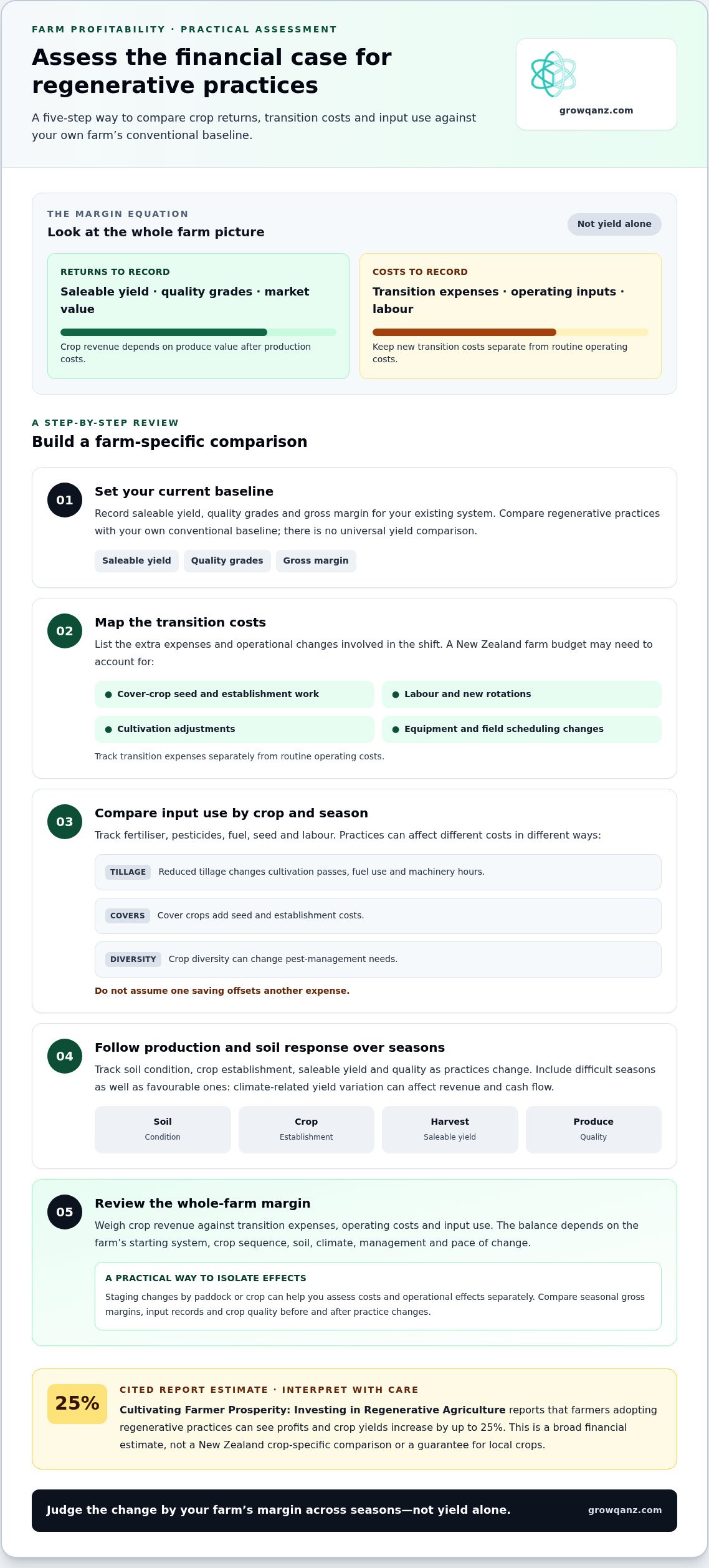
Regenerative practices affect profit through crop revenue, production costs and the resilience of farm income. For New Zealand farmers, the important measure is the whole-farm margin, not yield alone.
Crop yields and farm returns
Crop returns reflect the value of harvested produce after production costs, so yield matters alongside quality and market price. Regenerative and conventional yields have no universal comparison: crop, soil, climate and management all influence the result.
According to Cultivating Farmer Prosperity: Investing in Regenerative Agriculture, farmers adopting regenerative practices can see profits and crop yields increase by up to 25%. This is not a New Zealand crop-specific comparison. Growers can assess returns by tracking saleable yield, quality grades and gross margin against their own conventional baseline.
Transition costs and long-term savings
Transition costs are the additional expenses and operational changes involved in moving towards regenerative practices. In New Zealand, a farm budget should account for cover-crop seed, labour, new rotations and any adjustments to cultivation or equipment.
For example, introducing cover crops adds seed and establishment work, while changing cultivation can affect machinery use and field scheduling. Savings may arise when established practices reduce purchased inputs or protect productive soil. The balance depends on the farm’s starting system, crop sequence and pace of change. Record transition expenses separately from routine operating costs.
Input costs and farm profitability
Input costs include fertiliser, pesticides, fuel, seed and labour, and changes in these costs directly affect crop margins. Regenerative systems may reduce reliance on purchased fertilisers and pesticides over time, but the effect depends on how practices alter a farm’s input requirements.
Reduced tillage changes the number of cultivation passes, affecting fuel use and machinery hours. Cover crops add seed and establishment costs, while crop diversity can change pest-management needs. Compare each input by crop and season alongside saleable yield and quality. This accounting shows whether lower spending contributes to profitability, rather than assuming one saving offsets another expense.
Financial returns and farmer livelihoods
Farm profitability is the income remaining after operating costs, and it underpins farmers’ livelihoods and a business’s capacity to invest. The named Cultivating Farmer Prosperity: Investing in Regenerative Agriculture report offers a broad financial estimate, not a New Zealand case study or a guarantee for local crops.
For a New Zealand example, growers can compare seasonal gross margins, input records and crop quality before and after practice changes. Include difficult seasons as well as favourable ones: climate-related yield variation can affect both revenue and cash flow. This evidence helps farmers judge whether soil health improvements support durable returns across their own operation.
What Is Regenerative Agriculture?
Regenerative agriculture brings together farming practices that aim to rebuild soil organic matter, support biodiversity and improve soil function. In New Zealand, its economic effects depend on the practices chosen, the farm’s starting point and how the transition is financed.
Regenerative farming practices
Regenerative farming practices are methods that work together to improve soil and farm-system function. Examples include cover cropping, reduced tillage, rotational grazing and integrating livestock with crops.
On a mixed farm, cover crops can keep living roots in the soil between cash crops, while rotations diversify plant cover. Reduced tillage limits soil disturbance; rotational grazing changes how livestock use pasture. These practices are not a fixed package. Their fit depends on the crop, soil and farm operation.
Soil health, water retention and productivity
Soil health describes the soil’s capacity to support plant growth and ecological processes. Water retention affects how moisture remains available to crops. Regenerative practices may improve soil structure and water retention, supporting productivity over time.
Better soil structure may help soil withstand droughts and floods, which are relevant in a variable climate. Rebuilding organic matter and supporting biodiversity are longer-term aims, not instant changes to crop performance. Track soil condition, crop establishment and yield across seasons to understand how your system responds.
Transition brings financial risks as well as agronomic change. New Zealand farmers may need initial investment, extra learning and adjustments to traditional farming practices. Cover-crop seed, altered rotations, labour and machinery use can affect the budget before soil benefits accrue. Staging changes by paddock or crop lets a farm assess costs and operational effects separately.
No-till or reduced-tillage farming limits soil disturbance, but does not automatically reduce pesticide use. Evaluate weed and pest management within each crop system rather than assuming one practice removes the need for another input. Changes to tillage, rotations and cover crops can influence input decisions in different ways.
Government support and financial innovation can shape adoption, but proposed assistance is different from an established grant. Greenpeace Aotearoa has called for a billion-dollar regenerative farming fund. Its proposal recommends grants for diversified pasture and cover cropping during farmers’ first three years, plus reduced-tillage grants for that period. It also recommends short-term agroforestry maintenance financing for up to five years.
These proposals outline possible investment pathways, not grants that are currently available. Financial planning can also stage investment around practice changes, with separate budgets for establishment, labour and machinery. This helps farmers identify costs associated with each change and assess effects on cash flow and productivity.
For growers considering how soil biology fits within a wider regenerative system, information about soil biology and microbial agriculture provides relevant context.
Reduced reliance on synthetic fertilisers and pesticides
Reducing reliance on purchased fertilisers and pesticides may lower ongoing farm costs, while regenerative practices also change how crops, weeds and soil are managed. Potential savings depend on the inputs a farm uses and how alternative practices affect production.
Cover crops, agroforestry and reduced tillage each influence input decisions differently. A cover crop between cash crops adds seed and establishment work, while providing living plant cover. Trees in an agroforestry system diversify the farm landscape, while reduced tillage changes cultivation and machinery passes. Each practice has its own costs, so assessing them separately helps identify where spending might change.
Fertiliser decisions depend on crop needs and soil nutrient supply. As soil organic matter and biological activity develop, nutrient cycling may change the role of purchased fertiliser in a farming system. That does not make fertiliser unnecessary. Consider crop demand, nutrient availability and system productivity when evaluating input use.
Pesticide use is also connected to crop diversity and biodiversity. Diverse plantings can provide habitat for beneficial organisms, while rotations can interrupt conditions that favour some crop pests and diseases. For example, changing the crop sequence between seasons can alter pest pressure. These measures inform pest management; they do not mean pesticides can be removed across the board.
Fuel and machinery costs may shift when farmers reduce tillage. Fewer cultivation passes mean less field work, but the full financial effect also depends on machinery operations and crop establishment needs. Cover cropping, for instance, adds a separate sowing task. Comparing fuel, labour and seed records by paddock helps distinguish savings from new costs.
Farmers can assess potential changes to operating costs by recording:
- Fertiliser and pesticide purchases for each crop and season.
- Fuel, machinery passes, labour and cover-crop seed.
- Crop yield and saleable quality alongside input use.
- Soil cover, crop rotation and observations of pest pressure.
These records connect management changes with farm margins, rather than treating a lower input bill as proof of improved profitability. For example, reduced pesticide spending needs to be considered alongside crop quality and marketable yield. A change that lowers input costs but also affects saleable produce has a different financial outcome from one that maintains returns.
Regenerative practices also have environmental aims beyond farm accounts. Cover crops and agroforestry can support biodiversity, while soil-focused practices may store carbon and reduce greenhouse gas emissions. These outcomes contribute to the broader potential of regenerative farming, but are distinct from immediate cash savings. Separating environmental measures from input and revenue records gives farmers a clearer view of both.
Training, resources and financial incentives
Training and financial support can help farmers manage the learning and investment involved in regenerative production. In New Zealand, distinguish policy proposals from available funding when building a farm budget.
Greenpeace Aotearoa’s proposal recommends grants for diversified pasture and cover cropping during farmers’ first three years of adoption. It also recommends reduced-tillage grants for the first three years, and short-term agroforestry maintenance financing for up to five years. These are recommendations in a proposal, not confirmation of an operating grant programme.
Training is practical when it connects a technique to farm decisions. A grower introducing cover crops, for example, needs to understand establishment, crop sequencing and cost tracking. Reduced-tillage learning can focus on machinery operations and field observations. Peer discussion, field demonstrations and farm records can help translate general guidance into decisions for a specific soil, crop and climate.
Before adopting a practice, farmers can use a simple planning sequence:
- Choose a practice, such as cover-cropping or agroforestry, and identify its purpose.
- Record establishment, labour, machinery and maintenance expenses separately.
- Track production and soil observations alongside each change.
- Review cash flow and the evidence before extending the practice across more land.
Carbon is another consideration in environmental investment. Regenerative practices may store carbon in soil, but a farm’s financial assessment should distinguish that environmental outcome from cash income. A carbon-related revenue estimate needs to account for how carbon change is measured, what monitoring is required and the market terms for the project. These factors determine whether carbon fits a farm’s wider financial plan.
Tax incentives also belong in financial planning, but should not be treated as guaranteed income. Keep tax-related assumptions separate from farm operating returns and proposed grants. This makes it easier to see which budget items rely on crop production, which depend on support and which relate to environmental outcomes.
For farmers responding to climate change, training and resources can reduce the practical uncertainty of changing established systems. A diversified pasture plan involves different decisions from a reduced-tillage crop programme. Matching learning to the selected practice supports more informed investment decisions, while consistent records show how costs and production develop over time.
Economic benefits of regenerative agriculture
The economic case for regenerative farming extends beyond a single season’s crop margin. It includes how production choices influence cash flow, business exposure and the productive use of land. These factors show why a farm’s financial assessment should consider both the timing of costs and how revenue is earned.
Findings from one farming system cannot automatically predict returns in another. Crop type, buyer arrangements, farm scale and the starting production system all shape the financial outcome. An overseas study, for example, should not be treated as a local forecast. Use evidence that matches the crop, location and management conditions before relying on a study for a business decision.
Resilience matters economically because farms depend on reliable production and functioning land. Soil erosion can reduce a paddock’s productive capacity, while poor water quality can affect the wider operation and its relationship with the surrounding environment. These effects may not appear in a single crop account. A longer-term view helps distinguish immediate operating performance from the condition of the farm’s productive assets.
Market interest is another possible part of the business case, but consumer attitudes aren’t the same as a guaranteed farmgate premium. A Nielsen survey found 66% of global consumers were willing to pay more for products supporting environmental and social causes. For a grower, the practical value depends on whether a buyer offers clear terms for a product and whether meeting those terms fits the farm’s production and marketing costs.
When considering market opportunities, distinguish consumer demand from revenue already secured. For example, a horticulture grower can assess a proposed buyer arrangement against existing harvest, handling and sales plans. This gives the business a clearer basis for deciding whether the opportunity supports its commercial objectives, rather than treating general interest in sustainable products as income.
A whole-farm review can group economic effects into distinct areas:
- Cash flow, including when transition expenses occur and when crop revenue arrives.
- Productive assets, including land condition and the farm’s capacity to sustain production.
- Market access, including buyer terms and the costs of meeting them.
- Business exposure, including reliance on a narrow range of production or sales channels.
This framework helps growers judge which outcomes matter most to their business and how to evaluate them over time. For growers considering biological inputs as one part of a wider farm system, GrowQanz’s soil biology resources offer relevant context.
A Nielsen survey found that 66% of global consumers were willing to pay more for products supporting environmental and social causes, indicating potential market interest rather than guaranteed farm income. Financial returns depend on farm-specific conditions and clear buyer terms; research from one farming system cannot automatically predict results for another.
GrowQanz: Quantum Organic-Total®
Quantum Organic-Total® is a microbial agricultural input offered by QANZ for use in crop and soil programmes. Growers may consider it alongside practices such as crop rotation, cover cropping and reduced tillage, rather than as a substitute for those management choices or fertiliser.
Its suitability depends on the crop, growing system and intended application programme. Growers weighing transition costs against potential returns can use QANZ’s product and application support to understand how Quantum Organic-Total® may fit their production plan. Using an input does not, by itself, make a crop or farm organic. Check current QANZ technical and BioGro documentation for product suitability, rates and certification requirements.
For information about whether Quantum Organic-Total® may suit your crop and growing system, contact GrowQanz.
Put your next practice change into perspective
Assess the financial benefits of regenerative agriculture against your farm’s production goals, operating records and time horizon. Before changing a system, decide what you want to learn, then track relevant costs and crop outcomes. This gives future decisions a practical basis, whether you’re considering a different rotation, soil-management approach or biological input.
The right next step depends on your crop, growing system and application programme. GrowQanz offers Quantum Organic-Total®, Quantum VSC® and Quantum, with product and application support to help growers consider how these inputs fit their plans. Results depend on the conditions and management of each farm, so weigh any input alongside the wider production system.
If you’re considering a biological input as part of your approach, contact GrowQanz to discuss your options. A considered next step can help you build a regenerative system with clear goals and sound farm-level records.
Frequently Asked Questions
What is regenerative farming?
Regenerative farming manages land with soil function and ecological health in view alongside production goals. Rather than following one prescribed system, growers consider how management choices affect the farm as a whole. When planning a crop change, for example, consider both the immediate crop outcome and its fit with longer-term land-management objectives.
Why the Growing Interest?
Interest reflects farmers’ efforts to make production decisions that account for environmental condition and business continuity. Buyers and consumers are also paying attention to how food is produced, which can influence conversations between growers and supply-chain partners. For an individual farm, this interest is useful context, not a business case by itself. Assess whether it aligns with the farm’s goals and actual commercial relationships.
What are the main financial benefits of regenerative agriculture for farmers?
Potential financial benefits depend on how management choices affect farm income, expenditure and business planning. Compare the same crop or enterprise across seasons using consistent accounting categories, and record one-off transition expenses separately. This helps distinguish recurring operating changes from establishment costs and assess whether an apparent improvement reflects lasting change or a single season.
How does regenerative agriculture affect farm profitability and net income?
Profitability and net income depend on which costs and receipts a farm includes. For a useful comparison, keep farm accounts consistent: separate crop-specific expenses from whole-business overheads and record timing differences between spending and sales. Including the value of family labour and finance expenses can also give a fuller picture than comparing crop revenue with input purchases alone.
Are there New Zealand grants, subsidies, or financial incentives for regenerative agriculture?
Greenpeace Aotearoa’s recommendations are policy proposals, not evidence of an open grant scheme. Build a base budget that works without proposed assistance, then keep a separate schedule of project expenses and intended outcomes. This makes it easier to assess the effect of any future funding terms without treating unapproved contributions as farm income.
Can regenerative farming earn premium prices or income from verified sustainable products?
A premium is commercially meaningful only when the sales arrangement sets out how it is earned. Before forecasting extra revenue, clarify the product specification, required evidence, traceability records, delivery volumes and payment conditions in the buyer agreement. Those details matter more to an individual farm’s budget than broad consumer-interest figures, which don’t establish that a particular New Zealand crop will receive a higher price.
What carbon-credit or ecosystem-service payments are available to regenerative farmers in New Zealand?
Soil carbon storage or another environmental outcome does not, by itself, generate farm income. Payment requires defined terms covering the measured outcome, evidence, monitoring responsibilities, ownership of any resulting credit and payment arrangements. Before including potential receipts in a business forecast, assess these obligations against your land-management plans and record-keeping capacity.
What evidence and case studies show the financial returns of regenerative agriculture in New Zealand?
The cited Cultivating Farmer Prosperity report estimates that profits and crop yields may increase by up to 25%, but it is not a New Zealand crop-specific comparison. New Zealand growers can assess local returns by comparing seasonal gross margins, input records, saleable yields and quality before and after changing practices.
Disclaimer
Important: This article provides general agricultural information only. Product performance can vary according to crop, soil, climate, management practices and application conditions. Trial or research results discussed may have been obtained under specific conditions and should not be interpreted as a guarantee of equivalent results. Always follow current product directions and confirm suitability for your crop, growing system and organic certification requirements. Contact QANZ for current product and application information.
