
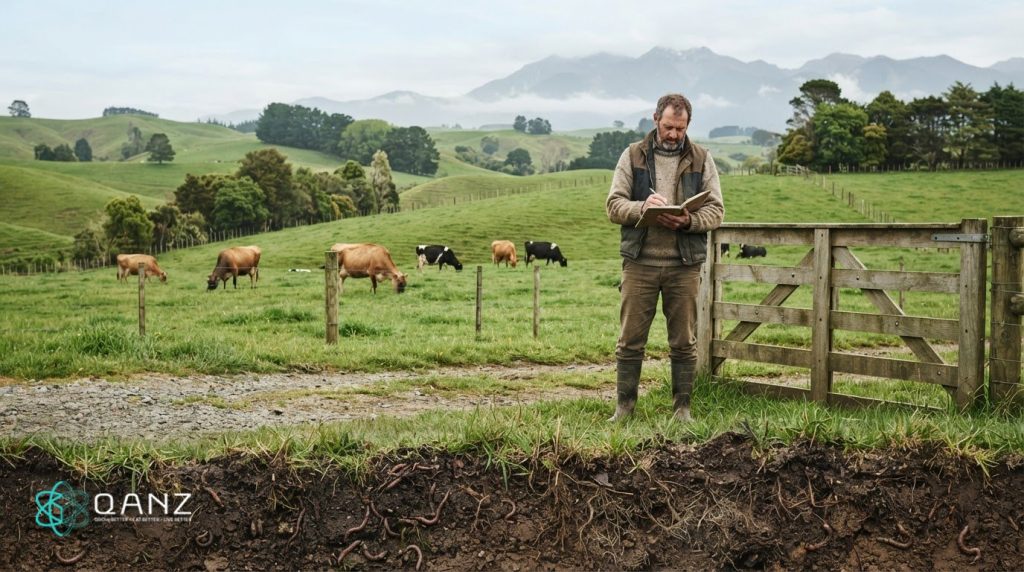
Organic conversion is a staged investment, not a single upfront bill. The cost of transitioning to organic farming in NZ depends on the farm’s starting point, production system and verification requirements. For dairy farms, conversion can take up to three years before the farm can supply at the full organic price. Budget for both changes to farming practices and the income implications of the transition period.
Upfront spending is only part of the picture. Timing and day-to-day production changes also matter. A gradual transition can help farmers plan adjustments to inputs, record keeping and soil management while considering possible effects on production.
This article explains how long organic dairy conversion can take in New Zealand, what may influence production during the transition, and how farming practices and shared verification can affect costs. It also sets out the main cost drivers to consider when assessing whether conversion fits your farm.
Key Takeaways
- Allow for a staged dairy conversion: reaching all organic certification requirements can take up to three years.
- Assess production and cash flow across the transition, including changes to inputs, labour, records and traceability.
- Review how soil management and organic practices fit your farm’s existing production system before budgeting for changes.
- Eligible businesses may be able to share verification costs through an organic group scheme.
- Certification costs can weigh more heavily on smaller producers, so include verification and ongoing record keeping in your cost planning.
Will my production drop during conversion, and for how long?
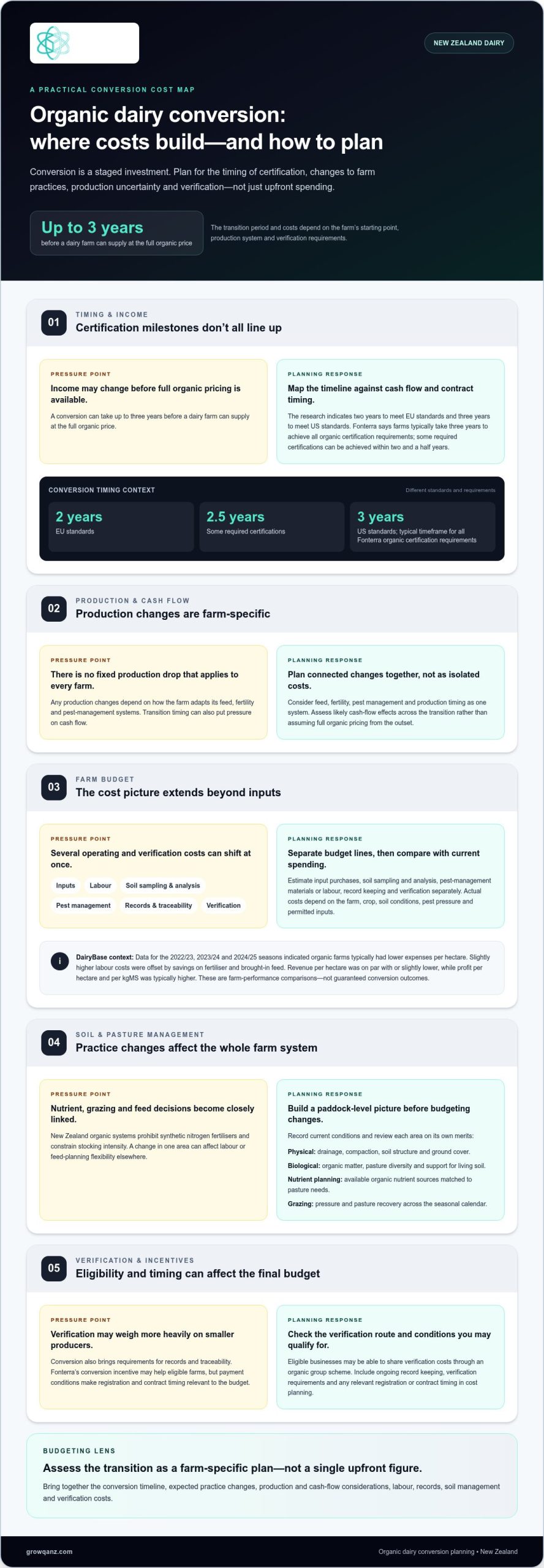
Production does not automatically fall by a fixed amount during organic conversion. For New Zealand dairy farms, the transition can take up to three years before the farm can supply at the full organic price. Any production changes depend on how the farm adapts its feed, fertility and pest-management systems.
How do organic farming costs compare with conventional farming in New Zealand? DairyBase data for the 2022/23, 2023/24 and 2024/25 seasons indicated that organic farms typically had lower expenses per hectare. Slightly higher labour costs were offset by savings on fertiliser and brought-in feed; revenue per hectare was on par with or slightly lower, while profit per hectare and per kgMS was typically higher.
These figures describe farm performance, not a guaranteed conversion outcome. During the transition, farmers need to manage the timing of practice changes alongside production and cash flow.
What are the costs of organic inputs, soil testing and pest control in NZ? Costs depend on the farm, crop, soil conditions, pest pressure and inputs permitted under the production system. Budget separately for input purchases, soil sampling and analysis, and pest-management materials or labour. Then compare those costs with current spending.
What financial support or grants are available for organic conversion in New Zealand? The Sustainable Food and Fibre Futures Fund supports projects intended to improve sustainability and productivity in New Zealand.
What are the main financial risks of transitioning to organic farming in NZ? Key risks include cash-flow pressure during conversion, production changes, extra labour and verification requirements, and the timing of eligibility for organic pricing. Fonterra’s conversion incentive may help eligible farms, but payment conditions mean registration and contract timing should be factored into the budget.
Conversion periods vary by standard: the research indicates two years to meet EU standards and three years to meet US standards. Fonterra says farms typically take three years to achieve all organic certification requirements, although some required certifications can be achieved within two and a half years.
Production sectors offer useful context for farmers weighing the market. In 2024, certified organic land included approximately 60,275 hectares for livestock production, 25,719 hectares for horticulture and cropping, and 3,016 hectares for viticulture. Fruit and vegetables accounted for 40.3% of organic exports by value, dairy 35.3%, and wine 12.2%.
Learning from established organic producers can help reveal operational changes behind the financial averages. DairyNZ provides a financial case study of a 168-hectare self-contained organic farm. Compare its system with your own farm’s labour, feed sourcing, input records and production calendar before estimating conversion costs.
Organic farming practices and soil management
Organic conversion changes how farmers manage nutrients, pasture and biodiversity. New Zealand organic systems prohibit synthetic nitrogen fertilisers and constrain stocking intensity. These requirements affect decisions about nutrient sources, grazing pressure and feed planning. For example, a dairy farmer needs to consider pasture demand and livestock numbers together, rather than treating fertiliser use as an isolated input decision.
Start by recording current soil and pasture conditions at paddock level. Note soil type, drainage, ground cover, compaction and pasture composition. A wet paddock with poor ground cover may need different management from a well-drained area with diverse pasture. Mapping these differences helps prioritise management changes and identify where extra work could affect labour or feed supply.
Pasture management links soil condition with day-to-day production. Track grazing pressure and pasture recovery across the farm’s seasonal calendar, then use those observations to adjust grazing plans. Plant diversity is another consideration: organic farms support higher on-farm biodiversity than conventional farming systems. The practical task is to understand how plant cover and grazing management interact in each paddock.
- Physical condition: record drainage, compaction, soil structure and ground cover by paddock.
- Biological function: assess organic matter, pasture diversity and how management supports living soil.
- Nutrient planning: identify available organic nutrient sources and match them to crop or pasture needs.
Soil health also includes chemical properties. Comparisons of organic and biodynamic farms with adjacent conventional farms found better physical, biological and chemical soil properties on the organic and biodynamic farms. The farms were also equally financially viable per hectare. These findings provide context for evaluating soil-management systems, not a prediction for any individual property.
Use these considerations to build a practical paddock plan. For example, prioritise a compacted gateway for management attention while reviewing nutrient planning separately for a productive pasture block. Grazing, cultivation and nutrient sources need to work together as a system. Otherwise, changes in one area can create pressure elsewhere, such as extra labour or less flexibility in feed planning.
Record the reason for each management change and the paddock or enterprise it affects. This gives you a useful basis for comparing soil condition, pasture cover and farm operations over time. For New Zealand farmers, linking field observations with nutrient and grazing decisions makes organic soil management more specific to the farm’s conditions and production system.
Group schemes and shared verification costs
Verification is part of the operating cost of organic production, alongside the work of maintaining records and demonstrating traceability. New Zealand’s organic regulatory system provides for group schemes that may enable eligible businesses to share verification costs. For a small producer, sharing some verification work may change how these costs fit within the farm budget.
A group scheme brings eligible businesses into a shared verification arrangement. Rather than treating each operation as entirely separate, the scheme can provide a common framework for demonstrating that participants follow organic production requirements. The exact cost benefit depends on how the scheme allocates shared and farm-specific work, and whether an individual business is eligible to take part.
Shared verification does not mean every farm has the same costs or responsibilities. A horticulture operation with several crops, for example, may need different records from a livestock producer. Each business still needs clear information about its own production, inputs and traceability, although the group arrangement may allow eligible participants to share some verification costs.
- Identify shared work: separate common scheme costs from tasks and records specific to your business.
- Map production activities: list crops, livestock or other production units that need to be covered.
- Set a budget method: understand how the scheme allocates shared expenses among eligible participants.
These steps make the arrangement easier to assess. For example, a small vegetable grower could compare its expected share of common verification expenses with the staff time needed for crop-specific records. A mixed farm could list livestock and horticulture separately, then consider how each activity affects documentation and verification needs.
New Zealand has four organic certifiers serving different producer needs. Distinguish certification or verification expenses from the internal time spent maintaining records. A shared scheme may affect the former, while staff time, production complexity and record-keeping routines remain important parts of a farm’s own cost planning.
For budgeting, record shared scheme expenses separately from business-specific costs. Include time spent compiling input records, keeping production information traceable and responding to verification requests. Then compare these figures with the cost of managing verification individually. This helps show where sharing may reduce duplicated work, rather than assuming every expense will be pooled.
Group schemes are most relevant when eligible producers can share verification costs while maintaining records of their own operations and production. Before preparing a conversion budget, map the activities that require verification, identify which costs are shared, and set aside a separate allowance for farm-specific administration. This makes the financial effect of group participation visible alongside other transition expenses.
Gradual transition to organic methods
A gradual transition helps organise farm changes, but it does not bypass organic requirements. In New Zealand, conversion can involve changes to production systems, input management, records and traceability, followed by assessment and verification. Planning these areas in stages helps farmers see how each change affects daily work and cash flow.
Start by comparing current practices with the requirements of the intended organic standard. List inputs used across each crop or livestock enterprise, then identify practices that need to change. On a mixed farm, for example, track pasture inputs separately from horticultural crop inputs. This inventory can reveal practical gaps before new routines begin.
Next, plan changes around the farm calendar. A dairy business can align staff training and record keeping with its seasonal workload. A vegetable grower can organise input records by crop and production block. These are planning examples, not prescribed certification steps; the sequence should reflect the farm’s operations and applicable standard.
- Map the system: record enterprises, production areas and current inputs.
- Plan operational changes: identify how input management, labour and production routines will alter.
- Build traceability: organise records so inputs and production activities can be followed through the farm.
- Allow for assessment: include verification work in the transition plan and operating budget.
New Zealand’s regulatory timeline also makes planning important. The Organic Products and Production Act received Royal assent on 5 April 2023. The Organic Products and Production Regulations 2025 came into force on 3 October 2025. National Organic Standards Regulations are scheduled to become mandatory on 31 March 2028. Farmers should plan records and processes with this changing framework in view.
Before committing resources to each change, note its operational effect. Replacing an input may require a revised nutrient or pest-management approach, while changing grazing practices may affect pasture use and labour. A staged budget can separate one-off adjustments from recurring costs, such as record administration and verification. This makes the cost of transitioning to organic farming in NZ easier to assess against the farm’s actual system.
Keep the sequence visible. A transition plan can show the practice being changed, the enterprise it affects, the records required and the person responsible. For example, a farm could assign input-record updates to the staff member applying products, then review those records alongside production activities. The aim is a manageable process that links field decisions with traceable documentation and assessment.
What does organic certification cost in New Zealand?
There is no standard certification cost for every New Zealand farm. Certification and regulatory costs can make up a larger share of a smaller producer’s budget, while the overall workload depends on production activities, records and verification needs.
Separate direct certification and verification expenses from staff time needed to keep the operation traceable. Organic certification requires farmers to keep records of all production inputs. A business with several crops or livestock activities may need to organise records for each enterprise, while a simpler operation may have fewer production details to track.
New Zealand’s organic regulatory system also includes an exemption for some small businesses. Some businesses with annual organic turnover below NZ$10,000 may be exempt from the operator approval process. This is a limited exemption, not a general statement that every small producer avoids certification or other organic requirements.
For budgeting, list the work and costs separately rather than treating certification as a single fee:
- Assessment and verification: include the costs associated with demonstrating compliance and maintaining verification.
- Record keeping: allow for staff time to record production inputs and keep information traceable.
- Production complexity: account for the records and oversight needed across different crops, livestock or production areas.
- Regulatory obligations: consider how the applicable organic requirements affect the business and its approval process.
The distinction matters because a lower direct fee does not necessarily mean a lower total workload. For example, a mixed farm may need to maintain input records for both pasture and horticultural production. Staff time spent organising those records is a real operating cost, even when it is not included in the certification invoice.
New Zealand’s national Organic Standards Regulations are scheduled to become mandatory on 31 March 2028. Producers planning a transition can account for this date when reviewing systems, records and regulatory costs. Keeping input information organised throughout production can make it easier to demonstrate traceability when assessment or verification takes place.
To estimate certification costs within a transition budget, first identify the production activities and record-keeping workload. Then separate direct verification expenses from internal administration and wider production-system changes. This gives a more useful estimate than relying on a single figure that may not reflect the operation’s size or complexity.
Certification costs are one part of the cost of transitioning to organic farming in New Zealand. For smaller producers in particular, comparing direct costs with staff time and production complexity gives a clearer view of the financial commitment.
GrowQanz: Quantum Organic-Total®
Quantum Organic-Total® is a microbial agricultural input offered by GrowQanz for use in crop and soil programmes. It may be considered as part of a broader growing plan, alongside the farm’s soil-management practices and production needs.
Using the product does not make a farm or its produce organic. Growers should assess its suitability for their certification programme and intended use against current product information.
To discuss how Quantum Organic-Total® may fit your crop, growing system and application programme, contact GrowQanz.
Build a transition plan around your farm
Make the next step a working plan, not just a broad estimate. Set out the production decisions to make, who will manage them, and how you will track costs and outcomes over time. A clear baseline for current inputs, labour and production gives you something practical to compare as your system changes.
The cost of transitioning to organic farming in NZ is best treated as a farm-specific planning question. Use your records and production priorities to identify which changes need attention first, then map their timing against the farm calendar and cash-flow requirements. This turns a complex decision into a series of informed choices.
If biological inputs form part of your approach, consider how they fit within your crop or growing system and intended application programme. Contact GrowQanz to discuss your transition and whether its products or application support suit your production goals. A thoughtful plan gives you a practical foundation for moving forward with confidence.
Frequently Asked Questions
What’s the organic milk premium and is it worth converting for?
That figure is the forecast organic price, not the premium over conventional milk. Assess the opportunity against conversion costs and farm cash flow.
What are the annual organic inspection and certification fees in NZ?
Annual certification and inspection fees vary according to production scope and the verification work required. Costs can make up a larger share of a smaller producer’s budget. For a useful estimate, separate certifier charges from staff time spent preparing input records, tracing production and responding to assessment requests. A single fee figure will not reflect the difference between one crop and a mixed operation with livestock and horticulture.
How much does it cost to transition a New Zealand farm to organic production?
There is no single transition total that applies to every New Zealand farm. Build a farm-specific budget for changes to inputs and production practices, staff time, record keeping, assessment and verification. For example, a business changing several enterprises may need to account for separate production records and operational adjustments. Compare transition expenses with current farm spending, then model cash flow across the conversion period rather than relying on one upfront-cost estimate.
How long is the organic conversion period for farms in New Zealand?
The conversion period depends on the organic standard and the farm’s production history. For practical planning, create a calendar for each enterprise, recording intended entry dates, input changes and documentation milestones. Keep records aligned with the relevant standard, especially on mixed farms where different production areas may follow separate schedules. This helps organise staff responsibilities and budget for verification throughout the transition.
How does organic farming affect yields and farm income during conversion in New Zealand?
Yield changes aren’t uniform across farms or production systems, so assess likely effects by enterprise and season. DairyBase comparisons for 2022/23, 2023/24 and 2024/25 indicated organic farms typically had higher profit per hectare and per kgMS than conventional farms. Use that comparison as context, then model your own feed costs, labour, production and the timing of organic-price eligibility. Farm-level budgets show how those factors combine.
What are the costs of organic inputs, soil testing, and pest control in NZ?
Costs depend on the farm, crop, soil conditions, pest pressure and permitted inputs. Budget separately for input purchases, soil sampling and analysis, and pest-management materials or labour, then compare these needs with current spending.
Disclaimer
Important: This article provides general agricultural information only. Product performance can vary according to crop, soil, climate, management practices and application conditions. Trial or research results discussed may have been obtained under specific conditions and should not be interpreted as a guarantee of equivalent results. Always follow current product directions and confirm suitability for your crop, growing system and organic certification requirements. Contact QANZ for current product and application information.
