
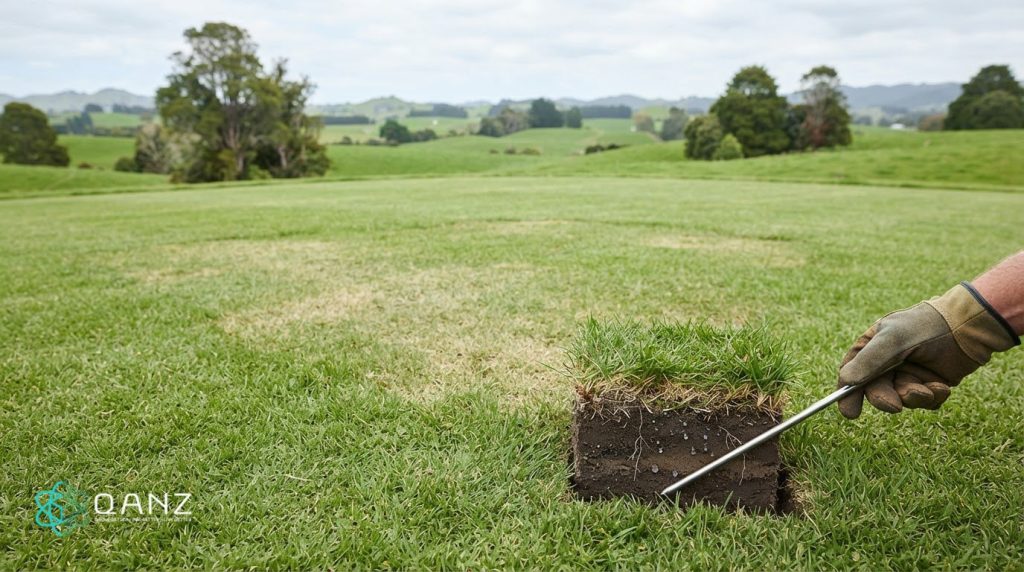
What if the brown patch in your turf isn’t asking for more water? If rain or regular watering hasn’t helped, the soil may be repelling moisture rather than simply lacking it. Preventing dry patch in turf naturally starts with checking whether water is reaching the root zone. Dry patch, also called localised dry spot, can leave water running off or failing to soak in, but drought and other turf problems can look similar.
It’s understandable to want a practical answer without reaching straight for chemical treatments. First check what’s happening in the soil, then address the conditions that may be limiting water movement and healthy turf growth. Adding more water without identifying the cause can waste it while nearby turf becomes too wet.
This guide explains signs consistent with dry patch, how to distinguish them from general drought stress, and which site-aware steps to consider. You’ll also learn how watering, compaction and thatch management fit into prevention, and how to keep useful records as you assess the area.
Key Takeaways
- Check whether water is penetrating the soil before choosing a response, and consider other possible causes of patchy turf.
- Soil structure, compaction and thatch can influence water movement, but dry patch doesn’t have one universal cause.
- Preventing dry patch in turf naturally means matching watering and maintenance practices to the conditions on site.
- Map affected areas and record rainfall, irrigation and maintenance to help identify patterns over time.
- Consider biological inputs only within a broader soil and turf programme. They are not a substitute for diagnosis or sound maintenance.
What does dry patch look like in turf, and why does diagnosis matter?
Before choosing a prevention method, inspect the soil beneath the affected turf and consider other causes of browning. Dry patch describes turf symptoms associated with soil that resists water penetration. Moisture may not reach the roots even after rain or irrigation. A brown patch alone can’t confirm the cause. Check how the soil responds to water and compare it with the surrounding turf before deciding what to do.
Which signs may point to dry patch?
Dry patch often appears as irregular or localised areas of discoloured, stressed turf. Look beyond the grass blades: carefully lift a small plug or examine soil at the edge of an affected area, then compare it with soil beneath healthy turf. If the affected soil feels dry while nearby soil is moist, that difference is useful evidence, but it doesn’t confirm a diagnosis by itself.
Apply a small amount of water to the affected area and observe what happens. Water that beads, runs sideways or remains at the surface rather than soaking in may indicate poor penetration. These observations can point to a water-repellency issue, but they don’t identify its exact cause. Soil hydrophobicity is the reduced ability of soil to absorb water; the overview of Hydrophobic Soil explains the underlying concept. Surface thatch, uneven ground or compacted soil can also affect where water goes.
Persistence can offer another clue. Turf browning during a dry spell may recover after the soil is rehydrated, depending on how stressed or damaged the grass is. With suspected dry patch, soil may remain dry beneath the surface despite watering, and the affected area may stay stressed. Neither pattern proves the cause on its own.
What else can cause brown patches in turf?
Several problems can look similar, and more than one may be present. Consider the shape and location of the patch, soil moisture and recent site activity before intervening.
- Drought: Dry conditions can affect broad areas, especially where turf receives less water or has shallow roots.
- Compaction or thatch: These can restrict water movement, though their presence doesn’t by itself confirm dry patch.
- Pests or disease: Damage may follow a spreading pattern or show other changes to the grass. Avoid assuming a treatment without identifying the cause.
- Spills or animal damage: A sharply defined mark or a patch near a regular animal route may provide a useful clue.
Check whether the pattern follows irrigation coverage, foot traffic, mowing or a recent spill. Note whether the soil is dry throughout the affected area or only at the surface. Comparing these details can help avoid unnecessary watering or treatments that don’t address the problem.
Careful diagnosis is the first step in preventing dry patch in turf naturally. If the signs remain unclear or patches keep spreading, pause before applying treatments. Record what you can observe, including soil moisture and water movement, and use those details to guide further assessment. The right response depends on the cause, the soil and the way the area is used.
How do soil conditions contribute to dry patch in turf?
Dry patch is associated with soil that repels water, but the conditions behind it and the severity of affected areas can differ from site to site. Soil texture, structure, organic matter, moisture, pH, turf cover and maintenance history all help explain how water moves through the root zone. Assess these factors together rather than assuming one soil issue is responsible.
Water repellency can occur when water-resistant organic substances coat soil particles, but it isn’t the only reason moisture may fail to reach roots. A review by Doerr, Shakesby and Walsh describes soil water repellency as a condition with varied causes and effects, reinforcing why site assessment matters. Their review of soil water repellency provides broader scientific context, not a turf-specific prescription.
Soil structure also matters. Stable aggregates and connected pores help water enter and move through soil, while a compacted surface can restrict infiltration and leave roots with less accessible moisture. Soil texture influences how quickly water drains or is retained. Organic matter can support soil structure, but its type, amount and state of decomposition matter too. Soil pH is another assessment factor because it influences nutrient availability and turf growth. It doesn’t, by itself, confirm or rule out water repellency. Sparse or stressed turf can also leave soil more exposed to drying.
How can thatch and compaction affect water movement?
Thatch is the layer of living and dead stems, roots and other turf material between green leaves and the soil surface. A thick or uneven layer may intercept water or change how evenly it reaches the soil. Compaction occurs when soil particles are pressed closer together, reducing pore space. Both can influence water entry and root-zone conditions, but neither proves the cause of a dry patch.
Assess the depth and distribution of thatch and look for compacted areas, especially where turf receives regular foot or equipment traffic. Scarification or aeration can disturb turf, so choose the method and timing to suit the grass type, soil moisture and site use. Avoid aggressive work based on appearance alone.
Why should seasonal and site conditions shape prevention?
Rainfall patterns, heat, soil types and turf use vary across New Zealand, and conditions can differ within the country. A maintenance window suggested for an overseas climate may not suit local turf or seasonal growth. Base decisions on recent weather, soil condition and turf response rather than applying a calendar recommendation unchanged.
For preventing dry patch in turf naturally, treat soil observations as context, not a guaranteed recipe. Record where moisture persists, where it drains quickly and how turf responds after rain. Then match maintenance to the condition identified. For broader local context on turf and horticulture, explore GrowQanz’s related information.
Which natural dry-patch prevention methods suit different turf conditions?
Choose turf practices to match the condition you’ve observed, not a universal dry-patch recipe. Check how water enters the soil, whether compaction or excess thatch is present, and how the turf responds to routine care. Adjust watering and mowing to local weather and site use. Reserve aeration, thatch removal and overseeding for situations where assessment indicates they may be appropriate.
When can watering and mowing practices help?
Water to wet the root zone rather than repeatedly dampening only the surface. How often and when to irrigate depends on rainfall, soil type, temperature, turf species and water availability. Check soil moisture and turf response between watering, and follow any local water restrictions. Avoid mowing so low that you scalp the grass. Removing too much leaf can add stress, particularly when turf is already struggling.
When should aeration, thatch management or overseeding be considered?
Match physical work to a diagnosed issue. Aeration may be considered where compaction is limiting water entry, while scarification or verticutting may suit excessive thatch. Overseeding can help renew suitable thin or bare areas, but first establish why the turf has thinned. Grass type, season, soil condition and site use all affect method and timing, so avoid disruptive work when the turf is unlikely to recover well.
Use this comparison to decide what to assess next. It’s a guide, not a fixed schedule.
| Observed condition | Natural practice to consider | Practical caution | Local considerations |
|---|---|---|---|
| Dry soil beneath a surface that sheds water | Check irrigation coverage and soil wetting; consider a wetting agent as one possible management tool. | A wetting agent doesn’t replace diagnosis or sound maintenance. Choose and use any product according to its label and intended purpose. | Account for rainfall, water availability and any current local restrictions. |
| Compacted ground, often in trafficked areas | Assess whether aeration is suitable for the soil and turf. | Aerating at the wrong time or in unsuitable conditions can damage turf or create an uneven surface. | Consider how frequently people or equipment use the area. |
| Thick or uneven thatch | Measure or inspect the layer before deciding whether thatch management is needed. | Overly aggressive removal can stress or thin the sward. | Match the approach to turf type and its growing conditions. |
| Thin or bare patches after the cause is addressed | Consider overseeding where the turf type and site are suitable. | Seed choice and establishment conditions matter; sowing alone won’t correct the original cause. | Check seasonal suitability and how quickly the area needs to return to use. |
For preventing dry patch in turf naturally, keep notes on watering and turf response so you can refine practices for the site instead of repeating an approach that hasn’t helped. For related information, explore QANZ’s turf and horticulture resources.
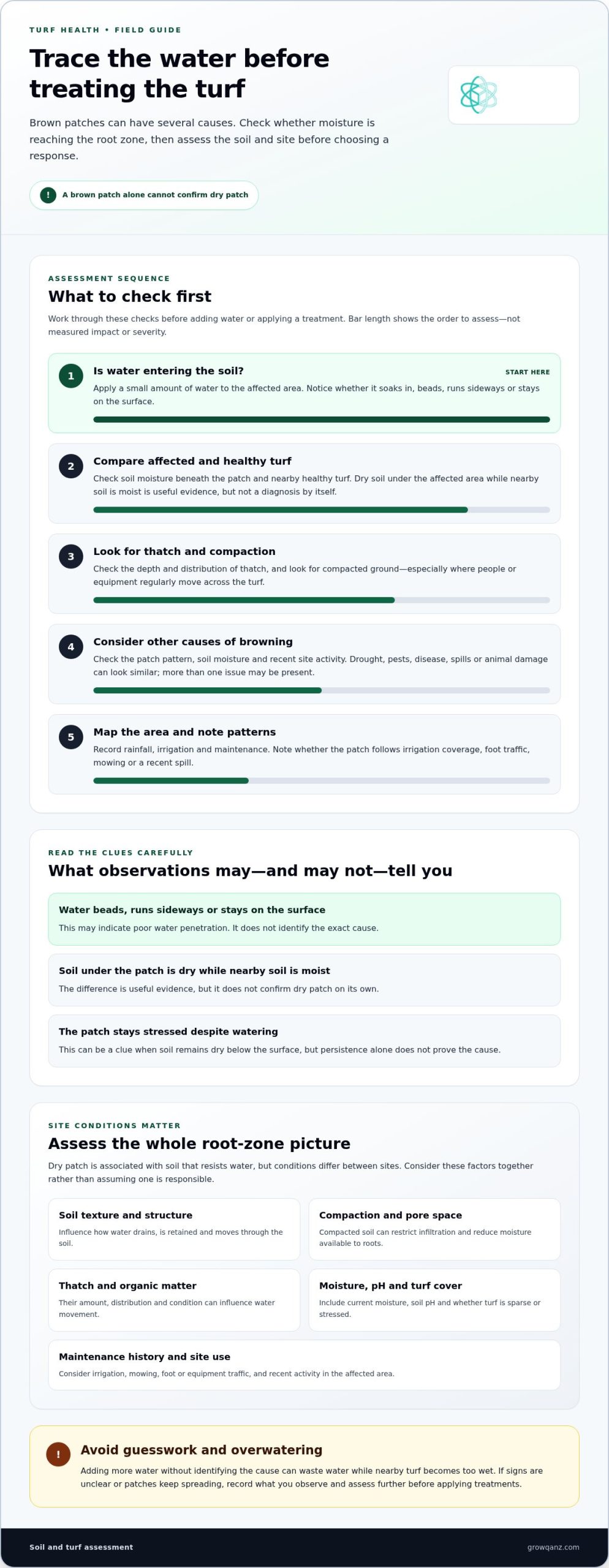
How can you inspect and prevent dry patch in turf step by step?
A consistent inspection helps separate what you can observe from what you suspect, then guides a response that fits the site. Work through the sequence below and keep a simple record. Repeated observations can reveal patterns, but they don’t prove a cause or guarantee turf recovery. Treat immediate care and longer-term improvement as separate decisions.
- Map the affected areas. Mark patch locations on a simple site sketch. Note their approximate size, shape and relationship to paths, irrigation coverage, slopes, trees or areas of regular use. This can show whether the pattern follows a site feature.
- Inspect the soil and turf. Compare affected and healthy areas. Record turf colour and density, soil moisture beneath the surface, and whether a small amount of water enters the soil or runs off. Avoid disturbing more turf than needed for a useful comparison.
- Rule out other possible causes. Review the pattern alongside recent weather and site activity. Drought, compaction, thatch, pests, disease, spills or animal damage may produce similar symptoms. If the signs don’t point clearly to one cause, pause before applying a treatment.
- Assess site conditions. Consider soil type, drainage, traffic, turf species, mowing, thatch and irrigation coverage. Check whether restrictions or limited water availability affect your options. These details help determine which maintenance choices are suitable.
- Choose and review a response. Start with a change that addresses the condition identified, such as adjusting watering where coverage is uneven. More disruptive work, including aeration or thatch removal, needs a clear reason. Record what you changed and observe the area again before deciding whether further action is needed.
What should a turf inspection record include?
Note the date, patch location and size, turf condition, soil moisture and what happened when water was applied. Add recent rainfall, irrigation, mowing, cultivation and other maintenance, along with relevant changes such as increased traffic. Repeat observations under comparable conditions where possible. A pattern developing over time can guide further investigation, but it isn’t proof that one factor caused the damage.
How should prevention change with local conditions?
Seasonal advice needs a place as well as a date. New Zealand and Australia span different climates, rainfall patterns and turf-growing conditions, so timing recommendations suited to one area may not suit another. Base watering and maintenance on local weather, soil moisture, grass type and site use. In New Zealand, check current local water restrictions before irrigating. Rules vary by area and can change.
Use observations to distinguish immediate management from longer-term turf improvement. A short-term adjustment may help manage water stress, while persistent compaction, uneven coverage or excessive thatch calls for a considered maintenance plan. Neither guarantees recovery, particularly if the underlying cause remains uncertain.
For information related to professional turf biological management, explore QANZ’s turf and horticulture information as one resource alongside sound diagnosis and site-specific maintenance.
Where could biological inputs fit into a natural turf programme?
Biological inputs are a possible consideration within a broader soil and turf programme, not a first response to unexplained brown patches. Diagnose the issue and address practical maintenance factors, such as water delivery, compaction, mowing or thatch, before considering an input. Don’t assume a biological product prevents, treats or improves dry patch unless evidence supports that specific use.
Quantum Organic-Total® is a microbial agricultural input offered by QANZ for use in crop and soil programmes. That description alone doesn’t establish its suitability for turf or demonstrate an effect on water-repellent soil. General research into soil biology also can’t be treated as proof of performance for a particular product or formulation.
What should growers check before considering a biological input?
Start with the product’s current technical information. Check whether it suits the intended crop or growing system, and follow the documented application rates and directions. If certification requirements matter to your programme, confirm that the input and intended use meet those requirements using current documentation. A product’s broad category or certification status doesn’t establish suitability for every use.
Keep evidence in perspective. Research about soil organisms or biological inputs in general may explain an agricultural principle, but it doesn’t demonstrate that Quantum Organic-Total® has been tested on turf or addresses dry patch. Product-specific evidence needs to identify the formulation and the conditions studied. Don’t transfer results from another product, crop or setting.
Alongside product information, keep a record of the diagnosis and maintenance: what was observed, what changed, and how the turf responded. This helps distinguish evidence about site management from claims about an input.
How can QANZ information support an informed decision?
The Quantum Organic-Total® product information provides a starting point for understanding its role as a microbial agricultural input. Product suitability, rates and certification requirements should be checked against current QANZ technical and BioGro documentation. QANZ’s Quantum technology information can offer further context, but neither general product information nor a technology overview should be read as evidence of a dry-patch outcome.
For preventing dry patch in turf naturally, keep diagnosis, suitable watering and sound maintenance at the centre of the programme. Consider a biological input separately and use relevant technical information rather than assuming it will resolve the problem. Talk to QANZ about whether Quantum Organic-Total® is appropriate for your crop, growing system and application programme through QANZ.
Make your next turf decision evidence-led
Set a clear baseline before making another change. A simple record of what you observe and adjust can help you judge whether your approach is making a difference and when the issue needs closer assessment. That’s a more considered way to approach preventing dry patch in turf naturally than applying treatments without understanding what the soil or turf needs.
Keep biological inputs in perspective, too. They may be considered as part of a wider programme, but product suitability depends on the intended use and current technical guidance. QANZ supplies Quantum agricultural biological products to growers in New Zealand and Australia, including Quantum Organic-Total®, a microbial agricultural input for crop and soil programmes.
If you’re considering a programme beyond routine turf maintenance, talk to QANZ about whether Quantum Organic-Total® is appropriate for your crop, growing system and application programme. Take your observations and intended use into that conversation so the next step is grounded in your conditions. Make changes one at a time and continue monitoring the turf response.
Frequently Asked Questions
Is dry patch in turf the same as drought damage?
No, the terms aren’t interchangeable. Drought can brown turf when moisture is limited, while dry patch is associated with soil that resists water entry. To investigate, compare soil beneath affected turf with nearby healthy grass after rain or watering. Check whether moisture has reached the root zone, not just the surface. Grass colour alone can’t confirm the cause, so don’t assume every brown patch needs the same response.
Can dry patch appear after heavy rain?
Yes, rainfall may fail to reach roots if water runs off or stays near the surface above water-repellent soil. However, pooling can also point to poor drainage, uneven ground or compaction, so it isn’t proof of dry patch. After rain, inspect soil below the surface in both affected and healthy areas. If the cause remains unclear, avoid repeating irrigation or maintenance treatments without further assessment.
Does dry patch spread from one area of turf to another?
Patch patterns can change, but visible expansion doesn’t prove that dry patch is spreading between areas or reveal a single cause. Mark the boundary on a simple sketch and note any new discolouration during later inspections. Check nearby turf for similar symptoms and compare irrigation coverage, shade, traffic and soil moisture. Separate patches may reflect different site conditions, even across one lawn or sports surface.
Can a wetting agent prevent dry patch in turf naturally?
A wetting agent may be considered where water-repellent soil is suspected, but it can’t replace diagnosis or appropriate turf care. Suitability and use depend on the particular product, site conditions and local guidance, so follow its label. Don’t assume it will prevent dry patch or restore affected turf. Wetting agents are a different product category from biological inputs such as microbial soil products, which shouldn’t be treated as interchangeable.
Should I aerate turf if I suspect dry patch?
Only consider aeration as a targeted response when inspection indicates compaction. It isn’t a universal treatment for suspected dry patch. For example, a heavily trafficked area may need a different assessment from a quiet lawn with loose soil. The method and timing depend on grass type, soil condition, site use and local growing conditions. Avoid aggressive cultivation until you understand the root-zone condition, as it may add stress to affected turf.
Can biological products be used to prevent dry patch in turf?
Don’t assume a biological product will prevent or treat dry patch without evidence for that specific product and use. Quantum Organic-Total® is a microbial agricultural input offered by QANZ for crop and soil programmes. This description doesn’t establish its suitability for turf or a dry-patch benefit. Product suitability, rates and certification requirements should be checked against current QANZ technical and BioGro documentation. General soil biology research isn’t proof of performance for a particular product or formulation.
Disclaimer
Important: This article provides general agricultural information only. Product performance can vary according to crop, soil, climate, management practices and application conditions. Trial or research results discussed may have been obtained under specific conditions and should not be interpreted as a guarantee of equivalent results. Always follow current product directions and confirm suitability for your crop, growing system and organic certification requirements. Contact QANZ for current product and application information.
