
What if a better playing surface starts with doing less, but in the right places? Golf course management works best when maintenance responds to the turf, soil and conditions on each part of the course, rather than relying on blanket inputs. That site-specific approach can help managers weigh playing quality alongside responsible use of water and other resources.
Consistent surfaces matter, but weather, drainage, shade, traffic and soil conditions can shift what the turf needs from one area to another. A practice that suits one green or fairway may not suit the next. The challenge is to make informed decisions while keeping course priorities clear.
This article sets out a practical framework for assessing turf and soil conditions, choosing maintenance practices and reviewing results over time. It also explains how to assess biological inputs carefully, including where Quantum Organic-Total® may be considered within an appropriate turf and soil programme, without assuming product-specific outcomes. The aim is a grounded basis for decisions that fit your course.
Key Takeaways
- Golf course management is about coordinating turf and course operations, not a golfer’s on-course strategy.
- Use a consistent sequence to set priorities, inspect site conditions and record what changes over time.
- Compare maintenance practices and biological inputs by their purpose, evidence, site fit, operational demands and monitoring needs.
- Build a turf plan around the course’s use, local conditions, seasonal context and available resources.
- Quantum Organic-Total® is a microbial agricultural input for crop and soil programmes that can be evaluated within an appropriate turf and soil programme.
What does golf course management involve beyond golfer strategy?
Golf course management is the coordinated planning and oversight of turf, facilities and course operations. It includes setting maintenance priorities, monitoring conditions and organising work to support the course’s intended playing experience while considering turf health, resource use and operational needs. It’s distinct from a golfer’s course strategy, which concerns how an individual plays each hole and chooses shots.
Player strategy is about choosing how to play the course; course-condition management is about deciding how the course is maintained. The two meet in the playing experience, but they involve different decisions and responsibilities. A golfer may choose a safer line around a hazard; the course team considers how that area is maintained, how it fits the design and how its condition affects play.
Which responsibilities sit with a golf course manager or superintendent?
Responsibilities vary with a course’s size, facilities and staffing structure. A manager or superintendent may set longer-term objectives, coordinate maintenance programmes, monitor turf and facility conditions, and communicate priorities with club leaders, staff and other stakeholders. The role often draws on practical knowledge of turfgrass and environmental management. The Golf course superintendent reference outlines the breadth of this work, including turfgrass care and environmental considerations.
Strategic planning and daily maintenance are connected, but they’re not the same. A strategic objective might define the playing character a course aims to maintain across greens, tees, fairways and rough. Daily tasks are the scheduled work that supports those objectives and responds to observed conditions. Clear priorities help teams direct time and resources where they’re needed, while communication helps club stakeholders understand why maintenance may differ between areas or seasons.
How do playing quality and turf health relate?
Playing quality isn’t a single surface standard applied everywhere. The desired condition of a putting green may differ from that of a fairway, tee or rough because each area has a different function, level of use and place in the course design. Management decisions need to account for those distinctions rather than treating uniform appearance as the only measure of success.
Turf condition is one part of a wider assessment. Course teams can consider how well an area serves its playing purpose alongside its observed health, site conditions, maintenance requirements and use of resources. For example, high-traffic areas may need different attention from less-used ground, while drainage, shade or exposure can influence what is practical at a particular location. These are factors to assess, not automatic reasons to adopt a particular treatment.
Golf course management therefore involves balancing playing expectations with turf resilience, available resources and the course’s operational priorities. The appropriate balance depends on the site, design, patterns of use and the quality of evidence behind proposed practices. A decision that suits one area or course shouldn’t be treated as a universal prescription.
How can course teams assess turf and soil before changing practices?
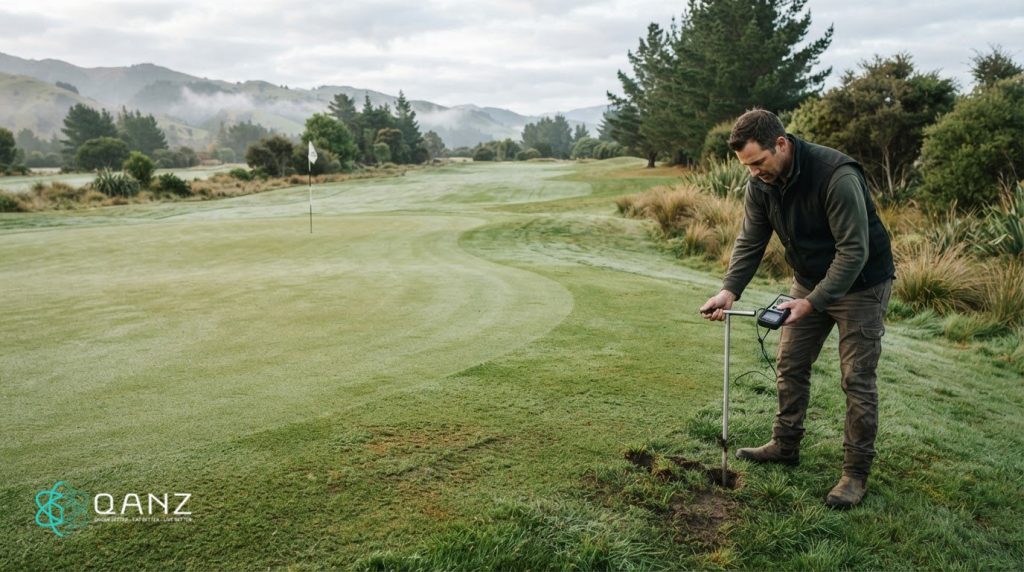
Before changing a maintenance practice, course teams can define the issue they want to address, inspect the affected area, record conditions and recent work, then review what happens after any adjustment. This simple sequence gives decisions a clear purpose and makes it easier to distinguish observed changes from assumptions about their cause. Consistent records also help teams build a useful picture of how conditions vary across the course and through the seasons.
- Define the priority. Be specific about what needs attention, such as surface consistency in a particular playing area, visible wear or water pooling after rain. Agree on what the team will observe, rather than starting with a treatment in search of a problem.
- Inspect the site. Look at the area in context. Note visible turf condition, ground firmness or moisture where relevant, drainage patterns, shade and signs of traffic. Compare affected areas with nearby areas that have different exposure or use.
- Record observations and actions. Log the date, area, conditions, recent maintenance and relevant weather. Separate what staff saw, such as thinning turf in a shaded section, from a possible explanation, such as inadequate light. The explanation remains a hypothesis until further evidence supports it.
- Review after a change. Record what was adjusted and compare subsequent observations with the starting point. Consider whether weather, use or another maintenance action may also have influenced the result. This helps avoid attributing a change to one practice without adequate support.
What should a turf and soil assessment record?
Keep records practical and comparable: include the area, date, observed condition, recent management actions and weather or site notes that may help explain variation. Use the same descriptions and observation methods where possible, and retain a baseline before making a change. Avoid treating an unsupported benchmark as a universal target. If laboratory analysis is needed to answer a soil question, incorporate results from an appropriate independent laboratory rather than inferring soil properties from appearance alone.
How should teams interpret seasonal and site variation?
Interpret observations alongside local climate, soil type, drainage, shade, traffic and intended playing use. A wet period, for example, may affect a poorly drained area differently from a more exposed section, so a course-wide response may not fit both. Guidance developed overseas can inform questions, but it shouldn’t be assumed to apply directly to New Zealand conditions. The Golf Course Superintendents Association of America (GCSAA) offers professional resources; use them as background and assess recommendations against local agronomic knowledge and site evidence.
Management decisions should reflect the conditions of each site, not a universal prescription. For New Zealand courses considering biological programmes, QANZ’s turf and horticulture information offers relevant context to consider alongside site observations and regional agronomic guidance. A clear evidence trail supports better-informed discussion about whether a practice should be continued, adjusted or reviewed further.
How should golf course teams compare maintenance approaches and biological inputs?
Compare each option against the same practical criteria before changing a turf programme. A biological input is one possible tool, not an automatic substitute for fertilisers, pesticides or established maintenance practices. Its relevance depends on the management objective, the evidence for that specific input, site conditions and whether the course team can monitor the outcome. This measured approach keeps Golf course management grounded in course needs rather than broad promises.
| Decision criterion | Questions to consider |
|---|---|
| Purpose | What defined turf or soil management objective is the practice intended to address? |
| Evidence | Is the information independent research, manufacturer research, an overseas trial or an observation? Does it relate to the specific product and intended use? |
| Site fit | Do the location, turf, soil, climate and course conditions resemble those relevant to the evidence? |
| Operational demands | Can the team fit the practice into its maintenance schedule and available resources, following current technical information? |
| Monitoring | What observations will indicate whether the practice remains appropriate, and how will the team record them? |
What evidence should inform a turf-management decision?
Start by identifying who produced the evidence and how it was gathered. Independent research, manufacturer research, overseas trials and commercial observations are different evidence types, and none should be presented as another. Check the turf or crop, product formulation, location, treatment and conditions before applying a finding to a course. General research into soil biology can explain broad concepts, but it doesn’t establish the performance of a particular product or formulation on golf turf. The USGA Green Section Record offers golf-course care material that can inform further reading; overseas guidance still needs to be considered in the context of New Zealand conditions.
Where might a biological input fit in a management programme?
Consider an input only in relation to a clear programme objective and its current technical information. For Quantum Organic-Total®, the supported description is a microbial agricultural input for crop and soil programmes. The available information here doesn’t establish a golf-turf mechanism, performance outcome or golf-turf trial history, so none should be assumed. Biological inputs don’t automatically replace fertilisers, pesticides or existing practices; assess them as distinct options and monitor any programme change.
When assessing a biological option, consider how it relates to the course’s wider turf and soil programme rather than viewing it in isolation. QANZ’s professional turf biological products information provides relevant context for that evaluation. More generally, material about biological soil enhancers in New Zealand should be assessed for its evidence base and relevance to the specific turf system, rather than treated as a universal recommendation. Keep the decision proportionate: define the purpose, review suitable evidence, consider site fit and record what follows.

How can a course build a practical, evidence-led turf management plan?
A useful turf management plan turns course priorities into area-specific actions, then gives the team a consistent way to review them. Start with what the course needs to provide, account for how each area is used and the conditions it faces, and plan work around available staff and resources. Make changes deliberately, document what happens and refine the plan as the season and course needs evolve.
- Agree on priorities. Set out the playing, turf and operational objectives that matter to the course. Clarify trade-offs, such as where surface consistency is a priority and where reducing routine intervention may be appropriate, so teams can make decisions against shared aims.
- Map management areas. Group parts of the course by function and relevant conditions. A map might distinguish greens, tees, fairways, rough, practice areas or specific sites with different drainage, shade or traffic patterns. The right categories depend on the course, not a universal template.
- Plan actions for each area. Record the intended playing condition, planned maintenance considerations and who needs to coordinate the work. Account for course use, seasonal context, site observations and the resources available. Avoid copying a practice from another area without considering whether the purpose and conditions are comparable.
- Record what happens. Note maintenance actions and relevant conditions alongside turf observations. If the team makes a change, keep the record clear about what changed, where and when. That creates a useful reference for later review.
- Review and adjust. Compare observations with the agreed objective and decide whether to continue, adapt or stop the approach. Revisit priorities when course use, conditions or operating needs shift.
How can management priorities be translated into area-based plans?
For each mapped area, specify its function, intended playing condition and the maintenance considerations that shape its plan. For instance, a frequently used tee and a less-trafficked rough area may have different operational objectives, even if they sit close together. Keep the map and priorities practical for the people carrying out and coordinating the work. Update them when observations or course requirements change.
How should a course review whether a change is useful?
Before adjusting a practice, decide what the team will observe, how it will compare conditions and when it will review the records. Keep other actions and relevant conditions in view, since weather, traffic or concurrent maintenance can also influence what staff see. An observed change alone doesn’t prove that a product caused it. Treat the result as information to assess, not proof of cause.
Golf course management becomes more coherent when each action has a stated purpose and a review point. A simple area plan can help staff communicate priorities, preserve continuity as conditions change and identify where more evidence is needed, without locking the course into a rigid schedule or assumed result.
For guidance on whether a biological input could fit a turf and soil programme, talk with QANZ about your course’s objectives and application programme.
How can QANZ biological products be considered within golf course management?
Biological inputs are best considered after a course has defined its turf and soil priorities, assessed site conditions and reviewed the evidence for a proposed practice. They are options to evaluate within a broader programme, not shortcuts around sound management decisions. For Australian course teams, the key questions are whether an input suits the intended use, what current technical information supports that use and how any change will be monitored.
What can be said accurately about Quantum Organic-Total®?
Quantum Organic-Total® is a microbial agricultural input for crop and soil programmes. That description does not establish a particular mechanism or outcome on golf-course turf. The information in this article also does not establish golf-turf trial results, product composition or application rates, so these should not be assumed. Product use alone does not make turf, a golf course or produce organic.
Course teams assessing its place in a programme can use the Quantum Organic-Total® product information to consider the product’s stated context alongside their objectives and current technical documentation. Suitability for a particular course depends on the intended use and the relevant information for that programme.
What should teams consider before evaluating an input?
Begin with the management objective, then compare it with the product’s stated intended use and current GrowQanz technical information. Review the relevant documentation for suitability and rates rather than inferring them from general information about microbial inputs or from another formulation. If the course operates under a certification programme, check current certification documentation and assess the input against that programme’s requirements. Certification of an input, where applicable, does not make the course or turf certified organic.
If a course team decides to evaluate an input, document the area and objective, the practice being considered, relevant conditions and the observations that will inform review. Keep the assessment distinct from a claim of proven performance. Evidence about soil biology in general cannot, by itself, demonstrate how a specific product performs on golf turf. Likewise, evidence for one formulation or setting should not be treated as evidence for another.
This careful approach keeps golf course management anchored to site needs and evidence. Talk to GrowQanz about programme suitability and whether Quantum Organic-Total® may be appropriate for your course’s growing system and application programme.
Make the next management decision count
The next step is to turn the course’s priorities into a learning process that continues beyond one maintenance cycle. Keep the reasoning behind each adjustment clear, and make it easy for the team to carry observations forward as conditions and course needs change. Over time, that record can support more informed choices about where to focus attention and what questions still need answering.
For any proposed input or practice, define the objective before acting, note the starting conditions and decide what observations will guide a later review. Where practical, avoid changing several things at once. That discipline won’t remove uncertainty, but it can make decisions more transparent and help the team interpret what it sees without jumping to conclusions. Strong Golf course management grows through careful observation and considered adaptation, not a single prescription.
If you’re weighing Quantum Organic-Total® for your course, discuss whether it fits your turf and soil programme with QANZ. A clear conversation about intended use and current documentation can help shape the next step. Keep the approach grounded in your course’s needs, and build progress one well-considered decision at a time.
Frequently Asked Questions
What is golf course management, and how is it different from course strategy?
Golf course management concerns the decisions that shape course condition and operations; course strategy is how a player chooses to play a hole. For example, a golfer might choose a club and target to avoid a hazard, while the course team coordinates maintenance and facility needs around the course’s intended use. The phrase “course management” can refer to either, so the context matters.
How do golf courses balance playable turf with soil and environmental priorities?
Teams balance these priorities by defining what each area needs to provide, then considering its condition, use and maintenance demands together. For example, a heavily used area may require a different approach from an area managed primarily for another course function. Track relevant resource use alongside playing and turf observations, so decisions reflect more than appearance alone. The appropriate balance depends on the course and its conditions.
Can biological inputs be used in golf course turf programmes?
They can be considered as one option within a turf and soil programme, provided the intended use fits the course’s objectives and current technical information. A biological input shouldn’t be assumed to replace established practices or deliver a particular turf result. For Quantum Organic-Total®, review current QANZ technical documentation for product suitability and rates, and evaluate any proposed use on its own evidence.
Does a biological product make a golf course or its turf organic?
No. Using a biological product by itself doesn’t make a golf course, turf or produce organic. If a course has certification-related requirements, assess the input against the relevant programme’s current rules and documentation before use. Product certification, where applicable, is distinct from certification of a course or operation, and the status of a product should be checked using current official documents.
How should a golf course team evaluate claims about a turf product?
Check what evidence supports the claim and whether it applies to the exact formulation and intended use. Look for the trial location, turf or crop, treatment and conditions, and distinguish independent research from manufacturer material or grower observations. A finding from another formulation or overseas setting doesn’t establish the same result on a New Zealand course. Treat broad promotional language cautiously if the supporting evidence isn’t clearly described.
What information should be recorded when changing a turf-management practice?
Record the area and date, the practice changed, who carried it out, and what the team observed before and afterwards. Add relevant weather, course use and other maintenance occurring at the same time. Where staff use measurements as well as visual observations, label them separately and use comparable methods at review. This added context helps the team interpret changes without assuming that one adjustment caused them.
Are golf course management recommendations the same in New Zealand and Australia?
Not necessarily. Climate, seasonal timing, soil, site conditions and local operating or certification requirements can differ between the two countries and within each country. Treat advice from another region as a reference point, not an automatic prescription. Before applying a recommendation, check that it suits the course’s local conditions and intended use, and rely on relevant regional agronomic guidance for decisions that depend on place or season.
Disclaimer
Important: This article provides general agricultural information only. Product performance can vary according to crop, soil, climate, management practices and application conditions. Trial or research results discussed may have been obtained under specific conditions and should not be interpreted as a guarantee of equivalent results. Always follow current product directions and confirm suitability for your crop, growing system and organic certification requirements. Contact QANZ for current product and application information.
