
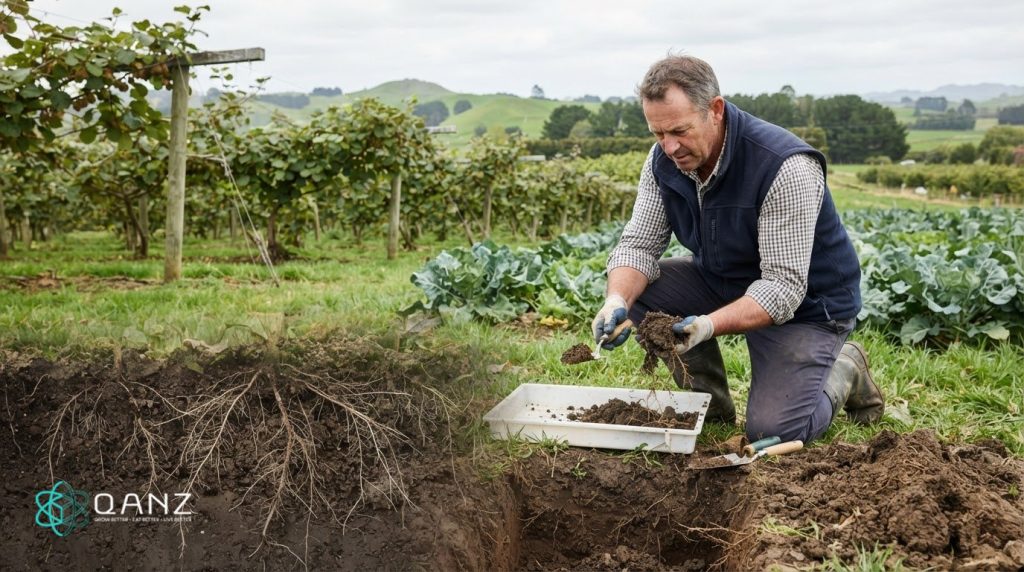
What does a product label tell you, and what evidence supports its claims? For growers considering microbial plant biostimulants, results from another crop, region or season may not reflect what happens in a New Zealand programme. The useful questions are what was tested, under which conditions, and whether those conditions resemble your own.
The answer depends on more than the product category. Assess research alongside the trial design, the exact formulation and the conditions in which it was used. Even relevant evidence doesn’t guarantee the same outcome on every farm.
GrowQanz has designed this guide to explain the terminology and general science behind microbial plant biostimulants, then outlines practical ways to assess product evidence without treating claims as promises. It also covers crop and growing conditions, programme compatibility, and certification or regulatory requirements to consider before use. The aim is to help you decide whether an input merits closer evaluation.
Key Takeaways
- Understand how microbial plant biostimulants differ from fertilisers, pesticides and other biological inputs.
- Assess evidence by checking the evidence type, trial conditions and exact formulation tested.
- Use a practical sequence, from defining a crop need to recording observations in your programme.
- Read current product documentation for intended use, application instructions, handling and compatibility.
- Quantum Organic-Total® is a microbial agricultural input offered by GrowQanz for crop and soil programmes. Its suitability, rates and certification requirements should be checked against current technical and BioGro documentation.
What are microbial plant biostimulants, and where do they fit?
New Zealand’s Ministry for Primary Industries (MPI) defines a plant biostimulant as a substance that stimulates a plant’s natural processes to benefit nutrient uptake or efficiency, stress tolerance or crop quality traits. MPI’s definition excludes plant growth regulators, including hormones. MPI’s plant biostimulant guidance is the relevant source for this New Zealand terminology. Microbial plant biostimulants are the microbial category of these inputs, but the label alone doesn’t establish a product’s contents, evidence or performance. For broader background, see Biostimulant – Wikipedia.
How is a microbial plant biostimulant different from other inputs?
To distinguish inputs, look at their intended and documented purpose. A fertiliser supplies nutrients to a crop. A pesticide is intended to control pests, diseases or weeds. A biostimulant is described by its intended role in supporting plant processes, rather than simply supplying nutrients or controlling a pest. Agricultural biological inputs also include products intended for other purposes, such as biological fertilisers and biological control products.
These are general category descriptions, not proof of a specific product’s composition, performance or suitability. The words “microbial” or “biostimulant” on a label don’t tell you which microbes are present, how the product has been tested, or whether it is appropriate for a particular crop. Use current product information to understand the intended use and claims. Regulatory treatment can depend on the product and the claims made, so don’t assume category names have the same meaning in every market.
Why does context matter to growers?
A product’s fit depends on the production setting, not just its broad category. Crop species and growth stage, soil characteristics, climate, existing management and application conditions all affect how relevant evidence is to a grower’s decision. Results from one setting shouldn’t be treated as a prediction for another. For example, a study involving grapes overseas isn’t direct evidence for an Australian vineyard, and an observation in kiwifruit doesn’t establish suitability for vegetables.
Growing systems, soils, seasons and conditions vary across New Zealand and Australia, and from site to site within each country. Recommendations developed for one location therefore need careful interpretation before being applied elsewhere.
Start by identifying the crop need, then consider whether the available information reflects your crop, conditions and intended use. Keep product-specific claims separate from general scientific knowledge about microbes and plants. That distinction gives you a more grounded basis for deciding what to investigate next.
Microbial biostimulants in soil and plant biology
Soil biology is shaped by the living plant, its surroundings and conditions beneath the surface. Roots release carbon-containing compounds into nearby soil, while microorganisms use available resources and interact with roots and one another. These relationships are complex. A general explanation of them doesn’t establish how a particular product works or what result it will produce.
What is the rhizosphere?
The rhizosphere is the soil region directly influenced by plant roots and their associated biological activity. This reflects the scientific description of root-influenced soil in research on rhizosphere microbial ecology.
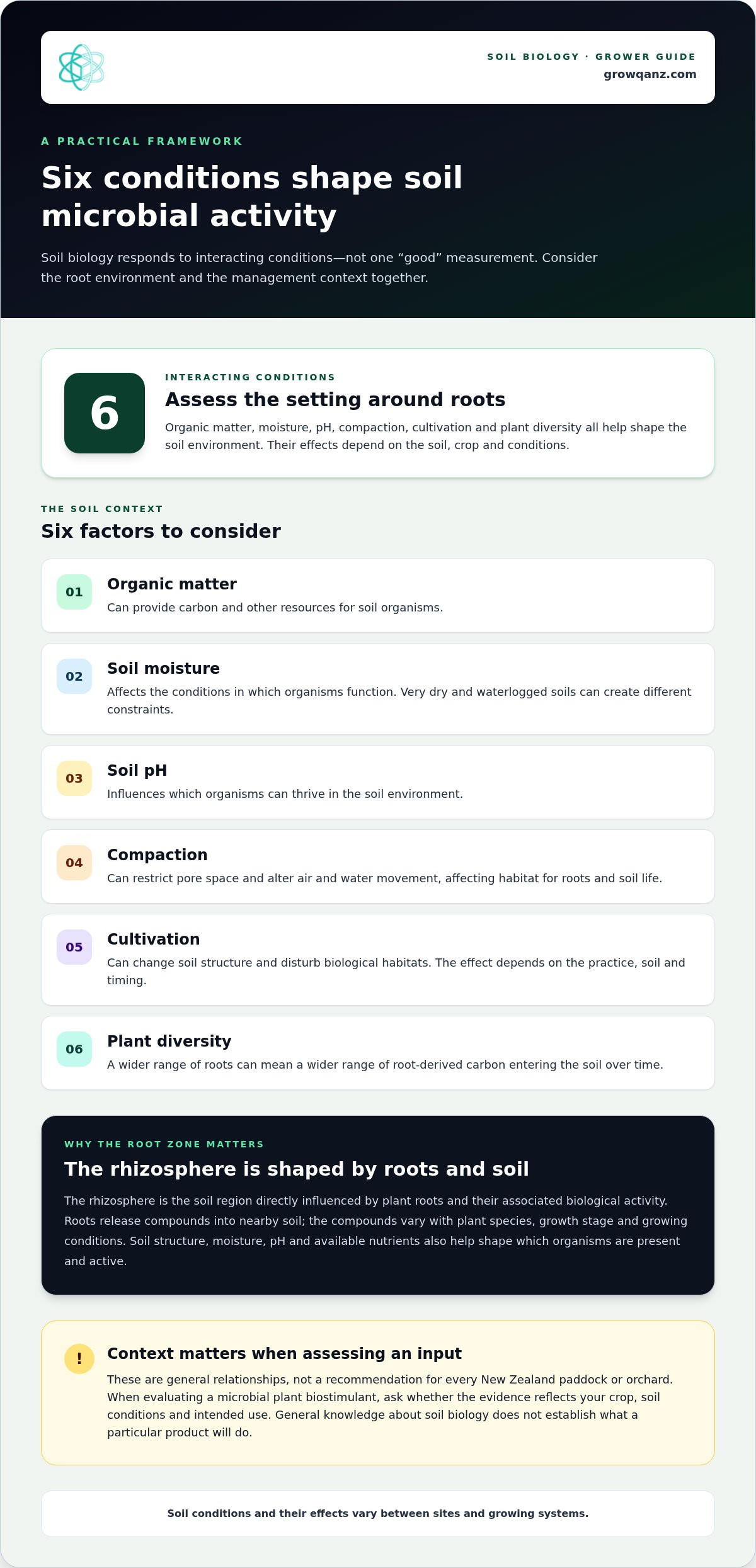
Roots alter the environment around them by releasing compounds into the soil. The types and amounts of these compounds can vary with plant species, growth stage and growing conditions. They provide resources for some soil organisms, while soil structure, moisture, pH and available nutrients also help shape which organisms are present and active. For a research overview, see Philippot and colleagues’ review of rhizosphere microbial ecology.
This zone matters because roots, microbes and soil properties meet there. But it isn’t uniform around every root. General knowledge about root and microbe relationships is not evidence that a named agricultural input changes them in a particular way.
Which soil and management factors influence microbial activity?
Microbial activity depends on several interacting conditions, not one “good” soil measurement. Organic matter can provide carbon and other resources, while soil moisture affects the conditions in which organisms function. Very dry or waterlogged soil can create different constraints, with effects depending on soil type and the organisms involved.
Soil pH influences which organisms can thrive. Compaction can restrict pore space and alter air and water movement, affecting the habitat available to roots and soil life. Cultivation can change soil structure and disturb biological habitats; the consequences depend on the practice, soil and timing. These are general relationships, not recommendations that one management approach suits every paddock or orchard in New Zealand or Australia.
Plant diversity can mean a wider range of roots and root-derived carbon entering soil over time. Research on root exudates describes how these compounds contribute to interactions between plants and soil microorganisms, but patterns vary between plants and conditions. A review of root exudates and plant-microbe interactions provides useful scientific context.
For growers assessing microbial plant biostimulants, this background helps frame practical questions: what soil and root environment will the input encounter, and does the evidence reflect comparable conditions? It doesn’t replace crop-specific assessment. If you’re exploring biological inputs for a crop or soil programme, QANZ’s agricultural biological information provides further context.
How should growers assess evidence for microbial plant biostimulants?
Evidence is useful only when you can tell what was tested and how closely the conditions resemble your own. A product claim, a laboratory finding and a replicated field trial answer different questions. For microbial plant biostimulants, identify the exact formulation, crop, location, treatment and conditions behind any reported outcome. Then assess the study design and whether it supports the claim being made.
What should a useful trial report include?
Look for enough detail to interpret the result, not just a headline or percentage. A report should identify the formulation and treatment, crop and site, trial dates or season, comparison or control, and relevant growing conditions. It should also explain how outcomes were measured and whether the design allows a fair comparison. New Zealand evidence relates to the conditions reported in New Zealand; Australian or other overseas findings are evidence from those locations, not local trial results.
Different evidence types have different uses:
| Evidence type | What it can help show | What to keep in mind |
|---|---|---|
| Independent field trial | How a defined treatment performed under the trial’s field conditions. | Check the methods, comparison, formulation, site and whether the result has been repeated. |
| Manufacturer trial | Results reported by the product manufacturer or supplier for a stated trial. | Review the same design details and identify who conducted or reported the work. |
| Commercial grower observation | What a grower noticed in a working production setting. | Useful context, but other management or seasonal factors may also explain an observed difference. |
| Laboratory study | How an organism or process behaves under controlled laboratory conditions. | Laboratory findings don’t by themselves establish a field outcome. |
| General peer-reviewed research | What published research suggests about broader biological concepts or patterns. | Research on a category or organism isn’t automatically evidence for a particular product. |
Can findings be transferred between products or growing regions?
Not without checking how closely they match. Formulations may differ, so evidence for one product doesn’t establish performance for another, including Quantum Organic-Total®. Crop, location, treatment and conditions matter too. A result in one crop or overseas region doesn’t guarantee an equivalent result in another crop or season in New Zealand or Australia.
Even when a trial reports a difference, interpret the outcome in light of its design. An association or observed change doesn’t necessarily prove the product caused it, especially if there was no suitable comparison or other factors weren’t controlled. Use the result to inform questions, not as a promise of what will happen on your block.
Results from individual trials or commercial observations are specific to the formulation, crop, location, treatment and conditions tested and should not be interpreted as a guarantee of equivalent performance elsewhere.
How can growers evaluate a microbial input for their crop programme?
A careful assessment starts with a defined crop need, then checks whether the input’s intended use and instructions suit the programme. Product identity, current technical documentation, certification requirements and consistent record-keeping all matter. The guiding principle is simple: fit depends on the intended crop programme and current documentation.
Use this sequence to assess microbial plant biostimulants without assuming that a broad category label guarantees a particular result.
- Define the crop need. Specify the crop, production system and management objective. For example, frame a question about vines around the actual issue and stage of production, rather than a general expectation of improved performance.
- Map the existing programme. Note relevant inputs and management practices already in place, along with the timing of key operations. This clarifies where an additional input might fit and what factors could affect observations.
- Identify the exact product. Record its full name and formulation. Don’t assume information about one microbial input applies to another, even if both use similar category language.
- Read current product information. Use the current label and technical documentation to understand the intended use, application instructions, handling and storage requirements. Follow that guidance for rates and timing; don’t infer them from another product, crop or region.
- Check compatibility in context. Review the product documentation alongside the other inputs and practices in your programme. Don’t assume products can be mixed or applied together unless current instructions support that approach. Resolve unclear directions before application.
- Review certification requirements. If the farm operates under a certification programme, check its current requirements for the specific input, crop and intended use. Growers in New Zealand and Australia should follow the requirements applicable to their own country and certification programme, rather than assuming the rules or accepted inputs are identical across the Tasman.
- Plan a fair assessment. Before applying, decide what you’ll observe and how you’ll record it. Where practical, use a suitable untreated or existing-programme comparison, while keeping other management as consistent as possible. A comparison helps interpretation but doesn’t remove every source of variation.
- Keep useful records. Record the product and formulation, application date and rate as directed, crop stage, field or block, relevant conditions, other programme inputs and observations. Review the notes over time; a single observation is not proof of cause or a guarantee of future performance.
Clear records help distinguish what was applied from what was observed, and show where conditions differed. QANZ provides product and application support for growers assessing inputs for crop programmes. Discuss your crop programme with QANZ.
Where does Quantum Organic-Total® fit in a grower’s evaluation?
Once you’ve defined the crop need and considered how to assess evidence, examine a specific input against that framework. Quantum Organic-Total® is a microbial agricultural input offered by QANZ for use in crop and soil programmes. This identifies its product category and programme context; it doesn’t, by itself, establish suitability or performance for a particular crop or growing situation.
What information should growers review about Quantum Organic-Total®?
Start with the current product information, then compare it with your crop programme requirements. The Quantum Organic-Total® product information is the place to review current product details. Check current QANZ technical documentation for intended use, suitability, application rates and instructions. Follow those details rather than borrowing a rate or practice from another formulation, crop or trial.
It also helps to separate product-specific information from broader explanations of biological technology. QANZ’s technology information provides general context, while current product documentation should guide decisions about Quantum Organic-Total® itself. General science about microbial inputs isn’t proof of this product’s composition, mechanism or effect. Information about a different formulation doesn’t establish a result for Quantum Organic-Total®.
For a considered review, note the formulation name and version of the documentation you consulted, then assess whether its stated use aligns with your crop and management objective. If your farm follows a certification programme, check the current requirements for the specific input and intended use. Input certification, where applicable, doesn’t mean that using it makes a farm or its produce certified organic.
How should crop and country context shape the next step?
Crop type and production system shape the questions worth asking. A broadacre grower and a nut orchard grower may have different application programmes, operating conditions and priorities. QANZ’s resources on field crop programmes and fruit and nut growing offer crop-context pathways, but shouldn’t be read as proof that a product has been tested on a particular crop.
Country matters, too. New Zealand and Australia have different growing regions, seasonal conditions and certification requirements. Don’t assume a recommendation developed for one country or location transfers directly to another. Consider where any supporting evidence was generated, which formulation it concerns, and how closely the crop and conditions match your own.
For a practical next step, bring your crop, growing system, management objective and current application programme into the discussion. QANZ provides product and application support to help growers consider programme fit without treating outcomes as guaranteed. Talk to QANZ about Quantum Organic-Total® suitability for your crop, growing system and application programme.
Make your next crop decision evidence-led
Before the next season begins, choose one question you want your crop programme to answer. A focused question gives your team a reference point as plans change through the season and helps turn routine observations into useful learning.
For growers considering a biological input, explore how it may fit within the wider programme. Explore QANZ’s biological growing resources as you plan ahead.
Each season offers an opportunity to refine your approach. Start with a clear purpose, observe how your own growing conditions shape the results, and use those records to inform future decisions.
Frequently Asked Questions
Are microbial plant biostimulants the same as microbial fertilisers?
No. The terms describe different intended roles, although a product’s label and claims determine how it should be understood. When comparing products, look at the stated purpose rather than assuming “microbial” means fertiliser or biostimulant. Check whether the documentation describes nutrient supply, support for plant processes or another function. This helps avoid treating products with different intended uses as interchangeable in a crop plan.
Can microbial plant biostimulants be used alongside fertilisers?
That depends on the specific products and their instructions. Using both doesn’t show that either input can be reduced. Keep nutrient decisions tied to the crop’s requirements and established management plan, and make any programme changes deliberately rather than attributing them to the addition of a biostimulant. If you’re assessing both, record each input and its timing separately. This gives you a clearer account of what was applied if crop observations change during the season.
How much microbial plant biostimulant should I apply?
There isn’t one universal rate for the category. Follow the directions for the exact product and application method, and calculate the amount for the area being treated. Check equipment calibration and units before preparing a full load, particularly if the block size or application setup differs from your usual practice. Don’t transfer a rate from a different formulation or copy a figure from a general article.
What happens if a microbial product is stored incorrectly?
The effect depends on the product and storage conditions, so appearance alone may not show whether it remains suitable. If storage conditions have been uncertain, set the container aside, note how and for how long it was stored, and refer to the product-specific handling guidance before use. Keep the batch details available when seeking product support. Avoid blending questionable stock with fresh product, as this can make later assessment harder.
Is BioGro certification proof that an input suits every organic programme?
No. Certification applies within a defined scope, so growers should check whether the input’s current approval covers their programme and intended use. Keep the relevant certificate or approval record with farm input records, and note the crop and purpose for which the input is being considered. This helps document what was used and why during programme reviews. Input approval alone doesn’t certify a farm or its produce.
Can I tank-mix a microbial product with other agricultural inputs?
Only do so when the product instructions support the proposed combination. A mixture that looks physically uniform doesn’t establish that the products remain suitable when combined. Before planning a tank mix, identify every product in it, check the relevant directions and consider whether the application can instead be made in separate passes. Don’t improvise mixing order or conditions based on advice for a different formulation.
Do microbial plant biostimulants need to be applied at a particular crop stage?
Follow the timing stated for the specific product, rather than assuming all microbial plant biostimulants share the same crop-stage window. Build any stated timing into the season’s operational plan alongside access to the block and other scheduled work. If an application window is missed, don’t assume a later stage is equivalent. Record the actual crop stage at application so observations can be interpreted against the instructions used.
Disclaimer
Important: This article provides general agricultural information only. Product performance can vary according to crop, soil, climate, management practices and application conditions. Trial or research results discussed may have been obtained under specific conditions and should not be interpreted as a guarantee of equivalent results. Always follow current product directions and confirm suitability for your crop, growing system and organic certification requirements. Contact QANZ for current product and application information.
