
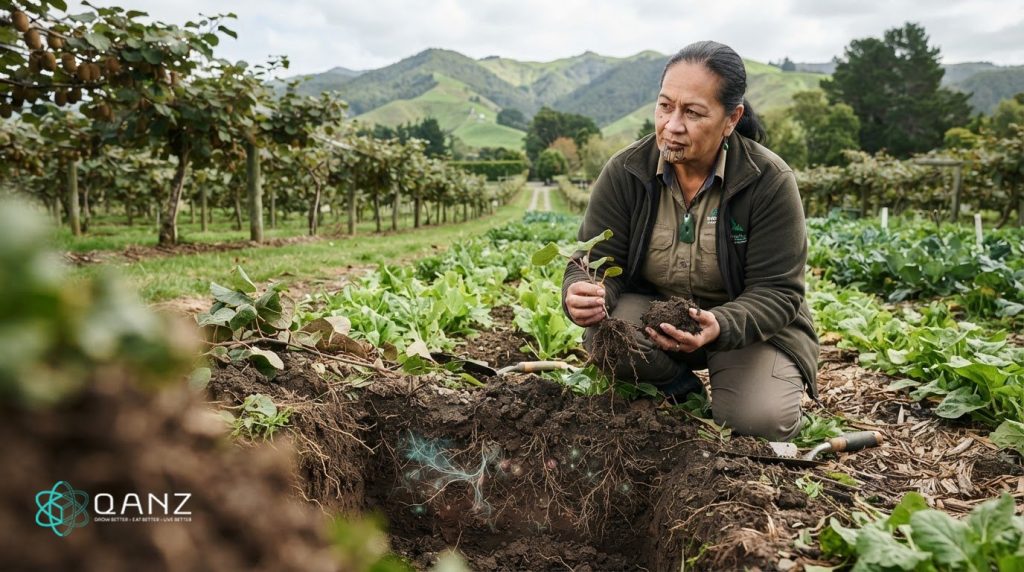
A crop symptom is a clue, not a diagnosis. Yellowing leaves, uneven growth or weak establishment can have several causes, so healthier crops start with understanding what is happening across the growing system, not reaching for a single input.
When a crop is not thriving, it is tempting to look for a quick fix. But an approach that suits one crop, soil type or season may not suit another. Start by observing the crop and reviewing soil conditions, moisture, nutrition, weather and management history together. This helps separate what you can see from what still needs investigating.
This article outlines a practical way to assess crop health in New Zealand and Australia, where seasonal conditions and local guidance can differ. It explains how to record symptoms, review likely contributing factors and evaluate microbial inputs, including Quantum Organic-Total®, against current product information and your programme needs. The aim is to support informed decisions without relying on unsupported performance promises.
Key Takeaways
- Assess crop health by considering crop condition and growing-system conditions together, rather than relying on one visible sign.
- Review soil structure, organic matter, pH, compaction and moisture as possible factors, not as automatic diagnoses.
- Record symptoms, their location and when they appeared, then review recent conditions before deciding what to investigate or change.
- Support healthier crops with measured management decisions that fit the crop, soil, production system and relevant local guidance.
- When considering a biological input, check the exact formulation, intended use, crop relevance and evidence behind any claims.
What Does a Healthier Crop Look Like in a Working Farm System?
Healthier crops are assessed through several observations considered together, not one visible sign or a single input. Look at growth, uniformity and plant condition, then interpret those observations alongside soil, water, nutrition, weather and management. These indicators can show what may need further investigation, but they do not diagnose a cause or guarantee a particular yield or crop quality.
Crop health is the observed condition of a crop in its specific growing system, assessed through multiple indicators rather than any one measure. It is a practical way to frame an assessment, not a universal score. A crop may look vigorous at one growth stage and show stress later. A visible blemish or uneven patch may also have more than one possible explanation.
The aim is to notice changes and gather useful context before altering a programme. Crop health is not the same as yield, produce quality or profitability. Those outcomes are influenced by crop genetics, growing conditions and management, among other factors. A healthy-looking crop is not proof of a particular future result.
Which signs can help growers assess crop health?
Start with observations you can record consistently. Note the crop’s growth and development, the condition of leaves and stems, and whether plants appear even across the area. Record where symptoms occur, when they first appeared and the crop stage at the time. Photos taken from the same locations over time can help show whether a pattern is changing.
- Compare plant size and development within a block.
- Record visible changes such as discolouration, wilting or damaged tissue without assigning a cause.
- Map whether affected plants occur in patches, rows, edges or across the whole area.
These signs are prompts for further investigation, not diagnoses. Similar symptoms can arise from different causes, and more than one factor may be involved. Comparisons between blocks or crop stages are most useful when conditions are comparable, including crop type, planting date, soil and recent management. Otherwise, differences may reflect those conditions rather than a change in crop health.
Why does crop health depend on the whole growing system?
Crop condition develops within a network of influences. Soil structure and moisture shape the root-zone environment, while nutrition, weather and management also affect what growers observe. Soil biology is part of this broader picture: soil microbiology describes the diverse microorganisms living in soil and their interactions with soil properties and plants. That general context does not identify the cause of a symptom in a particular crop.
Interpret observations in context. Crop type, growth stage and production system all matter. A sign that warrants attention in one crop may be expected at a different stage in another. Recommendations also need local context: New Zealand and Australian seasons, conditions and guidance can differ. For growers considering field-crop systems, GrowQanz’s field crops information provides relevant crop context.
Which Soil, Water and Crop Factors Can Influence Crop Health?
Soil, water, nutrition and management interact, so read a crop symptom alongside the conditions in which it developed. Soil structure, organic matter, pH, compaction and moisture are useful topics to assess, but none is a diagnosis or an automatic instruction to change practice. The relevance of each factor depends on the crop, its growth stage, the production system and recent conditions.
Crop symptoms are signals to interpret alongside growing conditions, because the same visible change can have different explanations in different systems. A single observation, such as slow growth or leaf discolouration, is rarely enough to identify a cause or decide on a response.
How can soil conditions affect the growing environment?
Soil structure describes how soil particles form aggregates and pore spaces. It helps growers consider the arrangement of the root zone, while organic matter is one part of the soil’s physical, chemical and biological context. Soil pH is another factor to assess, as it forms part of the conditions that influence nutrient availability. These factors are connected, not stand-alone prescriptions.
Compaction may be worth investigating where root growth or water movement appears restricted, but surface appearance alone does not confirm it. Consider the soil profile and compare affected areas with nearby areas under similar conditions. Interpret soil moisture alongside recent rainfall, irrigation, drainage, soil type and crop stage. Independent soil-science research can explain these relationships, but it does not establish what is limiting a particular crop.
How do water, nutrition and crop management fit together?
Irrigation and drainage both shape water conditions around roots. A dry-looking crop does not, by itself, show whether the issue is irrigation, water movement through the soil, root function or another factor. Nutrient symptoms can also overlap with other stresses. Review the nutrition programme alongside soil information and the timing of recent applications, rather than responding to appearance alone.
Management history adds useful context. Depending on the system, consider:
- the timing and pattern of irrigation, rainfall and drainage issues
- nutrition programme records and the crop stage when changes appeared
- cultivation practices and areas where soil structure may differ
- crop rotation and plant diversity, where these form part of the system
These details help frame what to investigate; they do not prescribe a universal fix. A rotation that suits one crop sequence may not fit another, and cultivation choices depend on soil, crop and operating conditions. New Zealand and Australian guidance can differ, as can seasons and growing environments, so recommendations from across the Tasman should not be assumed to transfer directly. For New Zealand growers reviewing crop and soil programmes, field crop information provides relevant system context.
Healthier crops depend on decisions that fit the growing system, not on applying the same response everywhere. To explore how biological inputs may fit within a crop or soil programme, QANZ’s agricultural biological programmes provide a relevant starting point.
How Can Growers Assess Crop Symptoms Before Changing the Programme?
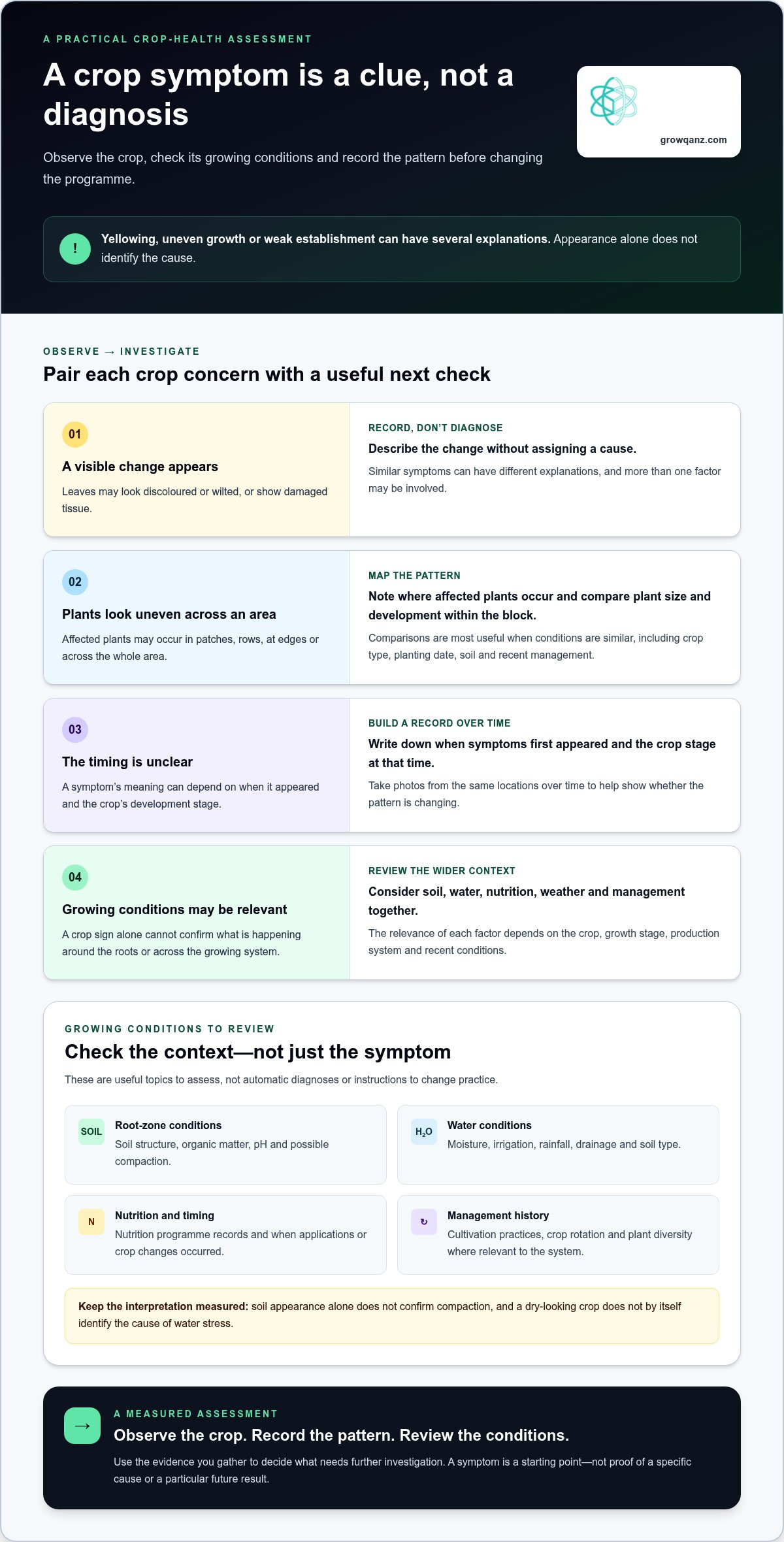
A consistent assessment helps separate what is visible from what may be causing it. Record the symptom, map where it occurs, review crop and growing conditions, then decide what to investigate. This provides a clearer basis for action than changing several programme inputs at once, and makes it easier to track whether the situation changes over time.
What should growers record when symptoms appear?
Build a simple record while the details are fresh. Note the crop, growth stage and date, describe what you see, and mark the affected area on a block map or field plan. Record whether the pattern follows rows, low-lying ground, headlands or another visible feature, without assuming that location explains the symptom.
Add relevant recent context where known, such as rainfall, irrigation, cultivation, nutrition applications or a change in routine. Photos can help show how a symptom develops, especially when taken from the same locations. Include both a wider view and close detail. These records show sequence and distribution; they do not prove that a particular event caused the change.
How can growers avoid jumping to the wrong conclusion?
Use the record to work through possible explanations, rather than confirming the first one that comes to mind. For example, patchy poor growth might prompt a review of soil conditions, water movement, crop nutrition and recent operations. The pattern can guide further investigation, but it cannot establish a cause by itself.
- Record the observation: describe the crop, growth stage, appearance and timing.
- Map the pattern: note where affected plants occur and whether nearby areas differ.
- Review the context: compare weather, irrigation, cultivation and nutrition records, along with relevant soil or crop information.
- Choose what to investigate: seek crop-specific technical advice or suitable independent diagnostic evidence if the cause remains uncertain.
Before changing the programme, consider more than one plausible factor and use guidance suited to the crop and country. New Zealand recommendations may not transfer directly from Australia, or vice versa. If a laboratory test could help answer a specific question, use a credible independent laboratory and follow its instructions for suitable samples and handling. Testing is most useful when the question is clear; results still need to be interpreted alongside field observations.
Keep evidence types distinct. General peer-reviewed research may explain how soil microorganisms relate to growing environments, but it does not show that a specific commercial product produces a particular result. Claims about a biological input need evidence for the exact formulation and intended use. Careful records support a measured assessment of healthier crops and help growers avoid treating an observation as a diagnosis or a research finding as a guarantee.
What Practical Management Steps Can Support Healthier Crops?
Management choices should follow crop-specific assessment, not a universal recipe. A practical sequence is to clarify the issue, review relevant programme factors, make a measured change and monitor what follows. The right response depends on the crop, soil, production system and current local technical guidance. Changing several things at once can make it harder to understand what, if anything, influenced later observations.
- Confirm the issue. Clarify what has changed, where it is occurring and which crop stage is affected. Separate the observed symptom from assumptions about its cause.
- Review the programme. Consider recent operations, irrigation, nutrition, cultivation and relevant soil or weather conditions.
- Choose a measured response. Prioritise the factor most relevant to the evidence and avoid unnecessary, simultaneous changes.
- Monitor consistently. Record the change and revisit comparable crop areas or stages using the same observations.
How can growers adapt management to crop and season?
Start with the crop’s specific needs. A vegetable block, kiwifruit orchard, vineyard, potato crop or blueberry planting may differ in growth stages, management practices and the conditions that matter most. These examples illustrate why context matters; they do not imply that any particular product has been tested on those crops. Use current guidance for the crop and production system rather than assuming one programme fits all.
Seasonal timing and recommendations can differ between New Zealand and Australia. Local conditions and the crop calendar matter, so guidance developed for one country should not automatically be applied in the other. Growers working in vegetables can use vegetable production information as crop context, while field crop programmes relate to field-crop systems. Neither replaces current crop-specific technical guidance.
How should growers monitor changes over time?
Before making a change, note the affected area, crop stage, visible condition and relevant programme details. Afterwards, revisit the same area and record observations consistently. Include the date and any changes in weather or routine. This creates a useful record without treating a change in appearance as proof that the management action caused it.
Keep track of other changes made during the same period. A shift in irrigation, cultivation, nutrition or weather may also affect what you observe, making it difficult to attribute differences to one decision. Where practical, compare areas with similar crop and growing conditions, and account for differences in crop stage. Avoid judging a management choice on a single observation.
For biological inputs, consider the product as one part of the wider programme. Check the exact formulation, intended use and current technical information before incorporating it, then assess any supporting evidence in the context of your crop and system. QANZ supplies microbial agricultural inputs for crop and soil programmes and provides product and application support. QANZ’s crop and soil programme information offers further context for planning.
How Should Growers Evaluate Biological Inputs for Healthier Crops?
Evaluate a biological input by checking its exact formulation and intended use, whether the evidence is relevant to your crop and growing conditions, and what kind of evidence supports any stated benefit. General research about soil microbes can explain broader biological principles, but it does not demonstrate the performance of a particular product. Consider the input within a crop and soil programme, not as a guaranteed fix.
What evidence should growers look for in a biological input?
Start with identity and relevance. Evidence is easier to assess when it clearly names the formulation and describes the crop, location, treatment and conditions. Check whether the work was a laboratory study, manufacturer trial, independent trial or commercial grower observation. Each can provide different information, but they are not interchangeable. A study on one formulation cannot automatically be applied to another.
Location matters. New Zealand evidence, Australian evidence and research from other countries come from different growing contexts; an overseas result is not a New Zealand trial. Consider whether the crop, production system and conditions resemble your own, and whether the evidence reports observations or tests a specific outcome. Broader peer-reviewed research on microbial agriculture may explain the subject, but it does not establish a product-specific effect.
If discussing trial or commercial observation results, use this qualification: “Results from individual trials or commercial observations are specific to the formulation, crop, location, treatment and conditions tested and should not be interpreted as a guarantee of equivalent performance elsewhere.”
A useful evidence check asks:
- Is the exact product formulation identified?
- Are the crop, location, treatment and growing conditions described?
- Is the evidence independent, manufacturer-generated, laboratory-based or observational?
- Does the conclusion stay within what the reported evidence actually shows?
When might Quantum Organic-Total® be considered?
Quantum Organic-Total® is a microbial agricultural input offered by QANZ for use in crop and soil programmes. Growers considering it can review the Quantum Organic-Total® product information alongside QANZ’s technology information to understand the product and its context. Consider these resources alongside crop-specific needs and evidence relevant to the intended use.
Product suitability, rates and certification requirements should be checked against current QANZ technical and BioGro documentation. If you operate within a certification programme, assess the input against that programme’s requirements and intended use. Using an input does not, by itself, make a crop, farm or produce organic.
For healthier crops, biological inputs are one possible part of a wider management plan, not a substitute for assessing crop and growing-system conditions. Talk to QANZ about whether Quantum Organic-Total® is appropriate for your crop, growing system and application programme.
Make your next crop decision evidence-led
Turn observations into a decision record: note what you are considering, what evidence supports it and what you will review afterwards. This keeps future programme choices connected to conditions in your own system, rather than relying on assumptions or results from a different crop or location.
Biological inputs deserve the same careful evaluation as any other programme decision. Review the exact formulation and current technical information, then consider how it fits your crop, growing system and application programme. Healthier crops are supported by informed choices that respond to what the crop and its conditions show over time.
Carry this approach into your next programme plan. Talk to QANZ about crop and soil programme support and a practical next step for your operation.
Frequently Asked Questions
What are the first signs of an unhealthy crop?
Early signs can include changes in leaf colour, growth rate, flowering or plant development compared with what is usual for that crop and stage. Check both older and newer growth, as well as the growing point, and note whether the change is widespread or limited to particular plants. The aim is to spot a departure from the crop’s normal pattern, not to treat one sign as a diagnosis.
Can soil health affect crop growth?
Yes. Soil conditions can influence the environment around crop roots. In New Zealand, regional councils monitor soil quality using seven indicators: pH, total carbon, total nitrogen, Olsen P, mineralisable nitrogen, bulk density and macroporosity. Interpretation depends on soil type and land use, so an indicator should be considered in context rather than treated as a universal pass-or-fail measure.
How can growers assess the cause of crop symptoms?
Match the investigation to the question. If a nutrient issue is suspected, for example, a relevant plant or soil analysis may help distinguish possibilities, provided samples are collected and interpreted appropriately. If a symptom is spreading quickly or could affect crop-management decisions, seek crop-specific technical advice promptly. A test result is evidence to weigh, not a stand-alone instruction; its meaning depends on the sample and crop context.
Do healthier soils always produce higher yields?
No. Soil condition alone cannot guarantee a yield result. When reviewing performance, growers can separate total harvested yield from marketable yield, pack-out or grade, where those measures apply to their crop. Comparing these records across seasons may help show how production varied, but weather, variety, crop management and market specifications also affect the figures. Keep the measure consistent before drawing conclusions about a programme change.
Are biological inputs suitable for every crop?
No. Suitability depends on the specific input’s intended use and the crop programme. Consider whether the product fits the identified need, how it is intended to be applied and whether its instructions address compatibility with other inputs or operations. Do not assume that products can be mixed or used interchangeably. Review the current technical information for the exact formulation before incorporating it into routine practice.
Does using a microbial agricultural input make produce organic?
No. Using a microbial input does not itself confer organic status. For a certified operation, keep the input’s current documentation and usage records with the farm’s certification records, and ensure the input and intended use meet the applicable programme’s requirements. Certification depends on the programme’s rules and assessment, not simply on a product being biological or microbial.
How should growers evaluate crop-health trial results?
Look beyond the headline result. Check whether a trial included a comparison treatment, how outcomes were measured, how long the assessment ran and whether the report discusses variability or limitations. Replicated, well-described results can provide a stronger basis for interpretation than an isolated observation, but they still apply to the work conducted. Read the methods and results together before deciding how relevant they are to your operation.
Do crop-health recommendations differ between New Zealand and Australia?
Yes. Recommendations may reflect local climate, crop calendars, production practices and the timing of crop development. Conditions can also vary between growing areas and seasons within either country, so a calendar date from elsewhere may not match the crop’s stage on your farm. Use guidance suited to the relevant country and crop, and interpret timing against the crop’s actual development rather than assuming dates transfer directly.
Disclaimer
Important: This article provides general agricultural information only. Product performance can vary according to crop, soil, climate, management practices and application conditions. Trial or research results discussed may have been obtained under specific conditions and should not be interpreted as a guarantee of equivalent results. Always follow current product directions and confirm suitability for your crop, growing system and organic certification requirements. Contact QANZ for current product and application information.
