
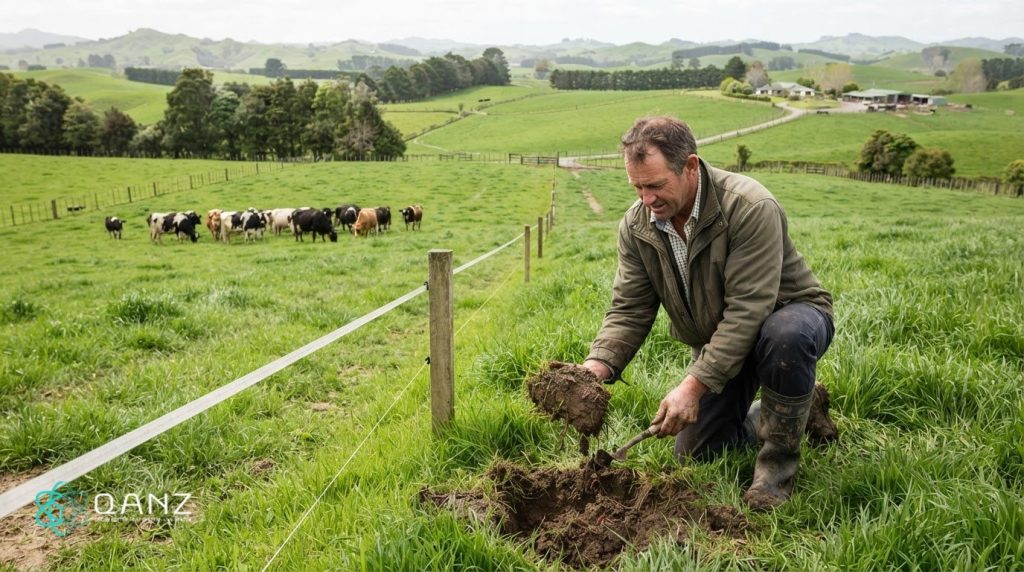
Effective organic dairy pasture management starts with observing pasture growth, soil condition and livestock needs, then adjusting grazing plans to the farm’s season and conditions. Rather than relying on a fixed calendar, use paddock observations and records to decide when to graze, what to monitor during recovery and when to review a management change.
Rainfall, soil type and pasture species all affect how general guidance applies on an individual farm. Input suitability adds another consideration: an input must fit the intended use and the farm’s organic certification programme. This guide sets out a practical way to connect grazing choices, soil observations and certification checks for growers in New Zealand.
Use the steps below to plan seasonal reviews, compare observations over time and assess information about biological inputs. Keep general agronomic principles separate from product-specific evidence, and check current, country-specific certification requirements with GrowQanz. The aim is a repeatable decision process that can be adapted to the paddock, rather than a single recommendation for every farm.
Key Takeaways
- Use organic dairy pasture management as a seasonal review process, linking grazing choices with pasture condition, soil observations and certification records.
- Track soil moisture, compaction, pH and organic matter alongside grazing and pasture recovery to build a clearer picture of paddock conditions.
- When assessing a biological input, distinguish general soil-biology research from evidence for the specific product, formulation, crop or pasture, and location.
- Make pasture reviews repeatable: observe, record, interpret, choose an action and review what follows.
- Assess any input against its documented intended use and your organic programme. Don’t assume an input described for crop and soil programmes is suitable for dairy pasture.
What does organic dairy pasture management involve?
Organic dairy pasture management brings grazing plans, pasture condition and soil care together with the requirements of the farm’s organic certification programme. In practice, growers observe how paddocks respond to grazing and seasonal conditions, make decisions suited to the property and keep records relevant to their programme.
The framework is broader than input selection. Pasture observations can inform grazing and soil-management decisions, but they don’t establish whether a specific product suits dairy pasture or indicate what result it may produce. Assess each input separately against its documented intended use, relevant evidence and the farm’s certification requirements.
Which decisions sit inside an organic pasture plan?
Organic dairy pasture management connects grazing timing, pasture recovery, species composition and soil condition with the farm’s certification obligations. These considerations affect one another. Grazing influences the conditions for regrowth, while pasture composition and soil state shape what growers observe in each paddock.
- Grazing and recovery: Record when stock enter and leave paddocks, then note the pasture’s condition before the next grazing.
- Pasture composition: Observe which species are present and record any changes in the sward over time.
- Soil condition: Note moisture, compaction and ground conditions alongside pasture observations.
- Certification records: Keep the documentation required by the farm’s organic programme, including relevant records for inputs.
These observations help growers notice patterns; they are not universal grazing targets. Compare notes over time to inform the next decision, while treating certification requirements as a separate set of obligations. A grazing decision, on its own, does not establish that a farm meets its programme’s requirements.
Why does country context matter for dairy growers?
New Zealand and Australia include varied climates and dairy systems. Pasture growth, grazing opportunities and seasonal decisions can therefore differ between farms and countries. A calendar or recommendation developed for one setting may not suit another. Use local farm observations for day-to-day decisions, and refer to current country-specific organic standards and certification documentation for programme requirements.
For general background, the Organic Milk Production Standards page offers an introductory overview of organic milk production. It is not a substitute for current official standards or the requirements of a farm’s certification programme. Use those current documents when assessing a practice or input for the programme and intended use.
Keep two questions distinct: “What is the pasture telling us?” and “What does our certification programme require?” The first supports routine farm decisions; the second depends on current, country-specific documentation. This distinction lets growers respond to local conditions without assuming that general agronomic guidance, or evidence about an input in another crop or location, establishes its suitability for dairy pasture.
How do grazing, pasture condition and soil management connect?
Grazing pressure affects how much pasture remains and the conditions for recovery. Soil conditions, weather and seasonal changes also shape what growers observe. Consider these factors together: a grazing decision should reflect the paddock’s current condition, not only a fixed interval or a target taken from another farm.
What should growers observe before adjusting grazing?
Build a consistent record of pasture condition before and after grazing, recovery between grazings, stock entry and exit dates, and visible changes in the sward. Add the date and recent weather. Conditions following dry weather may differ from those after sustained rain, so include this context when comparing paddocks or deciding whether to change the plan.
Use records to spot patterns, not to treat one observation as a diagnosis. If recovery appears slower in a paddock, for example, compare its recent weather, grazing timing, soil observations and pasture composition with earlier records. These factors can help guide what to investigate, but one observation does not prove a single cause.
A universal grazing interval or residual target cannot account for every farm’s pasture mix, soil and seasonal conditions. Use a target only when it comes from credible, relevant research or extension guidance, and interpret it in the context of your farm. When using a numerical threshold, record its source and confirm that it applies to the pasture system and conditions being managed.
How can soil condition inform pasture decisions?
Assess soil factors separately, then compare them with paddock observations. A single sign is not a definitive measure of overall soil condition.
- Moisture: Record whether the soil is dry, moist or saturated, and note recent rainfall. This provides context for pasture growth and grazing conditions.
- Compaction: Note areas that feel unusually firm or show signs of stock or machinery pressure. Compare them with nearby parts of the paddock rather than relying on one spot.
- pH: Use existing soil-test results to understand measured acidity or alkalinity. Interpret them alongside the sampling details and farm context.
- Organic matter: Review reliable test results over time where available. A visual impression is not a measurement.
Plant diversity is another consideration. Record species composition as part of routine pasture observation, but don’t treat a particular mix as a universal prescription or a guarantee of a specific outcome. Any change should suit the farm’s goals, conditions and organic programme.
For scientific explanations and numerical recommendations, use credible New Zealand or Australian research and extension sources, and check that the location and pasture system are relevant. Interpret soil-test results in light of their sampling context. For background on how GrowQanz describes its biological technology, see its overview of microbial agricultural technology.
How should growers compare organic pasture approaches and biological inputs?
Compare practices and inputs by their purpose, the evidence behind them and their fit with the farm’s organic programme. The aim is not to rank options as universally better or worse. Instead, separate routine pasture decisions from product claims and identify what information is needed before acting.
| Approach | What to consider | Evidence question |
|---|---|---|
| Grazing and pasture management | How does the practice fit the farm’s pasture, stock and seasonal conditions? | Is the recommendation supported by relevant research or local extension guidance? |
| Soil-care practice | What soil condition or management issue is it intended to address? | Does the source explain the conditions and system to which its advice applies? |
| Biological input | What is the documented intended use, and does it fit the farm’s programme? | Is evidence specific to this formulation, crop or pasture, location and use? |
| Certification suitability | What does the farm’s own certification programme require? | Are current product and programme documents available for review? |
What evidence should growers look for in an input claim?
Start by identifying the exact formulation, crop or pasture, trial location, treatment and conditions behind a claim. Then establish what kind of evidence is being presented. General peer-reviewed research on soil biology can explain broader processes, but it does not by itself demonstrate how a named product performs in dairy pasture.
Keep evidence categories distinct. Independent research, company-run trials, overseas results and commercial grower observations answer different questions. A result from another crop, formulation or country is not proof of a result in New Zealand dairy pasture. If an outcome is reported, review its source and study context before using it to inform a farm decision.
Quantum Organic-Total® information describes the product as a microbial agricultural input offered by QANZ for use in crop and soil programmes. That description alone does not establish suitability or performance in dairy pasture. Assess any proposed use against relevant evidence and current technical information.
How do certification checks differ across New Zealand and Australia?
Input assessment depends on the grower’s own programme, country and intended use. Before using an input, review current official documentation and the requirements that apply to the farm’s certification programme. Do not assume that a document or approval relevant to one country or programme automatically applies to another.
An “organic” label on an input does not certify a farm, pasture, milk or crop. Nor does a certification claim automatically establish acceptance under every programme. Review current product documentation alongside programme requirements, and keep the records that support the farm’s decisions. This evidence-first approach grounds organic dairy pasture management in practical farm needs and the relevant certification context.
How can a dairy grower build a pasture-management review?
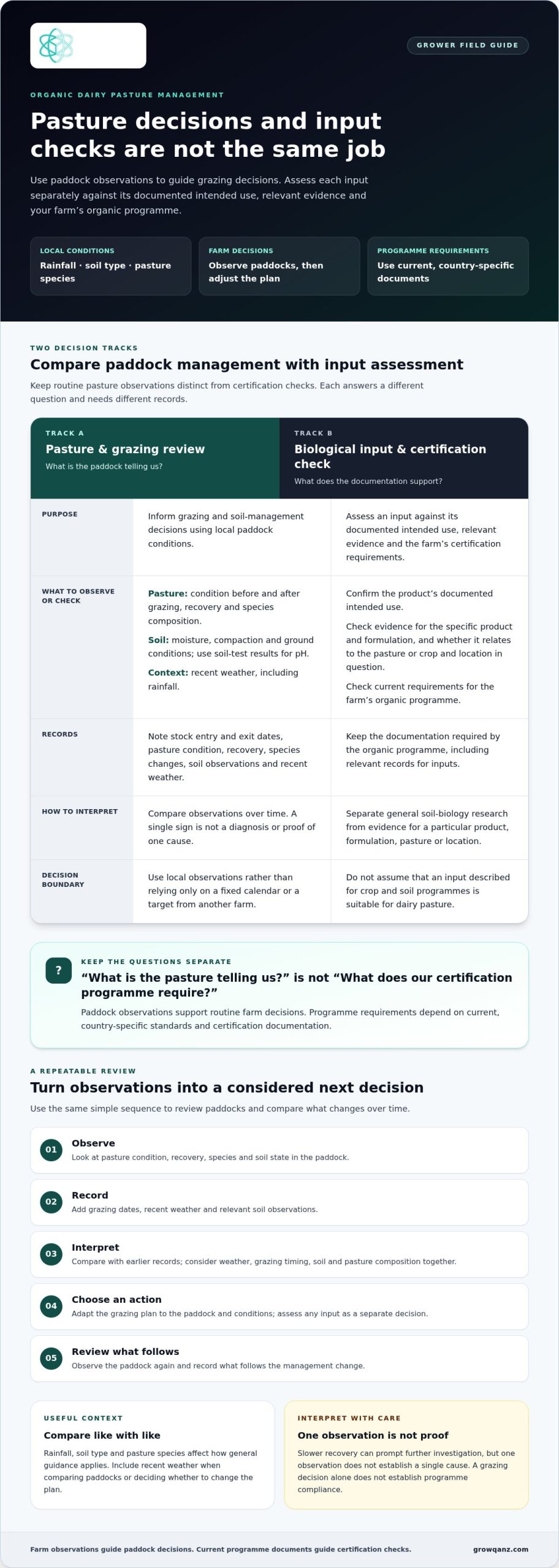
A regular review turns paddock observations into considered management choices. Keep the process simple and repeatable: observe, record, interpret, choose an action and review what follows. For organic dairy pasture management, keep certification and input checks alongside this process, but separate them from agronomic observations. Fit the review to the farm’s pasture system, conditions and season rather than following a template designed for another property.
- Observe: Look at pasture condition, recent recovery, soil concerns and grazing activity in the paddock.
- Record: Note what you see, when you see it and the relevant weather or seasonal context.
- Interpret: Compare observations with earlier records and consider more than one possible influence.
- Choose an action: Select a practical change that suits the farm and can be reviewed.
- Review: Revisit the same measure at a point that makes sense for the practice and the change you want to observe.
What belongs in a useful pasture record?
Start with a record you can keep consistently and link to a paddock and season. Include grazing dates, pasture observations, soil concerns, relevant weather and management changes. If an input is used, record its name, intended use and the documents relevant to the farm’s certification programme.
Consistency matters more than detail for its own sake. Use familiar descriptions or the same measurement approach each time, and note how you made the observation. “Slow recovery” is more useful when recorded with the date, paddock, grazing history and recent conditions. Over time, these notes can help distinguish a recurring pattern from a one-off observation, but they do not establish the cause on their own.
When should a grower review a management change?
Set the review point according to the action and the measure being observed. A change to grazing timing may need a different check from a longer-term pasture or soil-management decision. Decide in advance what you will look at and when, then record conditions that could affect the comparison, such as rainfall or a change in grazing pressure.
Be careful when drawing conclusions. If pasture condition changes after an action, record the sequence as an observation, not proof that the action caused the change. Weather, season, grazing and other management decisions may also have contributed. Claims about an input need evidence relevant to the specific formulation, intended use and conditions.
Keep certification review separate: compare current requirements and input documentation with the farm’s own programme in New Zealand or Australia. QANZ provides information about its biological growing programmes. Any assessment of an input for dairy pasture still needs documentation and evidence relevant to that intended use.
Where might Quantum Organic-Total® fit in a pasture programme?
Assess Quantum Organic-Total® against the intended use, relevant evidence and the farm’s organic programme before considering it for a pasture plan. Quantum Organic-Total® is a microbial agricultural input offered by QANZ for use in crop and soil programmes. This description does not establish its suitability or performance in dairy pasture, so do not assume it is appropriate for that use.
What can be said accurately about Quantum Organic-Total®?
Quantum Organic-Total® is a microbial agricultural input offered by QANZ for use in crop and soil programmes. Do not extend this description into claims about microbial composition, how it works in pasture or effects on pasture growth without supporting technical evidence. The Quantum Organic-Total® product information is a starting point for reviewing the product, not evidence of a dairy-pasture outcome.
For a proposed application, review current QANZ technical and BioGro documentation for product suitability, rates and certification requirements. Then assess the intended use against the farm system and organic programme. A product’s name or organic-related documentation does not certify a farm, pasture or produce as organic.
How can growers assess a biological input responsibly?
Keep the decision grounded in evidence and farm context. Compare the proposed use with current product documentation and the farm’s certification requirements. Check whether any performance evidence relates to the exact formulation, intended use, pasture or crop, location and conditions. General research on soil biology can provide useful background, but it cannot replace evidence specific to a product and its proposed use.
- Clarify the intended use: Identify the crop or soil programme described in current technical information. Don’t assume it also covers dairy pasture.
- Check the evidence: Distinguish independent research from manufacturer trials, overseas results and commercial observations. Note the formulation, location and conditions for each result.
- Review certification documents: Check current requirements for the farm’s programme in New Zealand or Australia, and assess the input for its intended use.
- Keep the farm context visible: Consider the pasture system, season and management objective, and record the evidence supporting the decision.
QANZ’s information about agricultural biological technology provides broader context; it is not proof of a specific dairy-pasture result. Certification documentation and input suitability depend on the programme and intended application, so don’t assume that one certification status guarantees acceptance everywhere.
A careful review may show that more relevant evidence or documentation is needed before making a decision. That is useful: it keeps the choice transparent and avoids treating a product claim as a substitute for pasture observation or sound grazing management. QANZ can provide product and application support for its biological products.
Make your next pasture decision with confidence
Choose one paddock for your next review and write down the decision you are trying to make. A clear baseline, a relevant observation and a planned review point can make organic dairy pasture management a practical learning process, rather than a search for one answer that fits every season or farm.
Keep the next step proportionate. If you are considering a biological input, define its intended role first, then assess whether the available product information and evidence relate to that use. For dairy pasture, don’t assume suitability from general soil-biology research or evidence from a different crop. Keep farm conditions and the organic programme central to the decision.
QANZ supplies Quantum agricultural biological products to growers in New Zealand and Australia. Talk to QANZ about whether Quantum Organic-Total® is appropriate for your crop, growing system and application programme. Contact QANZ to discuss your programme.
Frequently Asked Questions
What is organic dairy pasture management?
Organic dairy pasture management is the farm-level coordination of grazing, pasture care and soil management with the requirements of an organic certification programme. A grower might assess whether a paddock is recovering as expected, consider recent conditions and check that planned inputs align with programme requirements. A useful plan connects routine decisions with the records and current documentation relevant to the farm’s certification.
How often should dairy pasture be grazed in an organic system?
There is no single grazing interval that suits every organic dairy farm. Timing depends on pasture growth, species, weather, soil conditions and the wider farm system. Rather than follow a fixed calendar, compare paddock observations with previous records and adapt decisions when conditions change. A schedule that seemed workable before a shift in weather may need reassessing against current pasture recovery and stock needs.
Can biological inputs be used on certified organic dairy farms?
Suitability depends on the input, its intended use and the farm’s own certification programme. Before use, review current product documentation and the requirements for the programme and country. Don’t assume that an “organic” label, a general biological description or acceptance under another programme means an input is suitable for your farm. Keep the relevant documents and input-use records together for programme review.
What soil conditions should dairy growers monitor in pasture paddocks?
Monitor soil moisture, signs of compaction, pH and organic matter, using observations and reliable test information where available. Keep visual signs separate from measured results. For example, note where stock movement has left a paddock unusually firm, then compare that observation with relevant soil information rather than treating it as a measurement. Record the paddock and timing so you can interpret results alongside pasture condition and farm activity.
Does Quantum Organic-Total® have proven results in New Zealand dairy pasture?
This guide does not establish verified trial results for Quantum Organic-Total® in New Zealand dairy pasture. General evidence about soil biology, or results for another crop, formulation or location, would not prove a pasture outcome for this product. Assess any proposed pasture use against current QANZ technical information and your certification programme.
Do organic pasture-management recommendations differ between New Zealand and Australia?
Yes. Climate, seasonal patterns, farm systems and organic certification requirements can differ between the two countries, and conditions also vary between farms within each country. Use local observations to guide pasture decisions, and consult current official documentation and your own certification programme for input requirements. Interpret an agronomic recommendation developed for another country or production system carefully before applying it.
Disclaimer
Important: This article provides general agricultural information only. Product performance can vary according to crop, soil, climate, management practices and application conditions. Trial or research results discussed may have been obtained under specific conditions and should not be interpreted as a guarantee of equivalent results. Always follow current product directions and confirm suitability for your crop, growing system and organic certification requirements. Contact QANZ for current product and application information.
