
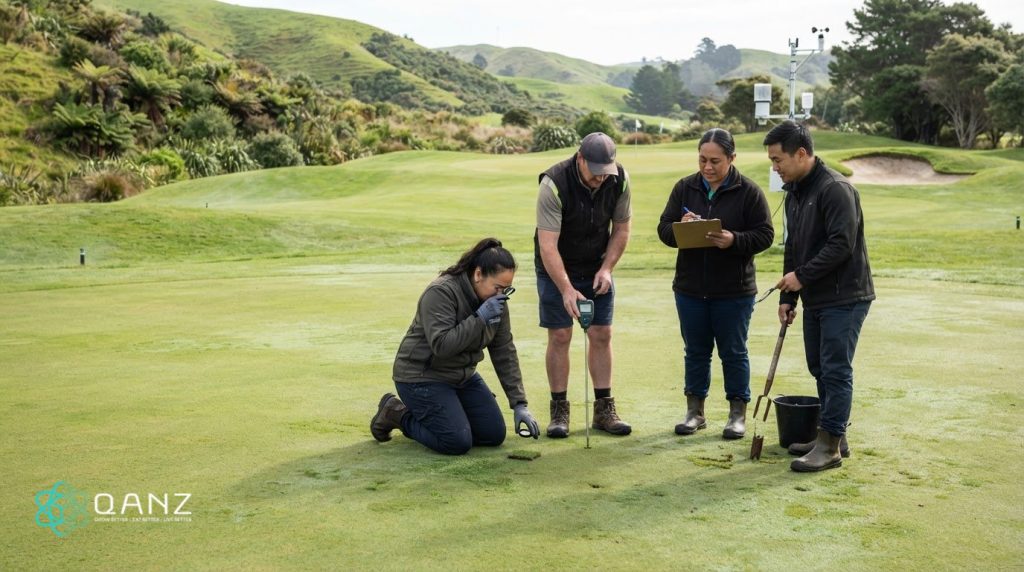
Reducing fungicide use on golf greens starts with better disease decisions, not a one-for-one product swap. For course teams, easing back on treatments can feel risky when disease threatens turf quality and consistent play. A practical first step is to understand what is affecting the green, how risk is changing and why each treatment is being considered.
Integrated pest management (IPM) brings disease observations together with weather, site conditions and the green’s performance. Cultural practices can support turf management, but their value depends on the disease, season and course conditions. They should not be treated as a guarantee of disease prevention or as an automatic substitute for fungicides.
This guide sets out a framework for monitoring disease, assessing risk and making considered treatment decisions in New Zealand. It explains how to review fertility, irrigation, aeration and thatch management within a broader programme, and how to adapt decisions to local conditions rather than follow a fixed recipe. It also covers how to assess biological inputs carefully: as options to evaluate within an integrated programme, not assumed fungicide replacements. The aim is to give course teams a clearer basis for managing disease risk while protecting the playing surface.
Key Takeaways
- Reducing fungicide use on golf greens starts with diagnosis and disease-risk assessment, not a blanket stop-use rule.
- Build a baseline before changing practice by recording disease signs, weather conditions, treatments and green performance.
- Use cultural practices as part of integrated disease management, while recognising they don’t guarantee disease prevention.
- Set documented decision points that consider diagnosis, timing and relevant local guidance.
- Assess biological inputs on their own evidence and suitability. Quantum Organic-Total® is a microbial agricultural input for crop and soil programmes, not a fungicide replacement.
Why reducing fungicide use on golf greens starts with understanding disease risk
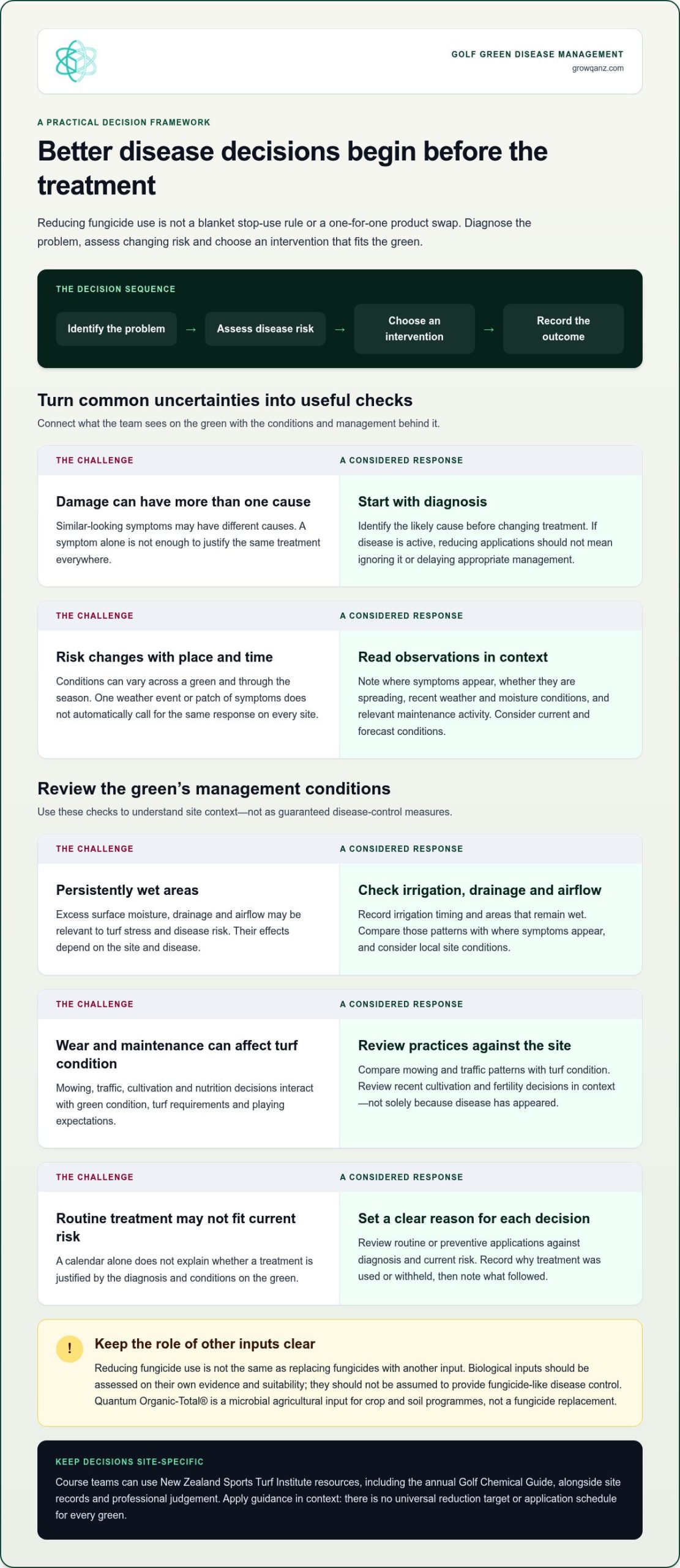
Reducing fungicide use on golf greens calls for integrated decisions, not a blanket stop-use rule. Start by identifying the likely cause of damage, assessing current and forecast conditions, and reviewing how the green is responding. Then choose an intervention that fits the assessed risk and record the outcome. If disease is active, reducing applications shouldn’t mean ignoring it or delaying appropriate management.
Fungicide stewardship means selecting interventions according to diagnosis, disease risk, timing and recorded outcomes. It gives the team a reason for each treatment decision rather than relying on a routine calendar alone. The aim is to manage disease while balancing turf condition, playability and course expectations. How much visible damage is acceptable is a course-specific decision.
What does reducing fungicide use on greens mean in practice?
In practice, reduction may mean reviewing routine or preventive applications and deciding whether each is justified by the diagnosis and current risk. That’s different from withdrawing treatment when disease has been identified and conditions support its development. The right approach depends on the site, turf condition, disease pressure and management priorities. There’s no universal reduction target or application schedule for every green.
Reducing fungicide use is not the same as replacing fungicides with another input. It means making better-supported decisions about whether, when and how to intervene. Other inputs may have a place in a broader programme, but shouldn’t be assumed to provide fungicide-like disease control.
Why can golf greens be difficult places to change a programme?
Golf greens are managed closely to support a consistent playing surface, so localised damage can matter to players and course teams. Conditions also vary across a green and through the season. Leaf wetness, excess moisture, drainage, temperature, traffic and maintenance practices can influence turf condition and disease risk. Their effects depend on the disease and site, so one weather event or symptom shouldn’t automatically prompt the same response everywhere.
Good decisions connect observations with context. Note where symptoms appear, whether they’re spreading, recent weather and moisture conditions, and relevant maintenance activity. Similar-looking symptoms can have different causes, so diagnosis matters before changing treatment. New Zealand teams can use current local resources, including the New Zealand Sports Turf Institute’s annual Golf Chemical Guide, alongside site records and professional judgement. Apply its recommendations in context, not as a universal prescription.
For a broader overview of turf management and integrated pest management, consider how pest management fits alongside soil, irrigation and other turf-care decisions. An integrated approach supports careful assessment; it doesn’t guarantee disease prevention. Start by defining the course’s risk tolerance, then record why a treatment was used or withheld and what followed.
How integrated disease management can support healthier golf greens
Integrated disease management brings several lines of evidence together: identify the problem, monitor how it develops, review cultural practices and use treatment when the assessment supports it. This gives a superintendent more context than symptoms or a calendar alone. Cultural practices can help manage conditions that affect turf, but they don’t guarantee disease prevention or remove the need to treat active disease.
General turf-management guidance treats irrigation, drainage, nutrition, mowing and cultivation as connected parts of maintaining turf. Their effects depend on the site, turf condition and season, so a change that helps one green may create a playability trade-off on another. This general agronomic guidance is distinct from product-specific evidence. It doesn’t establish that a particular biological input will prevent disease or reduce fungicide use.
Which green-management factors should a superintendent review?
Use site observations to check whether management is suited to the green’s conditions. Review:
- Irrigation and surface moisture: record irrigation timing and areas that remain wet. Compare these patterns with where symptoms appear.
- Drainage and airflow: identify persistently damp or poorly ventilated areas, then consider whether local site conditions may be contributing to turf stress.
- Mowing and traffic: compare current practices and wear patterns with the green’s condition and current turf guidance.
- Cultivation and nutrition: review recent work and fertility decisions in context, rather than making changes solely because disease has appeared.
Adjustments need local assessment. For example, changing irrigation timing may affect surface moisture, but the decision also needs to account for turf requirements and playing conditions. Use New Zealand Sports Turf Institute guidance, including its turf-management resources, alongside observations from the course. Don’t treat any single cultural adjustment as a guaranteed disease-control measure.
How should disease monitoring inform treatment decisions?
Keep a consistent record so the team can compare conditions over time. For each observation, note the date, location and appearance of symptoms, affected area, weather and moisture conditions, maintenance actions, and any treatment dates. A simple green map can help staff track whether symptoms are confined to one area, recurring in a similar pattern or spreading.
Confirm the likely diagnosis before attributing symptoms to a particular disease or changing the programme. Similar-looking damage can have different causes. A scouting record documents what was observed; it isn’t a guaranteed forecast. The New Zealand Sports Turf Institute’s Turf App provides a local resource for identifying turf diseases, pests and weeds. Use it as an aid alongside careful inspection and applicable turf guidance.
After an intervention, review the records: did symptoms change, and what else changed in the weather or maintenance programme? This supports more considered decisions about reducing fungicide use on golf greens without assuming a cultural practice or input will deliver a specific outcome. For more information on QANZ’s turf and horticulture information, explore the resources available for turf programmes.
Fungicides, cultural practices and biological inputs: compare their roles carefully
These approaches serve different purposes, so compare them by the problem they address and the evidence supporting their use. Fungicides may remain part of a programme when a disease is diagnosed and current local guidance supports treatment. Cultural practices can help manage turf conditions, while biological inputs should be assessed on their own evidence. Neither should be assumed to provide the same disease control as a fungicide.
| Approach | Role | Evidence to consider | Operational considerations and limitations |
|---|---|---|---|
| Fungicides | Manage a diagnosed disease when treatment is justified. | Diagnosis, disease risk, current product information and applicable local guidance. | Check the current label and relevant New Zealand requirements. Treatment choice, timing and application constraints matter; don’t assume a routine schedule suits every green. |
| Cultural practices | Manage growing conditions through practices such as irrigation, mowing, cultivation and nutrition. | Site observations, turf condition and recognised turf-management guidance. | Changes may affect playability and need to suit the green. These practices support management but aren’t guaranteed substitutes for fungicides. |
| Biological inputs | Potential inputs to assess within a broader turf or soil programme. | Evidence for the exact formulation, intended use and relevant turf conditions. | Check suitability and directions for the intended use. General research on microbial inputs doesn’t establish the performance of a named product on golf greens. |
What should a golf course team compare before changing its programme?
Compare the diagnosis and disease risk first, then consider timing, application constraints and possible effects on the playing surface. Review current product labels and applicable New Zealand requirements. Australian requirements and recommendations are separate and shouldn’t automatically be applied in New Zealand. Without current, applicable source material, it isn’t responsible to prescribe a chemical, rate or interval.
Record the reason for a programme change and what happens afterwards. This helps distinguish a change supported by course observations from an assumption that fewer fungicide applications will maintain the same level of disease control.
How should biological inputs be assessed for golf turf?
Check the intended use, turf suitability, directions and evidence for the exact formulation. General scientific research about microbial agriculture can inform questions, but it isn’t evidence that a particular Quantum product has been tested on golf greens or will reduce disease or fungicide use. Quantum Organic-Total® is a microbial agricultural input for crop and soil programmes; don’t treat it as a fungicide or fungicide replacement. For broader context, see QANZ’s turf and horticulture information.
How to build a measured fungicide-stewardship plan for golf greens
A useful stewardship plan starts with a baseline, sets out why and when the team will act, then reviews what follows. This gives course staff a consistent way to evaluate programme changes without assuming fewer applications will suit every season or green. Use the steps below to structure decisions, not as a fixed treatment schedule.
What should the baseline review include?
Before changing current practice, gather records that show what has been happening and where. Use a consistent method across greens so observations can be compared over time.
- Summarise disease history. Record observed symptoms, suspected or confirmed diagnosis, dates and affected locations. Keep confirmed diagnoses distinct from initial observations.
- Review treatment history. Note treatment dates, the reason for each decision and the relevant product information. Include decisions to withhold treatment where a reason was documented.
- Add course conditions. Record relevant weather and moisture observations, maintenance actions and changes in green condition.
- Describe playing quality. Include observations about turf condition and playability so disease management is considered alongside course expectations.
Keep the record factual. A map or consistent location description can help staff see where symptoms recur, but don’t invent a numerical threshold or treat a pattern as a reliable forecast.
How can a team review changes responsibly?
Set a clear decision point before altering the programme. Document which practice is changing, why the team is changing it, what observations will prompt a review, and what action may be needed if risk increases. Where practical, change clearly defined elements rather than several at once; otherwise, it may be difficult to understand which factors contributed to an outcome.
Review records over time with qualified turf expertise and current product guidance. A change followed by healthier turf doesn’t, by itself, prove that the change caused the result. Weather, disease pressure, maintenance and other conditions may also have shifted. Pause or revise the approach if disease risk or turf condition calls for action.
Consistent records make programme changes easier to evaluate because they show what the team observed, why it acted and what happened next.
What differs between New Zealand and Australia?
Conditions and seasonal timing vary between sites, and guidance should be interpreted locally. Use the current product label and applicable requirements for the country where the course is located. In New Zealand, the New Zealand Sports Turf Institute’s annual Golf Chemical Guide is a relevant local reference. Australian recommendations and labels aren’t automatically applicable in New Zealand, or vice versa.
For information about biological inputs within a broader turf programme, explore QANZ’s turf and horticulture information.
Where GrowQanz and Quantum Organic-Total® fit in a golf-turf programme
Once disease monitoring and decision points are established, a biological input can be considered on its own merits within the wider programme. GrowQanz supplies Quantum agricultural biological products to growers in New Zealand and Australia. This does not make a product a fungicide or show that it will control disease on golf greens. For teams focused on reducing fungicide use on golf greens, evaluate any input without assuming it will replace a treatment or reduce applications.
What is Quantum Organic-Total® described as?
Quantum Organic-Total® is a microbial agricultural input offered by GrowQanz for use in crop and soil programmes. That description does not establish a particular mechanism, turf-green performance or disease-management outcome. The Quantum Organic-Total® product information is a starting point for reviewing the product and its current technical documentation.
Before considering use in a golf-turf programme, review current technical documentation for intended use, suitability and directions. Product suitability, rates and certification requirements should be checked against current GrowQanz technical and BioGro documentation. Don’t infer that the input is suitable for greens, or that its use makes a course or turf organic, without relevant documentation supporting those points.
What evidence should be checked before considering a biological input?
Evaluate the exact formulation and the question the evidence actually answers. General research on soil biology or turf management may help explain broader principles, but it isn’t proof of performance for a named product. Evidence from a different formulation, crop, location or set of conditions shouldn’t be treated as evidence for Quantum Organic-Total® on golf greens.
- Confirm the formulation: make sure the documentation relates to the specific product being considered.
- Check intended use and directions: use current technical information to assess whether the proposed use fits the programme.
- Assess evidence relevance: distinguish general scientific research from product-specific trials, and note the location, turf type and conditions where evidence is available.
- Keep expectations measured: don’t assume disease control, fungicide reduction or replacement unless relevant evidence supports that outcome.
No golf-green trial evidence is presented here, so no turf performance claim should be inferred. Consider product suitability alongside the course’s diagnosis, management priorities and applicable local guidance. Talk to GrowQanz about whether Quantum Organic-Total® is appropriate for your crop, growing system and application programme through GrowQanz product and application support.
Make your next programme decision evidence-led
Reducing fungicide use on golf greens is a process of careful assessment, not a fixed reduction target. Start with sound disease identification, review site conditions and cultural practices, and use consistent records to guide decisions. Fungicides may still have a role when diagnosis and current local guidance support treatment.
Biological inputs should be judged on their own documentation and evidence, not assumed to prevent disease or replace fungicides. Quantum Organic-Total® is a microbial agricultural input for crop and soil programmes. QANZ supplies Quantum agricultural biological products to growers in New Zealand and Australia. Assess product suitability for a golf-turf programme using current technical information.
For a considered discussion about whether Quantum Organic-Total® suits your crop, growing system and application programme, talk to QANZ about programme suitability. Keep monitoring, recording decisions and adapting to local conditions. A measured approach gives your team a clearer foundation for managing turf condition and playability.
Frequently Asked Questions
Can golf courses reduce fungicide use without risking disease on their greens?
They can review and potentially reduce unnecessary applications, but no approach can guarantee that disease won’t occur. Base decisions on diagnosis, observed risk, site conditions and course expectations, rather than stopping treatments across the board. If disease is active and treatment is supported by current local guidance, reducing use shouldn’t mean ignoring it. Monitor turf condition and keep records so the team can respond if risk changes.
What is the first step to reducing fungicide use on golf greens?
Start by establishing a baseline before changing the programme. Review disease observations, treatment history, green-management records and playing-quality notes, keeping confirmed diagnoses distinct from suspected symptoms. Record where damage appeared and relevant conditions or maintenance actions. This helps identify which applications were routine and which responded to diagnosed disease, giving the team a more informed basis for reviewing future decisions.
Can cultural practices replace fungicides on golf greens?
No. Cultural practices such as adjusting irrigation, reviewing mowing or addressing drainage can support turf management, but they don’t guarantee disease prevention or provide an automatic substitute for fungicide treatment. Their suitability depends on the green, turf condition, disease pressure and playability requirements. Consider them as part of integrated management, and retain treatment options where diagnosis and current local guidance support their use.
Do biological products reduce fungicide use on golf greens?
That outcome shouldn’t be assumed. Biological inputs need to be assessed on evidence for the exact formulation, intended use and relevant turf conditions. General research on soil biology doesn’t demonstrate that a particular product controls disease on greens or reduces fungicide applications. Treat biological products as possible inputs to evaluate within a broader programme, not as proven fungicides or replacements for fungicide treatment.
How should a golf course monitor disease before changing its fungicide programme?
Inspect greens consistently and record symptoms, affected locations, weather and moisture conditions, maintenance actions and treatment dates. Map observations where useful, and distinguish suspected symptoms from a confirmed diagnosis before changing the programme. Look for patterns across records, but don’t treat them as a guaranteed forecast. Reviewing observations alongside turf condition and course priorities helps the team set clear, documented decision points.
Do fungicide recommendations differ between New Zealand and Australia?
Yes. Product labels, applicable requirements and seasonal conditions may differ between the countries, so use guidance relevant to the country where the course is located. Don’t transfer an Australian recommendation directly to a New Zealand programme, or vice versa. In New Zealand, the New Zealand Sports Turf Institute’s current Golf Chemical Guide is a relevant local reference for golf-course teams.
Can Quantum Organic-Total® be used on golf greens?
Don’t assume it is suitable for greens without support in current product documentation. Review current QANZ technical information for intended use, suitability and directions before considering it in a turf programme. No golf-green trial evidence or disease-control outcome is established here, and it shouldn’t be treated as a fungicide or fungicide replacement.
Disclaimer
Important: This article provides general agricultural information only. Product performance can vary according to crop, soil, climate, management practices and application conditions. Trial or research results discussed may have been obtained under specific conditions and should not be interpreted as a guarantee of equivalent results. Always follow current product directions and confirm suitability for your crop, growing system and organic certification requirements. Contact QANZ for current product and application information.
