
A BioGro-approved input doesn’t certify your whole farm or crop. When assessing BioGro approved soil inputs, check the current official documents for the exact product, its recorded status and any conditions. Then compare the intended use with your own certification programme and market requirements. This helps you distinguish an input’s status from whether it suits your crop and growing system.
A product name or approval mark alone may not give you the full picture. Before use, match the product and formulation to current BioGro documentation, including any annex or conditions. Also consider the planned application and destination market, as requirements can differ between New Zealand and Australia.
This article explains what BioGro documentation can tell you, which records to review and how to assess a soil input before adding it to a programme. It also outlines why growers should check the requirements that apply to their own operation rather than assume one approval applies across different certification systems.
Key Takeaways
- Assess BioGro approved soil inputs by the exact product and intended use, not by a general approval claim.
- Check current official BioGro documentation and product-specific technical information before adding an input to your programme.
- An input’s status is separate from certification of your farm, crop or produce. Approval alone doesn’t make them certified organic.
- Requirements can differ between New Zealand and Australia, so compare the input and intended market with your own certification programme.
- Assess the crop need and growing conditions first, then record why an input fits your system and planned application.
What Does “BioGro-Approved Soil Input” Mean for a Grower?
BioGro status should be verified for the specific input in current official documentation. For growers considering BioGro approved soil inputs, the relevant record needs to match the exact product and identify any conditions that apply. Check the latest documentation, then assess whether the recorded status fits your crop, planned application and certification programme.
This keeps input decisions separate from farm or produce certification. An input’s status is one part of a wider organic programme, which has its own standards and requirements. For background on the sector and the role of certification bodies, see this overview of organic farming in New Zealand. Use current BioGro records, rather than general sector information, to verify a particular input.
Does input approval make a crop or farm organic?
No. Using an approved input does not, by itself, make a farm, crop or produce organic or certify it. Certification applies to the grower’s operation and production under the requirements of their chosen programme, not simply to one input used in the system.
An approved input does not, by itself, certify a farm or crop. Growers remain responsible for meeting their programme’s requirements, including establishing whether a particular input suits their system and intended use. Don’t assume a product is appropriate for every certified organic operation because it has a BioGro status.
What does the word “approved” need to identify?
Start with the exact product name and formulation in the current official record. Similar names or related formulations are not interchangeable. An old label, historic certificate or broad marketing statement may not reflect current status, so review the latest BioGro documentation and any associated annex or conditions.
Then consider the planned use. The crop, application method and wider programme can affect whether the documented status fits your decision. A product record may specify a status or conditions, and those details matter more than a general claim that an input is “approved”. If the product name, formulation or intended use does not match the current record, resolve the discrepancy before applying it in a certified system.
Which Documents Should You Check Before Using a BioGro-Approved Soil Input?
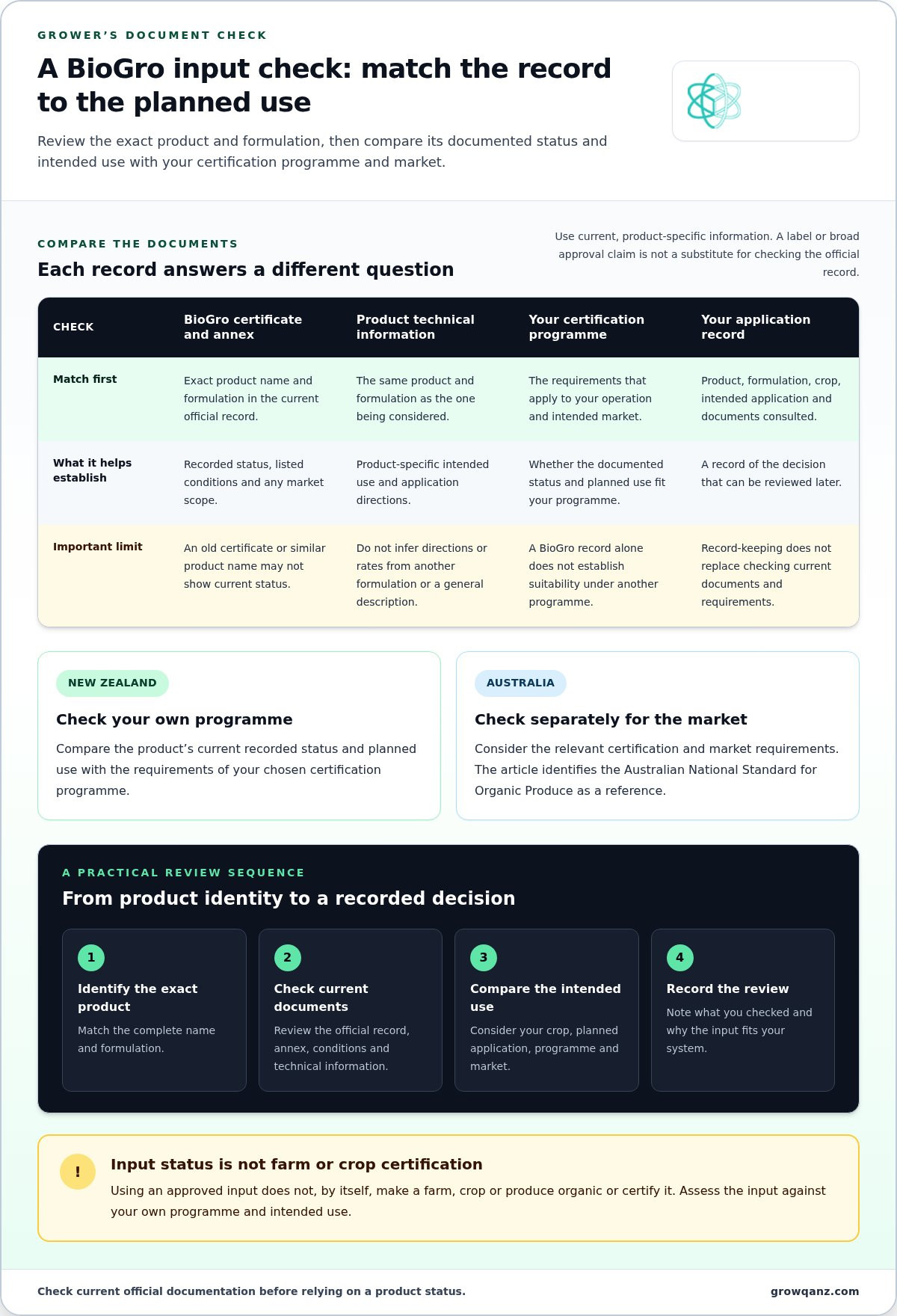
Start with current, product-specific records rather than a label or general claim. For BioGro approved soil inputs, review the current official BioGro documentation alongside technical information for the exact product. These records answer different questions: one covers the input’s status and any conditions, while the other provides product-specific information. Neither replaces your own certification programme’s requirements.
A practical document check includes:
- Current BioGro certificate and associated annex: Match the product name and formulation, then read the recorded status and any listed conditions or market scope.
- Current product technical information: Check the intended use and application directions for the exact product and formulation.
- Your certification programme’s requirements: Establish whether the documented status and planned use fit your programme and intended market.
- Your application record: Note the product, formulation, crop, intended application and documents consulted so the decision can be reviewed later.
A certificate or listing is relevant only when it matches the exact product and formulation being considered. A similar name or an older article is not enough to establish current status. Check document dates and scope, and don’t carry certificate numbers or status claims forward from historic material.
How do you verify the product and its current status?
Compare the complete product name on the packaging with the current official BioGro record and current GrowQanz product information. Confirm that the documents refer to the same formulation and note any conditions in the annex. If information is missing, outdated or inconsistent, don’t rely on it as evidence of current status until it has been checked against current documentation.
How do you check suitability for a crop programme?
Once the product identity and status are clear, compare the documented intended use with your crop, soil programme and planned application. Use current product-specific technical information for rates and directions. Don’t infer them from another formulation or a general description. For Quantum Organic-Total®, refer to the Quantum Organic-Total® product information for product-specific material.
If your programme involves Australia, consider the relevant certification and market requirements separately. The Australian Department of Agriculture, Fisheries and Forestry provides the Australian National Standard for Organic Produce. A BioGro record alone doesn’t establish suitability under another certification programme. For related GrowQanz product and application information, visit GrowQanz’s growing resources.
How Do BioGro Requirements Differ Between New Zealand and Australia?
Don’t assume an input’s status in one country automatically satisfies a certification programme in the other. BioGro documentation helps growers check a product’s status within the scope it covers, but you still need to establish whether the input, planned use and market fit your own programme. Certification requirements can differ by country and programme.
Use this comparison to organise your checks, not as a substitute for current documentation or the requirements of the programme governing your operation.
| Grower location | Documents and checks | Questions to resolve |
|---|---|---|
| New Zealand | Check current official BioGro documentation, including any relevant product listing or annex, alongside your own certification programme requirements. Match the exact product and formulation to the crop and planned application. | Does the current record cover this product and use? Do any listed conditions apply to your programme or intended market? |
| Australia | Check the requirements of the certification programme relevant to your operation and intended use. Review current product-specific technical information and country-specific requirements. | Is this input acceptable within your programme for the planned crop and application? Are there conditions or market requirements to consider? |
What should New Zealand growers verify?
Start with current BioGro records, then consider your own certification programme’s rules rather than treating a product listing as a complete decision. Keep the product identity, crop and intended application consistent across the documents you review and your farm records. If technical information specifies measurements, follow the current product directions and use the stated metric units, such as litres or millilitres. Don’t convert guidance from another product or source.
What should Australian growers verify?
Use the requirements relevant to your Australian certification programme and the specific use you’re considering. A BioGro record or New Zealand guidance should not be treated as automatic acceptance under an Australian programme. Use current authoritative information for country-specific requirements and product information. Don’t infer suitability from a product name, an overseas label or a general statement about organic use.
The practical rule is simple: verify for the country, programme and use. Growers working across both markets should keep the New Zealand and Australian checks distinct. The same product may need to be assessed separately against each programme’s requirements, crop context and intended market. This avoids relying on an approval statement that does not address the requirements for a particular operation.
How Can Growers Assess a Soil Input Before Adding It to a Programme?
A considered input decision starts with the crop need, not the product claim. Use a consistent sequence to assess whether an input fits the crop, production system and certification programme, then keep a record of the evidence behind your decision. This separates general soil-management choices from claims about a specific branded product.
What is a practical input-checking sequence?
- Define the need and context. Record the crop, production system, issue or objective, intended use and certification programme. Be specific about where and how you plan to apply an input.
- Identify the exact product. Note its complete name and formulation. Don’t assume information for a related formulation applies to the product you’re considering.
- Match it to current records. Check current official certification documents and product-specific technical information. Confirm that the product identity and any conditions match the intended use.
- Assess the crop and soil setting. Consider soil conditions, crop stage, the existing programme and planned application timing. A product’s documented status doesn’t establish that it meets every agronomic need.
- Record the decision. Keep copies of the documents consulted, the formulation reviewed, the planned application and the reason for proceeding or not proceeding. Revisit the record if the product, programme or documentation changes.
Which soil and crop factors belong in the decision?
Consider practical field conditions before adding another input. Soil moisture, pH, organic matter, compaction, cultivation and crop stage can all inform a broader soil-management assessment. Also consider how the input fits alongside existing practices and planned applications. These are general management factors, not evidence that a particular product will improve yield, nutrient availability, disease pressure or crop tolerance to stress.
Keep the evidence in its lane. General scientific research on soil biology can explain broad processes, but it doesn’t demonstrate the performance of a specific branded input. Product-specific claims need product-specific evidence, and guidance for one formulation should not be transferred to another without support.
For a crop programme, use relevant crop information alongside current product directions. QANZ provides Quantum crop application programmes and product and application support. Use crop-specific material only where it matches your production context.
Once you’ve identified the crop need and gathered the relevant records, talk to QANZ about product and application support for your growing programme.
Where Does Quantum Organic-Total® Fit in a BioGro Input Review?
After checking input status, certification documents and intended use, apply the same process to the specific product. Quantum Organic-Total® is a microbial agricultural input offered by QANZ for use in crop and soil programmes. Assess its place in a programme using current product-specific technical information and relevant certification documents, not assumptions based on its name or category.
What can be said about Quantum Organic-Total®?
Start with the product identity. Review current Quantum Organic-Total® product information alongside current BioGro documentation, and confirm that the name and formulation match the record you’re relying on. The product page provides product information; it doesn’t replace an official certification record or the requirements of your own programme.
Don’t infer current BioGro status from older labels, past articles or broad descriptions of BioGro approved soil inputs. Make certification claims only when current official documentation supports them. When discussing product evidence, identify Quantum Organic-Total® specifically and state the formulation and intended application where that information is available. Evidence or directions for another product should not be presented as applying to this one.
For growers considering the product, check suitability, rates and application directions against current QANZ technical information. Then compare the proposed use with relevant BioGro documentation and your own certification programme. A product’s status is only one part of the decision; it doesn’t certify the farm, crop or produce.
What is a useful next step for growers?
Bring the decision back to your actual programme. Note the crop, country, production system and intended application, then compare those details with current product information and certification requirements. New Zealand and Australian growers should assess the product against the requirements that apply to their own operation, rather than assume documents for one country settle the question in the other.
QANZ’s technology information can provide further context about its agricultural biological products. Use it alongside, not instead of, the current technical and certification documents relevant to your intended use.
For product and application information relevant to your crop, talk to QANZ about your crop programme.
Make Your Next Input Decision With Confidence
Choosing BioGro approved soil inputs calls for more than a broad approval claim. Check current official documents for the exact product and formulation, then assess whether the recorded status and intended use fit your crop and certification programme. Approval of an input doesn’t certify your farm, crop or produce, and requirements may differ between New Zealand and Australia.
Keep current product technical information alongside the certification records used to make your decision. Quantum Organic-Total® is a microbial agricultural input offered by QANZ for use in crop and soil programmes. Product suitability, rates and certification requirements should be checked against current QANZ technical and BioGro documentation. QANZ supplies Quantum agricultural biological products to growers in New Zealand and Australia.
For product and application information to help inform your programme, talk to QANZ about your crop programme. A careful, well-documented assessment is a practical step towards a decision that suits your growing system.
Frequently Asked Questions
What does BioGro-approved mean for a soil input?
It refers to a status recorded for a specific input in BioGro’s current documentation, which may include conditions or restrictions. Check the certificate and any annex for the exact product name, formulation and recorded status. BioGro status isn’t a blanket endorsement for every crop, application or market, so compare the documented conditions with your certification programme and intended use.
Does using a BioGro-approved input make my farm or produce organic?
No. Using an approved input alone doesn’t certify a farm, crop or produce as organic. Certification depends on meeting the requirements of the grower’s own programme across the operation and production process. Treat the input’s status as one part of your decision, not proof of farm or produce certification. Confirm that the product and planned use fit your programme’s requirements.
How can I check whether a soil input is currently BioGro certified?
Review current official BioGro documentation and any associated annex, then match the complete product name and formulation to the record. Check the document date, status and any conditions or market scope, and compare these details with current product-specific technical information. Don’t rely on an old label, a certificate number copied from an older article or a broad marketing claim. If records conflict or omit details, don’t assume current status.
Are BioGro-approved soil inputs automatically suitable for Australian growers?
No. A BioGro listing doesn’t automatically establish suitability under an Australian certification programme or for a particular Australian market. Australian growers should check the requirements of their own programme, along with current product information and the intended crop and application. Treat New Zealand documentation as a reference, not automatic cross-border acceptance, and assess the applicable country-specific requirements.
Can a BioGro-approved soil input be used on any crop?
Not automatically. The input’s recorded status and conditions, product-specific directions, crop, application and certification programme all matter. Check current BioGro documentation and technical information for the exact formulation, then compare them with your intended use and programme requirements. Don’t assume a listing or recommendation for one crop, application or formulation applies to another without supporting documentation.
What documents should I keep when assessing an organic soil input?
Keep the current BioGro certificate and relevant annex, current product-specific technical information, and any guidance from your certification programme that informs the decision. Record the exact product name and formulation, crop, intended application, date reviewed and documents consulted. These records make it easier to revisit the decision if the product, programme or documentation changes.
Disclaimer
Important: This article provides general agricultural information only. Product performance can vary according to crop, soil, climate, management practices and application conditions. Trial or research results discussed may have been obtained under specific conditions and should not be interpreted as a guarantee of equivalent results. Always follow current product directions and confirm suitability for your crop, growing system and organic certification requirements. Contact QANZ for current product and application information.
