
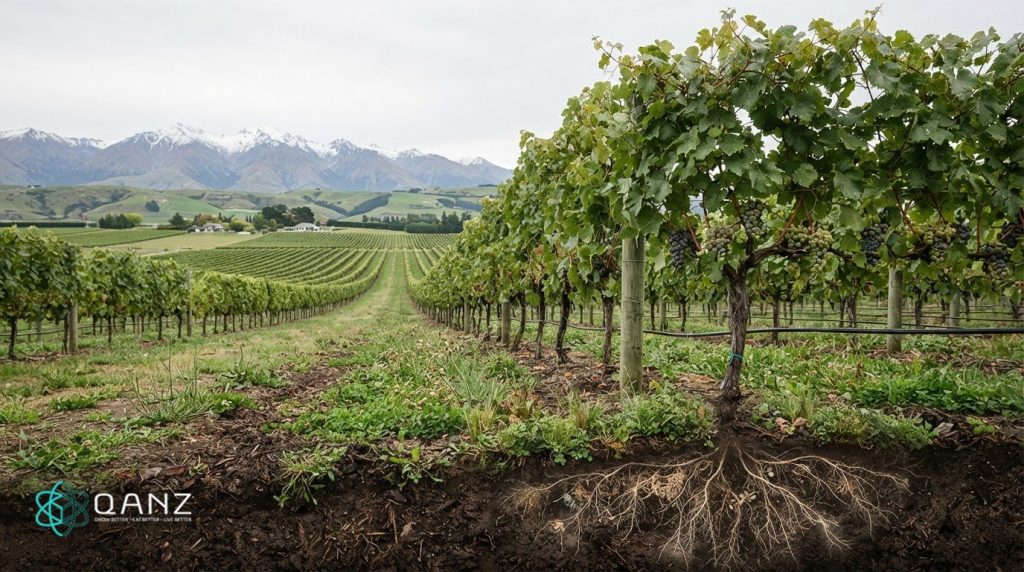
A healthier vineyard floor won’t, by itself, stop Botrytis. Improving vineyard soil health naturally means taking practical steps such as maintaining soil cover, limiting unnecessary disturbance and building organic matter over time. These practices support soil management, not Botrytis treatment. In wet conditions, canopy density and moisture around grape bunches still need direct attention.
Soil care and disease management belong in the same vineyard plan, but they address different issues. This guide explains how soil management fits into a broader Botrytis plan for New Zealand and Australian vineyards, with practical steps for assessing soil, canopy and bunch-zone conditions. It also explains how to evaluate biological inputs using evidence for the exact product and its intended use, rather than assuming that general research on soil microbes applies to a particular formulation.
Key Takeaways
- Improving vineyard soil health naturally supports longer-term vineyard management, but isn’t a stand-alone Botrytis treatment.
- Assess canopy density, bunch-zone airflow and moisture alongside seasonal conditions when considering disease risk.
- Compare canopy management, vineyard hygiene, monitoring and soil stewardship by their purpose, timing and practical limits.
- Build a plan by observing and recording block conditions, setting priorities, choosing practices and reviewing what changes.
- Consider Quantum Organic-Total® as a microbial input for crop and soil programmes, not as a Botrytis control product.
Vineyard soil health and natural Botrytis management
Healthy soil is important to vineyard function, but it is not a Botrytis control treatment. Botrytis bunch rot is a grape disease associated with the fungus Botrytis cinerea, which can affect plant tissues and become problematic in grape bunches. This overview of Botrytis cinerea describes the fungus and disease. Managing risk also requires attention to the vine canopy and bunch zone.
Soil condition and disease risk are connected parts of vineyard management, but they are not interchangeable. Soil observations can inform decisions about vine growth and vineyard operations. Disease risk also depends on conditions around susceptible bunches. Improving vineyard soil health naturally belongs in a longer-term site plan, alongside in-season monitoring and practices directed at the canopy and crop.
How can soil condition influence the wider vineyard system?
Soil structure affects the spaces through which air and water move and roots grow. Organic matter, soil moisture and compaction are all relevant to root-zone management, traffic and cultivation. Their importance varies with soil type, season and block history, so assess conditions on site rather than assuming one practice suits every vineyard.
Soil management can also inform decisions about vine vigour and canopy work. If vine growth is difficult to manage, review the block’s soil and site conditions as part of the wider picture. That does not show that improving soil suppresses B. cinerea. Assess bunch rot risk through crop and canopy conditions rather than inferring it from soil health alone.
What should growers mean by natural Botrytis control?
Natural management is best understood as an integrated approach, not a guarantee attached to a particular input. It can include regular monitoring, canopy practices that improve bunch-zone conditions and vineyard hygiene, such as removing infected or decaying bunch material where appropriate. The timing and usefulness of each practice depend on block conditions and disease pressure.
Keep the categories clear. Cultural practices change how the vineyard is managed. Biological products are inputs with specific intended uses and evidence that must be assessed for the exact product. Registered crop-protection products are a separate category, subject to relevant local requirements and directions for use. “Natural” alone does not establish efficacy, suitability or approval. In New Zealand and Australia, use current guidance for the relevant country and crop.
Soil-health improvement supports the wider vineyard system; direct Botrytis management requires practices and products suited to disease risk. This distinction helps growers pursue long-term soil goals without treating them as a substitute for monitoring or targeted bunch-zone management.
Which vineyard conditions shape Botrytis risk and soil-health decisions?
Botrytis risk is shaped by interacting factors, including vine growth, bunch structure, canopy conditions and seasonal weather. A dense fruiting zone can restrict airflow and retain moisture around bunches. Exposure, crop load and the timing of wet conditions also influence the conditions in which disease may develop. No single canopy style suits every site. The aim is to understand how block structure and the season combine to affect risk.
Plant & Food Research and New Zealand Winegrowers’ Botrytis Decision Support Model uses weather and block-specific information to help estimate harvest risk. It illustrates why vineyard observations are most useful when considered alongside seasonal conditions. Australian guidance may offer relevant comparison, but recommendations need to be applied in the context of the vineyard’s location, season and local crop-protection guidance.
Which canopy and bunch factors should growers observe?
Inspect the fruiting zone at relevant crop stages. Note canopy density, airflow through the bunch zone, whether bunches are exposed or shaded, and any signs of persistent moisture or disease. Botrytis risk is associated with susceptible grape tissues and humid, wet conditions around bunches. The relationship between weather and block conditions is reflected in the Botrytis Decision Support Model.
Record observations consistently, including when wet weather occurs and what you see in the canopy and bunches. Note the block and crop stage as well, so you can compare observations over time. This helps show whether conditions are changing through the season and supports timely decisions, rather than relying on a single inspection.
How do soil and site observations inform vineyard decisions?
Keep soil observations alongside crop records, but interpret them as site-management information, not a Botrytis diagnosis. Note soil structure, surface water after rain, drainage patterns and signs of compaction, particularly where traffic or cultivation may affect the block. Soil moisture and drainage inform vineyard operations and soil management; they do not establish disease pressure in the fruiting zone.
Soil tests can provide information about soil properties relevant to longer-term management. Interpret results in context, alongside block history and field observations. Neither a soil test nor a visual soil assessment alone diagnoses Botrytis or justifies a product recommendation.
The Australian Wine Research Institute’s vineyard soil health practices fact sheet offers guidance on soil management. Use it to inform longer-term work on improving vineyard soil health naturally, while canopy and bunch observations guide in-season disease-risk decisions. Growers considering biological inputs as part of a broader programme can read GrowQanz biological growing programme information.
How do natural vineyard practices compare for Botrytis risk management?
No single natural practice suits every block or season. Canopy management and vineyard hygiene address conditions in and around the fruiting zone, while monitoring helps growers decide when and where attention is needed. Soil stewardship has a different role: it supports longer-term site management, but soil amendments and microbial inputs are not substitutes for measures directed at Botrytis risk.
Compare practices by purpose, timing, practical limits and the evidence available for the vineyard conditions in question. The Australian Wine Research Institute’s guidance on vineyard soil health practices can inform soil stewardship, but it is not evidence that soil practices control bunch rot.
What can canopy management and vineyard hygiene contribute?
Suitable canopy work can help manage the fruiting-zone environment. Depending on vine vigour, cultivar, training system and seasonal conditions, growers may adjust shoots or remove leaves around bunches to improve exposure and airflow. Respond to the block rather than imposing one canopy design everywhere. Excessive or poorly timed leaf removal may create other management concerns, and the labour required can affect what is practical.
Vineyard hygiene has a separate purpose: removing infected or decaying grape material may reduce sources of disease in the block. Its value depends on how much affected material is present, whether it can be found and removed, and the time available. Neither canopy work nor hygiene can be assumed to prevent or eliminate disease. Record the work and subsequent observations so future decisions are based on block-specific information rather than expectation.
Where do monitoring and soil stewardship fit?
Monitoring connects these practices to changing conditions. Through the season, inspect and record canopy density, bunch-zone moisture, disease observations, weather events and relevant vineyard work. Consistent notes can reveal patterns between blocks or seasons and support timely decisions. They do not replace current local advice on crop-protection options.
Soil stewardship follows a longer time frame. Track soil organic matter, structure, compaction and moisture as part of site management, and consider how cultivation, traffic and ground cover relate to those observations. These are useful priorities for improving vineyard soil health naturally, but assess a soil amendment or microbial input for its stated purpose and supporting evidence. Do not assume it directly controls Botrytis.
When considering a biological or crop-protection product for disease management, rely on current, locally relevant guidance for New Zealand or Australia, as applicable. Check documented use and evidence for the specific crop and formulation. General research on biological products does not establish the performance of a particular product.
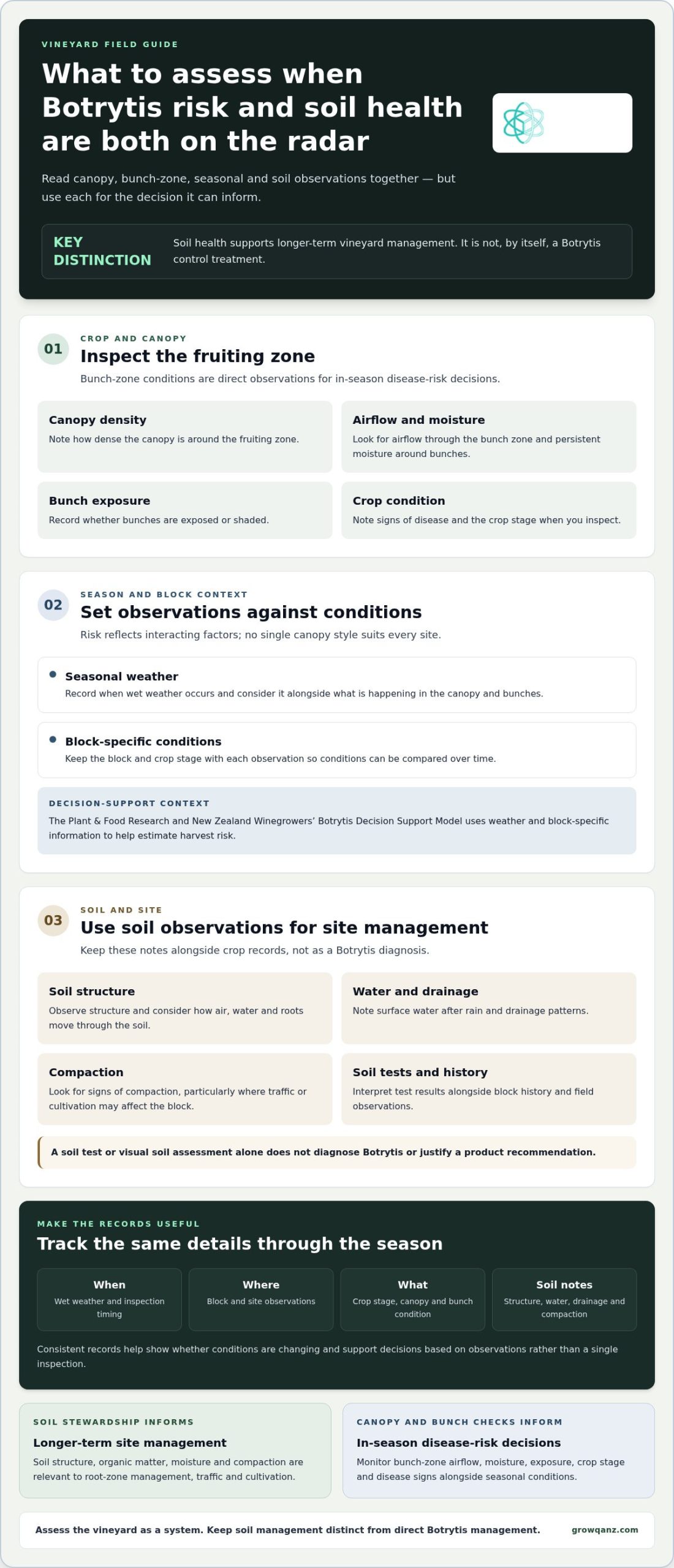
How can vineyard growers build a practical Botrytis and soil-health plan?
A useful plan separates actions for current disease risk from work to improve soil condition over time. Start with block observations, choose priorities based on what you find, then record and review the response. This makes improving vineyard soil health naturally part of a considered vineyard programme without treating soil practices as immediate Botrytis control.
What should a grower record before changing practices?
Keep a consistent record for each block. Include crop stage, canopy density, bunch-zone conditions, visible disease observations, soil structure, compaction, surface water and relevant weather patterns. Note differences between blocks, such as soil type, vine vigour or bunch characteristics, so comparisons have context.
Use this sequence to guide decisions:
- Observe: Inspect the canopy, fruiting zone and soil, and note recent weather conditions.
- Record: Log the date, block, crop stage and observations. Document any practice or input used, including where and when it was applied and the formulation, if relevant.
- Identify priorities: Separate immediate concerns, such as wet or dense bunch zones, from longer-term soil issues, such as compaction or limited ground cover.
- Select practices: Choose suitable in-season cultural actions for current crop conditions, then plan soil-management changes over an appropriate longer-term timescale.
- Review outcomes: Revisit the records and note what changed. Avoid attributing an outcome to a particular action unless the evidence supports that conclusion.
For any crop-protection product, follow its current country-specific label and relevant local agronomic guidance. New Zealand and Australian recommendations may differ, so use information that applies to the vineyard’s location and growing conditions.
How should growers review whether the plan is useful?
Compare records across suitable blocks or seasons, accounting for differences in weather, crop stage, cultivar, canopy structure and management. If one block has less observed disease after a practice, that observation alone does not prove the practice caused the change. Weather and other management actions may also have influenced the result.
Keep field observations distinct from controlled trial evidence. A trial can help assess whether a practice or input contributed to an outcome under defined conditions. Grower records are valuable for understanding individual blocks, but they do not carry the same evidential weight. Review the plan regularly and adjust priorities when conditions or evidence change.
For information on considering microbial inputs within crop and soil programmes, read QANZ’s biological growing programmes.
When could a microbial soil input fit a vineyard programme?
A microbial input may be considered as one part of a broader crop and soil programme when its documented purpose aligns with the grower’s priorities. Assess it separately from in-season Botrytis measures. Quantum Organic-Total® is a microbial agricultural input offered by QANZ for use in crop and soil programmes. It is not presented here as a Botrytis treatment or a proven vineyard disease-control product.
For growers focused on improving vineyard soil health naturally, an input is only one possible programme consideration. Start with observed vineyard needs and existing practices, then assess whether the product’s verified intended use, technical information and supporting evidence are relevant. Do not infer that general research on microbial agriculture demonstrates the performance of a particular formulation in grapes.
What evidence should growers check before considering an input?
Read the evidence closely, not just the headline or conclusion. Check:
- Formulation: Is the evidence for Quantum Organic-Total® specifically, or a different product?
- Crop and location: Was it conducted on grapes, and in New Zealand, Australia or another growing region?
- Conditions: Do the crop stage, soils, weather and management resemble the vineyard where the input is being considered?
- Study type: Is the information from independent research, a manufacturer trial, laboratory work or commercial grower observations?
These distinctions affect how confidently a finding can inform a vineyard decision. A laboratory result or overseas trial may provide context, but it should not be represented as a New Zealand vineyard result. Grower observations can also be useful, but they are not equivalent to a controlled trial. No trial outcomes are cited here.
How should Quantum Organic-Total® be described accurately?
Quantum Organic-Total® is a microbial agricultural input offered by QANZ for use in crop and soil programmes. Review the Quantum Organic-Total® product information and current QANZ technical and BioGro documentation for product suitability, rates and certification requirements relevant to your growing system. Do not assume that using an input makes a vineyard or its produce organic.
Keep the decision within its proper scope. Consider the product only as a potential part of a crop and soil programme, not as a substitute for monitoring bunch-zone conditions or following locally appropriate Botrytis guidance. Disease-management options and requirements can differ between New Zealand and Australia, so use current country-specific information for your vineyard.
For information about Quantum Organic-Total® and its place in a crop and soil programme, read QANZ’s product and application information.
Build a vineyard plan that works with your site
Improving vineyard soil health naturally is valuable long-term work, but it should sit alongside, not replace, direct Botrytis risk management. Soil condition informs site stewardship, while canopy, bunch-zone moisture, seasonal weather and monitoring guide in-season decisions. Keep records so you can review practices in the context of each block and season without assuming an observed change proves what caused it.
Assess any biological input against its own evidence and intended use. Quantum Organic-Total® is a microbial agricultural input offered for crop and soil programmes, not a Botrytis treatment. QANZ supplies Quantum agricultural biological products to growers in New Zealand and Australia, with product and application information to support informed consideration.
Talk to QANZ about whether Quantum Organic-Total® is appropriate for your crop, growing system and application programme: explore QANZ’s product and application information.
Frequently Asked Questions
Can improving vineyard soil health naturally control Botrytis?
No. Improving vineyard soil health naturally supports longer-term site and soil management, but it isn’t a direct Botrytis control treatment. Assess Botrytis risk in the crop, especially in the canopy and around grape bunches, alongside seasonal conditions. Soil observations can inform vineyard decisions, but they do not diagnose bunch rot or show that a soil practice will suppress the disease.
What vineyard practices can help manage Botrytis risk naturally?
Growers can monitor blocks, manage the canopy and fruiting zone where appropriate, and remove infected or decaying grape material when practical. These cultural practices address vineyard conditions and potential disease sources, but their suitability depends on cultivar, site, labour and seasonal conditions. They do not guarantee disease prevention. Assess any biological or crop-protection product separately, using current, locally relevant evidence and directions for its intended use.
Does canopy management reduce Botrytis in grape bunches?
Suitable canopy management may help manage conditions around bunches by adjusting density, airflow and exposure. The right approach depends on vine vigour, cultivar, training system and the season, so one canopy design or leaf-removal approach will not suit every block. Canopy work is one part of integrated risk management, not a guarantee against Botrytis. Record conditions before and after management to inform future decisions.
Can microbial soil inputs prevent Botrytis in vineyards?
Do not assume they can. A microbial soil input intended for crop or soil programmes is not automatically a Botrytis treatment, and general research on microbial agriculture does not prove that a specific product controls disease in grapes. Before considering an input, check the exact formulation, stated use, crop-specific evidence and current technical information. Continue to base Botrytis decisions on monitoring and locally relevant disease-management guidance.
How should New Zealand and Australian growers assess Botrytis management advice?
Use guidance relevant to the country and vineyard where the decision will be made. Check current product labels and relevant local agronomic advice, as crop-protection recommendations and requirements may differ between New Zealand and Australia. Consider whether cited evidence matches the formulation, crop, location and conditions in question. Keep records of block observations, weather and practices, and do not treat overseas findings as New Zealand evidence.
Does Quantum Organic-Total® control Botrytis in vineyards?
Quantum Organic-Total® is not presented here as a Botrytis treatment or a proven vineyard disease-control product. It is a microbial agricultural input offered for crop and soil programmes. Do not infer disease-control performance from its general product description or from evidence about a different formulation. For product suitability, rates and relevant documentation, refer to current QANZ technical and BioGro information and assess the product separately from Botrytis management.
Can a vineyard input make grapes or a farm certified organic?
No. Using an agricultural input by itself does not make grapes, produce or a farm certified organic. Certification applies to the production system and its requirements, not simply to the use of one product. Check current certification documentation and confirm that an input is suitable for your own programme and intended use. Do not assume a product’s name or description establishes certification suitability or status.
Disclaimer
Important: This article provides general agricultural information only. Product performance can vary according to crop, soil, climate, management practices and application conditions. Trial or research results discussed may have been obtained under specific conditions and should not be interpreted as a guarantee of equivalent results. Always follow current product directions and confirm suitability for your crop, growing system and organic certification requirements. Contact QANZ for current product and application information.
